Weekend links 103

fripp.jpg

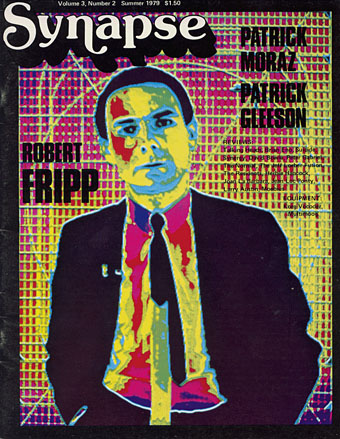
Robert Fripp photographed by Chris Stein. Video posterization by Michael Schiess.

Scans of Synapse, “The electronic music magazine”, are posted here. Issues range from 1976 to 1979, and include interviews with the more notable synthesists of the period, Kraftwerk included. Brian Eno was regularly interviewed by synth mags despite always being reluctant to talk about what equipment he might be using; sure enough he’s featured here. Far more interesting is a longer interview with Robert Fripp that catches the guitarist as he emerged from his self-imposed retirement in the mid-70s with the extraordinary Exposure album. (See a 1979 promo video for that here.) Related: TR-808 drum sequences in poster form by Rob Ricketts.

• More electronic music from the 1970s: “[Don Buchla] showed me that the idea of playing a black-and-white keyboard with one of these instruments was completely ridiculous. It was inappropriate and had nothing to do with the way you would use an electronic instrument.” Suzanne Ciani talks to John Doran about electronic music composition. A collection of her early recordings, Lixiviation, is released by Finders Keepers. Related: The Attack of the Radiophonic Women: How synthesizers cracked music’s glass ceiling.

• “Her writing—full of immigrants, circus animals, freaks, socialists, hipsters, servants, and suffragettes—revels in the atmosphere of the ‘Yellow Nineties,’ a period characterized by Wildean decadence and art for art’s sake.” Jenny Hendrix on Djuna Barnes.
brunovsky.jpg

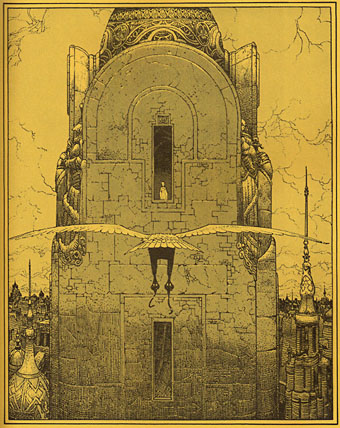
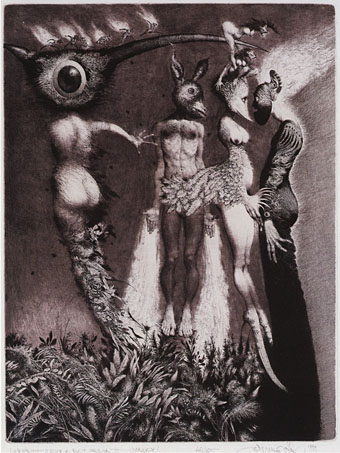
More etchings by Albin Brunovsky at But Does It Float.

• More scanned magazines: the Fuck You Press archive at Reality Studio. A trove of rare publications produced by Ed Sanders in the 1960s with contributions from world-class writers, William Burroughs included.

• “[My parents] were horrified by what I did, but they encouraged me to keep doing it because I was obsessed, and what else could I do?” John Waters writing in (of all places) the Wall Street Journal.

• A time-lapse assembly of Alfred Hitchcock’s Rear Window (1954) by Jeff Desom who explains how he did it here.

• The Occult Experience: a 95-minute documentary on the international occult scene, filmed in 1984–85.

• Compost and Height re-post A Gold Thunder, a song by Julia Holter first sent to them in 2010.

• Drawings by Bette Burgoyne.

• Schroeter’s Salomés

• Cats are liquids

• Fade Away And Radiate (1978) by Blondie (featuring Robert Fripp) | Exposure (1978) by Peter Gabriel (produced by and featuring Robert Fripp) | Exposure (1979) by Robert Fripp | Babs And Babs (1980) by Daryl Hall (produced by and featuring Robert Fripp) | Losing True (1982) by The Roches (produced by and featuring Robert Fripp).
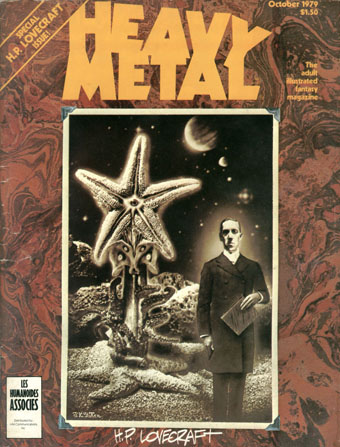
Heavy Metal, October 1979: the Lovecraft special

hm1.jpg

Mr Lovecraft by JK Potter.

HP Lovecraft died seventy-five years ago on 15th March, 1937. Twenty-five years ago I was halfway through drawing my comic strip adaptation of The Call of Cthulhu, conscious at the time that, yes, it was fifty years ago today… I mentioned at the weekend the special Lovecraft edition of Heavy Metal that was published in October 1979; of the many stimuli that led to the drawing of CoC, this magazine was by far the most important. Given the date, now seems as good a time as any to say something about it.

hm2.jpg

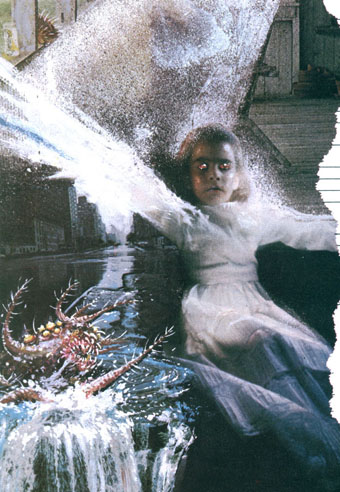
Illustration for the contents page by Stephen R. Bissette.

Heavy Metal was the US offshoot of Métal Hurlant, the sf/fantasy comics magazine founded by Jean Giraud (Moebius), Philippe Druillet and Jean-Pierre Dionnet in 1974. Copies of Métal Hurlant could be found in London but none ever made it further north. The advent of Heavy Metal provided an invaluable introduction to a generation of European artists whose work was otherwise difficult to find. Even better: their stories were being translated into English for the first time. The late 70s was a dizzying period for a Lovecraft reader: HR Giger appeared apparently out of nowhere in 1977 when Big O published the first UK collection of his art (which I couldn’t afford at the time), a book with Necronomicon in the title; a year later Thames & Hudson published Franz Rottensteiner‘s The Fantasy Book, an overview of the genre that devoted eight pages to Lovecraft and Arkham House, and which included many illustrations I’d never seen before; in 1979 Giger was all over the newspapers and magazines thanks to Alien; then in October the Lovecraft special dropped onto the shelves. I was stunned: this was that rare occasion when someone creates exactly the thing you want to see at precisely the right moment.

hm3.jpg

The Dunwich Horror by Alberto Breccia. A superb adaptation.

Looking back, the issue isn’t quite as good as it seemed at the time: many of the stories are slight, a couple have nothing whatever to do with Lovecraft, and, Breccia aside, none of the artists tackle the major works. What counted in the end was the idea of the issue, the implication that Lovecraft’s imagery was there to be seized and reworked in visual form. There were better issues of the magazine, before and after, but for the next six years this one remained for me a tantalising possibility. They hadn’t got it quite right…what if someone else did? After searching comic shop shelves in vain I eventually decided to have a go myself.

Continue reading “Heavy Metal, October 1979: the Lovecraft special”

Weekend links 99

moebius.jpg

From the Crystal Saga portfolio (1986) by Moebius. Via Quenched Consciousness.

Moebius: A while ago, [science fiction] was filled with monstrous rocket ships and planets; it was a naive and materialistic vision, which confused external space with internal space, which saw the future as an extrapolation of the present. It was a victim of an illusion of a technological sort, of a progression without stopping towards a consummation of energy. But we’ve completely changed that vision. It’s been a sharp, radical change, and somewhat brutal.
HM: Why brutal?
Moebius: Because all those beautiful projects we believed in are gone. But the real sense of science fiction is the discovery that the voyage is interior, and the real energy, the rockets of the past, is what is contained in people’s spirits.
HM: One doesn’t have to read other people’s visions then, one can make the discovery oneself?
Moebius: Well, that, and also the fact that the “new planet” of old science fiction is right here: it’s the Earth.

The Moebius Interview by Diana K. Bletter, Heavy Metal, August 1980.

RIP Jean Giraud, aka Moebius, one of the great artists of the 20th century. My approach to drawing comics was almost wholly derived from the illustrational style of the French, Belgian and other artists being published in Heavy Metal magazine in the late 1970s/early 1980s. Many of the stories were appearing in English for the first time, and for me they revitalised a medium in which (undergrounds aside) I’d lost all interest. It wasn’t only the exceptional artwork that was attractive. The narratives of Moebius, Druillet, Bilal and co. presented a more sophisticated approach to science fiction and fantasy than the simple-minded fare filling the superhero titles or the pages of 2000 AD. Moebius’s work was wittier, sexier and far more imaginative than any American comics I’d seen up to that time. Some of the stories read like graphic equivalents of New Worlds-era science fiction so it came as no surprise to find Moebius drawing a strip called The Airtight Garage of Jerry Cornelius (the title was later amended at Moorcock’s request) while Druillet in his September 1980 Heavy Metal interview mentioned enjoying books by William Burroughs, Michael Moorcock and Thomas Disch, and singled-out Ballard’s Crash as a favourite novel. Without the examples of Druillet and Moebius (and the intoxicating inspiration of the October 1979 issue of Heavy Metal) I wouldn’t have spent 17 months adapting The Call of Cthulhu as a comic strip.

Hasko Baumann’s 2007 documentary, Moebius Redux: A Life in Pictures (some of which can be seen on YouTube) is a good place to start when trying to appraise Jean Giraud’s extensive career. The film is now available on DVD.

Update:
• The hour-long cut of Moebius Redux has been posted to Vimeo
• An obituary by Kim Thompson at The Comics Journal
• The Moebius posts at But Does It Float

moebius2.jpg

From Les Yeux du Chat (1978) by Jodorowsky & Moebius. Via Quenched Consciousness.

• “Naked Lunch,” Ballard wrote later, “was a grenade tossed into the sherry party of English fiction.” The criss-crossing careers of JG Ballard and William Burroughs are examined in detail at RealityStudio. Related: The Discipline of D.E. (1982) by Gus Van Sant and The Unlimited Dream Company (1983) by Sam Scoggins.

• Dr John’s forthcoming album, Locked Down, has been produced by The Black Keys‘ Dan Auerbach. Those of us who favour the Doctor’s voodoo-inflected early albums are hoping this might mean he gets groove back after wandering for years in an MOR swamp. One of the new recordings, Revolution, sounds promising.

I don’t think sexuality is fixed anymore. I think more from the gay male side than the lesbian side, there is often a wish for things to be fixed. I heard Lady Gaga’s Born This Way and I don’t know why they like it. Maybe, they need more certainty than girls do. For me, it’s like why do you care anyway? Maybe you were, maybe you weren’t. What’s the big deal? I can’t connect to that emotionally, so it baffles me.

Jeanette Winterson talks to Sassafras Lowrey.

• “In [Jacob’s Room], [Virginia] Woolf makes the subject matter not Jacob himself but the ways in which we know and don’t know each other – the gaps in our knowledge.” Alexandra Harris on Modernism in art and literature.

• The Northwest Film Forum in Seattle hosts Magick in Cinema on 5th April, an evening of occult-themed short films which includes a rare screening of Curtis Harrington’s Wormwood Star.

• John Bertram’s Lolita cover competition from 2009 is due to appear in June as a book-length study entitled Recovering Lolita. Bertram previews the contents here.

• “Erotic fiction is having a steamy renaissance and its hottest authors are women.”

• LSD helps to treat alcoholism.

• The other Moebius (Dieter): News (1980) by Moebius & Plank | Tollkühn (1981) by Moebius & Plank | Conditionierer (1981) by Moebius & Plank.

Weekend links 97

conformist.jpg

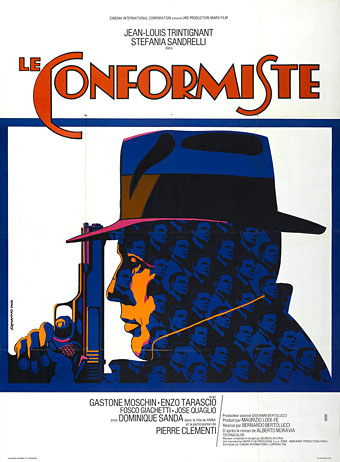
Illustration by Ermanno Iaia. Hard to believe that Bernardo Bertolucci’s The Conformist (1970) is only now appearing on DVD in the UK. Arrow Films release a dual-format edition at the end of this month.

• The week in perfume: Perfumes: The Guide by Luca Turin & Tania Sanchez is reviewed by Emily Gould (“this is a golden age of perfume criticism”) and prompts a meditation on the art and process of scent from Rishidev Chaudhuri.

• Electrical Banana by Norman Hathaway & Dan Nadel is “the first definitive examination of the international language of psychedelia, focusing on the most important practitioners in their respective fields”.

• Sacred Monsters is a forthcoming collection of essays and criticism by Edmund White. Related: Colm Tóibín from 1999 reviewing A History of Gay Literature: The Male Tradition by Gregory Woods.

• Medium, a video by Clayton Welham and Sam Williams for Emptyset whose imminent release (also entitled Medium) I’ve designed. Related: Dave Maier on music versus noise.

• Couldn’t happen to a nicer guy: the face of US presidential contender Rick Santorum rendered as a collage of (mostly) gay porn. More provocation: All Dead Mormons Are Now Gay.

• Coilhouse discovered a rough copy of Bells of Atlantis (1952), an experimental film which features Anaïs Nin, input from Len Lye and an electronic score by Louis & Bebe Barron.

• “The idea that we should have but two options when it comes to our gender presentation, male or female, has always felt ludicrous to me,” says LaJohn Joseph.

Bely paints “a universe of strange manifestations” which drifts across Apollonovich’s consciousness every night before he falls asleep. We are even shown congeries of images that are shards of events which took place that day for the senator: “all the earlier inarticulacies, rustlings, crystallographic figures, the golden, chrysanthemum-like stars racing through the darkness on rays that resembled myriapods”

Malcom Forbes on Andrei Bely’s masterwork, Petersburg (1916).

• RIP Barney Rosset, publisher of Grove Press books and the Evergreen Review.

• The Brothers Quay will be at work in Leeds city centre this May. Lucky Leeds.

• Warm Leatherette, a short film by Analogue Solutions.

• Cormac McCarthy, Quantum Copy Editor.

• The importance of being axonometric.

• Always Crashing In The Same Car (1977) by David Bowie | Crash (1980) by Tuxedomoon | Crash Dance (1983) by Yello.

German bookplates

exlibris08.jpg

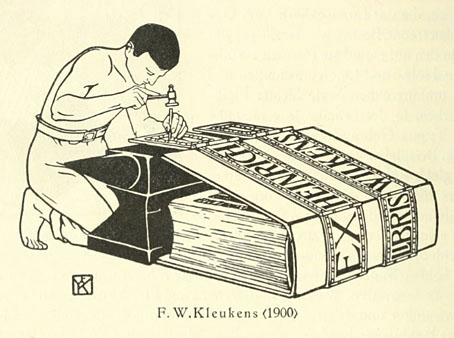
A selection from Das Moderne Deutsche Gebrauchs-Exlibris (1922) edited by Richard Braungart, an overview of the practioners of the bookplate form in Germany and Austria during the first decades of the 20th century. Some of the German and Austrian art magazines featured here over the past couple of years included bookplate designs, and Braungart’s collection includes many artists from those magazines: Melchior Lechter, Hugo Höppener (aka Fidus), Julius Diez, Heinrich Vogeler, Marcus Behmer, Franz von Bayros, Koloman Moser, Carl Otto Czeschka, Ephraim Moses Lilien, Franz Stassen and others. 400 examples in all.

exlibris01.jpg

exlibris02.jpg

Continue reading “German bookplates”