Weekend links 129

proffer.jpg

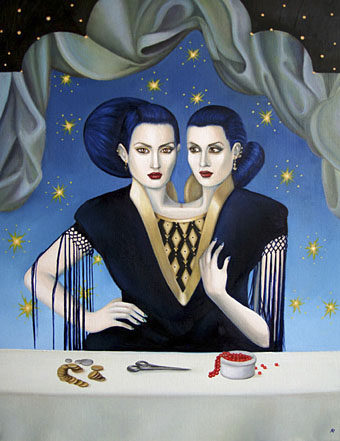
Daughters of Maternal Impression by Arabella Proffer.

A genre’s landscape should be littered with used tropes half-visible through their own smoke & surrounded by salvage artists with welding sets, otherwise it isn’t a genre at all.

M. John Harrison, incisive as ever, on what he memorably labels “Pink Slime Fiction”. Elsewhere (and at much greater length) Cowardice, Laziness and Irony: How Science Fiction Lost the Future by Jonathan McCalmont, and a two-part Paul Kincaid interview here and here.

• “Once upon a time, in almost every city, many rivers flowed. Why did they disappear? How? And could we see them again? This documentary tries to find answers by meeting visionary urban thinkers, activists and artists from around the world.” A trailer for Lost Rivers, written and directed by Caroline Bâcle. Related (and mentioned here before), London’s Lost Rivers: A Walker’s Guide by Tom Bolton.

• Ghosts in the Machine: “Curated by Massimiliano Gioni and Gary Carrion-Murayari, a recent exhibition was imagined as a Wunderkammer simultaneously tracing and questioning the relationship between people and technology.” And in Istanbul a Wunderkammer of a different kind: Rick Poynor looks at Orhan Pamuk’s Museum of Innocence.

• “There’s a vast territory still to be explored…” Bristol duo Emptyset (James Ginzburg & Paul Purgas), many of whose releases I’ve designed, talk about their music. Tracks from their new EP on the Raster-Noton label can be heard here. You’re going to need bigger speakers.

• “I liked doing it one time but I don’t want to become the gay porn soundtrack guy.” Ben Chasny of Six Organs of Admittance talking to Sir Richard Bishop about one of his more unusual commissions.

durham.jpg

Double Vision (2009) by Bonnie Durham.

• FACT mix 349: Silent Servant puts together a great selection of music old and new with the emphasis on the grit of the early Industrial era.

• Read Joyce’s Ulysses line by line, for the next 22 years, with Frank Delaney’s podcast.

• Borges and the Plain Sense of Things, an article from 2006 by Gabriel Josipovici.

• Clive Hicks-Jenkins on Equus and seeing your inspirations come full circle.

• At Pinterest: A few nice paintings of men

• Spunk [arts] magazine

• Derelict London

• Ritualistic Bug Use (2009) by Pink Skull | Demiurge Variations (2012) by Emptyset | Utopian Disaster (End) (2012) by Silent Servant.

Golden apples and silver apples

yeats.jpg

The Wind Among the Reeds (1899). Cover design by Althea Gyles.

1: The Song of Wandering Aengus by WB Yeats.

I went out to the hazel wood,
Because a fire was in my head,
And cut and peeled a hazel wand,
And hooked a berry to a thread;
And when white moths were on the wing,
And moth-like stars were flickering out,
I dropped the berry in a stream
And caught a little silver trout.

When I had laid it on the floor
I went to blow the fire a-flame,
But something rustled on the floor,
And someone called me by my name:
It had become a glimmering girl
With apple blossom in her hair
Who called me by my name and ran
And faded through the brightening air.

Though I am old with wandering
Through hollow lands and hilly lands,
I will find out where she has gone,
And kiss her lips and take her hands;
And walk among long dappled grass,
And pluck till time and times are done,
The silver apples of the moon,
The golden apples of the sun.


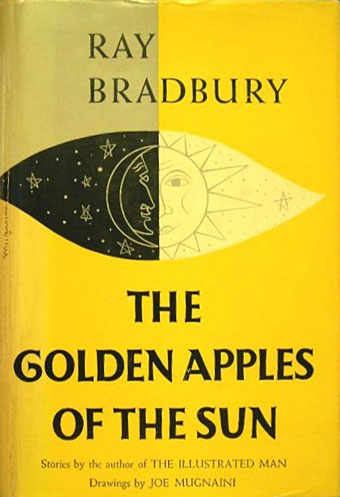
bradbury.jpg

Illustration by Joe Mugnaini.

2: The Golden Apples of the Sun (1953), a story collection by Ray Bradbury.


judycollins.jpg

Cover design by William S. Harvey.

3: Golden Apples of the Sun (1962), the debut album by Judy Collins. The first track is her setting of The Song of Wandering Aengus.


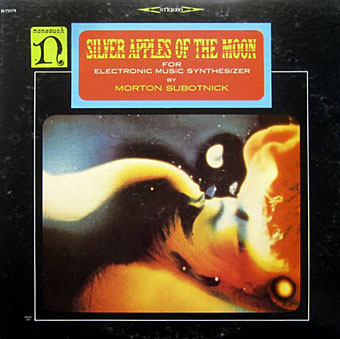
subotnick.jpg

Cover design by William S. Harvey. Artwork by Anthony Martin.

4: The Silver Apples of the Moon (1967), an album of electronic music by Morton Subotnick.


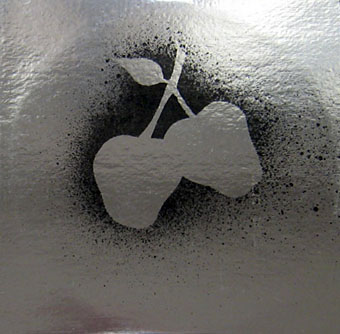
silverapples.jpg

Artwork by Anonymous Arts.

5: Silver Apples (1968), an album of electronic music by Silver Apples.


donovan.jpg

Art Direction by Sid Maurer. Artwork by Patrick.

6: HMS Donovan (1971), a double album of poems for children set to music by Donovan. The second song on side four is The Song of Wandering Aengus.


goldenapples.jpg

Cover by Devendra Banhart.

7: The Golden Apples of the Sun (2004), a freak folk compilation selected by Devendra Banhart for Arthur magazine‘s Bastet label.

Previously on { feuilleton }
• The Golden Apples of the Sun

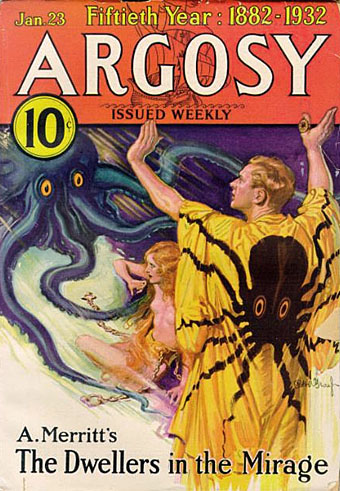
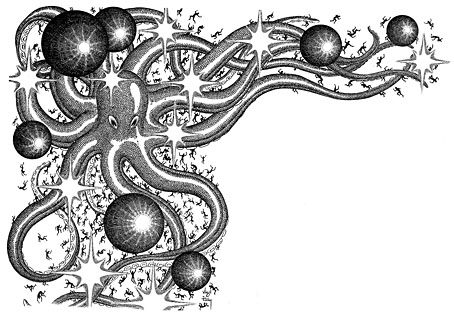
Tentacles #3: Dwellers in the Mirage

dwellers01.jpg

Illustration by Robert A. Graef (1932).

If the predatory octopuses of the Sargasso Sea are too mundane for you, how about an extra-dimensional Kraken named Khalk’ru which has to be placated with human sacrifice? This creature is the prime menace in A. Merritt’s Dwellers in the Mirage (1932), a novel I’m afraid I haven’t read despite its quite evident tentacular delirium. The story is a Lost Race adventure with the unlikely setting of a warm valley in Alaska where the usual heroic outsider encounters the diabolical Kraken worshippers. Merritt’s work is out of copyright in Australia so the text of the book can be found at the Australian Project Gutenberg. There you’ll discover that chapter four is entitled Tentacle of Khalk’ru.

A handful of covers and illustrations follow.

dwellers06.jpg

Virgil Finlay (1941).

Continue reading “Tentacles #3: Dwellers in the Mirage”

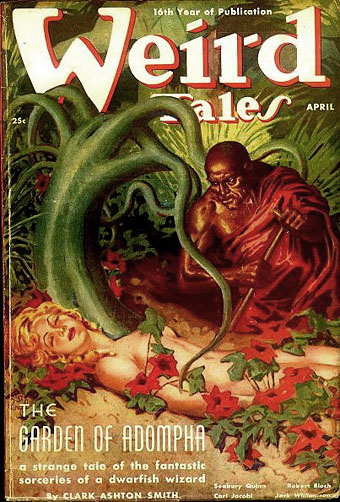
The Garden of Adompha

adompha1.jpg

…the growths of that garden were such as no terrestrial sun could have fostered, and Dwerulas said that their seed was of like origin with the globe. There were pale, bifurcated trunks that strained upwards as if to disroot themselves from the ground, unfolding immense leaves like the dark and ribbed wings of dragons. There were amaranthine blossoms, broad as salvers, supported by arm-thick stems that trembled continually.

And there were many other weird plants, diverse as the seven hells, and having no common characteristics other than the scions which Dwerulas had grafted upon them here and there through his unnatural and necromantic art.

These scions were the various parts and members of human beings. Consummately, and with never failing success, the magician had joined them to the half-vegetable, half-animate stocks on which they lived and grew thereafter, drawing an ichor-like sap. Thus were preserved the carefully chosen souvenirs of a multitude of persons who had inspired Dwerulas and the king with distaste or ennui. On palmy boles, beneath feathery-tufted foliage, the heads of eunuchs hung in bunches, like enormous black drupes. A bare, leafless creeper was flowered with the ears of delinquent guardsmen. Misshapen cacti were fruited with the breasts of women, or foliated with their hair. Entire limbs or torsos had been united with monstrous trees. Some of the huge salver-like blossoms bore palpitating hearts, and certain smaller blooms were centered with eyes that still opened and closed amid their lashes. And there were other graftings, too obscene or repellent for narration.

Thus Clark Ashton Smith in The Garden of Adompha, one of the stories in the author’s Zothique cycle which was first published in Weird Tales in April, 1938. Zothique was Smith’s contribution to the Dying Earth subgenre, sixteen stories set on the last continent in the final days of the Earth, and a home to no end of sorcery and cruelty. I’ve always enjoyed this subgenre, especially in the hands of Jack Vance whose later Dying Earth stories show the influence of Zothique, so these are some of my favourites among Smith’s prodigious output. The Garden of Adompha is a particularly grotesque piece, concerning the sequestered garden of the title to which King Adompha has undesirables removed. Once there his wizard, Dwerulas, drugs the victims and grafts parts of their bodies to the garden’s hothouse plants. Virgil Finlay’s cover painting downplays the horror somewhat, and Dwerulas’s supine prey, Thuloneah, looks like a very typical American girl, but then for a story that reads like a pulp equivalent of Octave Mirbeau it’s surprising it made the cover at all.

adompha2.jpg

Re-reading some of Smith’s stories over the past week, The Garden of Adompha among them, there’s been the additional pleasure of searching for illustrations from their original publication. I knew that Virgil Finlay had painted this cover, one of the few cover features Smith received from Weird Tales, but Alistair Durie’s Weird Tales (1979) collection only has a monochrome reproduction. The always reliable Golden Age Comic Book Stories not only has a copy of Finlay’s original painting but also the interior illustration which looks like a litho drawing rather than the artist’s more usual scratchboard. The most recent book collection featuring the story was The Collected Fantasies Of Clark Ashton Smith Volume 5: The Last Hieroglyph (2010) from Night Shade Books. (I would have linked to the publisher’s page but their site seems to be broken.)

Update: Golden Age Comic Book Stories changed its name then vanished altogether. The picture links here have been updated.

adompha3.jpg

Previously on { feuilleton }
• Vathek illustrated
• The Vengeance of Nitocris
• The House of Orchids by George Sterling
• Haschisch Hallucinations by HE Gowers
• Odes and Sonnets by Clark Ashton Smith
• The King in Yellow
• Clark Ashton Smith book covers

Raymond Bertrand’s science fiction covers

bertrand01.jpg

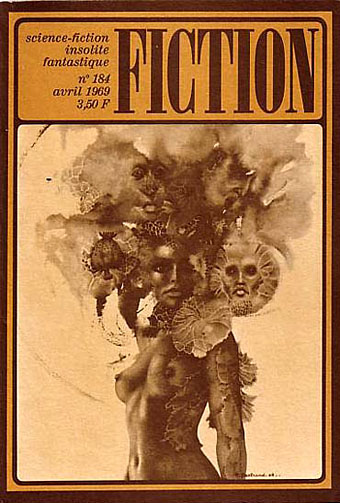
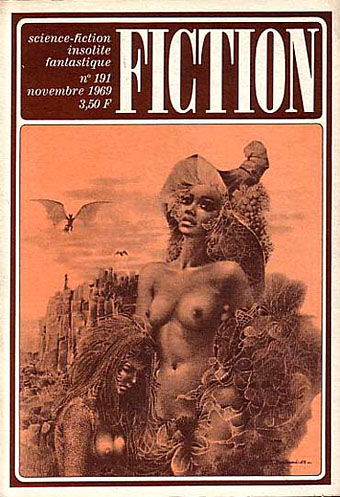
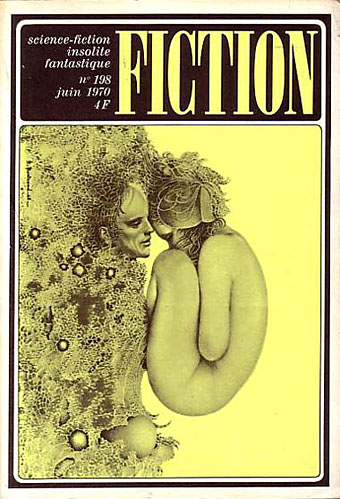
Work by the elusive French artist Raymond Bertrand has appeared here before although the art continues to be more visible (if obscure) than the man himself. Bertrand’s most famous drawings are the naked women that appeared on the cover of issue 28 of Oz magazine, the notorious School Kids Issue, but I don’t think he was credited for the usage and his name is never mentioned when the magazine is discussed. Looking for information about the Chute Libre books at French SF site Noosfere led me to an entry for Bertrand’s work. The list doesn’t include any of the book collections of his drawings but does have these magazine covers which feature some pieces I hadn’t seen before.

bertrand02.jpg

Fiction was the leading French SF magazine, and sported a fascinating range of cover art especially from the mid-60s on. Artists at that time included Philippe Druillet and Philippe Caza, both of whom would become big names in the comics world a few years later. Galaxie was the French edition of American magazine Galaxy, and featured unique material among its translations of Anglophone works. Being French, there’s a greater amount of flesh on display than you’d find on magazine covers in the US and UK; some of this is as salacious as anything else from the period although at least one of the artists drawing naked females was a woman, Sophie Busson. Naked females emerging from—or being absorbed by—strange vegetation, polyps or aquatic organisms were Bertrand’s métier so that’s mostly what one finds here. Few of the covers seem to relate to the magazine’s contents, the artists appear to have been free to draw what they liked; in the case of Druillet that means his usual Lovecraftian architecture. An exception is issue 198 of Fiction which has an article about Bertrand’s work by Jacques Chambon: Raymond Bertrand ou de l’amour de l’art à l’art de l’amour. I’m hoping now that someone might be good enough to translate that piece for us lazy Anglophones.

And speaking of former Oz artists, Renaud Leon left a message recently with news that YouTube now has a channel featuring many examples of Jim Leon’s remarkable paintings.

bertrand03.jpg

bertrand04.jpg

Continue reading “Raymond Bertrand’s science fiction covers”