Picturing Dorian Gray

dorian1.jpg

It’s taken a while but here at last are some of the pages from my series of illustrations based on The Picture of Dorian Gray, as featured in volume 2 of The Graphic Canon (“The World’s Great Literature as Comics and Visuals”) edited by Russ Kick. I agreed with Russ not to run everything so there’s some incentive to buy the book (or books…there are three volumes altogether). Now I’ve seen the printed edition the whole project seems even more remarkable: 500 large illustrated pages in a variety of media and art styles. Volume 2 runs through the 19th century and ends with my contribution; I opted to do this story in black-and-white but there’s colour used throughout the books. I especially like the Moby-Dick sequence by Matt Kish, a very different take on a very familiar tale.

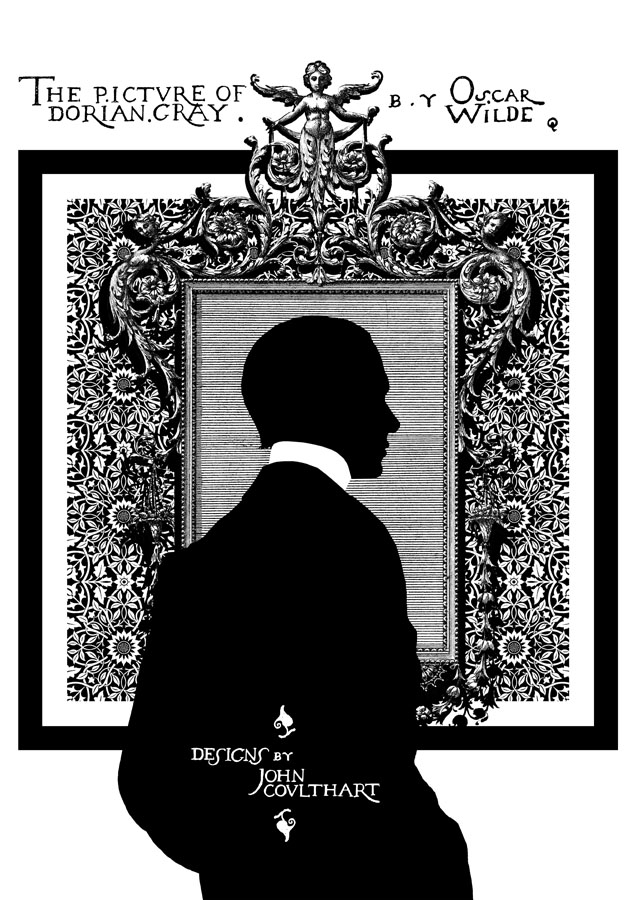
As with many of the things I’ve been doing recently I opted for adapting materials of the period. Since I have a lot of Oscar Wilde-related reference material I was able to go further and incorporate details that relate directly to the book and Wilde’s life. All the text is taken from a scan of the first printing of the novel at the Internet Archive, the title lettering being drawn originally by Wilde’s friend, publisher and illustrator Charles Ricketts. A heavy black square on each page provides some continuity as well as resembling the frames of comic pages. (Or a picture frame.) The silhouette on the opening page is another of Wilde’s friends, the writer Max Beerbohm, taken from a drawing by William Rothenstein. The pair were dandyish Café Royal regulars throughout the 1890s.
dorian2.jpg

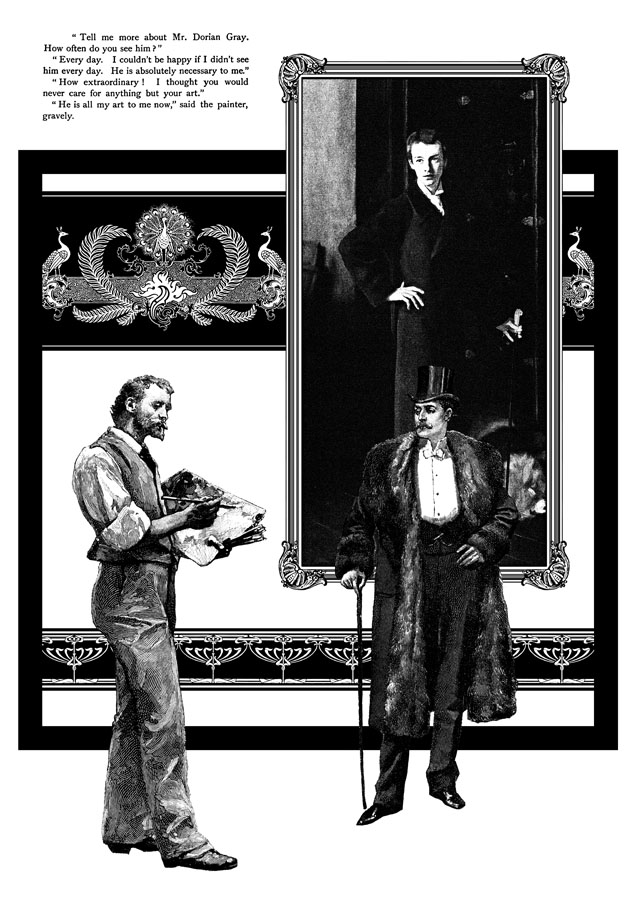
This is my favourite page. I liked the way the composition came together and also enjoyed being able to use John Singer Sargent’s portrait of W. Graham Robertson as the picture of Dorian. I’ve noted in an earlier post the similarity between this painting and the portrait seen in the BBC’s adaptation of the novel by John Osborne. Robertson was a theatre designer and illustrator who Wilde consulted when planning stage designs for what would have been the London debut of Salomé. Robertson was also (so far as we know) homosexual which adds an extra resonance.
dorian3.jpg

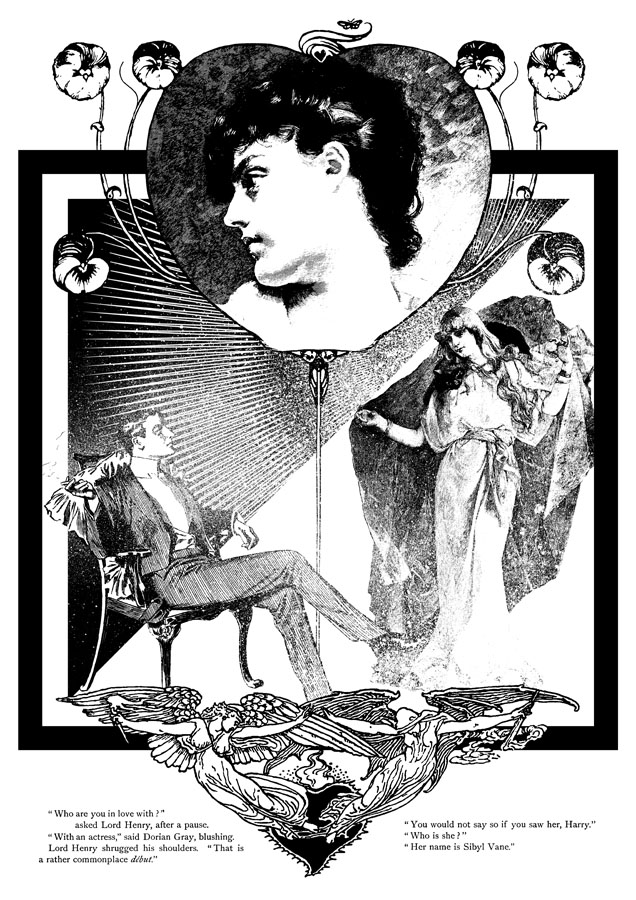
The Sibyl Vane page: a combination of details from The Studio, The Strand and The Magazine of Art. The motif at the foot of the page is by Walter Crane. Nothing of Wilde’s appeared in The Strand but that magazine’s most popular writer, Arthur Conan Doyle, had his second Sherlock Holmes adventure, The Sign of Four, commissioned at the same dinner that saw the commissioning of Dorian Gray, both novels being published by Lippincott’s Monthly Magazine in 1890.
dorian4.jpg

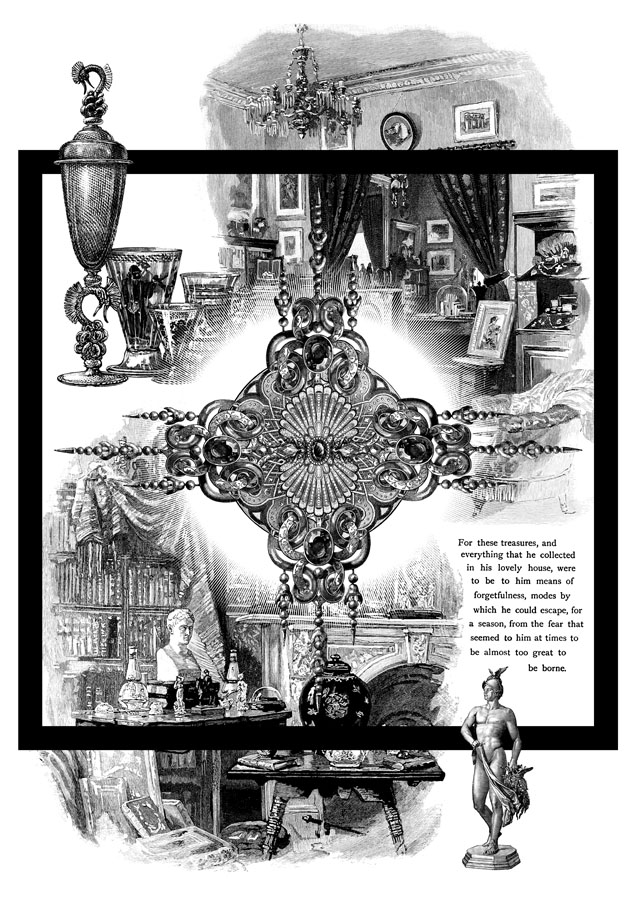
A page depicting Dorian’s distracting obsession with jewels and luxurious goods. This chapter can seem somewhat superfluous unless seen in the light of Wilde’s intention to write something like Huysmans’ À rebours (1884).
dorian5.jpg

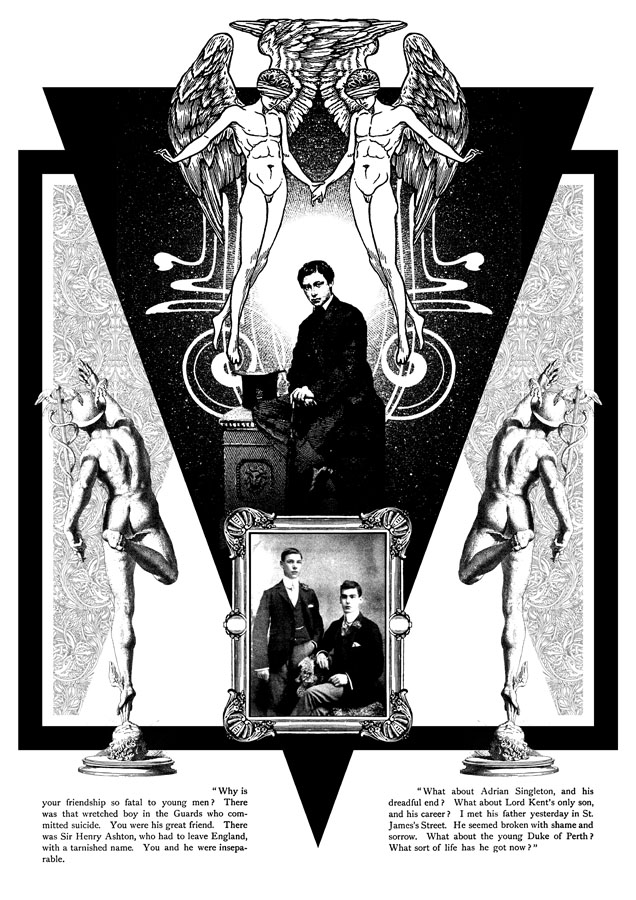
The “Love that dare not speak its name” page. This makes explicit the subtext of the book although if you read the two paragraphs I selected it’s evident enough why Dorian is causing a problem for so many young men. The blindfolded Eros was a drawing by Walter Crane which I doubled then re-drew slightly so the pair were holding hands. The boy below is a picture from The Strand of the young Edward VII, a robust heterosexual in later years but with a son, Prince Albert Victoria, who became linked to the notorious Cleveland Street Scandal which involved a male brothel catering to aristocrats. The two young men in the picture frame are described as a pair of “panthers” in Neil McKenna’s The Secret Life of Oscar Wilde (2003), by which he means that they were fin de siècle rent boys (as in Oscar’s remark about “feasting with panthers”); McKenna doesn’t give any further details about the photo but it suited the picture.

In addition to this series of illustrations, volume 2 of The Graphic Canon includes two of my Lewis Carroll illustrations in a section by different artists based on the Alice books. I’d be recommending The Graphic Canon even if I wasn’t a contributor, as I said above it’s a remarkable achievement. Watch out for it.

Elsewhere on { feuilleton }
• The Oscar Wilde archive
Arthur Rising

arthurrising.jpg

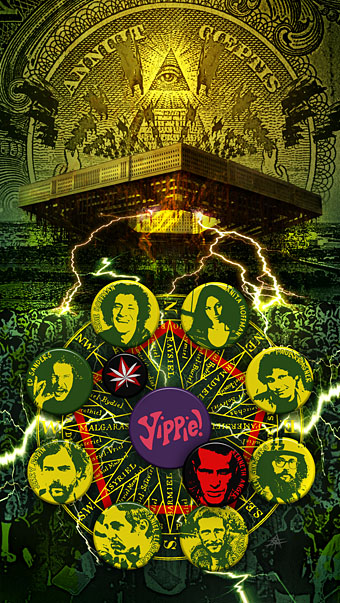
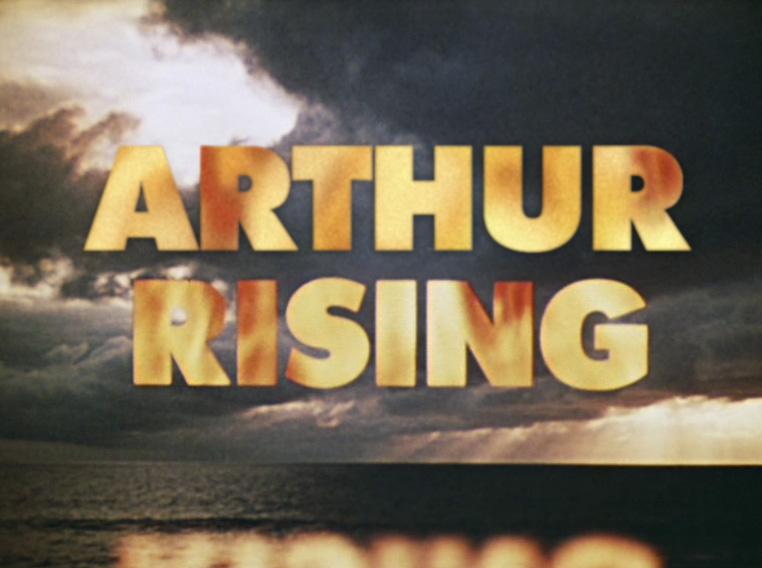
In which the sorely missed Arthur magazine returns to the world of print after a four-year slumber in Avalon. I was involved with the magazine from the outset so regular readers may recall many earlier posts about America’s most vital cultural bulletin:

After a four-year sabbatical (faked death?), your beloved revolutionary sweetheart Arthur returns to print, renewed, refreshed, reinvigorated and in a bold new format: pages as tall and wide as a daily newspaper, printed in color and black and white on compostable newsprint, with ads only on the back cover(s). Amazing!

In partnership with Portland, Oregon’s Floating World Comics, Arthur’s gang of goofs, know-it-alls and village explainers are back, from Bull Tonguers Byron Coley and Thurston Moore to radical ecologist Nance Klehm to trickster activists Center for Tactical Magic to Defend Brooklyn‘s socio-political commentator Dave Reeves to a host of new, fresh-faced troublemakers, edited by ol’ fool Jay Babcock and art directed by Yasmin Khan. You want a peek at the contents? Sorry, compadre. That would be saying too much, too soon. Wait ’til Dec. 22, 2012: that’s right—THE DAY AFTER THE NON-END OF THE WORLD!

Please keep in mind… Arthur is no longer distributed for free anywhere. Those days are (sadly) long gone. Now you gotta buy Arthur or you won’t see it. Our price: Five bucks cheeeeeep!

Arthur No. 33
Broadsheet newspaper, 15″ x 22.75″
Available Dec. 22, 2012
NOW YOU MAY PRE-ORDER ARTHUR NO. 33 HERE.

The NYT picked up on the news on Thursday. Is re-launching a paper magazine in 2012 a crazy idea? We’re about to find out. A selection of my illustrations for previous issues follows.

mbvarkestra.jpg

MBV Arkestra (2003).

crowley.jpg

The Aeon of Horus (2004).

pentagon.jpg

Out, Demons, Out! (2004).

eno.jpg

Brian Eno (2005).

richardbishop.jpg

Sir Richard Bishop (2007).

TV Wipeout

tvwipeout1.jpg

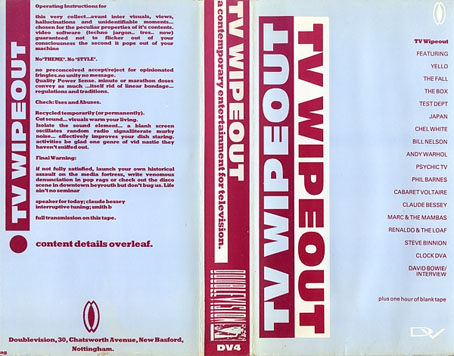
Another of the videocassette releases on Cabaret Voltaire’s Doublevision label, TV Wipeout was released in 1984 as a “video magazine”. This and Johnny YesNo were the two Doublevision releases I was most interested in, and I did get to see some of the former release when Cabaret Voltaire’s first appearance at the Haçienda in 1983 was preceded by an hour of “Doublevision Presents…”. The most memorable sights from that screening were the weird and scary Renaldo & The Loaf film and the video for Terminus by Psychic TV, a very Wild Boys-esque piece directed by Peter Christopherson. The Cabs’ Stephen Mallinder explained why the contents of the tape tended to be more commercial than other releases on the label:

Q: The next Doublevision was the TV Wipeout video which was a sort of disposable magazine compilation. It contained a fairly wide variety of contributors, from people like The Fall and Test Dept to some more mainstream groups like Bill Nelson and Japan.

Mal: The point was that Virgin Films were quite happy to work with us; they even gave us money in the form of advertising revenue for using some film clips from the Virgin catalogue. We were then able to camouflage them into the whole set-up and make them look as if they were part of the whole nature of the video compilation.

Q: One of those clips was a particularly inane interview with David Bowie. Was its inclusion merely a selling point?

Mal: Yes, it was purely that. There are a lot of people who will buy anything with David Bowie on it. So we said “Fuck it, why not use that as a selling point!” Actually the interview is appalling, it’s terrible. Our including it was almost like a piss-take. We were saying “you really will buy anything with David Bowie on it if you buy this”.

From Cabaret Voltaire: The Art of the Sixth Sense by M. Fish and D. Hallbery

Unlike some of the other Doublevision releases this one doesn’t seem to have been uploaded anywhere but since much of the content was music videos it’s possible to compile an incomplete playlist. The Paul Morrissey films (Heat and Flesh), Eating Raoul and Plan 9 from Outer Space were cult items that weren’t being screened on TV so this was an opportunity to see them outside a cinema. Some of the other selections—the Chel White, Steve Binnion and Space Movie—are still a mystery. Lost Possibilities Of Modern Dreams was footage of a painting exhibition by Phil Barnes soundtracked by the Cabs. The Claude Bessy piece is the only one from the original tape, a short film of the Haçienda’s VJ shot by Ikon Video’s Malcolm Whitehead in the basement of the club.

Bill Nelson: Flaming Desire
Bill Nelson interview
Plan 9 from Outer Space excerpt
Clock DVA: Resistance
Chel White: Industrial Park
Cabaret Voltaire: Just Fascination
Steve Binnion: Mediaevil
Renaldo & The Loaf: Songs For Swinging Larvae
David Bowie interview for Merry Christmas, Mr. Lawrence
Andy Warhol: excerpt from Heat
The Fall: Live at The Venue (1983) with documentary footage
Space Movie excerpt
The Box: Old Style Drop Down
IKON FCL advertisement featuring various groups on the Factory label
Japan: excerpt from Oil On Canvas
Andy Warhol: excerpt from Flesh
Test Dept: Shockwork
Dieter Meier interview
Yello: excerpt from Jetzt Und Alles
Eating Raoul excerpt
Psychic TV: Terminus
Phil Barnes featuring Cabaret Voltaire: Lost Possibilities Of Modern Dreams
Marc & The Mambas: Caroline Says
Claude Bessy: Operating Instructions

Previously on { feuilleton }
• Seven Songs by 23 Skidoo
• Elemental 7 by CTI
• The Crackdown by Cabaret Voltaire
• Network 21 TV

Astronomy in China: The Pekin Observatory, 1888

observatory6.jpg

Observatoire de Peking (c. 1790).

Work this week has necessitated going through more 19th-century journals. For a while now I’ve had some downloaded copies of Scientific News, a kind of London equivalent of Scientific American, but I hadn’t noticed this particular article until I had to look through it again. The uncredited piece describes the ancient astronomical instruments at the observatory in the heart of Beijing, China (or “Pekin” as they have it here). Armillary spheres always catch my attention, and the Beijing ones are splendid examples supported by ornamental dragons. The text is informative but also mildly condescending as most discussion of China or Japan at this time tended to be. The piece includes some nice engraved illustrations of the instruments (scroll down), all of which can still be seen today surrounded by a city which the Chinese of 1888 would no longer recognise.

*   *   *

ASTRONOMY IN CHINA: THE PEKIN OBSERVATORY

VICE-ADMIRAL MOUCHEZ has just received from Pekin, for the Astronomical Museum which he has founded in connection with the Observatory of Paris, a series of photographs representing the Pekin Observatory and the instruments there erected. By the courtesy of our contemporary La Nature we are enabled to place these curious views before our readers, and thus give them an exact idea of the present state of astronomy in the nation which has cultivated it with the greatest zeal, for the longest time, and among whom it has received the most remarkable developments.

Astronomical functions have not ceased to be held in honour in China, and the Observatory of the Celestial Empire is at present under the direction of an uncle of the Emperor, who ranks as the fifth prince of the blood, and bears the title of Chancellor.

The number of persons attached to this establishment is more considerable than that at Paris. It amounts, including students, to 196. The chief functionaries after the Chancellor are a Chinese director and a Tartar director, having the right to wear a button of a precious stone, and to bear on the chest the image of a sea-raven. Then follow two sub-directors, one Chinese and one Tartar, and two assistants entrusted with calculations. These latter, prior to the expulsion of the Jesuits, were always foreigners. Two other functionaries require to be noted. The first is the keeper of the buildings, and the second the custodian of the water-clocks, as chronometers have not been as yet introduced into the observatory, any more than have telescopes.

Continue reading “Astronomy in China: The Pekin Observatory, 1888”

Weekend links 130

teraoka.jpg

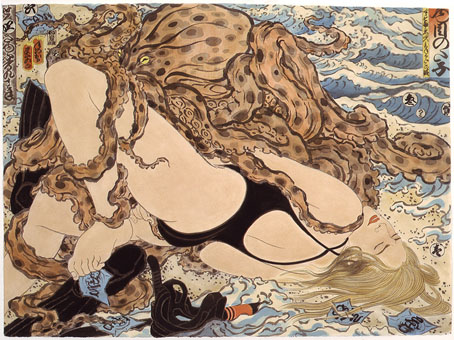
Sarah and Writhing Octopus (New Wave Series, 1992) by Masami Teraoka.

Strange Flowers continues to push all my buttons. For a while now I’d been intent on writing something about the strange (unbuilt) temples designed by German artist/obsessive naturist Fidus (Hugo Höppener) but I reckon James has done a better job than I would have managed. Also last week he wrote about Schloss Schleißheim, a palatial estate outside Munich with connections to Last Year in Marienbad and another eccentric, pseudonymous German artist: Alastair (Hans Henning Voigt).

• The circus poster that inspired John Lennon’s Sgt. Pepper song Being For The Benefit Of Mr. Kite! has been reproduced as a limited edition letterpress print. Related: Wikipedia’s page about Pablo Fanque (1796–1871), “the first black circus proprietor in Britain”.

• The first two volumes of The Graphic Canon, both edited by Russ Kick, are reviewed at Literary Kicks. I’ve not seen either of these yet but volume 2 contains my interpretation of The Picture of Dorian Gray. Related: the second book previewed at Brain Pickings.

You only have to read [Alan Bennett’s] diaries to see that, underneath the wit and humour and sandwich-filled pottering around old churches, there is a deep resentment at what has happened to England in his lifetime and an instinctive distrust, sometimes amounting to deep loathing, of most politicians. Listening, for instance, to Alan Clark and Kenneth Clarke talking on the radio about the arrest of General Pinochet in 1998, he writes: “Both have that built-in shrug characteristic of 80s Conservatism, electrodes on the testicles a small price to pay when economic recovery’s at stake.”

Michael Billington on Alan Bennett: a quiet radical

• Hauntologists mine the past for music’s future: Mark Pilkington draws a Venn diagram encompassing Coil, Broadcast, the Ghost Box label, Arthur Machen, MR James, Nigel Kneale, Iain Sinclair and others.

• Hell Is a City: the making of a cult classic – in pictures. The mean streets of Manchester given the thriller treatment by Hammer Films in 1959. The film is released on DVD this month.

• The Function Room: The Kollection, Matt Leyshon’s debut volume of horror stories, has just been published. The cover painting is one of my pieces from the 1990s.

• New Worlds magazine (now apparently known as “Michael Moorcock’s New Worlds“) has been relaunched online.

konahin.jpg

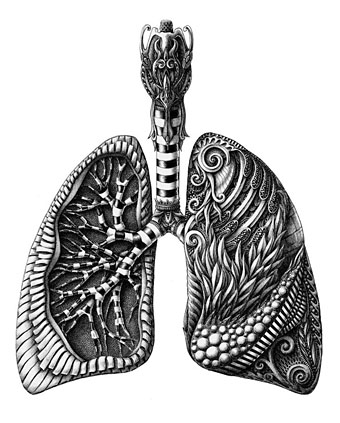
A drawing from Anatomy (part 1), a series by Alex Konahin.

• The forthcoming Scott Walker album, Bish Bosch, will be released on December 3rd. 4AD has a trailer.

• Cormac McCarthy Cuts to the Bone: Noah Gallagher Shannon on the early drafts of Blood Meridian.

• The Velvet Underground of English Letters: Simon Sellars Discusses JG Ballard.

• Michelle Dean on The Comfort of Bad Books.

• The typewriter repairers of Los Angeles

• Cats With Famous People

• Marienbad (1987) by Sonoko | Komm Nach Marienbad (2011) by Marienbad | Marienbad (2012) by Julia Holter.

(Thanks to Ian and Pedro for this week’s picture links!)