Weekend links 138

durette.jpg

Heartsick (2011) by Kelly Durette.

• Now that Scott Walker’s Bish Bosch album is out and causing the usual consternation, the spotlight-shy singer/composer has been doing a surprising amount of promotional interviews. Simon Hattenstone talked to him for the Guardian at the end of last month; this week it was John Doran’s turn at The Quietus. One quote from the latter piece stood out in the light of this week’s posts: “…the music we’re making is meant to be an aural version of the HR Giger drawings for Alien. It always sounds to me like those look.”

• Satanica is a limited-edition publication curated by Gio Black Peter & Christopher Stoddard “for anyone who rejects societal norms, for those dedicated to a life of pleasure, excess and self-reflection”.

• Sci-Fi-O-Rama has put five years’ worth of blog pictures onto Pinterest. I don’t really need to do that, there’s already a diverse crowd of Pinterest users compiling their own selection of things posted here.

As Susan Sontag once observed, pornography is practical. It was designed as a marital aid, and its vocabulary should follow natural biological rhythms and stick with hot-button words in order to produce a predictable climax. It is not about sex but is sex. Whereas the great sex writers (Harold Brodkey, DH Lawrence, Robert Gluck, David Plante, the Australian Frank Moorhouse) have a quirky, phenomenological, realistic approach to sex. They are doing what the Russian formalists said was the secret of all good fiction – making the familiar strange, writing from the Martian’s point of view.

Edmund White on writing about sex in fiction

• When pirate DVDs of films by Cocteau, Bresson and Pasolini are on sale in a Mexican market, life in the 21st century increasingly resembles a William Gibson novel. Joanne McNeil investigates.

• Copies of City Fun, Manchester’s premier music fanzine/alt culture mag (founded 1978), can now be read online at the Manchester District Music Archive.

• Linked everywhere during the past few days, the astonishing map of bomb hits on London during the Blitz (October 1940 to June 1941).

• At 50 Watts: 30 Vintage Magazine Covers from Japan and Alfred Kubin’s illustrations for Lesabéndio: An Asteroid Novel (1913) by Paul Scheerbart.

• Earlier this year for Frieze Magazine Geeta Dayal talked to musical collaborators of the great German producer Conny Plank.

• Invisible Ink by Christopher Fowler, “the extraordinary stories of over one hundred forgotten authors”.

• Cynthia Carr talks about Fire in the Belly, her biography of American artist David Wojnarowicz.

• “Blasphemy, Filth, And Nonsense” More Aleister Crowley ephemera at Front Free Endpaper.

• At Strange Flowers: Surrealist art by Jindrich Heisler (1914–1953).

• Vladimir Nabokov wrote to Alfred Hitchcock in 1964.

• Scott Walker’s four tracks from the Nite Flights album (1978): Shutout | Fat Mama Kick | Nite Flights | The Electrician.
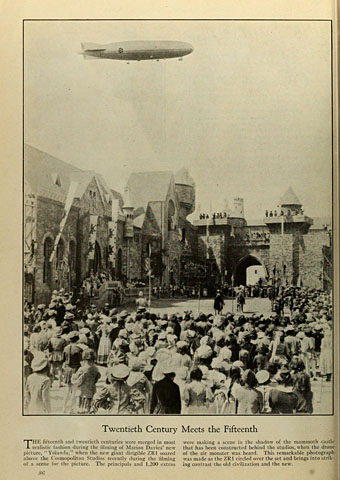

Twentieth Century Meets the Fifteenth

dirigible.jpg

Something spotted whilst browsing issues of Photoplay magazine at the Internet Archive, a photo showing the US dirigible ZR1 drifting over the Cosmopolitan Studios in 1923 during the filming of Yolanda. I don’t doubt that the ZR1 really did fly over Hollywood although it looks here to be at an odd perspective (it’s also being completely ignored by the crowd of extras). This makes me think the magazine may have comped two separate photos for convenience, as famously occurred with the cover photo of Pink Floyd’s Animals album.

kibardin.jpg

Searching around for details about the ZR1 turned up this 1931 poster by Georgii Kibardin exhorting Soviet citizens to build a fleet of airships in Lenin’s name. The Hindenberg disaster six years later put an end to this kind of enthusiasm.

Previously on { feuilleton }
• Zeppelinology
• Vickers Airship Catalogue
• The Air Ship
• Dirigibles
• The Airship Destroyer
• Zeppelin vs. Pterodactyls

The art of George Stavrinos, 1948–1990

stavrinos1.jpg

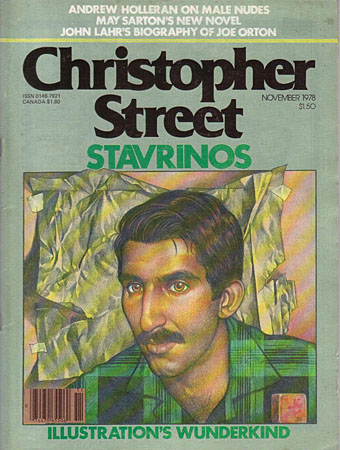
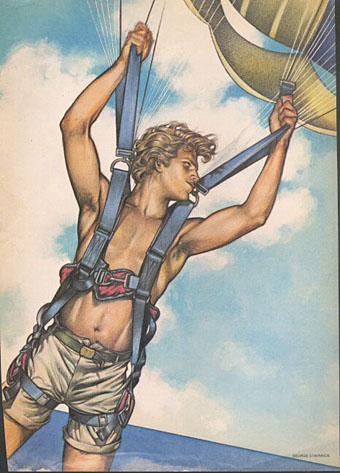
I’m still playing catch-up with the generation of gay artists who came to prominence in the 1970s or early 1980s. Many of them worked for American magazines which were seldom seen over here: both Mel Odom and George Stavrinos provided illustrations for Blueboy while Stavrinos was popular enough to be given the cover treatment from Christopher Street in 1978. Stavrinos is rightly remembered for his stunning Art Deco-styled fashion illustrations but there was enough work in the gay press for him to be regarded as an important artist in that sphere. There’s more at The Advocate and Decoy.

stavrinos2.jpg

stavrinos3.jpg

stavrinos4.jpg

Bather (1977).

stavrinos5.jpg

Elsewhere on { feuilleton }
• The gay artists archive

How It Works

hiw1.jpg

Yes, it’s all happening this month… Unlike other work that’s surfaced recently the cover art for issue 41 of How It Works magazine was completed less than a month ago. Headlines obscure much of the artwork but the picture is also run full-page inside, something I wasn’t expecting. How It Works has major newsstand distribution so people in the UK may see this on shelves in newsagents and supermarkets throughout December.

The theme is the Industrial Revolution but the brief was for something similar to a couple of my recent steampunk illustrations, with a request for a colour scheme like that used for the Bookman Histories cover. The main visual requirement was the train looming out of the picture. I thought this wouldn’t be a problem, I have the old Dover Publications’ Transportation book which features many copyright-free engravings of trains, in addition to other books and source material downloaded from the Internet Archive. One of these would be sure to have a decent front elevation of a steam locomotive, right? Wrong. When you start looking for pictures of locomotives you quickly find that 99% of them show the machines from the side or from an angle, as on the Bookman cover. I downloaded three entire books of over 500-pages each from the Internet Archive, fantastic volumes in themselves, especially Modern Locomotive Construction (1892) which contains meticulous descriptions of every last part of a steam locomotive, down to the smallest screw. But none of their drawings were usable.

Continue reading “How It Works”

Weekend links 136

tintenfisches.jpg

Der Triumph des Tintenfisches from Meggendorfer-Blätter (c. 1900). Via Beautiful Century.

Much dismay this week at the news that Coilhouse—the web and print magazine founded in 2008 by Nadya Lev, Meredith Yayanos and Zoetica Ebb—was closing its doors for the foreseeable future. I always loved what they were doing, and was delighted when S. Elizabeth interviewed me for the website two years ago. Looking at the list of their featured articles is like seeing the contents of my head laid bare. Have a browse and see what you may have missed. And fingers crossed they return soon.

• “I think we are just used to seeing naked women because they are used as objects of desire in advertisements and TV. Naked men are not that common—we are not used to seeing a penis. I think that is the main problem for people.” The shock of the (male) nude.

• Michael Clarke asks “What Can Publishers Learn from Indie Rock?” Also: Michelle Dean on the value of used books.

Queers find themselves on both sides of the free speech question. Those of us who are writers want the freedom to write and say what we want. I know I do. Yet a preponderance of LGBT people have become part of the larger wave of those who would limit free speech. Because while we want to be able to say whatever we want about “them,” we do not want “them” to say whatever they want about us.

Victoria Brownworth on The Case Against Censorship

• Caspar Henderson re-reads The Book of Imaginary Beings by Jorge Luis Borges.

• One hundred classic minimalism, electronic, ambient and drone recordings.

• BLDGBLOG visits the Chand Baori stepwell in Abhaneri, India.

• Brion Gysin’s Dreamachine is launched in the UK.

• Ken Hollings visits Ludwig II’s Venus Grotto.

• A guide to Meredith Monk‘s music.

• RIP Boris Strugatsky.

• Maldorora: a Tumblr.

• Stalker: Meditation (1979) by Edward Artemiev | Undulating Terrain (1995) by Robert Rich & B. Lustmord | Stalker (2004) by Shackleton.