Wildeana 7

wilde1.jpg

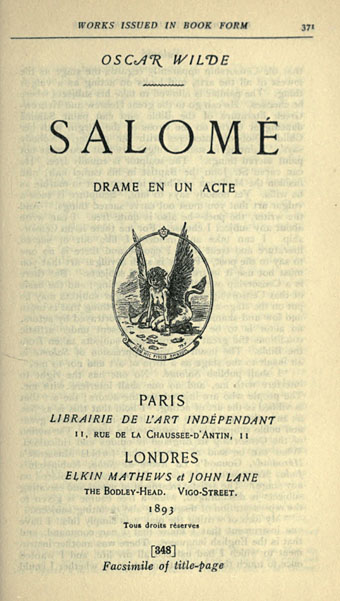
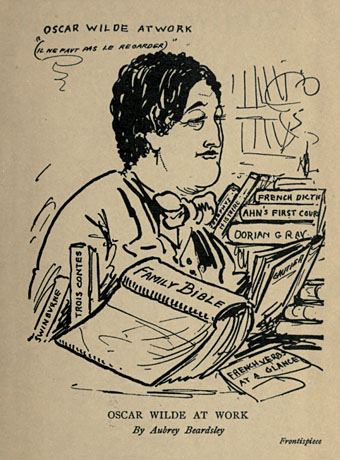
Continuing an occasional series. The drawing above is frequently credited to Aubrey Beardsley in books about Oscar Wilde but receives an “anonymous” attribution in books of Beardsley’s work. The copy here, and the pages below, are from Bibliography of Oscar Wilde (1914) by Stuart Mason.

• Last November it was announced that Wilde’s lipstick-blotched tomb in Père Lachaise cemetery is to be cleaned (again) then shielded from the persistent kissers and graffiti writers by a glass screen. Flickr has a collection of photos showing the earlier condition of the tomb and its embellishments.

wilde2.jpg

• Maria Bustillos in The Vexed Posthumous Life of Oscar Wilde chronicles the story of the blue plaque on Wilde’s former home in Tite Street, London.

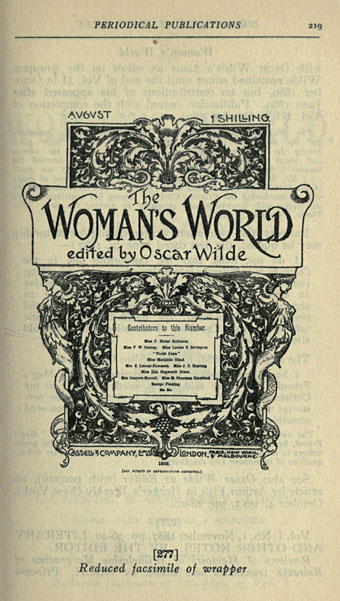
• “A hundred and twenty five years ago, Oscar Wilde edited a fashion magazine, his first and only office job. We have yet to learn from the experience.” Wilde in the Office by Kaya Genç.

wilde3.jpg

Elsewhere on { feuilleton }
• The Oscar Wilde archive

Weekend links 121

lambshead.jpg

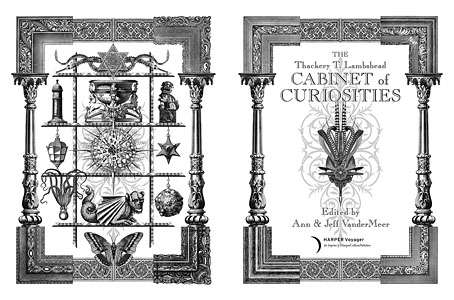
Title spread for The Thackery T. Lambshead Cabinet of Curiosities (2011) edited by Ann & Jeff VanderMeer.

I was surprised this week to find myself nominated as Best Artist in the World Fantasy Awards. The results will be announced at the World Fantasy Convention in November. Among the books nominated for Best Anthology is the Thackery T. Lambshead Cabinet of Curiosities for which I provided title page designs and some illustrations. Editors Ann & Jeff are well-represented (and ought to win for their landmark The Weird anthology), and I’m pleased to see Mark Valentine receive a nod for his excellent Wormwood magazine. Mark and Roger Dobson published my first Lovecraft adaptation, The Haunter of the Dark, in a large-format edition under their Caermaen imprint in 1988.

I remember having a conversation with my father about it. I told him what I’d really have liked to find, in my exhaustive search of the canon, was a gay superhero. You know: fucking dudes, saving the world. Never mind the fact that superheroes, with their notoriously contour-hugging apparel, are usually assumed gay by default. I wanted something that had existed, something from history. My father considered my criteria.

“I think what you want is Gore Vidal.”

Henry Giardina on Gore Vidal’s Bully Republic at the Paris Review.

• Appreciations and memorials for the late Gore Vidal continue to surface: “He was punk rock with a traditional, smooth exterior. But there was nothing traditional about him, not really. He defied singular category,” says Aaron Tilford at Lambda Literary. “Jokes course through Vidal’s entropy-heavy commentaries like a warm, reviving current. They, more than the barbs to which they form a counterpoint, are what make his essays a continuing pleasure to read,” says “J.C.” at the TLS.

• “Winterson’s opposition to strict realism is less an artistic critique than a cultural one. She uses the term ‘realism’ to describe an entrenched way of viewing the world, which it is the writer’s duty to challenge.” Hannah Tennant-Moore on Jeanette Winterson at n+1.

• The Ghosts of Bush by Robin The Fog: “A final hauntological perambulation around the hidden corners of Bush House, Aldwych, London, June 2012”.

• “For everything that is not shown, the filmmaker counts on the power of imagination of his viewers.” Lebbeus Woods on Chris Marker and La Jetée.

• Joseph Burnett on “Rainbow Ambiguity: Defying conservatism in mainstream LGBT culture”.

• Leigh Brackett book and magazine covers at Golden Age Comic Book Stories.

• BLDGBLOG visited the Whitechapel Bell Foundry in London.

• Stilled Life: A collection of photography by Thom Ayres.

• Underground subversion: Stickers on the Central Line.

• Andrei Codrescu on five favourite Fantastical Tales.

• Vangelis performs an analogue synth freakout for Spanish TV in 1982 | Oro Opus Alter, a track from the forthcoming album by Ufomammut | New World, a track from the forthcoming album by The Irrepressibles. Can’t wait.

A Trip to Mars

mars3.jpg

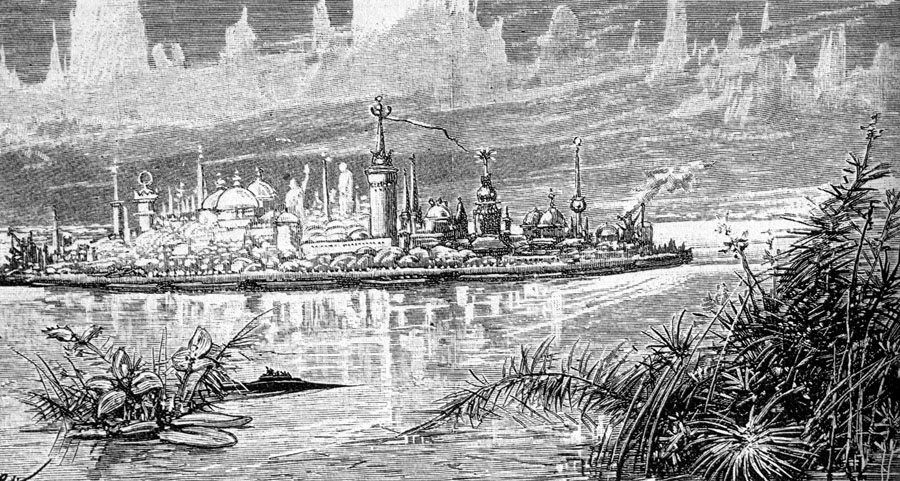
A floating Martian city from Letters from the Planets (1890) by WS Lach-Szyrma. Illustration by Paul Handy.

In honour of the remarkable landing on Mars of the Curiosity Rover, a handful of random illustrations from the vast stock of imagery generated by the Red Planet over the past century-and-a-half. When it comes to Mars I’m afraid you can keep your terraforming and geodesic domes, I prefer the more fanciful scenarios involving air-boats, cloaks and actual canals. Paul Handy’s illustration above shows what I believe is a Venusian vehicle sailing past a Martian city, Lach-Szyrma’s book concerning a journey through the solar system. I only have small copies of these pictures in a book, so far they don’t seem to have turned up online.

mars2.jpg

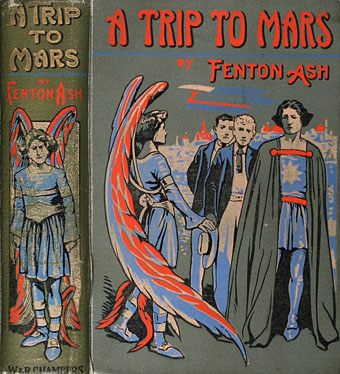
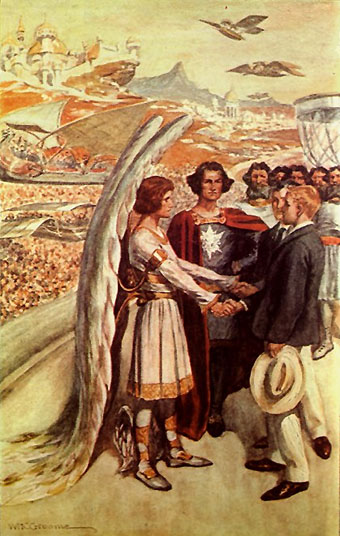
A Trip to Mars (1909) by Fenton Ash. Illustrations by WHC Groome.

Fenton Ash was the nom de plume of British author Francis Henry Atkins. A Trip to Mars concerns another exploratory journey taken this time by a pair of Edwardian schoolboys.

mars1.jpg

Continue reading “A Trip to Mars”

Muto Manifesto, volume 7

muto7-1.jpg

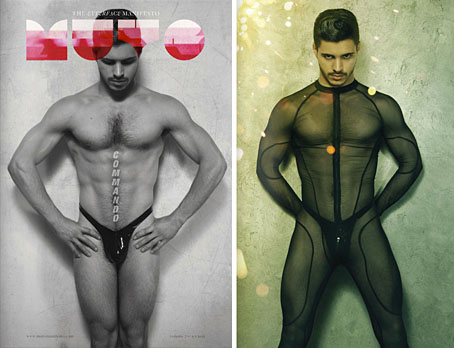
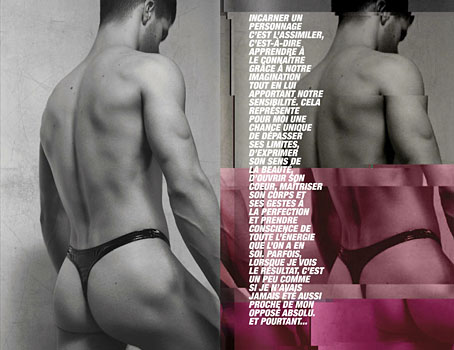
In which Muto Manifesto, the photo-magazine created by ace French photographers Exterface, celebrates a year of publication with a new edition that’s available in two print editions (one of which is already sold out). The model is the splendid Matthieu Charneau who featured in the first issue. See page samples here and in the online version at Issuu. Via Homotography.

muto7-2.jpg

Elsewhere on { feuilleton }
• The gay artists archive

Previously on { feuilleton }
• Muto: The Exterface Manifesto
• Exterface

The End of Books, 1894

robidabooks01.jpg

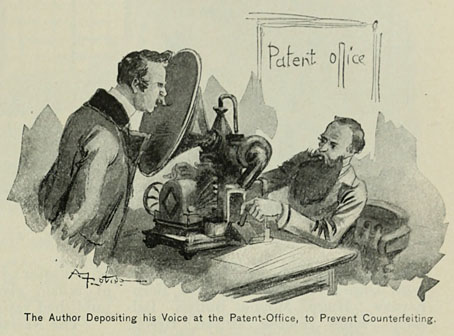
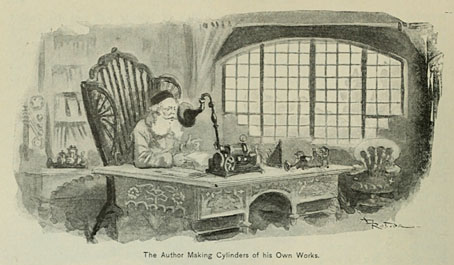
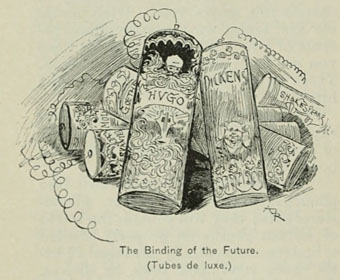
More illustrations from Albert Robida, and a riposte to anyone thinking that the idea of the end of books is a recent thing. This article by bibliophile Octave Uzanne appeared in Volume 16 of Scribner’s Magazine (July–December 1894). The piece opens with a description of various scientists and artists at a Royal Society evening making predictions about life in the future. Among other proposals there’s that old saw of science fiction, the meal of condensed nutrients which would supposedly put an end to world hunger. Uzanne’s account of the future of the book involves authors speaking their works into recording devices. Despite Robida’s somewhat comic extrapolations Uzanne seemed to have been semi-serious; even if he wasn’t he made a good job of predicting audio books, and (after a fashion) television: those wanting illustrations would have images projected by one of Edison’s Kinetoscopes.

There will be registering cylinders as light as celluloid penholders, capable of containing five or six hundred words and working up on very tenuous axles, and occupying not more than five square inches; all the vibrations of the voice will be reproduced in them; we shall attain to perfection in this apparatus as surely as we have obtained precision in the smallest and most ornamental watches.

As to the electricity, that will often be found in the individual himself. Each will work his pocket apparatus by a fluent current ingeniously set in action; the whole system may be kept in a simple opera-glass case, and suspended by a strap from the shoulder.

As for the book, or let us rather say, for by that time books “will have lived,” as for the novel, or the storyograph, the author will become his own publisher. To avoid imitations and counterfeits he will be obliged, first of all, to go to the Patent-Office, there to deposit his voice, and register its lowest and highest notes, giving all the counter-hearings necessary for the recognition of any imitation of his deposit. The Government will realize great profits by these patents.

The full article may be read here.

robidabooks02.jpg

robidabooks03.jpg

Continue reading “The End of Books, 1894”