Weekend links 310

monogenis.jpg

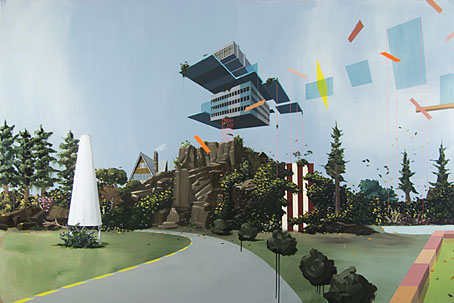
Parkland (2012) by Dean Monogenis.

• “The Story Behind the Planet’s Most Influential Road Map of ‘Weird Music’“. Gustavo Turner investigates the enduring influence of The Nurse With Wound List. Related: A Discogs list of links to all the NWWL discographies, and a recommended listening guide by Ultima Thule.

Tokyo Melody: Un film sur Ryuichi Sakamoto (1985) by Elizabeth Lennard features Sakamoto at work on Illustrated Musical Encyclopedia, together with Akiko Yano, Haruomi Hosono and Yukihiro Takahashi.

• “We wanted to fuse the aesthetics, histories and values of witchcraft, the traditional ideas with a contemporary edge,” says editor and creative director of Sabat magazine, Elisabeth Krohn.

There is a very seductive and very dangerous demon: the demon of generalities. He captivates man’s thought by marking every phenomenon with a little label, and punctiliously placing it together with another, similarly carefully wrapped and numbered phenomenon. Through him a field of human knowledge as changeable as history is turned into a neat little office, where this many wars and that many revolutions sleep in folders – and where we can pore over bygone ages in complete comfort. This demon is fond of words such as “idea”, “tendency”, “influence”, “period”, and “era”. In the historian’s study this demon reductively combines in hindsight the phenomena, influences and tendencies of past ages. With this demon comes appalling tedium – the knowledge (utterly mistaken, by the way) that, however humanity plays its hand or fights back, it follows an implacable course. This demon should be feared. He is a fraud. He is a salesman of centuries, pushing his historical price list.

Vladimir Nabokov in a previously unpublished lecture, On Generalities

• More Tom Phillips: 20 Sites n Years, a film by Jake Auerbach & David Thorp about the artist’s long-term urban photography project, is showing at Camberwell College of Arts next month.

• Mixes of the week: Sass In Pocket by Abigail Ward, Near Mint, 17th May 2016 by Robin the Fog & Hannah Brown, and Secret Thirteen Mix 184 by Andi Stecher.

• Grey Dog Tales talks to Brian J Showers of Swan River Press about horror and supernatural fiction.

• “Magic mushrooms lift severe depression in clinical trial.” But their use is still illegal in the UK.

• “Your brain does not process information, and it is not a computer,” says Robert Epstein.

Cliff Martinez’s theme for Nicolas Winding Refn’s forthcoming The Neon Demon.

Diamanda Galás, Still Wild and Primal, Returns to the New York Stage.

Janae Corrado on the photography of Joel-Peter Witkin.

Alastair Gee on gay home movies from the 1940s on.

People Laugh At Me (Coz I Like Weird Music) (1980) by The Instant Automatons | Weird Caravan (1980) by Klaus Schulze | Call It Weird (1983) by Xymox

Weekend links 309

witch.jpg

From What is a Witch, “an illuminated manifesto on witchcraft” by Pam Grossman and Tin Can Forest.

• “The other strand of influence for me from dance music was a production house called Savoy in Manchester, England. They were a super underground publishing house that printed cartoons and comic books, and they also released a series of underground dance records. And they were always being shut down by the police and all their stuff was being confiscated, because it was considered ‘anti-society’ in England.” Anohni giving a shout to my colleagues at Savoy Books in a new interview.

Belladonna of Sadness (1973), a feature-length animated film by Eiichi Yamamoto, has been restored, and is being given a premier release in the US. There’s a review here and a trailer here. No news as yet of a UK release but Finders Keepers has the soundtrack album.

Alejandro Jodorowsky talks to Daniel Kalder about his new novel, Albina and the Dog-Men, while Jodorowsky’s comic-book collaborator, Ladrönn, talks to Smoky Man about their new graphic novel, The Sons of El Topo.

Pretty little watercolours these are not. Made by bulldozers and dynamite instead of a paintbrush and easel, the works—often sited on baking sandscapes—fuse minimalism and modern industrial aesthetics to evoke the otherworldly structures of ancient civilisations, from Stonehenge to Mayan temples and the Egyptian pyramids.

Alex Needham on America’s land artists. A few years ago I tracked down some of the structures he describes using Google Maps.

• In every dream home a heartache: High Rise director Ben Wheatley on adapting Ballard, practical special effects and ’70s parenting.

Tom Phillips: From Prequel To Sequel, an exhibition of pages from A Humument at Shandy Hall Gallery.

• From fresh food to magic mushrooms: Michael Pollan probes the medicinal uses of psychedelic drugs.

• “Let’s not forget graphic design is an artistic discipline,” says Jonathan Barnbrook.

Supervert discusses censorship and related matters at SomethingDark.

• “I’ve sung gospel music when in great despair,” says Diamanda Galás.

• Mix of the week: FACT Mix 550 by James K.

Boy Club is a new gay magazine.

Gospel Trane (1968) by Alice Coltrane | The Gospel Comes To New Guinea (1981) by 23 Skidoo | Gospel Train (1990) by African Head Charge

Weekend links 305

marchbank.jpg

Threads of Fate—The Weird Sisters from Macbeth (2013) by Fiona Marchbank.

• The week in books: Claire Cameron on the difference between US & UK cover designs | Jason Diamond asks “Why do cats love bookstores?” | Alan Moore’s cover art for his forthcoming novel, Jerusalem, has been revealed | Brian Phillips on the typefaces used by New English Library for their Dune covers in the 1970s.

• On writing: Poetry and horror “share a universally human quest toward intimacy” says Evan J. Peterson | “The best work neither shows nor tells: it says by being, not by saying,” says M. John Harrison.

• At the BFI this week: Where to begin with Jerzy Skolimowski, and 10 overlooked British horror films of the 1970s. Both lists include Skolimowski’s excellent The Shout (1978).

Cultures do not, and cannot, work through notions of ‘ownership’. The history of culture is the history of cultural appropriation—of cultures borrowing, stealing, changing, transforming.

Nor does preventing whites from wearing locks or practicing yoga challenge racism in any meaningful way. What the campaigns against cultural appropriation reveal is the disintegration of the meaning of ‘anti-racism’. Once it meant to struggle for equal treatment for all. Now it means defining the correct etiquette for a plural society. The campaign against cultural appropriation is about policing manners rather than transforming society.

Kenan Malik on ill-considered complaints against “cultural appropriation”. Malik isn’t the first to note the intersection of such complaints with those of white supremacists who also want cultural purity and segregation

OUT, DEMONS, OUT!: The 1967 Exorcism of the Pentagon and the Birth of Yippie! An oral history by Larry “Ratso” Sloman, Michael Simmons and Jay Babcock.

• The long-overdue republication of Moebius’s work in English will begin with a new edition of The World of Edena (1985).

• More from radioactive Russia: Nadav Kander’s photographs of Soviet nuclear test sites.

• Comic artist and illustrator Kris Guidio in conversation with Jonathan Barlow.

• Francesca Gavin meets Tadanori Yokoo, “the Grandmaster of Pop-Psych Art”.

• “LSD’s impact on the brain revealed in groundbreaking images”

• Mix of the week: Secret Thirteen Mix 182 by Paul Jebanasam.

• A trailer for Nicolas Winding Refn’s The Neon Demon.

• Tony Conrad: 1940–2016 by Geeta Dayal.

Brian Eno’s favourite records

Neonlicht (1994) by Mitja VS (with Enzo Fabiani Quartet) | On Demon Wings (2000) by Bohren & Der Club of Gore | Shout At The Devil (2002) by Jah Wobble & Temple Of Sound

Weekend links 301

ruscha.jpg

The Music from the Balconies (1984) by Edward Ruscha.

• At The Quietus: High-Rise director Ben Wheatley runs through his favourite films. Kudos for mentioning Elem Klimov’s Come and See (1985) among the more familiar fare, a nightmarish masterwork that everyone should watch at least once. On the same site, author Joe R. Lansdale also lists some favourite films while discussing the new TV series of his Hap and Leonard books.

Electric Hintermass (Sound Apart) by Hintermass, a track from The Apple Tree, their debut album on the Ghost Box label.

Michael Mann’s Heat: “A complex, stylistically supreme candidate for one of the most impressive films of the Nineties”.

• Despair Fatigue: David Graeber on how [political] hopelessness grew boring, and what happens next.

• Mix of the week: FACT Mix 541 by Tortoise, and Blowing Up The Workshop 56 by Eric Lanham.

• At Dennis Cooper’s: “Some books (1961–1975) that either faked ingesting LSD or did”.

• David Litvinoff again: “Was he only an opportunistic hustler?” asks David Collard.

John Carpenter’s The Thing rescored with one of the director’s Lost Themes.

Overlooked: a book by Marina Willer about the manhole covers of London.

• Pam Grossman (words) and Tin Can Forest (art) ask What is a Witch?

• A long way down: Oliver Wainwright on JG Ballard and High-Rise.

• A conversation with designer and typographer Erik Spiekermann.

• The BFI compiles a list of “The 30 Best LGBT Films of All Time“.

• Decoding the spiritual symbolism of artist Hilma af Klint.

Sabat Magazine

Heat (1983) by Soft Cell | The Heat (1985) by Peter Gabriel | Heat Miser (1994) by Massive Attack

Weekend links 295

dupre.jpg

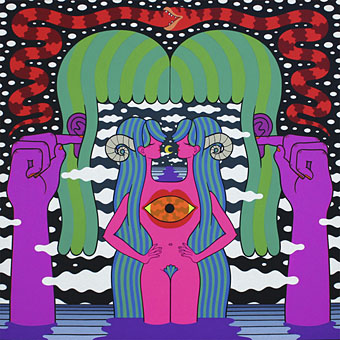
Untitled (2014) by Lola Dupré. Via.

Announcement of the week (if not the month/year) is the news that the BFI will be releasing all of the BBC dramas directed by Alan Clarke on DVD/Blu-ray in May. In addition to the long-awaited appearance on disc of Penda’s Fen (1974) we can expect a previously unseen director’s cut of Clarke’s last TV film, The Firm (1989), the DVD premier of Baal (1982) with David Bowie, plus many other works including some from the 1960s that were believed lost. (And it should be noted that this isn’t everything of Clarke’s; he also worked occasionally for ITV and later directed feature films for Channel 4.)

The BFI attention is a tribute to an exceptional director that’s overdue. Clarke has long been a cult figure among the British actors who worked with him, and among directors such as Harmony Korine and Gaspar Noé, but the tendency of TV to give one-off dramas a single screening has meant that much of his best work has been unavailable for years outside old VHS tapes. Clarke is important for having persistently chosen difficult subjects which he directed with a flair and intensity usually only found in cinema. When he died in 1990 the BBC repeated a handful of his films but the only ones given repeated DVD release have been the violent dramas with the big names attached: Scum (1979, with Ray Winstone), Made in Britain (1982, with Tim Roth), and The Firm (with Gary Oldman). Clarke’s oeuvre is much more than a parade of nihilistic villains, as will become evident later this year.

• A psychedelic video directed by Peter Strickland for Liquid Gate (ft. Bradford Cox) by Cavern of Anti-Matter. The debut album from Cavern of Anti-Matter, Void Beats/Invocation Trex, will be out later this month.

Celebrating Dusseldorf, the city that birthed Krautrock. (Article loses points for not mentioning producer Conny Plank.)

All Rivette’s features might be regarded as different kinds of horror films; Céline et Julie vont en bateau is his first horror comedy. The anxiety and despair of Paris Nous Appartient and La Religieuse, L’Amour Fou and Spectre seem relatively absent, yet they perpetually hover just beyond the edges of the frames. We still have no privileged base of ‘reality’ to set against the fictions, each of which is as outrageous as the other; and along with Borges, we can’t really say whether it’s a man dreaming he’s a butterfly or a butterfly dreaming he’s a man—although we may feel, in either case, that he and we are just on the verge of waking.

Jonathan Rosenbaum on work and play in the house of fiction: Jacques Rivette’s Out 1 and Céline and Julie Go Boating

• Mixes of the week: Finders Keepers Radio Show Krautrock Special, and The Ivy-Strangled Path Vol. XV by David Colohan.

• At Dangerous Minds: Super strange sculptures (by Shary Boyle) only the dark and demented could love.

• Beautiful Brutalites: S. Elizabeth questions Arabella Proffer about her paintings.

KTL is a musical collaboration between Peter Rehberg and Stephen O’Malley.

• Why study art when you can make it? The strange world of…This Heat.

Sarah Galo on the explicitly sexual female artists that feminism forgot.

Irmin Schmidt‘s favourite music (this week).

• LSD: My life-saving drug by Eric Perry.

The Occult Activity Book

Twenty Tiny Cities

Der LSD-Marsch (1970) by Guru Guru | Krautrock (1973) by Faust | Düsseldorf (1976) by La Düsseldorf