Weekend links 843

eclipse.jpg

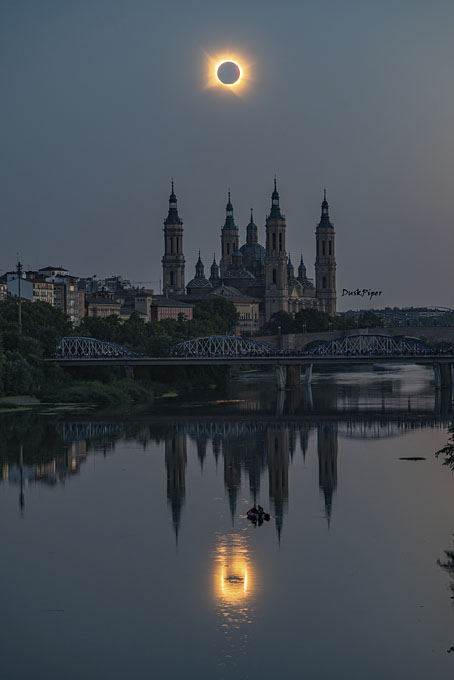
Total solar eclipse over Zaragoza, Spain, 12th August, 2026. Photograph by Ruiyu Zhang.

• Kenneth Anger (again), in a transcript for another KPFA radio interview, in which we Anger have mentioning HP Lovecraft. Not a major revelation in itself but it’s not something I’ve seen before. On a related note, Anger wrote to August Derleth in 1947 asking permission to adapt The Dreams in the Witch House for one of his films. Another tantalising might-have-been from the Anger filmography, along with his unfinished film of Maldoror. (Thanks to Hagen for the info.)

• A recording of Jon Hassell’s final concert (London, 2015) will be released later this year as Music Is Invisible, which will become the third part of the Pentimento series. This may not be the last Hassell album, however. Other live recordings exist, and you could make a substantial compilation from all the one-off pieces Hassell recorded over the years.

No City Fun: Manchester in 1979 (again) in a short film by Charles Salem with the music of Joy Division on the soundtrack.

• New music: Melting Days by Lusine; Yours Sincerely by Haruomi Hosono; Seedhead by Avi Engel.

• At Unquiet Things: Rebecca Chaperon‘s dreaming thresholds and painted portals.

• Mix of the week: Bleep Mix #322 by Tyondai Braxton.

• Finalists for the Ocean Photographer of the Year.

• Old music: Arles 75 Sechs by Can.

• RIP John Crowley.

Eclipse (1968) by The Moving Sidewalks | Total Eclipse (1974) by Billy Cobham | Eclipse (1998) by Talvin Singh

Weekend links 740

severin.jpg

Winged Figure (no date) by Mark Severin.

• At Wormwoodiana: News of the publication of two uncollected early stories by Cormac McCarthy. I happen to be reading McCarthy’s penultimate novel, The Passenger, at the moment. Very enjoyable and very different to what I was expecting.

• At Smithsonian Magazine: Yayoi Kusama‘s largest permanent public sculpture arrives in London.

• At Colossal: A futuristic 150-foot installation imagines Chicago’s never-built architecture.

The record sounded like nothing else, seemingly came from nowhere and related to nothing I could identify with any confidence: whistling, whispering, mumbling, pig grunts, exhalations of breath, chants and vocal imitations of nocturnal forest sounds, arco double bass and electric bass, nursery rhymes, impenetrable accents and languages, tambourines, unidentifiable tuned percussion imprecisely struck, mandolin, banjo, flutes, congas, bottleneck guitar, second line drumming with virtually no cymbals, dense percussion, organ bass, harpsichord, reed instruments played through electronic effects and organ lines sounding like anything but themselves. There was no piano, despite what some later commentators have claimed, and in fact very little harmonic underpinning in the majority of tracks. Instead of piano or guitar chords to fill out the ensemble sound there is the celebrated Gold Star echo chamber, into which instruments and voices sank as if dropping away into the abyss.

Zozo la Brique, Jump Sturdy, Coco Robichaux, Queen Julia Jackson, Mama Roux, Tit Alberta—questions flared like fireworks. Who were these characters who populated the lyrics. Were they voodoo practitioners, alive or dead, fictitious or real? Ishmael Reed’s visionary novel, Yellow Back Radio Broke-Down, was published not long after, in 1969. Years later I read it and was startled to bump into Zozo la Brique once more. So these were real people, or named phantoms, or figures of legend at least. “O Doc John,” Reed wrote, “Doc Yah Yah and Zozo Labrique Marie Laveau the Grand Improvisers if I am not performing these rites correctly send the Loa anyway and allow my imagination to fill the gaps.”

David Toop in an extract from Two-Headed Doctor: Listening For Ghosts In Dr. John’s Gris-Gris

• New music: Hidden Structures by Time Being, and Buried (Your Life Is Short) by The Bug.

• At Spoon & Tamago: Minimal and tranquil charcoal drawings by Masahiko Minami.

• New weirdness: Cat Location Conundrum by Moon Wiring Club.

• At Unquiet Things: The art of Dylan Garrett Smith.

• At Dennis Cooper’s: Toshio Matsumoto Day.

• RIP Alain Delon.

Gris-Gris Gumbo Ya Ya (1968) by Dr John | Gumbo (1971) by Santana | Roochoo Gumbo (1976) by Harry “The Crown” Hosono

Weekend links 674

moon.jpg

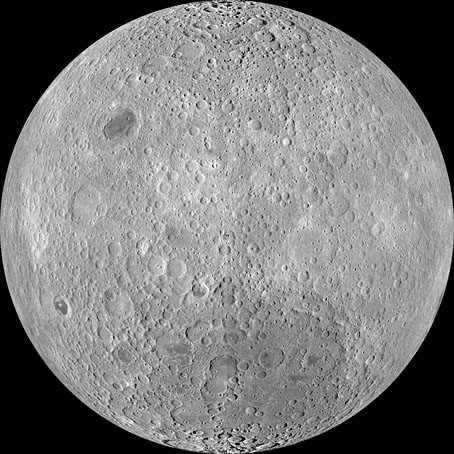
The Far Side of the Moon, as photographed by NASA’s Lunar Reconnaissance Orbiter.

• “It goes against centuries of traditional belief to accept that the moon is barren, that it is indifferent, that it is innocent of any role in monthly spikes in the crime rate or in the cycles of menstrual unreason. When telescopic observation had found nothing on the near side (Roger Boscovich had established by 1753 that it lacks even an atmosphere), the far side still remained a site for the projection of fantasies of a different, neighbouring world.” Justin EH Smith working his way towards a history of the dark side of the moon.

• “It shocks me that movies still lean in so hard to all these outmoded gay narrative tropes: coming out, coming of age; very identity-oriented representations of gay characters. It’s much easier to represent a gay boy who’s repressed in high school and comes out and makes friends. It’s very mainstream, and kind of played out.” Bruce LaBruce on cinematic trends in relation to his new film, a gay-porn take on Pasolini’s Teorema.

• At Cartoon Brew: Pavel Sannikau explains how he developed his own techniques of digital animation in order to create the ever-expanding Floor796.

• There’s always more Poe: Mysterium, Incubus et Terror, Poe-inspired music by a variety of artists, plus illustrations by John D. Chadwick.

• At Smithsonian Magazine: The results of a themed contest in the Close-Up Photographer of the Year Challenge.

• Mixes of the week: In Praise of the Saddest Chord at Ambientblog, and The Funky Eno Pts 2 & 3 by DJ Food.

• Steven Heller talks to Hungarian artist István Orosz about his Escher-like drawings.

• At Unquiet Things: Caitlin McCormack’s ghostly chains of knotted memory.

• At Spoon & Tamago: Intricate and organic sculptures by ceramicist Eriko Inazaki.

• New music: Illumina by Call Super with Julia Holter.

Dark Side Of The Mushroom (1967) by The Chocolate Watchband | Dark Side Of The Star (1984) by Haruomi Hosono | On The Dark Side Of The Sun (live) (2003) by Helios Creed

Weekend links 653

clarke.jpg

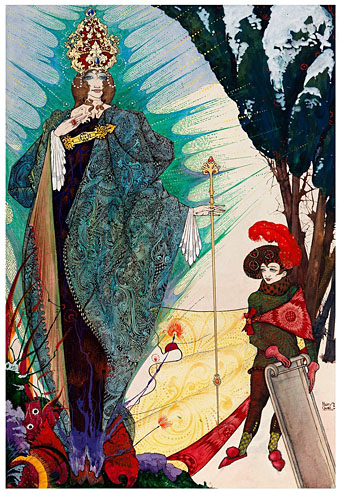
The Snow Queen (1916) by Harry Clarke.

• “…blogging remains my favourite format precisely because the writing so rarely feels like labour. Liberated from the need to pitch an idea or wield credentials, blogging—for a professional writer—frees you up to address topics outside your perceived expertise. It feels like a leisure activity because it’s leisurely—a ramble across fields of culture and knowledge, during which you sneak short cuts and trespass into areas you are not meant to go. A post doesn’t have to have a destination, a point. You can bundle or concatenate several different topics, push into adjacency things that don’t obviously or naturally belong together—like oddments inside a Cornell box. You can start somewhere and end up somewhere completely different, without any obligation to tie things up neatly.” Simon Reynolds reflecting on 20 years of the blogging thing, and neatly summarising the attractions of the medium. For some of us, anyway…

• At Smithsonian Magazine: “Structural colour was first documented in the 17th century, in peacock feathers, but it is only since the invention of the electron microscope, in the 1930s, that we have known how it works.” Tomas Weber on Andrew Parker’s nanotechnology developments which are creating some of the brightest hues in the world.

• “Bring back the Cailleach, beloved Scottish goddess of winter, shaking out the snow on the land. Bring back Mother Holda, with her wild geese and her snowflakes landing on the tongue like a gift from the sky…” Yvonne Aburrow would like to see the festival of Yule returned to its anarchic origins.

Merry Christmas Mr Lawrence, an extract from a recent audience-less concert by Ryuichi Sakamoto which he says is liable to be his last.

• At Unquiet Things: S. Elizabeth posts some of the pictures that couldn’t be fitted into The Art of Darkness.

• Mix of the week: A Tribute to Manuel Göttsching by Low Light Mixes.

• It’s the end of December so it must be time for Alan Bennett’s diary.

• RIP Mike Hodges.

Vale Berfrois.

Snow (1985) by Takashi Toyoda | Snowfall (2000) by Haruomi Hosono | Snowfall (2005) by Robin Guthrie & Harold Budd

Weekend links 642

wheel.jpg

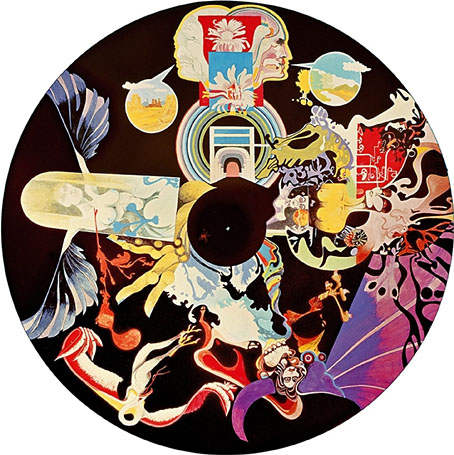
A light wheel. Via.

• “Part of the instrument’s draw is its fallibility. Famously, or perhaps infamously, every Rhodes is different: some freakishly responsive, some with keys that stick like glue, and all with uneven registers, darker corners, and sweet spots.” Hugh Morris on the delicate art of reinventing the Fender Rhodes.

Rambalac’s YouTube channel of first-person walks through Japanese locations is a vicarious pleasure, especially on a big screen. It’s not all city streets but if you like urban meandering then Tokyo walk from day to rainy night – Higashi-Ikebukuro, Mejiro, Ikebukuro is a good place to start.

• At Igloomag: Chang Terhune interviews Stephen Mallinder in a gratifyingly lengthy piece which covers Mallinder’s recent solo recordings and collaborations, his work with students on his sound-art course, and (unavoidably) the late Richard H. Kirk and Cabaret Voltaire.

What I think might be a useful approach—perhaps impractical, but bear me out—I think that if we were to reconnect magic and art as a starting point, because they’re practically the same thing anyway, make art the product of your magical experiments, the way that Austin Spare did for example, then that would give magic an enormous sense of purpose and I think it would also lend art the vision that it seems to be lacking at present. A lot of modern art seems rather empty and hollow conceptualism that lacks any real vision or substance or power. A linking of magic and art would help both of those fields. Then, once you’ve done that, maybe linking art and science. There’s plenty of work already done in that regard.

Alan Moore talking to Miles Ellingham about the usual concerns plus his new story collection, Illuminations

Wheels of Light: Designs for British Light Shows 1970–1990 is a book by Kevin Foakes (aka DJ Food) which will be published later this month by Four Corners Books. The author talks about his book here.

• “The Sandjak of Novi Pazar always sounded as if it were a title, like the Sultan of Zanzibar or the Dame of Sark…” Mark Valentine on discovering outdated maps in forgotten books.

• “My brief was to find tracks that had been left by the wayside or disregarded.” Lenny Kaye on 50 years of his influential garage-rock compilation Nuggets.

• Mixes of the week: XLR8R Podcast 768 by Lawrence English, and King Scratch (Musical Masterpieces from the Upsetter Ark-ive) by Aquarium Drunkard.

• At Dennis Cooper’s: Spotlight on Shirley Jackson The Haunting of Hill House (1959).

• Steven Heller’s font of the month is Slag.

• This Wheel’s On Fire (1968) by Julie Driscoll, Brian Auger & The Trinity | Cosmic Wheels (1973) by Donovan | Wheels On Fire (1985) by Haruomi Hosono