Weekend links 102

flannery.jpg

Flannery O’Connor with one of her many peacocks.

When the peacock has presented his back, the spectator will usually begin to walk around him to get a front view; but the peacock will continue to turn so that no front view is possible. The thing to do then is to stand still and wait until it pleases him to turn. When it suits him, the peacock will face you. Then you will see in a green-bronze arch around him a galaxy of gazing haloed suns. This is the moment when most people are silent.

Flannery O’Connor

Essay of the week was without a doubt Living with a Peacock by the great Flannery O’Connor, originally published in Holiday magazine in September 1961. I’d heard about Flannery’s peacocks before but had no idea she was such a pavonomane. Thanks to Jay for the tip!

• “‘He’s chameleon, comedian, Corinthian and caricature.’ But he was more like the very hungry caterpillar, munching his way through every musical influence he came across…” Thomas Jones reviews two new books about David Bowie for the LRB.

• In June Mute Records release The Lost Tapes by Can, a 3-CD collection. Here’s hoping this doesn’t merely repeat the outtakes that’ve been circulating for years as the Canobits bootlegs. This extract is certainly new.

• Animator Suzan Pitt, director of the remarkable Asparagus (1979), discusses her new film, Visitation, inspired, she says, by reading HP Lovecraft in a cabin while wolves howled outside.

Night Thoughts: The Surreal Life of the Poet David Gascoyne, a biography by Robert Fraser reviewed by Iain Sinclair.
oelze.jpg

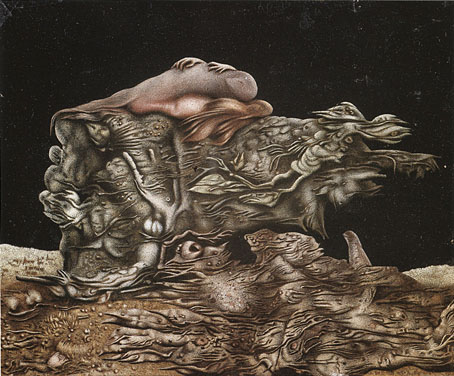
The Dangerous Desire (1936) by Richard Oelze (1900–1980) at But Does It Float.

• Making the Mari: the stuff of nightmares brought into the world by Jefferson Brassfield.

• The Background to the Moorcock Multiverse: Karin L. Kross reviews London Peculiar.

Orson Welles’s lost Heart of Darkness screenplay performed for the first time.

The Erotic Films of Peter de Rome: the new BFI DVD collection reviewed.

• Page designs by Alphonse Mucha for Ilsée, Princess de Tripoli (1897).

• A Slow-Books Manifesto by Maura Kelly.

Tim Parks asks “Do we need stories?”.

Musical table by Kyouei Design.

Horror Asparagus Stories (1966) by The Driving Stupid | Peacock Lady (1971) by Shelagh McDonald | Peacock Tail (2005) by Boards of Canada.
Philippe Druillet album covers

druillet1.jpg

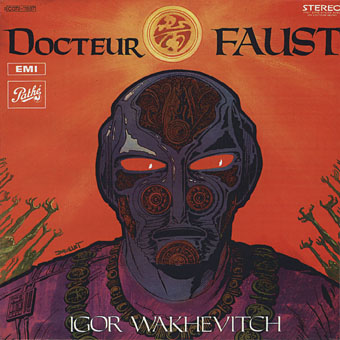
Docteur Faust (1971) by Igor Wakhévitch.

Philippe Druillet: album cover artist. As with John Martin, I’m surprised there aren’t more examples. Once again, Discogs.com proves incomplete so I’ve added a couple more including the first on this list, Docteur Faust. If you know of any others, please leave a comment.

Igor Wakhévitch’s berserk masterpiece is a cult item in this house, and something I’ve written about already. The cover art is the icing on an unclassifiable cake.

druillet10.jpg

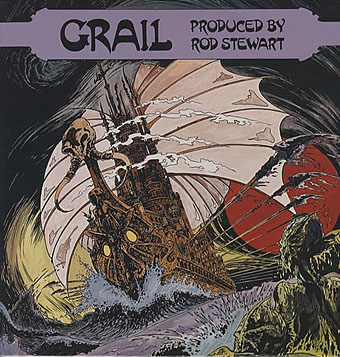
Grail (1970) by Grail.

The cover is the opening page of The Wild Wind Isles, one of Druillet’s Lone Sloane stories. Produced by Rod Stewart; did you notice? “We are sailing…”

druillet4.jpg

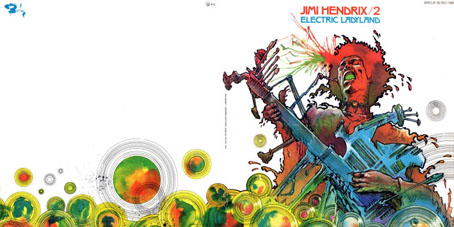
Electric Ladyland (1975) by The Jimi Hendrix Experience.

A gatefold sleeve for a series of four Hendrix reissues on the Barclay label. The other covers were provided by Moebius, Jean Solé and an artist unidentified on the link above but it looks to me like the work of Philippe Caza.

druillet3.jpg

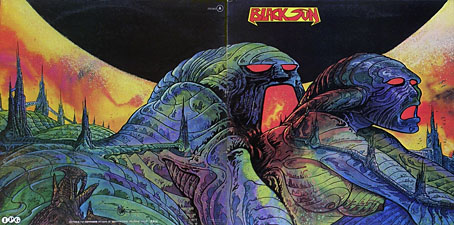
Black Sun (1978) by Black Sun.

Black suns are a regular feature of Druillet’s work (and mine, ahem) so the artist at least suits the title. The debut album of a short-lived French funk/soul group.

East/West (1980) by Richard Pinhas.

The French equivalent of Krautrock doesn’t have a name but Richard Pinhas is one of its leading practitioners. This is still my favourite among his solo works, not least because it’s more successfully musical than other albums which feature great slabs of guitar or synth doodling. In addition to a cover of David Bowie’s Sense Of Doubt there’s also science fiction author Norman Spinrad ranting through a vocoder on the opening and closing tracks. The great cover art is a page from Druillet’s 1980 adaptation of Flaubert’s Salammbô.

Continue reading “Philippe Druillet album covers”

Weekend links 97

conformist.jpg

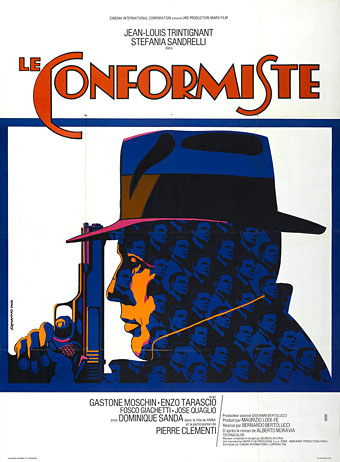
Illustration by Ermanno Iaia. Hard to believe that Bernardo Bertolucci’s The Conformist (1970) is only now appearing on DVD in the UK. Arrow Films release a dual-format edition at the end of this month.

• The week in perfume: Perfumes: The Guide by Luca Turin & Tania Sanchez is reviewed by Emily Gould (“this is a golden age of perfume criticism”) and prompts a meditation on the art and process of scent from Rishidev Chaudhuri.

Electrical Banana by Norman Hathaway & Dan Nadel is “the first definitive examination of the international language of psychedelia, focusing on the most important practitioners in their respective fields”.

Sacred Monsters is a forthcoming collection of essays and criticism by Edmund White. Related: Colm Tóibín from 1999 reviewing A History of Gay Literature: The Male Tradition by Gregory Woods.

Medium, a video by Clayton Welham and Sam Williams for Emptyset whose imminent release (also entitled Medium) I’ve designed. Related: Dave Maier on music versus noise.

• Couldn’t happen to a nicer guy: the face of US presidential contender Rick Santorum rendered as a collage of (mostly) gay porn. More provocation: All Dead Mormons Are Now Gay.

• Coilhouse discovered a rough copy of Bells of Atlantis (1952), an experimental film which features Anaïs Nin, input from Len Lye and an electronic score by Louis & Bebe Barron.

• “The idea that we should have but two options when it comes to our gender presentation, male or female, has always felt ludicrous to me,” says LaJohn Joseph.

Bely paints “a universe of strange manifestations” which drifts across Apollonovich’s consciousness every night before he falls asleep. We are even shown congeries of images that are shards of events which took place that day for the senator: “all the earlier inarticulacies, rustlings, crystallographic figures, the golden, chrysanthemum-like stars racing through the darkness on rays that resembled myriapods”

Malcom Forbes on Andrei Bely’s masterwork, Petersburg (1916).

RIP Barney Rosset, publisher of Grove Press books and the Evergreen Review.

The Brothers Quay will be at work in Leeds city centre this May. Lucky Leeds.

Warm Leatherette, a short film by Analogue Solutions.

Cormac McCarthy, Quantum Copy Editor.

The importance of being axonometric.

Always Crashing In The Same Car (1977) by David Bowie | Crash (1980) by Tuxedomoon | Crash Dance (1983) by Yello.

Weekend links 82

morris.jpg

At the Mountains of Madness (1979) from Halloween in Arkham by Harry O. Morris.

• Golden Age Comic Book Stories always pulls out the stops in the run up to Halloween. In addition to a wonderful collection of Harry O. Morris collages, Mr Door Tree has also been posting Virgil Finlay’s illustrations for Edgar Allan Poe, Lynd Ward’s tremendous illustrations for a collection of weird tales entitled The Haunted Omnibus, Barry Moser’s woodcuts for an edition of Frankenstein, and Virgil Finlay’s illustrations for stories and poems by HP Lovecraft.

• “Eugene Thacker suggests that we look to the genre of horror as offering a way of thinking about the unthinkable world. To confront this idea is to confront the limit of our ability to understand the world in which we live – a central motif of the horror genre. In the Dust of This Planet explores these relationships between philosophy and horror.”

• “…the reader […] becomes a conscious participant in the process of imposing a linear sequence, while at the same time remaining aware that all narrative is an act of memory, and that memory is necessarily random.” Jonathan Coe reviews Marc Saporta’s book-in-a-box, Composition No.1, recently republished by Visual Editions.

• Nearly fifty years after its first performance, Peter Weiss’s Marat/Sade is still disturbing playgoers. And nearly ninety years after its release, Alla Nazimova’s silent film production of Oscar Wilde’s Salomé is touring the UK with live musical accompaniment.

Tom of Sinland at Homotography, in which illustrator Bendix Bauer portrays some of the fashion world’s notable male designers as Tom of Finland-style characters for Horst magazine.

Neil Gaiman Presents is a new audiobook imprint which launches with works by Jonathan Carroll, Alina Simone, Keith Roberts, M. John Harrison and Steven Sherrill.

• The Weird Wild West: Paul Kirchner has put all his Dope Rider comic strips online.

Leonora Carrington prints at Viktor Wynd Fine Art, London, from November 5th.

The Fall to Earth: David Bowie, Cocaine and the Occult.

Photos of New York City, 1978–1985.

Kathy Acker recordings at Ubuweb.

The Occupied Times of London.

The Golden Age of Dirty Talk.

Pushkin silhouettes.

• This week I’ve been lost in the Velvet Goldmine (again): John, I’m Only Dancing (1972) by David Bowie | The Jean Genie (1972) by David Bowie | Drive-In Saturday (1973) by David Bowie.

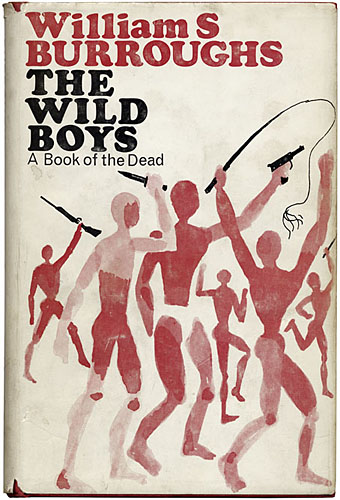
Looking for the Wild Boys

wildboys-calder.jpg

Calder & Boyars, 1972. Design by John Sewell.

This must be the first space novel, the first serious piece of science fiction—the others are entertainment.

Mary McCarthy defending The Naked Lunch in the New York Review of Books, June, 1963.

Mary McCarthy’s view—echoed a year later by Michael Moorcock and JG Ballard in the pages of New Worlds magazine—has never been popular or even particularly acceptable. William Burroughs gets touted as an sf writer by other writers, and John Clute gives him an entry in the Encyclopedia of Science Fiction, but Burroughs’ sf scenarios are guaranteed to offend those readers who prefer their narratives presented in a neat, linear form with detailed explanations of How The Future Would Actually Work, or the physics behind some piece of imaginary technology. The books which immediately follow The Naked LunchThe Soft Machine, The Ticket that Exploded, and Nova Express—all feature sf scenes or ideas. The latter was deemed sufficiently generic to prompt Panther Books in the UK to publish it three times as “Panther Science Fiction” although given the severe criticism that Moorcock sustained for trying to broaden the horizons of readers in the late 60s I don’t expect sales were encouraging.

The Wild Boys, published in 1971 (1972 in the UK), was Burroughs’ first novel after Nova Express, and his first book of fresh material after mining the stack of writing that birthed The Naked Lunch and the titles which followed. The novel is subtitled A Book of the Dead (as in the Egyptian or Tibetan Books of the Dead), and is certainly science fiction although I’ve never seen it marketed as such or noticed any sf reader include it in a list of notable genre novels of the period. My Calder & Boyers hardback offers a précis of the fractured narrative:

The year is 1988. The Wild Boys, adolescent guerilla armies of specialized humanoids, are destroying the armies of the civilized nations and ravaging the earth. The wild boys, who began in the pre-present past as petrol gangs, dousing their victims with petrol and setting them on fire for kicks, have grown to an army, dedicated to violence. One of them is used in a cigarette commercial. He becomes a new cult figure, a demi-god responsible for great destruction, and it is left to strong man Arachnid Ben Driss to exterminate the wild boys. He slaughters them, but the battle continues underground until all civilization collapses, revealing a future of horrifying dimensions. The originality of the theme and the very special Burroughs style together make this one of the most unusual science fiction novels ever, a prophetic exploration of the future, that should quickly establish itself as one of the classics of the present time.

That’s accurate, up to a point, although like many book blurbs it misrepresents the content somewhat. It also neglects to say how funny the book is. For anyone with a black sense of humour Burroughs has always been a great comic writer, and The Wild Boys has some prime examples, not least the opening chapter, Tío Mate Smiles, which is best appreciated in the author’s own reading.

Having gone through the novel in the past week, and going through its follow-up/appendix/remix Port of Saints at the moment, a couple of things occurred to me. The first was the way The Wild Boys strongly prefigures later works like Cities of the Red Night and The Place of Dead Roads. This is a fairly obvious point but it’s one that hadn’t fully clicked until now. The Wild Boys takes the problems of repressive control systems posed in the first few novels and offers a possible solution: a homoerotic utopia/dystopia where gangs of teenage boys hide out in depopulated regions, waging war against the rest of humanity with sex, magic and a mastery of weapons, including biological and viral varieties. While doing this they are steadily mutating so they can leave behind all human concerns with nation, family, laws and written language. Cities of the Red Night was Burroughs first novel after The Wild Boys and presents a less radical proposal, ranging through time with its anarchist pirate colonies and the six cities of the title. In The Place of Dead Roads Kim Carsons has his band of outlaw cowboys, The Wild Fruits, and the book gives us the conflict between the Johnsons—those who “mind their own business”—and the Shits: lawmen, politicians, tycoons, all the usual agents of Control.

Continue reading “Looking for the Wild Boys”