Weekend links 76

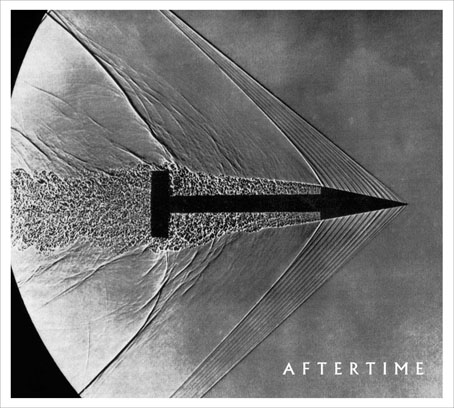
aftertime.jpg

Despite appearances I’m still doing bits of design and layout work for various musicians. In the past week I’ve been trying to reorganise this sprawling website a little so it’s easier to add new work quickly and easily. One recent job was more layout than design, a CD and vinyl package for a Roly Porter collection of instrumentals entitled Aftertime. Each track on the album is named after a different planet from Frank Herbert’s Dune books although the music isn’t as illustrative as that implies. Porter’s use of an Ondes Martenot and various acoustic instruments which he subjects to degrees of distortion is just the kind of thing I like hearing. One track can be heard at FACT where Porter is interviewed about his work. Aftertime is released this month on the Subtext label.

It is a rollicking saga that involves all sorts of things not normally associated with think tanks – chickens, pirate radio, retired colonels, Jean-Paul Sartre, Screaming Lord Sutch, and at its heart is a dramatic and brutal killing committed by one of the very men who helped bring about the resurgence of the free market in Britain.

Adam Curtis on the strange history of Britain’s think tanks and their hidden agendas.

• Other assorted music business: Getting down to the Cabinessence: “This is the first of what may become an intermittent series of observations about Smile, and how Brian Wilson tried to put his dream on this planet.” | After The Flood: Talk Talk’s Laughing Stock 20-Years On: a lengthy and detailed Quietus piece on one of the best albums of the 1990s. | Jonathan Barnbrook uses an old analogue video synth to create a visual accompaniment for Interplay by John Foxx & The Maths. The HD version is an eye-searing delight.

Meredith Yayanos favours the sister instrument of the Ondes Martenot, the theremin, which she uses to provide a spooky score for a new film, Empty Rooms. There’s more spectral ambience at her SoundCloud page.
giovani.jpg

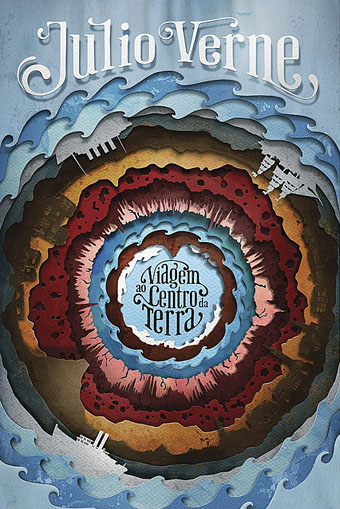
A Jules Verne cover by Carlo Giovani for Editora Ática.

• Sculptor and writer Josiah McElheny transforms the Whitechapel Gallery into a hall of mirrors.

Jacob’s Lament, an animated collaboration between illustrator Ian Miller and Stijn Windig.

Pornographic Poem (1967) by John Giorno.

Oscar Wilde grandson scorns “new” play.

• Manhattan in marble by Yutaka Sone.

Paul Atreides pt. 1 (1978) by Richard Pinhas | Harkonnen (1979) by Zed (Bernard Szajner) | Prophecy Theme (1984) by Brian Eno.
Weekend links 68

dorosheva.jpg

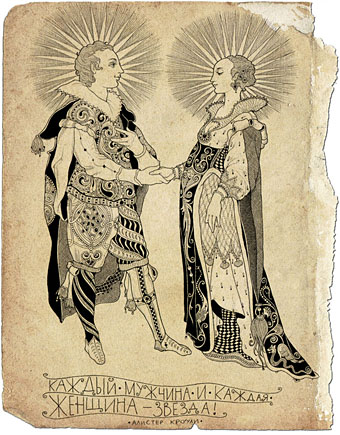
Every man and every woman is a star by Sveta Dorosheva.

• Matt Taylor (illustration) with Gregg Kulick and Paul Buckley (design) provide new Penguin covers for John Le Carré. I love the look which seems inspired by Daniel Kleinman’s title sequence for Casino Royale even if it doesn’t quite suit the shabby world of George Smiley and the Circus.

[Deborah Kass] told me that when she was going to art school in the ’70s, she tripped on LSD almost every week and she said she felt it was her “moral duty as an artist to take the trip.” […] I think psychedelic experience makes you think that there are multiple realities, that there isn’t just this one normal real world to which we’re supposed to conform, but that the reality changes depending on the state of consciousness that we’re in when we’re experiencing it. So, any different kind of art kind of posits a different reality. (more)

New York Times art critic Ken Johnson discussing his new book Are You Experienced?: How Psychedelic Consciousness Transformed Modern Art.

• “That got me thinking that evolution really isn’t survival of the fittest, when it comes to these things, it is more like survival of the interesting, survival of the beautiful, survival of the weird, cool stuff that managed to evolve.” Laurie Anderson and David Rothenberg discuss music and animals.

• Laura Cumming on the late Lucian Freud. And Stephen Heller on Alex Steinweiss, the originator in 1939 of the artistic record sleeve who also died last week.

• Alan Moore says “Think Locally: Fuck ‘Globally'”. He and Queen Calluz explain how Dodgem Logic magazine puts their ideas into practice.

Adam Curtis gets interviewed while Alan Bennett returns to Armley Public Library in Leeds.

Peacock’s Garden, a celebration of pavonine splendour.

• A visit to Seher Shah’s studio in Brooklyn, New York.

• Maximum androgyny at Epicenity, a Tumblr.

Does your god have a penis?

Chrysalide (1978) is an album of “cosmic” guitar instrumentals by Michel Moulinié which sounds at times like a French equivalent of Manuel Göttsching. It’s never been released on CD but a copy can be found here.

Weekend links 66

kunz.jpg

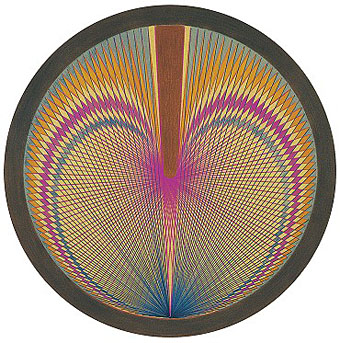
A design by Emma Kunz (1892–1963).

• Following the news this week it’s worth reminding people of a great post put together by Adam Curtis back in January, Rupert Murdoch—A portrait of Satan. One detail there concerns the death of chat show host Russell Harty in 1988. This week the London Review of Books posted an extract from Alan Bennett’s diaries referring to the Harty episode where he notes how the tabloid practice of getting private phone numbers from the police was common and widespread, not simply the actions of a single newspaper. For more about the deathbed hounding of Russell Harty (and Bennett’s loathing of Murdoch) see Writing Home. Related: Dennis Potter shortly before his death discussing his desire to kill Rupert Murdoch.

• Don’t get mad, get even: Hakim Bey’s Black Djinn Curse: “How to invoke a terrible curse on a malign institution.” See also: Black magic as revolutionary action.

Village Voice talks to Linda Manz about her experience as a young actor in Days of Heaven, The Wanderers and Out of the Blue.

Truth Wins Out infiltrates the “ex-gay” clinic run by Michelle Bachmann’s husband.

Free Situationist booklets by Larry Law. Related: films by Guy Debord at Ubuweb.

• Have tea with Doctor Dee in Mortlake, London, next Wednesday.

Publisher Peter Owen: Sixty years of innovation.

Wilhelm Reich: the man who invented free love.

A conversation with Brian Eno by Ben Sisario.

The mysterious minaret of Jam, Afghanistan.

Stereolab cover designs at Hardformat.

Orgone Accumulator (1973) by Hawkwind | Cloudbusting (1985) by Kate Bush | Orgasmatron (1986) by Motörhead | Orgasmatron (1993) by Sandoz | Orgone Donor (2004) by Deathprod.

Weekend links 46

finalprogramme.jpg

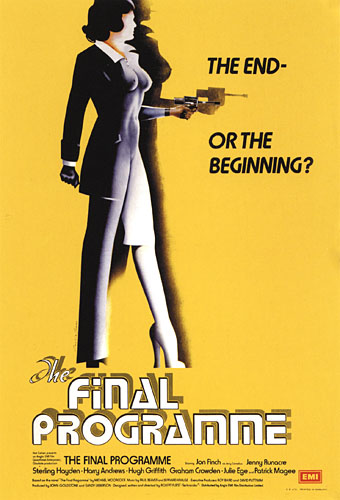
The Final Programme (1973). Philip Castle’s poster art implied the androgynous finale of Moorcock’s novel which the film itself evaded.

They were musty-smelling 10p messages from the futuristic past, complete with cover designs (and content) that were unlike anything I’d seen before. I’m fairly certain that this was how I first came across Michael Moorcock, in an early-70s Mayflower paperback, with a psychedelic cover by Bob Haberfield.

(…)

Moorcock steered New Worlds towards a set of concerns that chimed with the times; this was the period ruled by Marshal McLuhan and RD Laing, and the exploration of “inner space” seemed just as interesting as the “outer space” of satellites and moonshots. This turn was controversial, not just with die-hard pulp fans, but, surprisingly, with people such as the pop artist Richard Hamilton, another denizen of the London scene. “He thought we were turning science fiction into something namby-pamby, losing its roots,” Moorcock says. “He wanted explosions and spaceships and robots.”

When Hari Kunzru met Michael Moorcock, a major feature on a great writer and cultural catalyst. Kunzru posted the full transcript of their conversation here. Jovike’s Moorcock Flickr set has many of the lurid Mayflower covers.

• Moorcock is among the contributors to the forthcoming Thackery T. Lambshead Cabinet of Curiositities. io9 posted a list of contents (and one of my pics) while co-editor Jeff VanderMeer added some detail.

• So long to The White Stripes whose dissolution was announced earlier in the week. We know they’ll be back one day. Jay Babcock gave them their first major interview for the LA Weekly in 2000 which he’s reposted here.

Mister Blues (1962) by Lasry-Baschet aka Structures Sonores, a rare 7″ single showcasing the unique glass-and-metal sounds of the Cristal Baschet. Young Teddy Lasry on clarinet was playing in prog-jazz outfit Magma a few years later. Related: John Payne on Magma and The Mars Volta.

Here’s one thing that changed me: a close reading of Flannery O’Connor’s Mysteries and Manners. In it, she says that, “it is the business of fiction to embody mystery through manners,” manners being those concrete details — depictions of the real — in story. “Mystery through manners…” I had never heard a modern author seeking deep metaphysical mystery through realism before. Well, sure, Robert Musil, Bruno Schulz, Robert Walser, and a handful of other personal faves. By deep mystery I mean, mystery about our relationship with the planet, not anthropocentric mystery. I get sick of thinking about humans quickly, as we only constitute about 1% of what’s happening in our universe, if that much, and it was refreshing to me to hear O’Connor critiquing Henry James’ idea that modern people should aspire to know nothing of mystery, to be completely rooted in humanity. That notion makes me feel like hurling myself off a cliff. In her opinion, great literature seeks to embrace and express mystery through its mimicry of actual mannerisms. Mystery — fantasy — through the real. And with that, the borders between fantasy and realism were completely transgressed in my brain. Suddenly, I saw them as two good means to the same end. This made me excited to write real human situations again.

Trinie Dalton is interviewed here.

• And speaking of mystery through the real, there’s London Intrusion, a sequence of metropolitan adumbrations by China Miéville. Am I the only person to spot an intrusion of a different kind in the presence there of one of Eugène Atget’s Parisian views? There’s a doorway to Viriconium in that curious wedge of buildings but nobody can tell you where.

Rupert Murdoch—A Portrait of Satan. Adam Curtis on top form looking at the Dirty Digger’s career and a reminder of why some of us have always called one of his rags The Scum. A key point for me: Murdoch’s insecure railing against “elites”, a favourite term of aspersion on his Fox News network.

• Rick Poynor asks What Does JG Ballard Look Like? Related: “…only two people in Bucharest are going to read this.” Eduardo Paolozzi in conversation with JG Ballard and Frank Whitford, 1971.

How many days does Bill Murray’s character really spend reliving Groundhog Day?

• Silent Porn Star explores The Translucent Beauty of Androgyny.

Ballets Russes brought back to life on film, and also here.

Dewanatron Electronic Music Instruments.

RIP Tura Satana. Remember her this way.

Warm Leatherette (1978) by The Normal | Warm Leatherette (1982) by Grace Jones | Warm Leatherette (1998) by Chicks On Speed.

Weekend links 20

wulfing.jpg

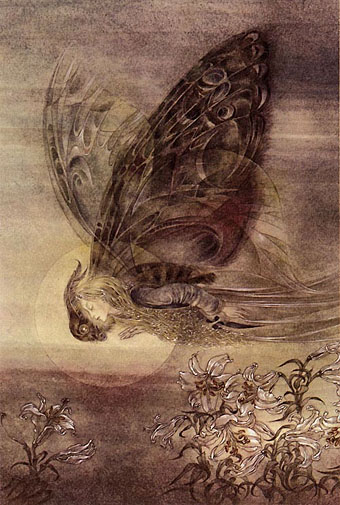
Transfiguration (1952) by Sulamith Wülfing.

• Observatory posted photos of its Lovecraft art exhibition; see if you can spot my pics. Related: Write Club has more photos. Also, A Word From Our Sponsor.

Taking the broooooaaaaad view of things: A Conversation with James Grauerholz on William S. Burroughs and Magick. Related: Beat Memories—The Photographs of Allen Ginsberg.

• Adam Curtis on BP and the Axis of Evil; how the the Anglo-Iranian Oil Company became British Petroleum and helped give Iran over to the Ayatollahs.

• The Quietus interviews Peter Christopherson (TG, Coil, etc) and Dr John.

The Strange World of Adolf Hoffmeister at A Journey Round My Skull.

An Artists’ Dialogue On CocoRosie’s Grey Oceans at Stereogum.

Werner Herzog and David Lynch combine their talents.

Jon Savage on The Residents versus The Beatles.

• BUTT magazine interviews James Bidgood.

• The Daily Drop Cap.

The Gay Rub.

Can on German TV in 1971.