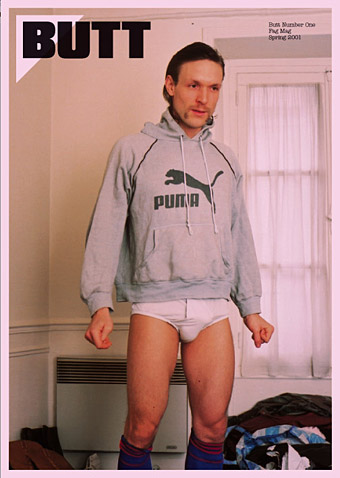
BUTT covered

butt00.jpg

What I discovered is that BUTT actually matters, and I’ll tell you why. BUTT fills a hole, as tautologous as that may sound. I’m tempted to say that BUTT fills the vacuum left by the sad and lamented loss of such historically important magazines as the original Andy Warhol’s Interview, After Dark and the first five years of index (under the editorship of Bob Nickas), but since none of those magazines were explicitly and overtly, capital G gay, I guess it’s more accurate to say that BUTT has single-handedly pioneered the notion of a smart, literate and fashionable, conversational gay magazine that isn’t interested in propping up some ideologically proper or even terribly consistent image of what it means to be a homosexual, and that also manages to be dirty. —Bruce LaBruce

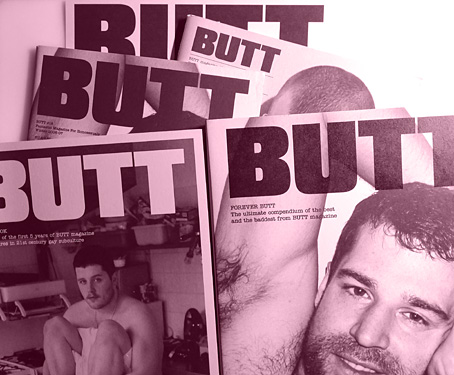
BUTT magazine—variously subtitled “Amazing (or Fantastic, or Hysterical) Magazine for Homosexuals”, “The Homosexualist Quarterly”, “International Fagazine”, etc, etc—ceased publication in 2012, but the best of its run is preserved in two book collections from Taschen: BUTT Book (2006), a paperback which seems now to be out of print, and Forever BUTT (2014), a hardback contained within leatherette boards. I was re-reading some of the interviews in the books recently, and feeling the loss of a gay magazine that was easily the best of its kind in the 2000s, a welcome alternative to contemporaries that were little more than glossy aspiration fodder, filled with fashion shoots and anodyne celebrity interviews.
butt01.jpg

Issue 1: Bernhard Willhelm by Wolfgang Tillmans.

BUTT wasn’t as thoroughly sex-obsessed as Boyd McDonald’s Straight to Hell but publishers/editors Gert Jonkers and Jop van Bennekom shared McDonald’s determination to reflect the lives of gay men as they were lived, with an equivalence given to complete unknowns (often the magazine’s own readers) as well as to successful writers, musicians and film directors. Interviews with the latter predominately concerned the subjects’ sex lives and interests, they were never promo pieces for current work. BUTT was the only magazine in the world where you might find interviewees such as Gore Vidal and Edmund White rubbing shoulders with a man like Dirty Danny (“the filthiest homosexual on earth”) or a gay refuse collector. I also loved the design which from the first issue used pink paper stock and only two typefaces for the entire run: Compacta for headlines, and different weights of American Typewriter for everything else. The minimal look established a distinct identity that inspired imitation among later titles such as Kaiserin (“A magazine for boys with problems”).
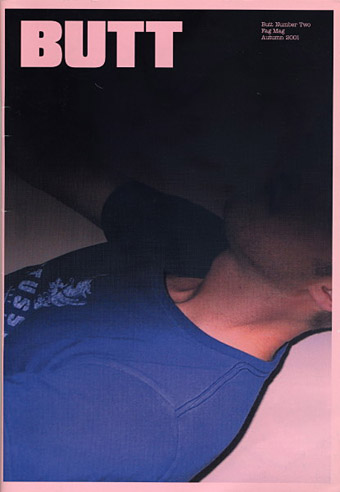
butt02.jpg

Issue 2: Lernert in Stüssy by Jop van Bennekom.

BUTT ran for 29 issues in all, stopping short of the 30-issue barrier which smaller magazines often struggle to pass. I’m always torn in cases like this, wishing there might have been more while also being aware that magazines can outlive their initial promise if they run for too long. BUTT certainly maintained its integrity, and we have the books, of course, which is more than many other titles manage. Back issues may be found for sale online but they’re increasingly expensive, a disappointment for would-be collectors but also a sign of the magazine’s cult value. I just wish I’d bought more of them as they appeared.
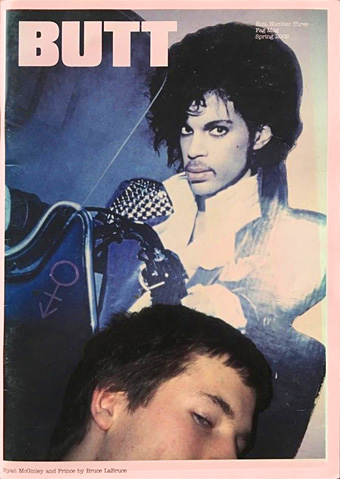
butt03.jpg

Issue 3: Ryan McGinley and Prince by Bruce LaBruce.
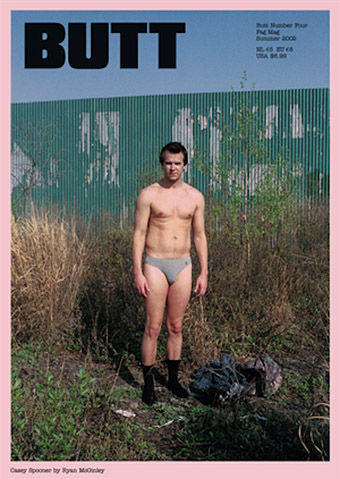
butt04.jpg

Issue 4: Casey Spooner by Ryan McGinley.
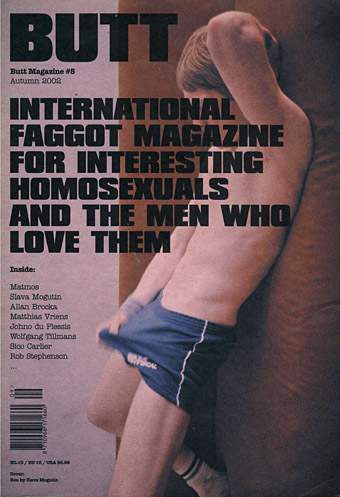
butt05.jpg

Issue 5: Ben by Slava Mogutin.

Continue reading “BUTT covered”

Weekend links 505

brown.jpg

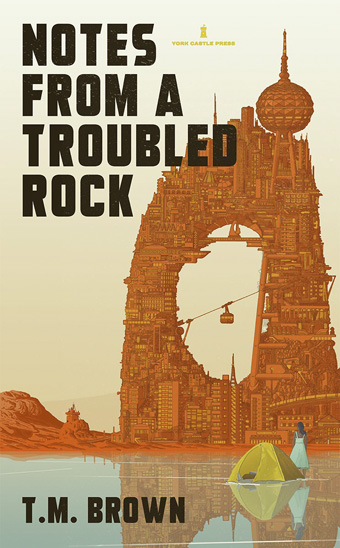
An imaginary book cover by Toby Melville-Brown.

• At the Internet Archive (for a change): Directory 1979, a collection of John Cooper Clarke’s poetry designed by Barney Bubbles; 25 issues of Wrapped in Plastic, the magazine devoted to all things David Lynch; and Cinefantastique, 1970–2002, the magazine about special effects in cinema whose making-of articles were often the first such analyses published anywhere. No contents list for the latter, unfortunately, but the covers shown here give an idea of the main features.

• “Physicist Andreas Schinner recounted a rumor that the Voynich manuscript can be ‘pure poison’ for a scholarly career, because when studying the manuscript there’s ‘always an easy option to make a ridiculous mistake.'” Jillian Foley on the strange quest to decipher the Voynich manuscript.

• At the BFI: Stephen Puddicombe examines six mysterious paintings on film, and Anna Bogutskaya selects ten examples of Lovecraftian cinema. Regarding the latter, I deplore the omission of Huan Vu’s Die Farbe (2011).

• In The Driver’s Seat: Neil Fox on the demented fun of Nicolas Winding Refn’s streaming site for cinematic obscurities, ByNWR.

• “Feed your head”: Akim Reinhardt on the progress of a White Rabbit from Charles Lutwidge Dodgson’s novel to Grace Slick’s song.

• Mixes of the week: Marshland: The Andrew Weatherall Mix, and Music’s Not For Everyone, hours of Weatherall mixes at NTS.

Borderland, an album of music by Fordell Research Unit based on The House on the Borderland by William Hope Hodgson.

• At Dangerous Minds: Thirteen-year-old Mariangela and her adventurous pop album, produced by Vangelis, 1975.

• Heavy Metal, Year One: Kory Grow on the inside story of Black Sabbath’s groundbreaking debut.

• “Theire Soe Admirable Herbe”: How the English Found Cannabis by Benjamin Breen.

Derek Jarman and friends in Dungeness: unseen pictures.

Closing periods at Flickr.

Heavy Rock (1976) by Sound Dimension | Heavy Denim (1994) by Stereolab | Heavy Soul (2002) by The Black Keys

Weekend links 502

wilson.jpg

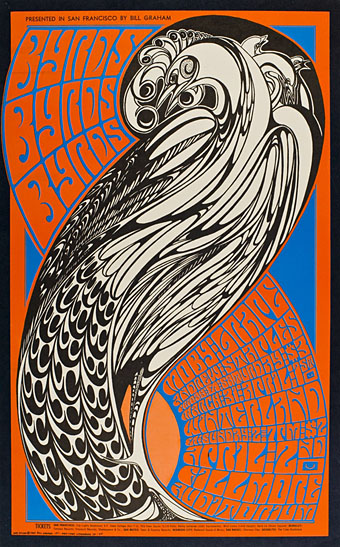
The Byrds (1967) by Wes Wilson.

• RIP Wes Wilson, one of the first of the San Francisco psychedelic poster artists of the 1960s, and also one of the more visible thanks to the popularity of his compressed type designs, some of which were derived from a style developed by Alfred Roller for the Vienna Secession circa 1900. When Playboy magazine wanted a cover that reflected the psychedelic art trend in late 1967 it was Wilson they called. Related: Wes Wilson’s posters at Wolfgang’s.

• “In the ’70s, New Age music offered listeners, trapped in the urban rat-race, audio capsules of pastoral peace to transform their homes into havens. Today the Internet and social media form a kind of post-geographic urban space, an immaterial city of information whose hustle ‘n bustle is even more wearing and deleterious to our equilibrium.” 2010–19: Back To The Garden: The Return Of Ambient And New Age by Simon Reynolds.

• “This pointed-finger symbol goes by many names: mutton fist, printer’s fist, bishop’s fist, pointer, hand director, indicule, or most unimaginatively as ‘a hand’. Scholarly consensus has pretty much settled on the word ‘manicule’, from the Latin maniculum, meaning ‘little hand’.” John Boardley on the typographic history of the pointing hand.

Tales Of Purple Sally (1973) by Alex. All instruments by Alex Wiska apart from bass by Holger Czukay, and drums by Jaki Liebzeit. The latter pair also produced the album. Related: Jah Wobble talking to Duncan Seaman about working with Czukay and Liebeziet.

• “On Jan 25, 2020, tired of negative film lists on Twitter, I asked people for ‘obscure [or] underseen films you adore and think more people should know about.’ This was the result.”

Flash Of The Spirit by Jon Hassell & Farafina “hails from a time when the possibilities of music seemed less well-defined, and borders felt more open,” says Geeta Dayal.

The Art Of Computer Designing: A Black and White Approach (1993) by Osamu Sato. There’s more of Sato’s print work at the Internet Archive.

• At the Morgan Library: Jean-Jacques Lequeu: Visionary Architect. Drawings from the Bibliothèque nationale de France.

• New from Strange Attractor: Inferno: The Trash Project: Volume One by Ken Hollings.

• At Dennis Cooper’s: Storm de Hirsch Day.

Celeste by Roger Eno & Brian Eno.

Ben Watt‘s favourite music.

The Inferno (1968) by The Inferno | Inferno (1990) by Jah Wobble’s Invaders Of The Heart | Inferno (1993) by Miranda Sex Garden

Weekend links 494

church.jpg

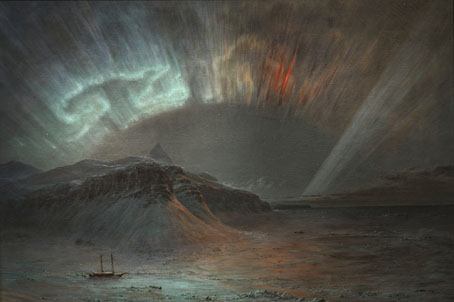
Aurora Borealis (1865) by Frederic Edwin Church.

• December is over-stuffed with enervating cultural lists, most of them reminding you of things which received enough attention earlier in the year. Better value than these—and always unpredictable—is John Waters‘ choice of favourite films; unpredictable and enlightening are the Secret Satan selections at Strange Flowers which come in two flavours: books originally published in English and books translated from other languages.

Flash Of The Spirit (1988), a collaboration between Jon Hassell and African group Farafina (with production by Hassell plus Brian Eno & Daniel Lanois), receives its first ever reissue on double-vinyl and CD next year. The last piece on the album is the 11-minute Masque (Strength).

• “In 1968, Federico Fellini decided he was going make the greatest homosexual movie ever made. What he meant by a homosexual movie, no one was quite sure, but it was going to be great.” Paul Gallagher on Federico Fellini’s delirious (and distinctly homosexual) Satyricon.

• “Here’s the typography of the next decade; the age of font minimalism is coming to a close,” says Rachel Hawley. I’ve been using Didones for the past decade so I’ll carry on happily ignoring the trends.

• More obituaries for comic artist Howard Cruse: Justin Hall at The Comics Journal; Trudy Ring at The Advocate; and Richard Sandomir at the New York Times.

• “Cowley records a kind of utopian sleaze that’s breathtaking.” Brett Josef Grubisic reviews Patrick Cowley’s sex journal of the 1970s, Mechanical Fantasy Box.

• At the BFI: Carmen Gray on where to begin with Sergei Parajanov, and Matthew Thrift on 10 essential Fritz Lang films.

A promo video by Julian House for Paul Weller’s In Another Room EP which is released in January by Ghost Box.

• At Aquarium Drunkard: San Francisco Radical Laboratory and the Mysterious Moogist of Altamont.

• Mix of the week: Through A Landscape Of Mirrors Vol. V – France III by David Colohan.

Aurora Australis (2005) by Émilie Simon | Iceblink (Aurora Borealis Mix) (2011) by Netherworld | Aurora Liminalis (2013) by William Basinski & Richard Chartier

Hawkwind: Days of the Underground

hawkwind.jpg

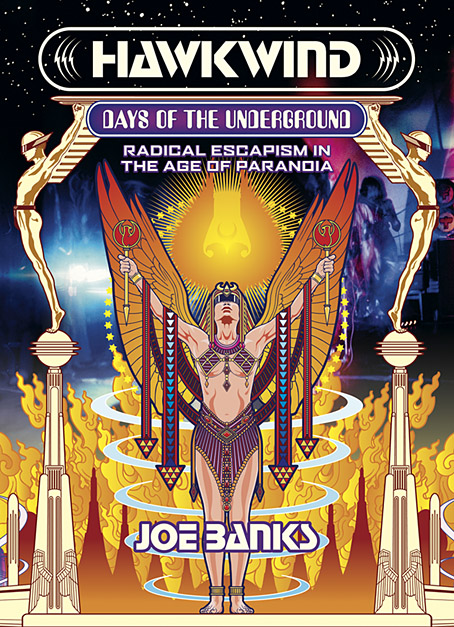
As mentioned at the weekend, Joe Banks’ account of the first ten years of Hawkwind will be published by Strange Attractor Press later this year with a wraparound cover of my design. I never expected to be doing anything else for Hawkwind after moving on to other things in 1985, but it was the group’s first decade of music that fuelled the drawings which brought me to their attention, so this cover design brings everything full circle. The earliest of my Hawkwind drawings dates to 1979 which means this cover is also an anniversary piece.

The design combines Barney Bubbles’ Space Ritual template with elements of the art he created before and afterwards, notably the inner and outer sleeve of Doremi Fasol Latido, and the futuristic Art Deco of his tour poster for The “1999” Party. All the Bubbles Hawk-art up to and including Space Ritual is a blend of the ancient (Egypt, tribal motifs, characters that resemble pirates or barbarians), the previous century (Art Nouveau in particular), and the far future as depicted in comics and pulp magazines. I wanted to reflect this blend without being too imitative of the details, so the cover works a variation on Space Ritual, with a similar hieratic woman as the focus, and a margin of stylised flames separating the foreground from Laurie Lewis’s photos of the band (the latter are unused shots from the same session used for Space Ritual).

haberfield.jpg

Art by Bob Haberfield, 1970.

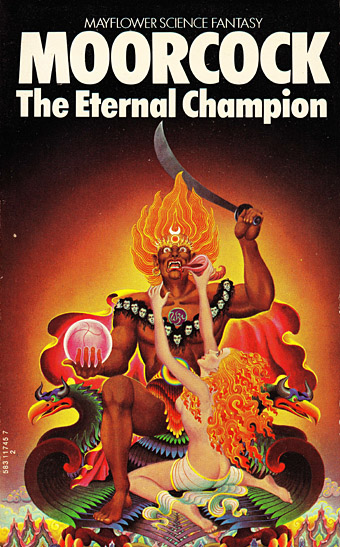
All the background elements run across the wrap but this hasn’t been revealed yet so you’ll have to wait a while to see the full design. The flames are based on Tibetan designs in a nod to the ancient side of the equation, as well as Bob Haberfield’s covers for the Moorcock novels published by Mayflower in the early 70s, many of which featured art derived from Tibetan Buddhism. (And one of the Mayflower Moorcocks, The Black Corridor, is the origin of the monologue of the same name on Space Ritual.) The full wrap shows a futuristic city whose Frank R. Paul-derived architecture is either on fire or menaced by a wall of encroaching flames. Many of Hawkwind’s songs of the period concern flight from cities or from the Earth itself—Born To Go, Time We Left (This World Today)—so the back cover also has a number of vehicles fleeing the scene: the radical escapism of the book’s subtitle in literal form. “Sign my release from this planet’s erosion,” as Nik Turner sings in Brainstorm.

Continue reading “Hawkwind: Days of the Underground”