Philippe Caza covers

caza12.jpg

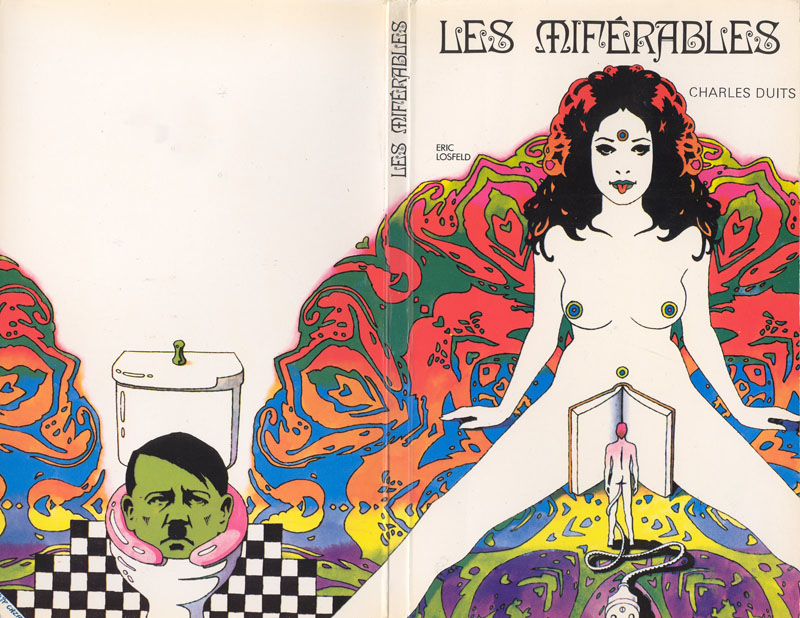
As usual, one thing leads to another. Research for yesterday’s post turned up a Caza book cover I’d not seen before. Les Miférables was published by Éric Losfeld in 1971, a year after producing Caza’s eyeball-searing psychedelic comic book Kris Kool. The author sounds like a character, a friend of André Breton who wrote a handful of novels inspired by his peyote experiences. As should be evident from the cover, Duits’ novel for Losfeld is more concerned with sex, described by this page (which is also the source of the cover art) as being “a kind of mixture of Eastern spirituality and unrestrained pornography”.

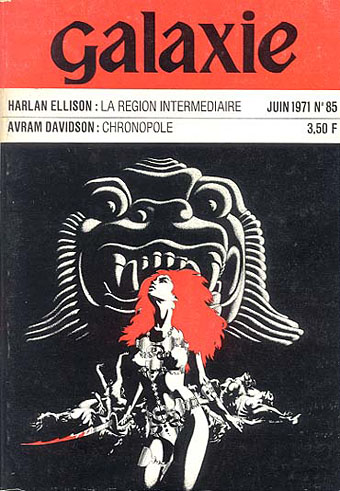
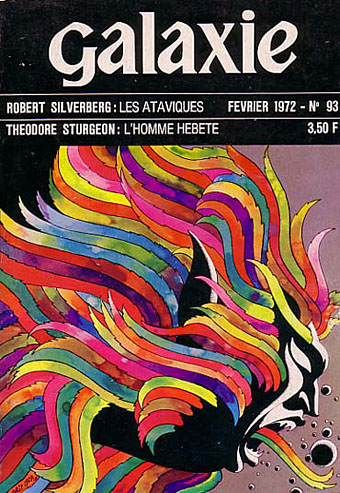
Caza’s art is often concerned with sex even if the subjects are the inhabitants of other planets. Many of the French comic artists of the 1970s produced covers for books and magazines but Caza alone seems to have been very popular as an artist for SF paperbacks. Noosfere has many examples from which I’ve chosen a small selection. (I’ve also had to hunt around for larger copies.) I wouldn’t mind seeing a collection of this artwork without the unsympathetic typography that spoils so many French novels.

caza05.jpg

caza07.jpg

Continue reading “Philippe Caza covers”

Saga de Xam by Nicolas Devil

saga01.jpg

Saga de Xam, a large-format comic book published by Éric Losfeld in 1967, is another example of French erotic psychedelia that remained off my radar until I got my hands on the exhibition catalogue for the Musée d’Orsay’s Art Nouveau Revival show in 2010. The glorious drawing below was used as the background for the exhibition poster, and appeared inside the catalogue with two more pages from this rare and sought-after book, described in the catalogue as “the best and most precocious example of French BD directly inspired by American psychedelia”.

saga02.jpg

Éric Losfeld is a fascinating character, a kind of pop-culture equivalent of Maurice Girodias, the founder of Olympia Press. Both men published erotic novels, and both had problems with the authorities as a result; but Losfeld also found a niche in art and graphics, producing albums of erotic comic strips—Jean-Claude Forest’s Barbarella, Guy Peellaert’s Jodelle and Pravda, Guido Crepax’s Valentina, Philippe Caza’s Kris Kool—and lavish portfolios from the weirder end of the erotic art spectrum, showcasing work by Raymond Bertrand, Jean-Marie Poumeyrol and others. It’s common for Brits to consider France a more enlightened nation where sex and comic-art is concerned but in the 1960s comics in France were considered an unsuitable medium for sexual material. Many of Losfeld’s comic-books of the late 60s and early 70s endured the kind of censure that was occurring in Britain and elsewhere. An early non-erotic title was Lone Sloane: Mystère des Abîmes in 1966, the first Lone Sloane story by Philippe Druillet. This no doubt explains Druillet’s involvement with Saga de Xam a year later.

saga16.jpg

Saga de Xam: les créateurs.

The comics by Forest, Peellaert and Crepax all featured attractive (often naked) woman as their lead characters. Saga de Xam continued the trend, a story in seven chapters that reads like an amalgam of all the comics Losfeld had published up to that point, Druillet included. The book is credited to Nicolas Devil, and based on a scenario by film director Jean Rollin. (Druillet would later design some posters for Rollin’s vampire films.) Devil, aka Nicolas Deville, was one of Rollin’s art directors who also worked for a time as a comic artist and illustrator. For Saga de Xam Devil was the principal artist in the first six chapters, and wrote most of the text and dialogue. In the final chapter other hands are involved: Jim Tiroff, an actor from Julian Beck’s Living Theatre, provided a poem in English, while the artwork is an unusual exercise in the Surrealist “Exquisite Corpse” technique with Devil, Druillet and several other artists—Barbara Girard, Merri, Nicolas Kapnist—collaborating on a series of improvised splash pages. The final chapter also features arrangements of text that resemble layouts from avant-garde art magazines. Druillet’s contributions are easy to identify since they resemble invasions from his Lone Sloane series, even including references to the Necronomicon.

Continue reading “Saga de Xam by Nicolas Devil”

The Captive, a film by René Laloux

captive.jpg

The feature films of French animator René Laloux are the closest thing to cinematic equivalents of comics magazine Métal Hurlant. Laloux’s collaboration with Roland Topor, Fantastic Planet (1973), is familiar to Anglophone audiences but fewer people are aware of Time Masters (1982) and Gandahar (1988), two more science fiction films made with Moebius and Philippe Caza respectively. Time Masters looks marvellous but the story (based on a novel by Stefan Wul) lacks the strangeness of Fantastic Planet. Gandahar,  based on a novel by Jean-Pierre Andrevon, I’ve yet to see but anyone searching for it should be aware that the version dubbed into English (and retitled The Light Years) dumped Gabriel Yared’s score, and had a sexual encounter censored by the usual rabble of prudish American producers.

The Captive (1988) continues the collaboration with Philippe Caza being a 7-minute adaptation of Caza’s comic story Equinoxe (1982). The music for this one is also by Gabriel Yared, and this copy at YouTube includes English subtitles. For comparison, the comic story is here. Of the two I prefer the comic but then I’ve always enjoyed Caza’s work.

Previously on { feuilleton }
Les Temps Morts by René Laloux

Atmospherics

jamoul1.jpg

Listening to Joy Division over the weekend prompted another of those idle speculations that are immediately answered these days (so to speak…) by a few seconds of web searching. While Atmosphere was playing I’d remembered a conversation with a friend about the identity of the painting of a cowled figure that appears on the original Atmosphere/Dead Souls single for the Sordide Sentimental label. Neither of us had a copy of the Holy Grail of JD collectors, nor did we know anybody who owned one, so the discussion wasn’t very fruitful.

jd.jpg

Licht Und Blindheit (1980) by Joy Division.

Sordide Sentimental were (and still are) a French company run by Jean-Pierre Turmel and Yves von Bontee whose speciality was limited releases of exclusive material often by bands with a cult following. The typical Sordide Sentimental release would be a 7-inch single in a numbered edition, packaged in an A4-sized sleeve with inserts and an idiosyncratic essay by Monsieur Turmel. Licht Und Blindheit, as the Atmosphere single was called, sold out immediately, and since 1980 has been one of the most collectible (and costly) releases of the era: the cheapest of two copies currently for sale at Discogs is over £1,500. (Many bootleg copies also exist: beware.)

As to the Licht Und Blindheit packaging, the cover collage was by Jean-Pierre Turmel while the enigmatic painting on the back turns out to be an untitled work by Jean-François Jamoul (1925–2002), not Caspar David Friedrich as my friend suspected, although it is very Friedrich-like. Jamoul was evidently a friend of Turmel who used more of his paintings on other Sordide Sentimental releases. During the 1970s Jamoul had been a regular contributor to French SF magazines, both as cover artist and essayist. In 2006 Sordide Sentimental released Temps Incertains, a DVD/book devoted to Jamoul’s art and writings.

jamoul2.jpg

Rite de Passage (1968) by Alexei Panshin.

It’s interesting looking at some of Jamoul’s other art in light of all this: one painting on the cover of Galaxie magazine looks distinctly Lovecraftian while another piece was used by a publication named Nyarlathotep. Back in 2008 journalist Jon Savage was corresponding with my colleagues at Savoy Books prior to writing a piece for the Guardian about Ian Curtis’s reading material. (The Savoy bookshops in Manchester during the 1970s and 80s were notable for their comprehensive stock of Burroughs, Ballard and other essential material.) One of the questions was whether Curtis had read (or bought) any HP Lovecraft, something that neither Dave nor Mike could answer. These French magazines at least show one very tenuous connection (which Curtis wouldn’t have known about, of course) via Jamoul’s paintings. Savage’s Guardian piece has since been expanded into an introduction for the recent Faber book of Ian Curtis lyrics; HP Lovecraft receives a passing mention there during discussion of Licht Und Blindheit‘s B-side, Dead Souls.

jamoul4.jpg

Continue reading “Atmospherics”

Weekend links 235

shadows.jpg

Shadows (1974) by Pawel Nolbert & Lukasz Murgrabia, one of three images recreating Francis Bacon’s Triptych–August 1972.

Breaking the Code (1996), a BBC film by Herbert Wise based on Hugh Whitemore’s stage play about Alan Turing. Wise’s film has been linked here before but it’s relevant again thanks to the release of The Imitation Game. Derek Jacobi played Turing on stage and screen, and Whitemore’s script managed to deal with Turing’s life and work without insulting the man or the intelligence of its audience.

• “…if you listen to A Beacon From Mars by Kaleidoscope or if you listen to some Turkish taxim then something starts happening.” Robert Plant talking to Julian Marszalek about the music that excites him.

• “CGI has become wearingly dull and clichéd. Can its deep weirdness be recovered and filmgoers’ minds stretched again?” asks Jonathan Romney.

The cult of the Thirty-Seven Nats is unique to Burma. […] The junta’s attempts to subdue nat worship had an unintended effect: the role of the nat wife was embraced by an already marginalized group. Homosexuality is illegal in Burma and has been since its British colonizers instituted a late-nineteenth-century ban on “intercourse against the order of nature”. Government restrictions opened a professional vacuum, says scholar Tamara C. Ho. Becoming a nat kadaw offered the achauk—a Burmese term for gay and transgender men—both “a vocation and queer visibility”.

After the Green Death by Will Boast

• “Cat memes and other frivolities aren’t the work of an Internet culture. They’re the work of an American one, ” says Caitlin Dewey.

• Hear the cavernous reverb of Berlin’s Kraftwerk captured by Emptyset’s James Ginzburg and Yair Elazar Glotman.

• Take part in the first #psychedelicpride photoshoot in central London on Saturday, December 13th.

• Mix of the week: FACT Mix 470 by Jonny Trunk who also appears in the list of vinyl hoarders below.

• Queer Noise: Abigail Ward on the history of LGB music and club culture in Manchester.

More photos of the steampunk exhibition at 751 D-Park, Beijing, China.

A chronological list of synth scores & soundtracks.

• Animated photography by Julien Douvier.

• A Third Ear Band archive at SoundCloud.

The secret lives of vinyl hoarders.

Taxim (1968) by Kaleidoscope | Water (1970) by Third Ear Band | Love Is The Devil (1998) by Ryuichi Sakamoto