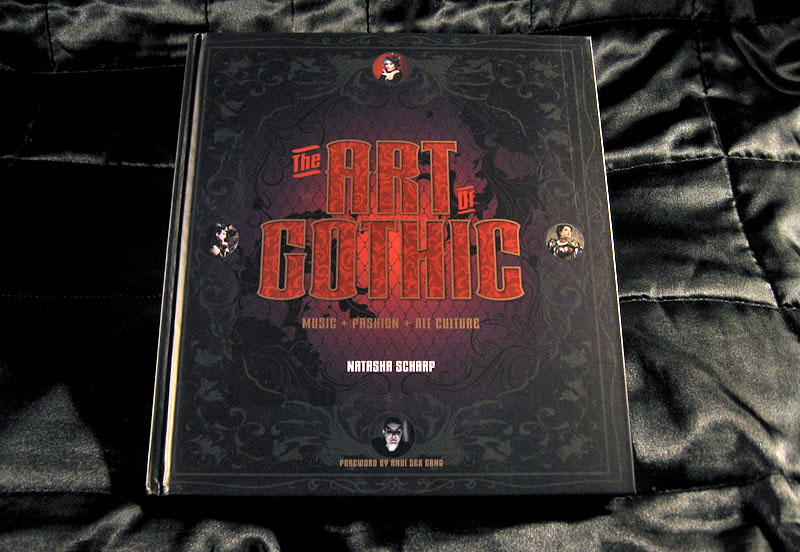

The Art of Gothic by Natasha Scharf

goth01.jpg

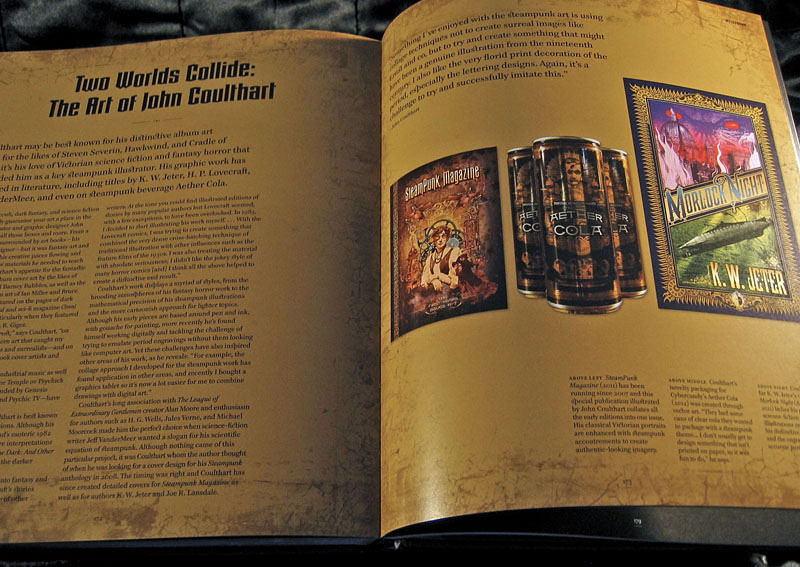
This weekend I was at the Louder Than Words music conference in Manchester to meet Peter Bebergal, author of Season of the Witch: How the Occult Saved Rock and Roll, and Mark Pilkington of Strange Attractor. By coincidence the event was hosting a discussion about goth music and culture based around The Art of Gothic, a new art book by Natasha Scharf. As mentioned last month, this book features some of my work but I hadn’t seen a copy until now.

goth02.jpg

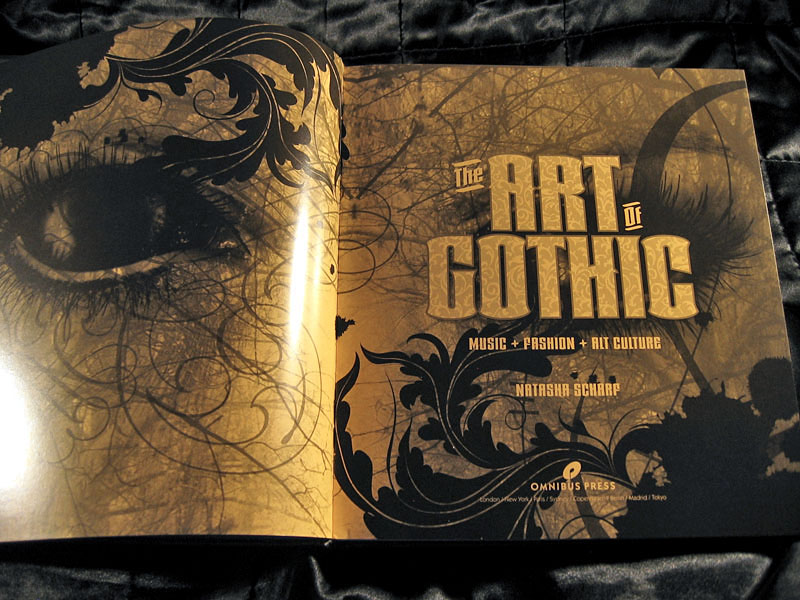
I’ve been fortunate recently to have my work appear in some impressive volumes but this outsize hardback takes some beating. It’s a very lavish production, 224 colour pages on heavy paper with gorgeous design by Paul Palmer-Edwards. Goth has been subject from the outset to mocking stereotypes, to a degree that many people would imagine they know exactly what a study such as this would contain. A recurrent theme of the Louder Than Words discussion was the growth of the goth subculture beyond its clichéd boundaries which is one reason my work is featured in the book. When Natasha was first in touch I thought it might be for the Cradle of Filth album covers but I’m in the chapter that examines the increasingly tangled goth/steampunk crossover. This is one development that’s come to seem almost inevitable given the roots of so much of the goth aesthetic in Victorian nightmares. Many steampunk novels tend towards the dark in their blend of science fiction and horror so the traffic goes in both directions.

goth03.jpg

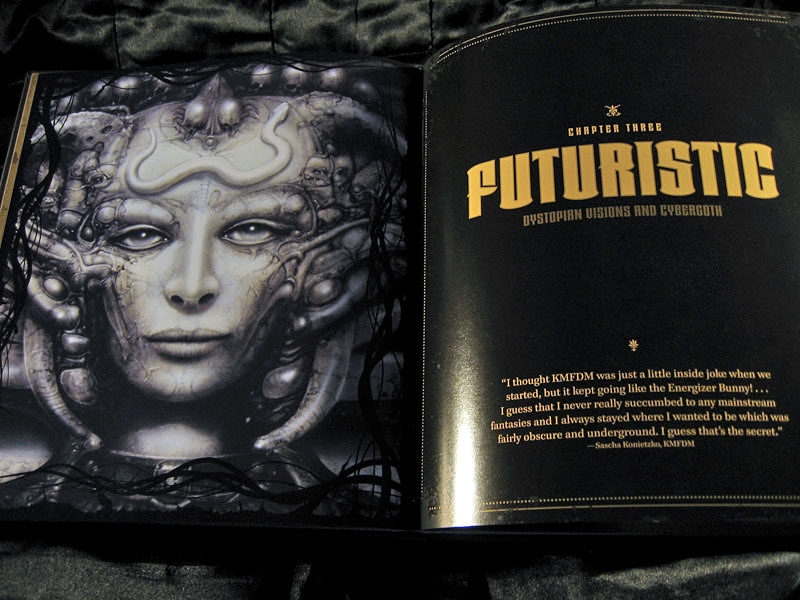
Elsewhere in the book there are chapters on Futuristic Goth, Japanese Goth, and Cybergoth, all of which maintain the requisite darkness while evolving away from the top hats, lace and veils (the latter are all present and correct elsewhere, of course). It’s a beautiful book, out now in the UK from Omnibus Press, and in the US from Backbeat Books. A few more page samples follow. There’s more at Amazon UK.

• See also: 13 Things That Prove Gothic Art Is Enchanting And Beautiful

goth04.jpg

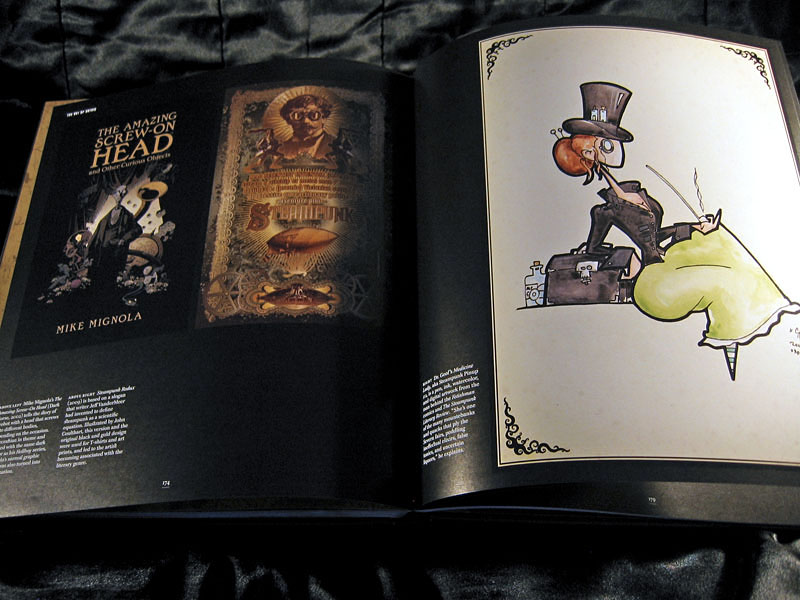
left: The Amazing Screw-On Head by Mike Mignola (2002); centre: the full-colour version of the ever-popular Steampunk Equation (2009), words by Jeff VanderMeer, graphics by John Coulthart; right: Dr Geof’s Medicine Lady, aka Steampunk Pinup #2.

goth05.jpg

The mighty Giger again. I’ve got a framed print of that picture on the wall, a fact that will surprise nobody.

Continue reading “The Art of Gothic by Natasha Scharf”

Steampunk in the Tank

tank00.jpg

Plague doctor mask by Tom Banwell.

Last month I wrote a little about the Steampunk: Art of Victorian Futurism exhibition that’s been running since the beginning of October in Beijing, this being the same event that was staged in Seoul earlier in the year. Five of my book cover designs have been featured in these shows, together with some very impressive artworks, designs and constructions by international artists. This week the organisers of the show, Artcenter IDA, sent their own photos of the event.

tank01.jpg

Locomotive Square.

As mentioned before, the venue is an exhibition space in 751 D-Park outside central Beijing, an area I’ve been told was formerly an industrial complex manufacturing armaments during the Cold War. If we occasionally find that life these days imitates the fictions of JG Ballard or Philip K Dick, 751 D-Park strikes me as a very William Gibson kind of place: Cold War industrial complex transmuted into an international art space—Beijing Design Week is hosted here each year—that on this occasion is showcasing antique science fiction. The 751 website has a map of the area with links to photos and other information. I’m rather taken with “Crached Furnace Square” and “Locomotive Square“.

tank02.jpg

Continue reading “Steampunk in the Tank”

Weekend links 231

advisory.jpg

Design by Julian House.

Always good to hear of a new release on the Ghost Box label, and a new album by The Advisory Circle (due on 5th December) is especially welcome. From Out Here is described thus: “Exploring darker territory than 2012’s more pastoral As The Crow Flies, The Advisory Circle hint at a Wyndham-esque science fiction story, where bucolic English scenery is being manipulated and maybe even artificially generated by bizarre multi-dimensional computer technology.” The Belbury Parish Magazine has extracts.

• Jon Hassell’s Fourth World Music Vol. I: Possible Musics receives a long-overdue reissue next month. Possible Musics was a collaboration with Brian Eno, and Eno has some of his own albums reissued again in expanded editions. Most notable is the first official release of My Squelchy Life, an album that was withdrawn in 1991 to be replaced by Nerve Net.

• Some Halloween theatre on Friday (the 31st) at the Museum of Bath at Work with a dramatisation of Ringing the Changes by Robert Aickman. There’s a repeat performance the following week (8th November) with added spectral atmospherics from the Electric Pentangle. Free admission.

The value of these books wasn’t anything wholesome they contained, or any moral instruction they offered. Rather, it was the process of finding them, the thrill of reading them, the way the books themselves, like the men they depicted, detached you from the familiar moral landscape. They gave a name to the palpable, physical loneliness of sexual solitude, but they also greatly increased your intellectual and emotional solitude. Until very recently, the canon of literature for a gay kid was discovered entirely alone, by threads of connection that linked authors from intertwined demimondes. It was smuggling, but also scavenging. There was no internet, no “customers who bought this item also bought,” no helpful librarians steeped in the discourse of tolerance and diversity, and certainly no one in the adult world who could be trusted to give advice and advance the project of limning this still mostly forbidden body of work.

Smuggler: A Memoir of Gay Male Literature by Philip Kennicott

• Getting in before the Mixcloud Halloween rush, mix of the week is Samhain Seance 3: Better Dead Than Never by The Ephemeral Man. My Halloween mix for this year is almost finished; watch the skies.

• For those who can’t wait until December for From Out Here, there’s a new Howlround album, Torridon Gate, out this week from A Year In The Country.

• Last week, Yello’s Boris Blank was choosing favourite electronic albums, this week he runs through a list of thirteen favourite albums.

Altered Balance: A Tribute to Coil by Jeremy Reed & Karolina Urbaniak. Richard Fontenoy reviewed the book for The Quietus.

Cut-Ups: William S. Burroughs 1914–2014, an exhibition of Burroughs’ typescripts at Boo-Hooray, NYC, from 7th November.

Brando, a film by Gisèle Vienne for the song by Scott Walker & Sunn O))).

NASA has a Soundcloud page

The art of leaves

Cobra Moon (1979) by Jon Hassell | Moon On Ice (1987) by Yello feat. Billy MacKenzie | Moon’s Milk Or Under An Unquiet Skull Pt. I (1998) by Coil

Etidorhpa by John Uri Lloyd

etidorhpa01.jpg

I wouldn’t usually post so many illustrations but these depictions by J. Augustus Knapp for Etidorhpa by John Uri Lloyd add a great deal to the attractions of this early work of science fiction. Lloyd’s book is subtitled The End of Earth; The Strange History of a Mysterious Being; The account of a remarkable journey as communicated in manuscript to Llewellyn Drury who promised to print the same, but finally evaded the responsibility. The novel was published in 1895, and shares features with similar works that concern travellers exploring the interior of the Earth. What sets it apart is a degree of imagination that generated enough interest for it to be reprinted many times.

etidorhpa02.jpg

Science fiction and fantasy evolved so rapidly in the early 20th century that the products of previous centuries often seem uninventive in comparison. Whatever hidden cities, lost continents or subterranean kingdoms are promised, too many of them reveal a race of pompous individuals, usually clad in Greek, Roman or Egyptian attire with little variety to their civilisations unless their world is also populated by the odd monster or two. The manuscript in Lloyd’s novel relates a journey to the Earth’s interior by a bearded, white-haired character variously named I-Am-The-Man and The-Man-Who-Did-It who reads his adventures in a series of visits to the irresponsible Llewellyn Drury. I-Am-The-Man is kidnapped by a secret society who take him to a cave in Kentucky where he’s eventually delivered into the care of a mysterious, unnamed guide from the subterranean world:

The speaker stood in a stooping position, with his face towards the earth as if to shelter it from the sunshine. He was less than five feet in height. His arms and legs were bare, and his skin, the color of light blue putty, glistened in the sunlight like the slimy hide of a water dog. He raised his head, and I shuddered in affright as I beheld that his face was not that of a human. His forehead extended in an unbroken plane from crown to cheek bone, and the chubby tip of an abortive nose without nostrils formed a short projection near the center of the level ridge which represented a countenance. There was no semblance of an eye, for there were no sockets. Yet his voice was singularly perfect. His face, if face it could be called, was wet, and water dripped from all parts of his slippery person.

The illustrations by J. Augustus Knapp show the guide as naked but conveniently sexless. The pair descend into the Earth’s interior where they encounter a succession of wonders, from giant fungi (possibly derived from A Journey to the Centre of the Earth) and a sea of “crystal liquid” which the pair traverse in a metal boat, to a variety of strange fauna and flora. Knapp’s illustrations make the journey seem much more interesting than it is on the page where Lloyd spends far too much time lecturing the reader—there’s a chapter about the evils of drunkenness—or having I-Am-The-Man relate his continual bewilderment. “Etidorhpa”, it turns out, is “Aphrodite” reversed, and Etidorhpa herself appears as the embodiment of love at the culmination of what has become a spiritual journey rather like a weak precursor of David Lindsay’s extraordinary A Voyage to Arcturus (1920). Lindsay had the good sense to write a continuous narrative whereas Lloyd frequently interrupts his story with scientific speculations that seek to qualify some of the less outlandish features of his interior world. There’s also a curious note from the author on page 276 about the various properties of intoxicating drugs, and the possibility that they might be combined by a chemist to create strange visions for a writer. Lloyd was a chemist as well as a writer so the speculation that he might have experimented on himself—and thus produced this book—is understandable. Speculation aside, L. Sprague de Camp dismissed the novel as “unreadable” (despite its multiple reprintings) whereas HP Lovecraft apparently enjoyed it. You can judge for yourself here.

etidorhpa03.jpg

etidorhpa04.jpg

Continue reading “Etidorhpa by John Uri Lloyd”

Weekend links 229

drongelen.jpg

Untitled (2007) by Remko van Drongelen.

• Another week, another Kickstarter project: Frank Woodward’s 2008 documentary, Lovecraft: Fear of the Unknown, was an excellent study of HP Lovecraft’s life and work featuring interviews with John Carpenter, Neil Gaiman, Caitlín R. Kiernan, Peter Straub, Guillermo Del Toro and leading Lovecraft scholar ST Joshi; the film also included a few examples of my Cthulhoid artwork. Disc copies of the film have been out-of-print for a while so Frank’s fund is hoping to raise money for a new Blu-ray edition featuring extended interviews and other extras.

• David Cronenberg’s debut novel, Consumed, “reads somewhat like a mashup of William Gibson, the king of near-future SF cool, and 1970s horror maestro James Herbert,” says Steven Poole. I’d have thought a more obvious analogy would be with JG Ballard; descriptions of Cronenberg’s narrative make it sound like Ballard’s concerns repurposed for our current era of electronically-mediated everything. Related: Crash by Sanyú, “adaptación de un fragmento de la novela de J. Ballard”.

• “To commune with the music of Cyclobe is to enter not just a strange world, but strange constellations – interdimensional, atemporal zones of carefully cultivated auras bordering wild, unstable forces.” Russell Cuzner talks to Ossian Brown and Stephen Thrower about Derek Jarman, hurdy-gurdies and the deceptive nature of time.

…there are no rules in fiction even if creative writing programs everywhere have tried to make people believe there are. When I read fiction that has passed through the filter of too many workshops, I often get the feeling that I’m reading the same novel over and over again: the same way of being humorous, the same way of being candid, the same way of creating empathy.

Valeria Luiselli talking to Jennifer Kabat about fiction, cities and maps.

• The rationale behind Silent Partners: Artist & Mannequin from Function to Fetish is “to explore the way that the artificial human figure has routinely provided artists with the most direct and reliable route to visual realism. And then to work out why that makes us so upset.” Kathryn Hughes on a new exhibition.

• “It immediately throws up some interesting thoughts: Bowie as the young dandy and the obvious comparisons with Oscar Wilde and The Picture Of Dorian Gray, with the portrait that ages.” Designer Jonathan Barnbrook on the cover photos for David Bowie’s forthcoming album Nothing Has Changed.

• October brings all the music mixes. This week there’s a choice of FACT mix 463 by Dntel, Autumn’s Whirr by Café Kaput (aka Jon Brooks), and Suspected Rural Telephone Box Poltergeist by The Geography Trip.

• “…when you first go into the room it’s like entering a furnace… a furnace of sound.” Scott Walker talks to John Doran about recording with Sunn O))). The new album, Soused, is out on 20th October.

We are the Martians: the Legacy of Nigel Kneale, a new collection of Kneale-related essays and appreciations, edited by Neil Snowdon.

• Kim Newman is one of the contributors to the Kneale collection. Here he is on the main types of ghost story, and how to recognize them.

Issue 7 of Glitterwolf magazine is out on the 15th, and it’s a Halloween special.

Etai Rahmil makes mask-pipes from glass for weed smokers.

Accidental Cool Art

Hurdy Gurdy Man (1968) by Donovan | Hurdy Gurdy Man (1970) by Eartha Kitt | Hurdy Gurdy Man (2009) by Patrick Cowley & Jorge Socarras