
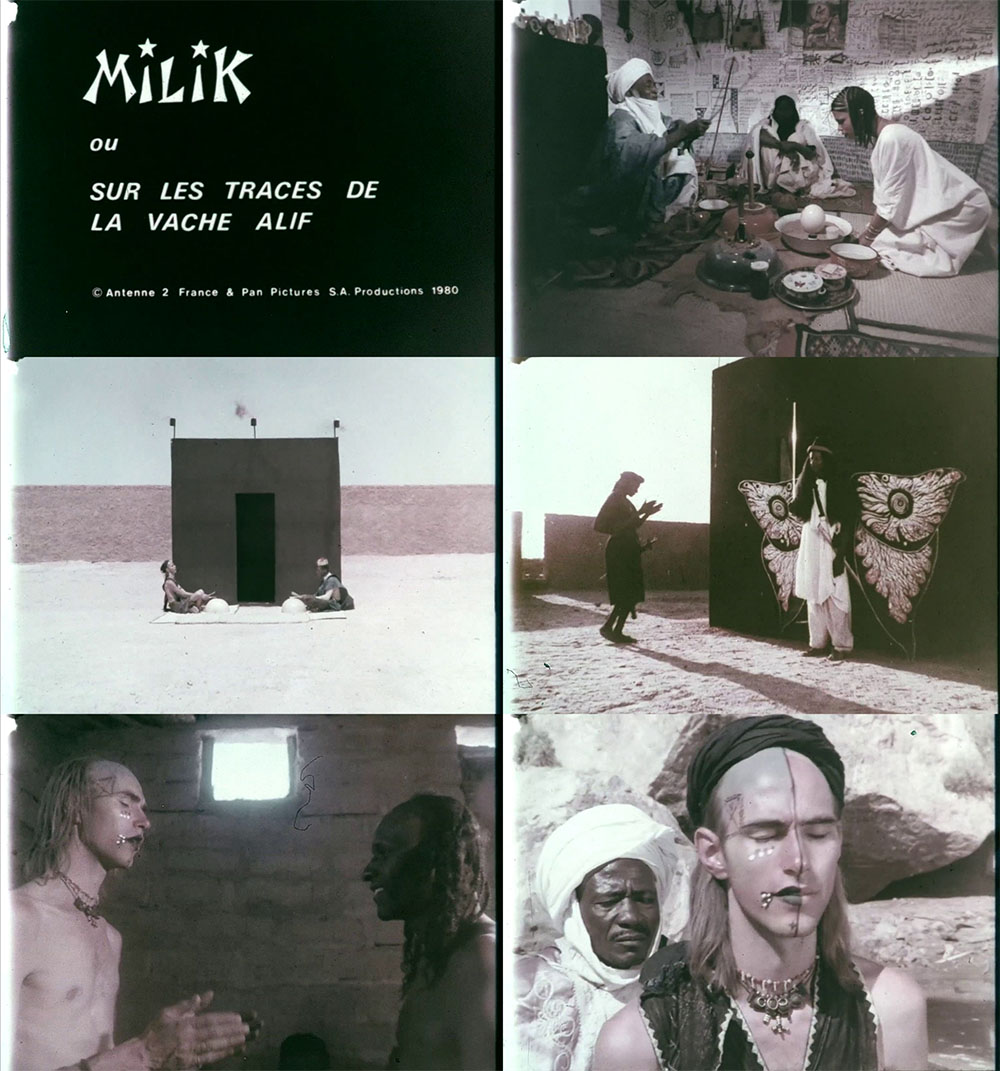
Giving this 30-minute curio a “film by…” designation is a bit of a stretch but it was co-written by artist Mati Klarwein and also directed by him. Milik was filmed among the towns and desert landscapes of Niger in 1972, and is a rambling thing that’s not easy to comprehend if you’re trying to do so while the all-French voiceover is being haltingly auto-translated. The film was a creation of members of the Deyá art community in Mallorca where Mati Klarwein spent his later years. The scenario is very typical of its time: a youth from Europe travels outside the continent to gain self-knowledge among people with darker skins and “exotic” lifestyles. The endeavour in this case involves a search for a lost cow marked with an aleph—the Hebrew letter which happens to mean “Ox”—with the cow being only the first of a herd of cosmic cattle marked with the remainder of the Hebrew alphabet. Or so we’re told; we only get to see a single animal. The repeated references to marabout angels reinforce the metaphysical nature of the youth’s quest, as do the various rituals that take place while we watch Didier Léon stumbling around the desert from one mysterious encounter to another. Given that the script is credited to three Europeans, with few of the Africans allowed to speak for themselves, it’s unclear whether the descriptions of the rituals that we observe are inventions of the scriptwriters or the genuine article.
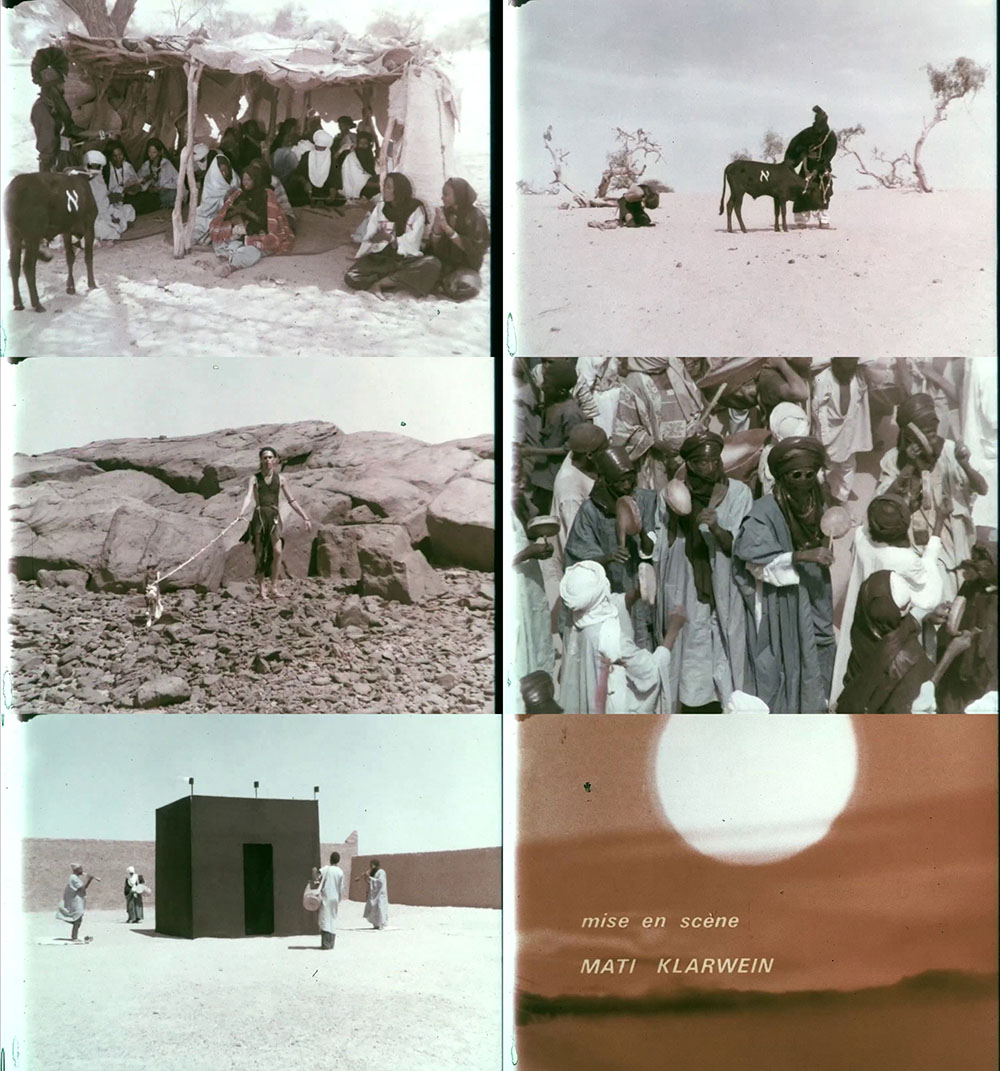
The best that can be said about this is that there’s some good music scattered underneath and around the narration, while the film as a whole is vaguely Klarweinesque if you’re familiar with the artist’s paintings and his books. Many of the burnoose-clad Africans are reminiscent of those who populate Klarwein’s earlier pictures, while the calf that appears with an aleph painted on its hide isn’t something you’re liable to find in the farmlands of Niger. The relentless narration is something I also take as a Klarwein hallmark even though other hands were at work. Verbiage is very much a feature of Klarwein’s art books and the one-off album he recorded in 1997 with Per Tjernberg, lengthy “cosmic” spiels littered with bad puns. Milik reminded me in places of Sergei Parajanov’s films, but Parajanov showed how well you could present a narrative like this without an explanatory voiceover.
Previously on { feuilleton }
• Visa de censure numéro X
• Mati Klarwein, peintre Américain, a film by Fabienne Strouvé
The letter “Aleph” has no connection whatever with ox [=Shor]. from where do you take your info?
I take my info from all the books I’ve ever seen that describe the origin symbols for the letters in the Hebrew alphabet: ox, door, tent, camel, eye, etc. The same info may be found in numerous online descriptions. See the Wikipedia entry for “Aleph”.
It’s more accurate to say the letter derives from a word (or hieroglyph) for ox rather than means ox but the ox connection is still there.