I’d been hoping that Malcolm Whitehead’s Snaps might be made public eventually, and here it is, a 25-minute film documenting the northern end of a British book-signing tour undertaken by three artists and their publisher in October 1979. Not only that, there’s also this shorter compilation of footage that didn’t make the final cut.
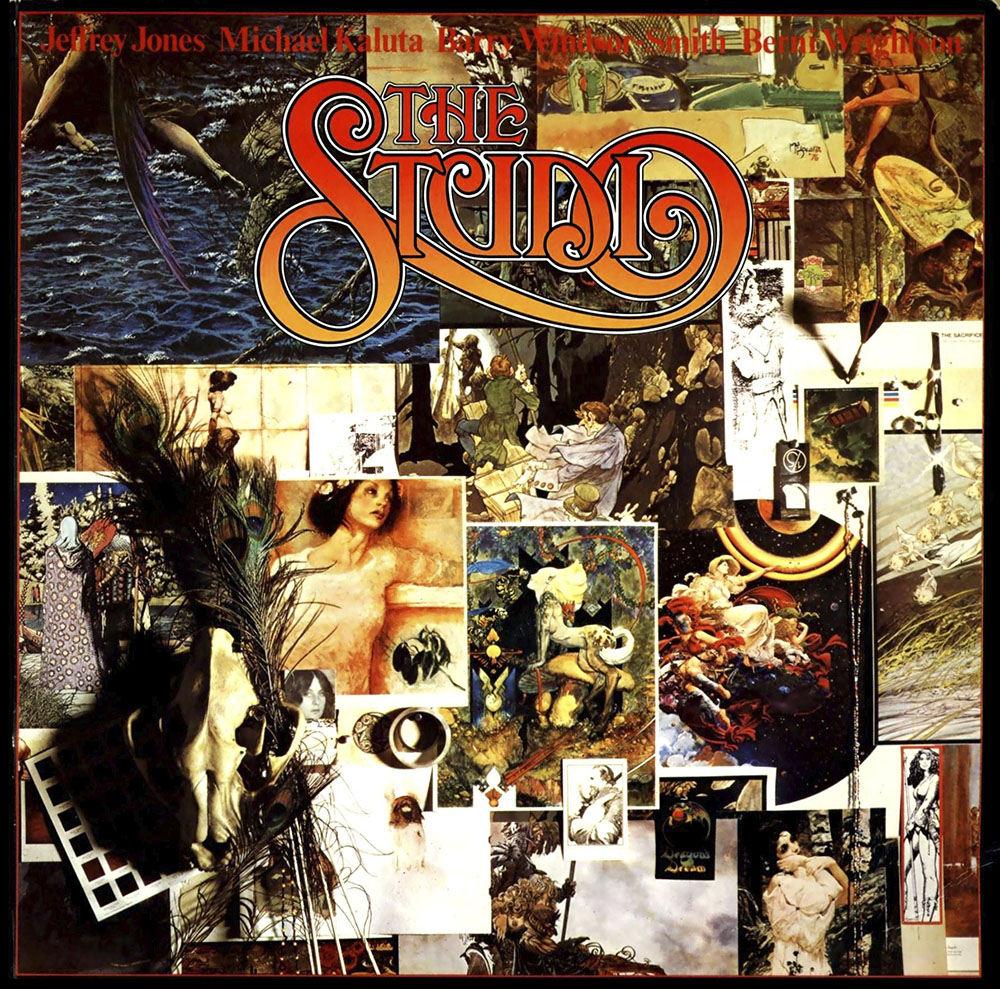
The artists were three of the four whose work is showcased in the book known as The Studio: Jeffrey Catherine Jones, Mike Kaluta and Bernie Wrightson. The other member of the quartet, Barry Windsor-Smith, either missed the jaunt to Leeds and Manchester or avoided the tour altogether. The publisher was fellow artist Roger Dean whose success in 1975 with his own art book, Views, prompted him to turn his self-publishing imprint, Dragon’s Dream, into a bona fide publishing company. Views was followed by a short run of art books by prominent fantasy and science-fiction illustrators including Chris Foss, Ian Miller, Bruce Pennington and Syd Mead. The Studio was one of these titles, a collection of the art produced by the quartet working in the communal loft (“The Studio”) they established in Manhattan in the mid-1970s, a space intended for the production of more personal work than the comic art for which they were all known. Malcolm Whitehead’s film is unusual for documenting an event in sound and vision that usually wouldn’t be documented at all beyond a handful of photographs.
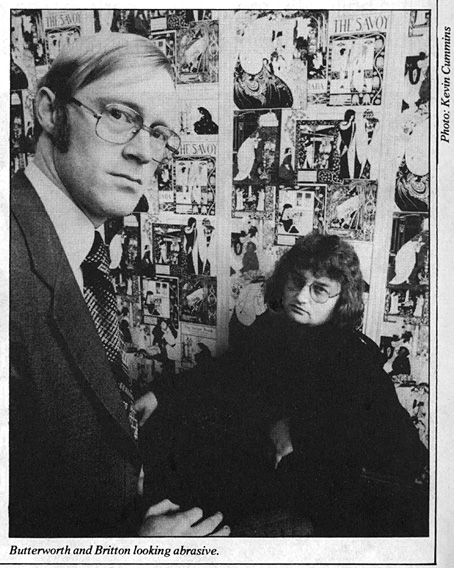
New Manchester Review, 1979: Michael Butterworth and David Britton in the Beardsley-papered Savoy office. Photo by Kevin Cummins.
The trail of circumstance that led to the creation of Snaps goes something like this: David Britton and Michael Butterworth were setting up Savoy Books in Manchester at around the same time that Roger Dean was expanding Dragon’s Dream. Both publishers had established co-production deals with Big O, a poster company, distributor and publisher of many pop-culture art books, notably the British edition of HR Giger’s Necronomicon. One of the first Savoy books in 1978 was James Cawthorn’s The Jewel in the Skull, an 80-page comic-strip adaptation of the novel by Michael Moorcock, which was a one-off co-production between Savoy and Big O. In addition to being a fledgling publisher, Savoy at this time also had a chain of bookshops in Manchester, Leeds and Liverpool, selling the usual 70s blend of genre and “cult” paperbacks, posters, comics (mainstream and underground), magazines, and so on. The main outlet was Bookchain on Peter Street, Manchester, which is where much of Snaps was filmed. Given the connection between Dragon’s Dream and Savoy I’d guess that Big O suggested the Savoy shops as venues for the Studio signing tour. Dave Britton would have been keen on this even without the extra business the signings generated for the shops. He’d bought some of the posters produced by Barry Smith’s Gorblimey Press, and always spoke highly of Smith’s Studio-era work. As for the film, Mike Butterworth was good friends with local film-maker Malcolm Whitehead, and it was he that commissioned “Malc” to document the signing. Whitehead is best known today for his subsequent involvement with Ikon, the video division of Factory Records. In addition to making Snaps, in 1979 he was also filming some of the live footage of Joy Division that’s been circulating ever since. He later directed a couple of the early New Order videos, and helped with the direction and editing of many video productions by other Factory artists and affiliated groups like The Fall and Cabaret Voltaire.
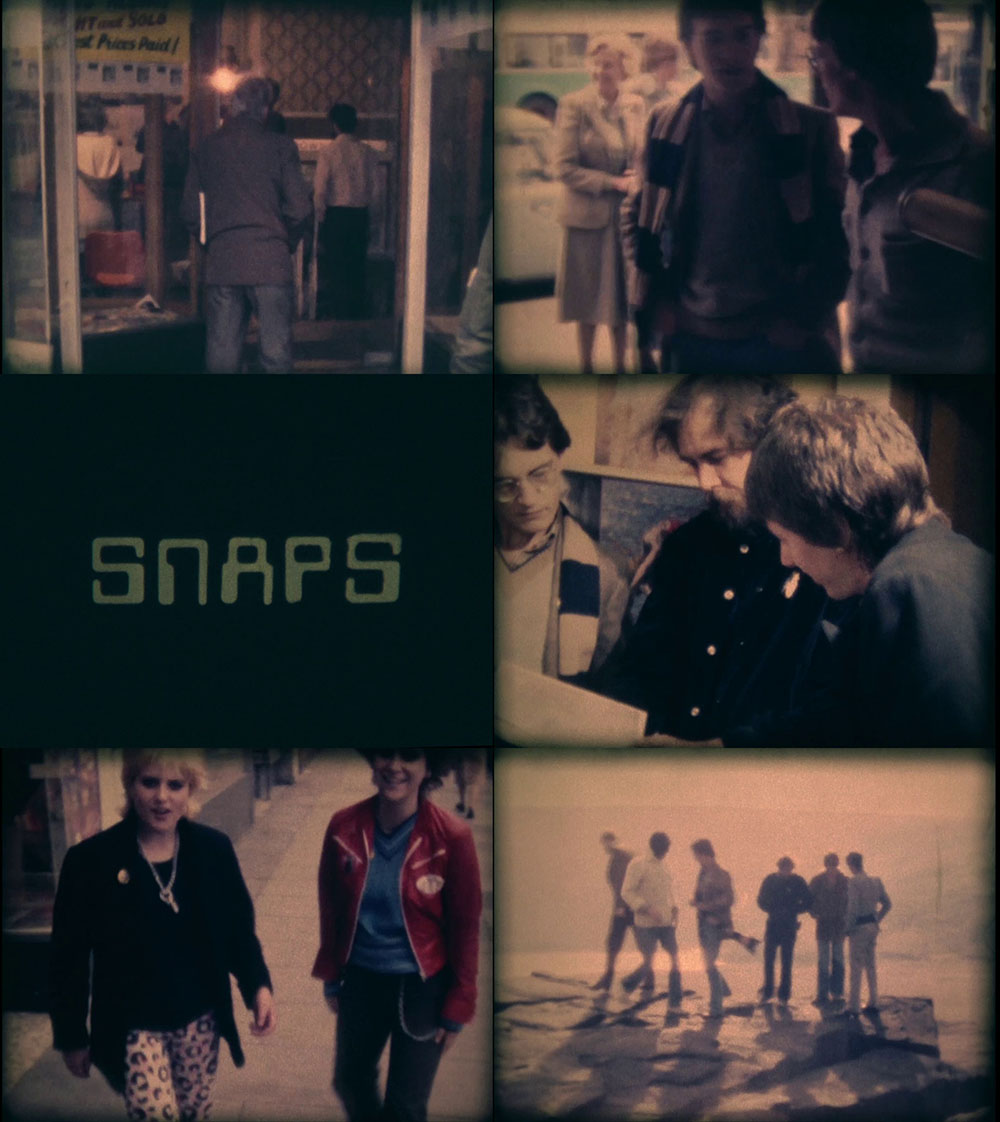
Snaps is a short and somewhat amateurish film but it’s a valuable record all the same. Anyone today can pull out their phone and record an event like this in high-definition and stereo sound; in the 1980s and 1990s you would have needed video equipment, but in the 1970s you had to have film, and 16mm film was an expensive professional product. Whitehead was using the cheaper option of Super-8 but he did at least manage to organise synchronised sound, something you don’t get on Pirate Tape, Derek Jarman’s Super-8 record of a William Burroughs signing. Mike Butterworth provides the stentorian voiceover for Snaps which he says he now regrets. Equally regrettable is his mispronunciation of the names “Paolo and Francesca” when he’s talking about Barry Smith’s art.
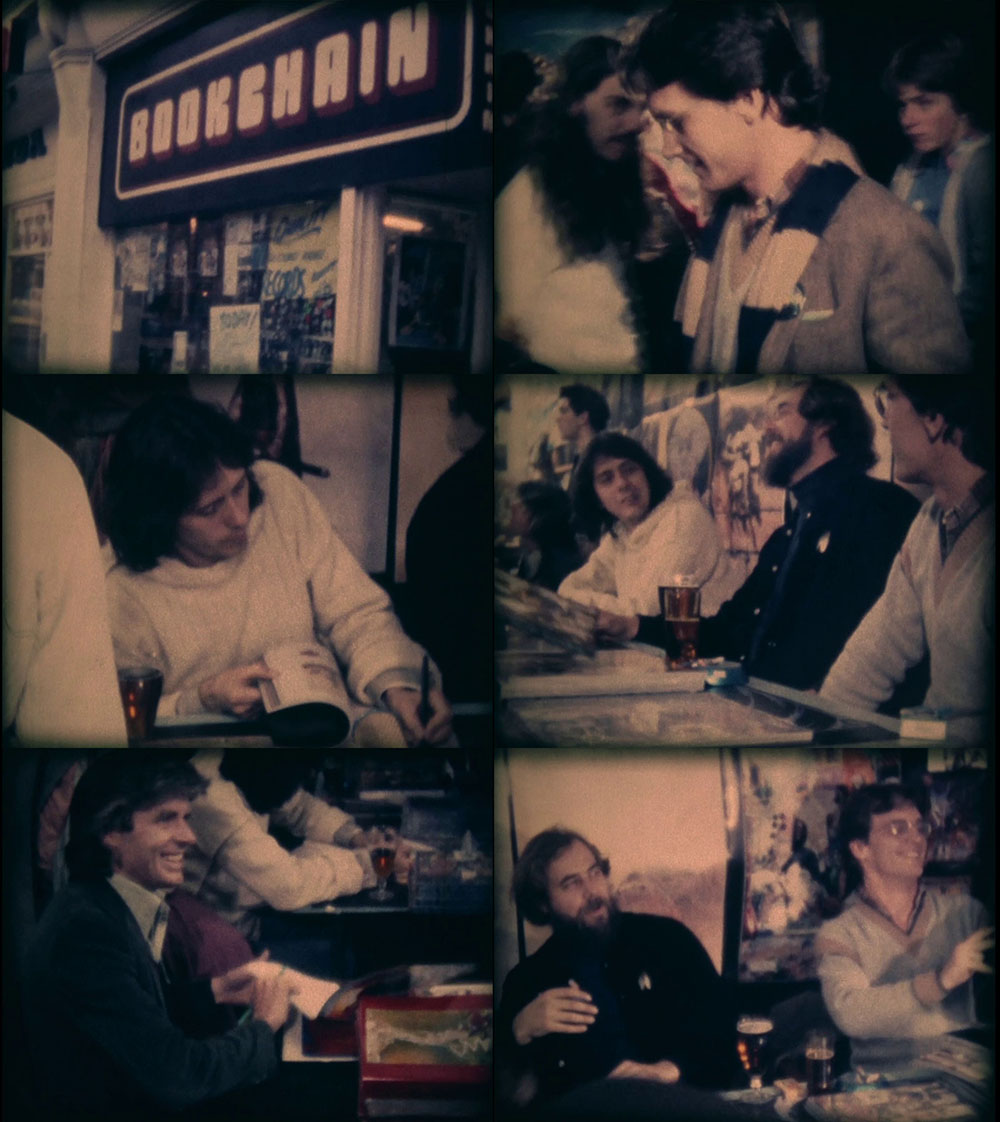
The film opens in Leeds for the first of the day’s two signings, a sequence I can’t say much about since I never visited the Leeds shop. The participants then pile into cars and drive across the Pennines where they pause for a brief Kraftwerk-soundtracked inspection of the landscape. The three Studio artists were Americans so all of this activity must have been very novel and interesting despite the drabness of the cities. The shots in Manchester are the ones I like to see since they capture Bookchain when the place was at its height of popularity. In 1979 I was still living in Blackpool and didn’t visit the shop until early in 1980 when I made a daytrip with friends to explore Manchester. By the time I moved to the city in 1982 Bookchain was set on its gradual decline although it managed to survive until the block of buildings it was part of was demolished in 1999. The basement area looks quite salubrious in the signing footage but I only knew it as a dank and unlit storage area with a toilet that belonged in a horror film. One thing that Whitehead didn’t capture was Dave Britton asking all the artists to sign the wall of the shop near the counter. I was in the place every Saturday when we were working on the Reverbstorm comics in the 1990s, and it was always a strange thing to see Roger Dean’s signature (plus dragon doodle) peeping out from behind rows of dusty shrinkwrapped books and magazines. You never see much discussion of this side of the city’s cultural history in writing about Manchester’s musical output. Yet without the Savoy shops, and other outlets like Percival’s and Grass Roots, Ian Curtis, Mark E. Smith, Howard Devoto and others would have had a harder time finding the fuel for their imaginations.
In addition to being a record of a lost place, Snaps is also a record of lost people: Jones, Wrightson, and Britton are all no longer with us, while Malcolm Whitehead died in 2019. Whitehead’s involvement with Factory Records is documented in a scattering of posts at Cerysmatic. This one seems like a good place to start.
Previously on { feuilleton }
• David Britton, 1945–2020
• Jeffrey Catherine Jones, 1944–2011
• Roger Dean: artist and designer
• Berni Wrightson’s Frankenstein
This is great, thank you so much for this.
Really nice to see this. I was a big fan of all those guys back then, nearly (gulp) half a century ago. I’d never seen footage of them before. Roger Dean comes across as the kind of groovy aristocrat who throws a lot of parties. A very tennis and Pimms sort of guy. And the great Jeff Jones actually has a very calm, strong presence about him that I hadn’t expected given the gender dysphoria of his later years.
Also, it’s somewhat ironic that the only Englishman of the four Studio artists was the only one who was AWOL on the English signing tour.
Yes, this is the only footage I’ve seen of any of them from this period. There may be something with Roger Dean from when he was working for Yes in the 1970s but if so I haven’t seen it. There really ought to have been a BBC documentary about him. All this stuff was ignored by the big media at the time despite its popularity, and the way things like the Dragon’s Dream Syd Mead book led directly to Mead working on Blade Runner (and thence to Tron, Aliens, etc, etc). There was no BBC interest in Hipgnosis either, despite their album covers being some of the most recognisable artefacts from that decade.
As you say, seeing someone on film (or in person) gives an insight into their character you don’t get from books. Dean always looks very serious in photo shots, nothing like he is here. Dave Britton said his main memory of him that day was that he seemed very business-like, which I’m sure he’d have to be considering he was running one publishing company and about to start another.
As for Barry Smith, he was the moodiest one of the four, and often temperamental. He was also a Londoner so I can imagine him being a bit sniffy about the idea of visiting the northern cities; Leeds and Manchester wouldn’t have seemed exotic the way they would to the Americans. But that’s just a guess. I don’t recall anyone at Savoy knowing why he wasn’t there.
Thanks for this. I think this is the first time I’ve seen film of the legendary Dave Britton. Those four artists did a signing session at the Forever People SF bookshop in Bristol in 1979 where I got them to sign a copy of The Flights of Icarus, another Dragon’s World book which they contributed to. Someone before me asked Dean to draw the Yes logo with his signature but he couldn’t remember how it went!
Thanks, Robin, that’s good to know. I’ve wondered a few times where else they were signing that year. In London I’d guess it would have been Dark They Were And Golden-Eyed since that was a bigger place than the original Forbidden Planet shop in Denmark Street.
I was very good at drawing accurate Yes logos for a while!
According to BWS in this Facebook post, he had a bit of a falling out with Dragon’s dream, though he was at the London signing I went to: https://www.facebook.com/share/1C2QPw2Jqg/?
As for Jeff Jones, when I plonked Swamp Thing 1-10 in front of Berni Wrightson, he said ‘I’ll sign them on a production line, as that’s how I drew them’. I then turned to Mike Kaluta asking him to sign issue 9 as at the time it was thought he inked some of it…He replied ‘I had nothing to do with that’…my 16 year old face suddenly going bright red…my blushes were saved by Jeff cooly leaning over and going ‘Oooh, I did those pages’ and signing the page – Phew!
Thanks, Martin, I’m really pleased this post has turned up the solution to the mystery of Smith’s absence after all this time!