Weekend links 240

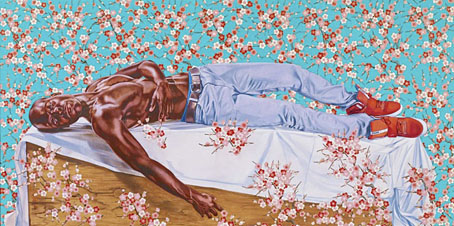
wiley.jpg

The Death of Chatterton (2014) by Kehinde Wiley.

• Mixes of the week (and the week before that): The Conjurer’s Hexmas: Second Rite by SeraphicManta; Secret Thirteen Mix 140 by Deaf Center; Best of 2014: A Highly Opinionated Mix by Robin The Fog.

• Never mind Music for Airports, how about Music for Neurosurgery? The Tegos Tapes Edits are extracts from “12 hours of unheard Vangelis music soundtracking films of various surgical operations”.

• “It was one of the first magazines that, with science-fiction and comics together, proposed comics for adults.” Aug Stone on 40 years of publisher Les Humanoïdes Associés and Métal Hurlant.

• Zinesters Do It on the Photocopier: Stephanie Schroeder on the Queer Zine Archive Project. Related: Holy Titclamps by Larry-bob Roberts.

A Year In The Country reached the end of its 365 posts. The archive is well worth a browse.

• “These people love to collect radioactive glass. Are they nuts?” asks Ben Marks.

• Think before you share: 86 viral images from 2014 that were totally fake.

• The Anti-Tolkien: Peter Bebergal on Michael Moorcock.

• Extracts from Alan Bennett‘s diary for 2014.

John Cage 4’33” Autotune

Alpha (1976) by Vangelis | Reve (1979) by Vangelis | L’Enfant (1979) by Vangelis

The Incredible Robert Baldick

baldick1.jpg

This is an odd one-off TV drama whose title I’ve known for years but which I hadn’t seen until this week. The Incredible Robert Baldick was broadcast in 1972 in a slot used by the BBC to test dramas that might later become series. The writer was Terry Nation, creator of Doctor Who and the dour post-apocalypse series, Survivors. Robert Hardy plays Robert Baldick, an aristocratic occult detective who we’re informed “cannot resist the inexplicable”. We’re also told he’s one of the finest scientific minds in 19th-century Britain. The exact period is vague but we first see Baldick and cohorts playing with an “electrical telepathy” communication device which would fix the time around the turn of the century. Baldick has a country estate, a bulletproof Russian train (“The Tsar”), a valet who is also an expert in Classics and ancient languages, a gamekeeper with preternatural senses, and a pet owl named Cosmo.

baldick2.jpg

The one-and-only 50-minute episode is entitled Never Come Night, and plays like something Nigel Kneale might have written, a combination of supernatural horror, suspicious yokels and archaeology, with an abrupt swerve into outright science fiction at the end. The cast features many familiar faces from film and television of the period: James Cossins as a fearful clergyman, Barry Andrews playing the same type of rustic he also played in Blood on Satan’s Claw, Julian Holloway as Thomas the valet, and John Rhys-Davies (Gimli in The Lord of the Rings) as Caleb the gamekeeper. All the ingredients are in place for what might have been a promising series along the lines of The Rivals of Sherlock Holmes, the first season of which had been running on another channel the year before, and which may have been an inspiration. A shame that the only women in the cast are a couple of barely visible servants and a corpse; even Holmes and Watson had Mrs Hudson. The timecoded copy on YouTube has evidently been hijacked from the BBC archives but it’s watchable enough.

Previously on { feuilleton }
The Horse of the Invisible
“The game is afoot!”

Weekend links 239

crystal.jpg

The Crystal Gazer (or The Magic Crystal, 1904) by Gertrude Käsebier.

• “I had to resort to extreme violence”: how Hipgnosis revolutionised the album sleeve. Aubrey Powell, last surviving member of the design team, talks to Joe Muggs.

• Mixes of the week: Radio Belbury: Programme 14; The Conjurer’s Hexmas by SeraphicManta; Secret Mix 139 by A Closer Listen.

• Social progress, high-speed transport and electricity everywhere: Iwan Rhys Morus on how the Victorians invented the future.

• At Cinephilia & Beyond: “The most complete investigation into the origins and making of Citizen Kane.”

Poor Souls’ Light: seven curious tales for the end of the year, and a dedication to Robert Aickman.

• Music and the Occult: Stuart Maconie and Rob Young spend an hour in the magick circle.

Alejandro Jodorowsky and Iain Sinclair in conversation at the British Library, July 2014.

• From 1972: An unpublished Victor Moscoso interview by Patrick Rosenkranz.

The Spooky Story Behind Hollywood’s Favourite Mansion.

The Lost World of British Tape Recording Clubs.

• 2014 was a year of outrage.

Wyrd Daze issue 11

Inspirograph

• Pepper-Tree (1984) by Cocteau Twins | Otterley (1984) by Cocteau Twins | Aikea-Guinea (1985) by Cocteau Twins

Moorcock: Faith, Hope and Anxiety

moorcock.jpg

Photo of the author by Linda Moorcock.

I mentioned a few days ago that I had another new piece of work to reveal, and this is it, a poster/promotional piece for Russell Wall’s forthcoming documentary about Michael Moorcock. The main challenge with one was to create something that would give a sense of Moorcock’s extensive career and the genre-spanning content of his many books.

mm1.jpg

I took the 1970s as the starting point, since this was the period when his reputation as a writer was established worldwide. The decade began with Britain’s bookshelves being colonised by Moorcock’s SF and fantasy novels published by Mayflower with vivid covers; it saw a cult feature film—The Final Programme—made from his first Jerry Cornelius novel, and it ended with the fourth Jerry Cornelius novel, The Condition of Muzak, winning a serious literary award, the Guardian Fiction Prize.

mm2.jpg

So the general appearance of the design, the headline typography, and the colour scheme are a nod to the Mayflower covers and especially to Bob Haberfield’s artwork which often used a similar style of Tibetan flames and clouds. The rest of the type is set in Rockwell, a preferred typeface of the Hipgnosis design team for much of the 1970s. Early on I had the idea of filling the design with stylised graphics like those used by some of the Hipgnosis illustrators, chiefly George Hardie, but that idea receded once the composition began to arrange itself. The fountain pen is the main hangover from this, a hard-edged graphic tilted at an angle like many of Hardie’s illustrations. The pen is a little inappropriate given that Moorcock is famous for knocking out novels at speed on a typewriter but it made a good visual rhyme with the guitar, a Rickenbacker like the one the author played in his Deep Fix band.

mm3.jpg

Elsewhere there are many specific references competing for attention: the Elric head is Jim Cawthorn’s illustration from the first edition of Stormbringer (1965); the Jerry Cornelius figure (straddling a repurposed Mayflower logo) is one of Mal Dean’s best, as seen on the cover of issue 191 of New Worlds magazine; the sorcerous blades are my own designs from 1985 as seen on the sleeve of Hawkwind’s Chronicle of the Black Sword album; the Beardsley figures from Salomé were a vague gesture to the 1890s but the Pierrot figure happens to be one Moorcock used for a while as a bookplate, something I didn’t know until I’d placed it in the design; the cat at Pierrot’s feet is another Beardsley from one of the Bon-Mots books; the London skyline is a contemporary one, London past and present having been a continual feature of Moorcock’s writing throughout his career. Lastly, all these details are contained by a graphic based on Abram Games’ BBC TV ident from the 1950s. When Russell and I began talking about this project the words “television biography” were being used so this would have connected to that idea, and to the decade when Moorcock’s career began.

mm4.jpg

I don’t know when the documentary will be released but any news will be posted here in due course. There’s also talk of making copies of the poster available for purchase but nothing concrete has been decided yet.

Previously on { feuilleton }
Eduardo Paolozzi at New Worlds
Elric 1: Le trône de rubis
Into the Media Web by Michael Moorcock
The Best of Michael Moorcock
Revenant volumes: Bob Haberfield, New Worlds and others

Weekend links 238

hinrichsen.jpg

We Are The Water – Snow Drawings Project, Colorado (2014) by Sonja Hinrichsen with 50 volunteers.

• I don’t do end-of-year lists but Dennis Cooper does. My thanks to Dennis once more for including this blog among his selections. Also there is Jonathan Glazer’s film of Under the Skin, an adaptation of Michel Faber’s novel that impressed me as the most insidiously disturbing thing I’ve seen since Mulholland Drive. The Guardian‘s film critics agreed, making it their film of the year. I’d add to Peter Bradshaw’s appraisal by noting the superb score by Mica Levi, the refusal to spoon-feed the audience with explanations, and a refreshing absence of Hollywood gloss. Glazer’s film, like Kill List before it, shows that mundane British streets and interiors can still be a setting for serious horror.

• Related to the above: “I like Caravan, Coil—it’s very sad that they’re both dead now. In fact, Peter Christopherson, who was leader of Coil, contributed a song to a CD which I made for my wife for what we believed would be her last birthday.” Michel Faber talks to Hope Whitmore about Under the Skin and his new novel, The Book of Strange New Things. M. John Harrison recommends the latter on his own end-of-year list. In January Black Mass Rising will release a recording of The Art of Mirrors, Peter Christopherson’s homage to Derek Jarman from 2004.

David Bowie and band live on Musikladen in 1978: 40 minutes with Adrian Belew on squealing lead guitar, some Kurt Weill and an outstanding performance of “Heroes”.

• “Realism is a literary convention – no more, no less – and is therefore as laden with artifice as any other literary convention.” Tom McCarthy on realism and the real.

• Mixes of the week: The Best of the Best of the Best by TheCuriosityPipe, and Secret Thirteen Mix 138, a medley of post punk from Psyche.

• “We spent two weeks making the penises.” Livin’ Thing: An Oral History of Boogie Nights by Alex French and Howie Kahn.

• At Dangerous Minds: Seeing The Man Who Fell to Earth was one of the greatest experiences of Philip K. Dick’s life.

• Giving Voice to Our Pagan Past and Present: Pam Grossman on Witches, Women and Pop Occulture.

• Neglected last week (and linked everywhere but still a good one): The typography of Alien.

William Mortensen, the photographer who Ansel Adams called the Anti-Christ.

• Hear a track from analogue synthesizer virtuoso Kaitlyn Aurelia Smith.

Rick Poynor on illustrations by Bohumil Stepan for Crazy Fairy Tales.

12 excellent features from directors who never made another feature.

Werner Herzog Inspirationals

The Devil in the Hedgerow

New Warm Skin (1980) by Simple Minds | Rapture Of The Skin (1996) by Paul Schütze | Take Me Into Your Skin (2007) by Trentemøller