Weekend links 432

urbanowicz.jpg

Tokyo at night, one of a series of watercolours depicting the back streets of the city by Mateusz Urbanowicz.

• “The experience of reading the book is something like watching Dr. Strangelove on one screen, Apocalypse Now on a second screen, and having both feeds interrupted by explicit gay erotica.” Bad Books For Bad People examines William Burroughs’ celebrated YA novel, The Wild Boys. The subject is a perennial one here, explored at length in this post.

• Lindsay Anderson’s The White Bus (1967), a surreal precursor to If…. and O Lucky Man!, will receive the high-quality BFI reissue treatment as part of the Woodfall Films portmanteau feature, Red, White and Zero.

• The Radiophonic Workshop have composed the score for Possum, a horror film by Matthew Holness. The main title theme is here. The film is released later next month.

Might I have written a sober affair, had I not been under the influence? Perhaps not—I have never needed tramadol to be attended by angels, or to feel demons pricking my feet. But I think of Vincent van Gogh, who looked at the world through the yellowish haze conveyed by digitalis, and grew enraptured by sunflowers and straw chairs, and I think of a glass prism through which a beam of white light passes and is split into a rainbow. What had been a single lucid idea had passed through the drugs I took and been dispersed into a spectrum of colours I had only half foreseen.

Sarah Perry on trying to write while besieged by bodily pain and prescription drugs

• Jacques Tourneur’s masterful MR James adaptation, Night of the Demon (1957), is released on region-free Blu-ray next month by Powerhouse Films.

• Mixes of the week: FACT mix 673 is The Bug presents PRESSURE, and XLR8R Podcast 561 by Zendid.

• The Space Shifters exhibition at the Hayward Gallery, London, messes with Adrian Searle‘s mind.

Gregory Wells on queers, faeries and revolutionaries in the psychedelic movement.

Wide Boys (1977) by Ultravox! | On Demon Wings (2000) by Bohren & Der Club Of Gore | Spoonful (2013) by Robert Plant and the Sensational Space Shifters

Weekend links 426

slinger.jpg

Self Preservation (1970–77), a collage by Penny Slinger from the series An Exorcism.

• RIP John Calder, one of the most important British publishers of the last century whose death was acknowledged in the Washington Post (and in the Telegraph, a paper that would have given him no support during his censorship battles) but at the time of writing hasn’t been mentioned at all in the increasingly useless Guardian. The omission in the latter seems even more surprising when Calder himself wrote obituaries for the paper, and they ran an archive piece two weeks ago for the 50th anniversary of Calder & Boyars’ successful court defence of Last Exit to Brooklyn. “Publishing is an industry run by capitalists now.

• Another 50th anniversary: David Bushman asked Alan Moore for his memories of Patrick McGoohan’s superb TV series The Prisoner.

Michael Moorcock in conversation with Hari Kunzru at Shakespeare and Company, Paris.

Stephen O’Malley presents Acid Quarry Paris – In Session with Richard Pinhas (Heldon).

• When a rock is a stone: Louise Steinman on finding Robert Smithson’s Spiral Jetty.

• Victorians, Vaults, and Violet Water: a profusion of links at Greydogtales.

• Mix of the week: FACT mix 666 by Róisín Murphy.

• The amazing adventures of Melinda Gebbie.

Starbirthed

Exorcism (1971) by Lucifer | The Final Calling (Physical Exorcism) (1984) by CTI | Exorcism Of The Hippies (2010) by Mater Suspiria Vision

A view over Yuggoth

yuggoth2.jpg

I mentioned in the post about the Sherlock Holmes illustrations that the next book from Editorial Alma featuring my work would be another Lovecraft collection. One of the illustrations in the new volume was of the planet Yuggoth, a world known to human beings as Pluto. In Lovecraft’s mythos Yuggoth has long been an outpost of advanced alien civilisations, particularly the fungoid crustaceans of The Whisperer in Darkness and the splendidly-titled sonnet sequence Fungi from Yuggoth. I’d broached this subject a couple of times in the past, first with a panel in my Haunter of the Dark comic strip (the Shining Trapezohedron is described as being brought to Earth from Yuggoth) then with a photocopy collage of Haeckel organisms for the first Starry Wisdom collection.

Yuggoth is one of several alien outposts in Lovecraft’s fiction, allied in its remoteness from humans with the underwater city of R’lyeh and the Antarctic city in At the Mountains of Madness. All these locations suggest exotic architecture so they’ve long been some of my favourite features in Lovecraft’s work, hence this new piece which I couldn’t resist doing after completing work on the Alma book. Since I acquired a Wacom tablet four years ago I’ve become so used to using it for line drawing that working with it now feels as natural as working with pens and inks. But digital painting was something I still didn’t feel happy with. This is mainly because the brush options in Photoshop are limitless, and one thing I’ve never liked with art materials is too much choice. When I was working with physical media I used to use a minimum of pens and brushes so what I really wanted from Photoshop was a single brush that would do what I wanted without having to swap tools all the time when working. This view of Yuggoth is the result of having finally settled (by chance, as it happened) on a brush that does everything I want without getting in the way. The drawing was completely improvised so as a composition it has some flaws; it could also have been developed a lot more to bring out highlights and details. But as an experimental piece it worked out well and also didn’t take too very long to do. When I have the time I’ll be doing more with this new brush.

Elsewhere on { feuilleton }
The Lovecraft archive

Weekend links 423

howe.jpg

The Miracle (Genet’s Dream) (2001) by Delmas Howe.

• “Zachary Lipton, an assistant professor at the machine learning department at Carnegie Mellon University, watched with frustration as this story transformed from ‘interesting-ish research’ to ‘sensationalized crap’.” Oscar Schwartz on how the media gets AI alarmingly wrong.

• The Aesthetics of Science Fiction: what does SF look like after cyberpunk? Very Brutalist if you ask Rick Liebling, although the first example shown in his piece—the Brunel University Lecture Centre—appears briefly as future architecture in A Clockwork Orange.

• At Expanding Mind: Erik Davis talks with philosopher and religious studies professor Dustin Atlas about ancient skepticism, Madhyamaka Buddhism, the taste of honey, Montaigne, Robert Anton Wilson, and the path of doubt.

• At Muddy Colors: Part 1 of their choices for best fantasy book covers of the year so far, a list which includes my cover for Moonshine by Jasmine Gower. Thanks!

• Soundtracking with Edith Bowman, episode 84: director Todd Haynes on the music of Wonderstruck, I’m Not There, Carol and Far From Heaven.

• Mixes of the week: FACT mix 663 by Space Afrika, Secret Thirteen Mix 262 by Mieko Suzuki, and Black Minimalism, a playlist by David Toop.

• Two minutes, eight barrels: drone and GoPro footage of surfer Koa Smith riding the waves of the Namibia shoreline.

• David Lynch’s Sacred Clay: Shehryar Fazli reviews Room to Dream by David Lynch and Kristine McKenna.

Charlotte Higgins on myths, monsters and the maze: how writers fell in love with the labyrinth.

• Monstrous Geometries in the Fiction of HP Lovecraft by Moritz Ingwersen.

Listen to the mournful wails of planets and moons.

• A Peel Session by Laika

Surf Ride (1956) by Art Pepper | Surf (1976) by Tim Blake | Surfside Sex (1982) by Patrick Cowley

Weekend links 422

kolosimo.jpg

Wu Ming, a communist writing collective known for its historical fiction, sees Kolosimo as using pseudohistory as a tool to shake people from their belief that capitalist society is natural and transhistorical, opening minds to other possibilities for how humans can live. They regret that popular proponents of his theories today, like Graham Hancock and Erich von Däniken, are unable to recognize the political motivations behind his project: “Nothing of his radicality survives in today’s copycats… Every corner has been blunted, the heresy has become telegenic, but we know that the revolution will not be televised.”

The secret history of Marxist alien hunters by AM Gittlitz

I received the Sphere edition of Peter Kolosimo’s book as a Christmas present in 1974, and being 12 years old at the time took its theories fairly seriously. As a work of pseudohistory it’s as poor as the books of Erich von Däniken but I always liked the title, and it happens to be the place I first encountered the mysterious words “Popol Vuh”, a name that would acquire a very different significance a few years later. Kolosimo also joins Kenneth Grant in taking HP Lovecraft’s work as a thin fictionalisation of supposed fact. For a serious dismantling of Not of This World see this review (the first of three parts) by “skeptical xenoarchaelogist” Jason Colavito.

• The Archons are back: Erik Davis talks with Gnostic scholar Matthew Dillon about religious mourning, the Nag Hammadi library, sex-magick Jesus, the Gnostic Eden, David Icke’s lizards, and the power of the Archons as an allegory of contemporary technological and political power.

Crystal Voyager (1973) is a surfing film by David Elfick that ends with a 23-minute sequence of slow-motion waves set to Echoes by Pink Floyd. Some of the same footage later appeared in the final scenes of Peter Weir’s The Last Wave (1977).

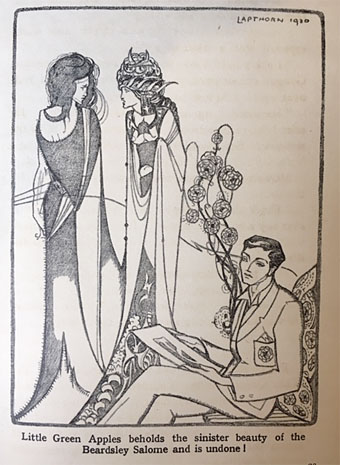
• Sweet artifice: “Dandies in the age of decadence favoured synthetics over nature, nowhere more so than in perfumery’s fabulous counterfeits,” says Catherine Maxwell.

• Now for a lampshade solo: Pascal Wyse on how the Radiophonic Workshop built the future of sound.

• Wilde about Paris: Alex Dean on the sex, drink and liberation of Oscar Wilde’s “lost” years.

Bee in the City: the vanguard of an invading army from Planet Bee.

• Five books that most inspired Alexander McQueen.

Colin Newman‘s favourite albums.

Echoes (1969) by Leon Thomas | Echo Waves (1974) by Ash Ra Tempel | Not Of This World (1988) by Danzig