Weekend links 447

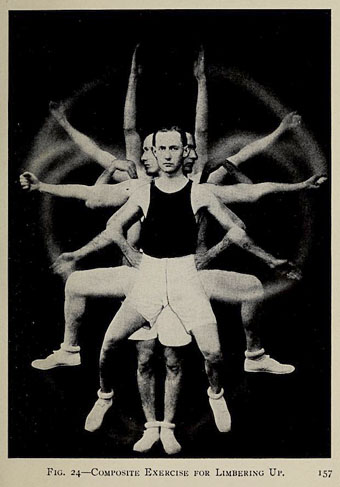
exercise.jpg

Physical Training for Business Men (1917).

• At Expanding Mind: Erik Davis concludes his discussion with religious scholar Diana Pasulka about anomalous cognition, 2001 monoliths, disclosure, future truths, absurd Christianity, and her book American Cosmic.

• This year the LRB wouldn’t let non-subscribers read Alan Bennett’s 2018 diary but they have a recording of Bennett reading entries here.

• “Glen thought it was very good PR for us to be heavily involved in the druids.” Tom Pinnock talks to the Third Ear Band.

• Rebecca Fasman on the forgotten legacy of gay photographer George Platt Lynes.

• Laura Leavitt on John Cleves Symmes Jr.‘s obsession with a hollow Earth.

• David Parkinson recommends 12 essential Laurel and Hardy films.

• Paul Grimstad on the beautiful mind-bending of Stanisław Lem.

• Mix of the week: Secret Thirteen Mix 277 by Sigillum S.

• The endlessly photogenic Chrysler Building.

Energy Flow by Ryuichi Sakamoto.

195 Gigapixel Shanghai

Solaris: Ocean (1972) by Edward Artemyev | The Sea Named Solaris (1977) by Isao Tomita | Simulacra II (2011) by Ben Frost & Daníel Bjarnason

Weekend links 440

roeg.jpg

The title of that film was originally different [Illusions]… I woke up one day and thought of Bad Timing which sounds exactly like the right title—for my career. Now there was a film I really thought was one to which there would be a different response. Whilst filming I felt sure that this was one for the streets, one that people would really want to see. — Nicolas Roeg

So long to the great Nicolas Roeg, always one of my favourite film-makers. Roeg’s works were naturally attractive when I was a teenager because he’d made a horror film and a science-fiction film; when these eventually turned up on TV it was evident that this was a director working on a level that had more in common with Continental Europe than Hollywood. Beyond the generic content it was his approach to directing that made his films essential: a fragmented editing style derived from Alain Resnais via Richard Lester (see below), a cosmic perspective almost entirely absent from the parochial concerns of British cinema, and a seemingly effortless ability to find visual rhymes in anything. Despite the “bad timing” comment above Roeg was fortunate to be working throughout the 1970s when having an approach that ran counter to the prevailing trends wasn’t an obstacle to maintaining a career; as with Ken Russell, you watch some of the films today and are amazed and grateful that they were made at all. When reading the forthcoming plaudits it would be worth remembering that even the films regarded now as Roeg’s best struggled for acceptance: Pauline Kael dismissed Don’t Look Now as “trash”, US screenings of The Man Who Fell To Earth provided explanatory notes for the hard-of-thinking, Bad Timing was described by its own distributors as “a sick film made by sick people for sick people”, while the distributors of Eureka hated the film so much that for a time it could only be screened in the UK if the director was also present.

• Related: Where to begin with Nicolas Roeg, and Nicolas Roeg: It’s About Time (2015), a 59-minute documentary for the BBC directed by David Thompson. Previous Roeg-related postings on this site include: The Nicolas Roeg Guardian Lecture, 1983 (Roeg discusses Eureka and other films with Philip Strick); Beyond the Fragile Geometry of Space (charting the recurrence of a book title from Don’t Look Now); Canal view (using Google Street View to find the church in Don’t Look Now); and Petulia film posters (designs for a Richard Lester film from 1968 that was photographed by Roeg, and whose fragmentary editing style prefigures the familiar Roeg technique).

• Edward Woodward’s greatest screen role wasn’t a prudish policeman or a mysterious vigilante but was David Callan, a conflicted assassin working for a division of the British Secret Service. Joseph Oldham explains.

• Mixes of the week: A mix for The Wire by Jing, FACT Mix 681 by Kelly Moran, and Crépuscules d’Automne, a seasonal mix by Stephen O’Malley.

• More Gorey: in 1978 Jeremy Brett was playing Dracula in the touring version of the Edward Gorey-designed play.

• Liberated from the LRB paywall for a brief time: George Melly writing in 1992 about René Magritte.

• Welcome to the witch capital of Norway: Chelsea G. Summers investigates.

Space colony artwork from the 1970s.

• At I Love Typography: Magic printed.

Memo From Turner (1970) by Mick Jagger | Wild Hearts (1985) by Roy Orbison | Be Kind To My Mistakes (1987) by Kate Bush

Weekend links 435

moss.jpg

An illustration by “Lapthorn” for Little Green Apples: the Chronicle of a Fallen Man (1930) by Geoffrey Moss.

Jean-Michel Jarre & Michel Granger: how we made Oxygène. “[It] was initially rejected by record company after record company. They all said: ‘You have no singles, no drummer, no singer, the tracks last 10 minutes and it’s French!’ Even my mother said: ‘Why did you name your album after a gas and put a skull on the cover?'”

• “When we ignore or demean consensual BDSM erotica, or stories about female sexual submission, we inadvertently contribute to a cultural legacy that routinely pathologizes, demeans, or erases women’s sexual desires.” Hayley Phelan on why we need erotica.

• “More than a literal reconstruction of an imagined collaboration between Eno and Morricone, Ghost Box opens a door onto a world where ambient music and country-western make for natural bedfellows.” Ghost Box (Expanded) by Suss.

Peter Bebergal and Janaka Stucky discuss Bebergal’s new book, Strange Frequencies: The Extraordinary Story of the Technological Quest for the Supernatural. There’s more at the Occulture podcast.

Great Noises That Fill The Air (1988), an album by Bow Gamelan Ensemble, receives its first release on CD next month. Related: the group in 1987 staging one of their pyrotechnic performances.

• Mixes of the week: Bleep Mix #45 by Lawrence English & William Basinski – Casting Voices Mixtape, DJ Food Solid Steel mix by Matt Berry, and The Séance – 13th October 2018.

• “…the social position filled by art and aesthetics is increasingly best understood in terms of magic.” Marina Warner and Eleanor Birne discuss forms of enchantment.

• From 2104: Ten little tales of terror for late of a Halloween night by Levi Stahl.

Words I Heard by Julia Holter.

The Cosmodrome Futurists

Urban Gamelan (Pt. 1) (1984) by 23 Skidoo | Chez Les Futuristes Russes (1984) by Aksak Maboul | Oxygen (1997) by Gas

Weekend links 434

klint.jpg

Group X, No. 1, Altarpiece (1915) by Hilma af Klint.

“Like Kandinsky, and other pioneers of abstract art, af Klint was deeply immersed in theosophy and anthroposophy. But she seems to have taken that interest much further than her male counterparts, participating in (and later leading) séances with a group of women friends. Whatever the spirits said, af Klint did.” Nana Asfour on pioneering abstract painter, Hilma af Klint.

• Four electronic artists reflect on the influence of composer Laurie Spiegel. Spiegel’s The Expanding Universe (1980) is reissued by Unseen Worlds next month. Related: Laurie Spiegel in 1977 playing the Bell Labs Digital Synthesizer.

• At Expanding Mind: Gurdjieffean writer and DuVersity director Anthony Blake talks with Erik Davis about dialogue, synergy, mind between brains, the trouble with teachers, and the gymnasium of beliefs in higher intelligence.

• Mixes of the week: Flashing Noise Mix by Tim Gane, Secret Thirteen Mix 268 by Bérangère Maximin, and Samhain Séance Seven: A Very Dark Place – Prologue by The Ephemeral Man.

Geeta Dayal on Broken Music (1989), a book about sound art edited by Ursula Block and Michael Glasmeier which is now available in a new edition from Primary Information.

• The Sainsbury Archive showcases the graphic design of several decades of the supermarket chain’s products.

• More of the usual suspects: Michael Moorcock and Alan Moore in 2006 discussing Moorcock’s career.

• “Karloff the Uncanny”: Joe Dante talks to Stephanie Sporn about the attraction of old film posters.

Mexico City, another preview (and a psychedelic one) of Randall Dunn’s forthcoming solo album.

• At Haute Macabre: Timeless Phantom Interludes: The Photography of Jason Blake.

Mark Valentine on the current state of Britain’s secondhand book shops.

• At I Love Typography: Unicorns, Frogs and the Sausage Supper Affair.

• “I never wanted to be a cult film-maker,” says John Waters.

• Artist Arik Roper chooses some favourite album covers.

Broken Head (1978) by Eno, Moebius, Roedelius | Broken Horse (1984) by Rain Parade | Broken Aura (2000) by Coil

Weekend links 433

ginzburg.jpg

Cover art for Six Correlations, a solo album by Emptyset’s James Ginzburg which is released later this month. Photo by Clayton Welham.

• “Every single leather S&M club in London was raided by the police at least once, but they couldn’t get any convictions because juries wouldn’t convict us.” Ed Siddons on the death of London’s gay leather scene.

• I’ve been listening to a lot of Stereolab this week so this post from Dangerous Minds last year was useful: “The intriguing origins of ‘Cliff,’ the cartoon character that’s all over Stereolab’s early album art”.

• Available for pre-order: Performance – The Making of a Classic, a book by Jay Glennie celebrating the 50th anniversary of Donald Cammell & Nicolas Roeg’s cult feature film.

• Out later this month from Strange Attractor: The Haunted Writings of Lionel Johnson, the Decadent Era’s Dark Angel, edited by Nina Antonia.

• Mixes of the week: Rosemary Hill – an Autumn Autobiography by cafekaput, and Secret Thirteen Mix 267 by Drew McDowall.

The top 100 albums of The Quietus’ existence, as picked by tQ’s writers.

RC Harvey on the 50th anniversary of (American) underground comix.

• At Haute Macabre: An enigmatic baroness and her collection of skulls.

Miyu Kojima creates miniature replicas of lonely deaths.

Scratches in Kubrick’s 2001: A Space Odyssey.

Richard Thompson’s favourite albums.

Wrong Airport Ghost by Sam Slater.

Mark Valentine’s 3 Wyrd Things.

• 4/4 In Leather (1981) by Eurythmics | The Girl With The Patent Leather Face (1981) by Soft Cell | Leather Bound (1982) by Patrick Cowley