Crafting steampunk illustrations

steampunk.jpg

Today’s post is another guest piece at Tor.com where I talk a little about using collage to create steampunk illustrations and designs. The post is part of their Steampunk Week, and I take the opportunity to acknowledge the influence of some artists who have become familiar points of reference here, namely Max Ernst and Wilfried Sätty.

Meanwhile, in light of this news, I should say that I don’t own an iPod, iPad or iPhone but there are four Apple computers of various vintage in this place, all of which have been used to create the art and design work I’ve been producing since the late 1990s. Apple machines and Adobe software literally changed my life by allowing me to get involved in graphic design and create artwork that would have been impossible to produce using pencil, ink and paint. Many thanks, then, to Steve Jobs. And RIP.

Previously on { feuilleton }
Initiations in the Abyss: A Surrealist Apocalypse
SteamPunk Magazine
Morlocks, airships and curious cabinets
The Steampunk Bible
Vultures Await
Steampunk Reloaded
Wilfried Sätty: Artist of the occult
Illustrating Poe #4: Wilfried Sätty
Steampunk overloaded!
More Steampunk and the Crawling Chaos
Steampunk Redux
Steampunk framed
Steampunk Horror Shortcuts

Weekend links 76

aftertime.jpg

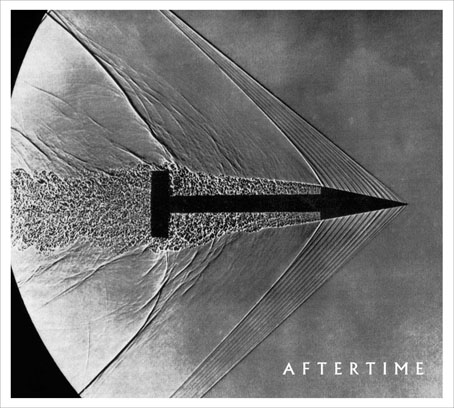
Despite appearances I’m still doing bits of design and layout work for various musicians. In the past week I’ve been trying to reorganise this sprawling website a little so it’s easier to add new work quickly and easily. One recent job was more layout than design, a CD and vinyl package for a Roly Porter collection of instrumentals entitled Aftertime. Each track on the album is named after a different planet from Frank Herbert’s Dune books although the music isn’t as illustrative as that implies. Porter’s use of an Ondes Martenot and various acoustic instruments which he subjects to degrees of distortion is just the kind of thing I like hearing. One track can be heard at FACT where Porter is interviewed about his work. Aftertime is released this month on the Subtext label.

It is a rollicking saga that involves all sorts of things not normally associated with think tanks – chickens, pirate radio, retired colonels, Jean-Paul Sartre, Screaming Lord Sutch, and at its heart is a dramatic and brutal killing committed by one of the very men who helped bring about the resurgence of the free market in Britain.

Adam Curtis on the strange history of Britain’s think tanks and their hidden agendas.

• Other assorted music business: Getting down to the Cabinessence: “This is the first of what may become an intermittent series of observations about Smile, and how Brian Wilson tried to put his dream on this planet.” | After The Flood: Talk Talk’s Laughing Stock 20-Years On: a lengthy and detailed Quietus piece on one of the best albums of the 1990s. | Jonathan Barnbrook uses an old analogue video synth to create a visual accompaniment for Interplay by John Foxx & The Maths. The HD version is an eye-searing delight.

Meredith Yayanos favours the sister instrument of the Ondes Martenot, the theremin, which she uses to provide a spooky score for a new film, Empty Rooms. There’s more spectral ambience at her SoundCloud page.

giovani.jpg

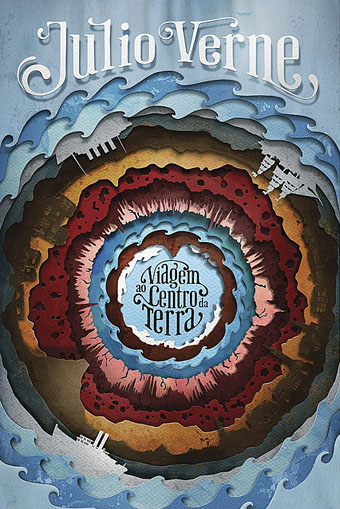
A Jules Verne cover by Carlo Giovani for Editora Ática.

• Sculptor and writer Josiah McElheny transforms the Whitechapel Gallery into a hall of mirrors.

Jacob’s Lament, an animated collaboration between illustrator Ian Miller and Stijn Windig.

Pornographic Poem (1967) by John Giorno.

Oscar Wilde grandson scorns “new” play.

• Manhattan in marble by Yutaka Sone.

Paul Atreides pt. 1 (1978) by Richard Pinhas | Harkonnen (1979) by Zed (Bernard Szajner) | Prophecy Theme (1984) by Brian Eno.

Screening Kafka

kafka1.jpg

Kafka (1991).

This week I completed the interior design for a new anthology from Tachyon, Kafkaesque, edited by John Kessel and James Patrick Kelly. It’s a collection of short stories either inspired by Franz Kafka, or with a Kafka-like atmosphere, and features a high calibre of contributions from writers including JG Ballard, Jorge Luis Borges, Carol Emshwiller, Jeffrey Ford, Jonathan Lethem and Philip Roth, and also the comic strip adaptation of The Hunger Artist by Robert Crumb. When I knew this was incoming I rewatched a few favourite Kafka-inspired film and TV works, and belatedly realised I have something of a predilection for these things. What follows is a list of some favourites from the Kafkaesque dramas I’ve seen to date. IMDB lists 72 titles crediting Kafka as the original writer so there’s still a lot more to see.

wellestrial.jpg

The Trial (1962), dir: Orson Welles.

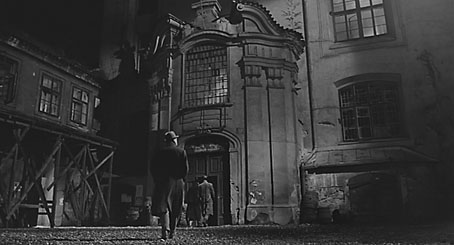
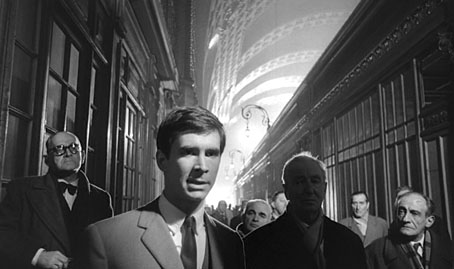
Orson Welles in one of his Peter Bogdanovich interviews describes how producer Alexander Salkind gave him a list of literary classics to which he owned the rights and asked him to pick one. Given a choice of Kafka titles Welles says he would have chosen The Castle but The Trial was the only one on the list so it’s this which became the first major adaptation of a Kafka novel. Welles always took some liberties with adaptations—even Shakespeare wasn’t sacred—and he does so here. I’m not really concerned whether this is completely faithful to the book, however, it’s a first-class work of cinema which shows Welles’ genius for improvisation in the use of the semi-derelict Gare d’Orsay in Paris as the main setting. (Welles had commissioned set designs but the money to pay for those disappeared at the last minute.) As well as scenes in Paris the film mixes other scenes shot in Rome and Zagreb, with Anthony Perkins’ Josef K frequently jumping across Europe in a single cut. The resulting blend of 19th-century architecture, industrial ruin and Modernist offices which Welles called “Jules Verne modernism” continues to be a big inspiration when I’m thinking about invented cities. Kafka has been fortunate in having many great actors drawn to his work. Here with Perkins there’s Welles himself as the booming and hilarious Advocate, together with Jeanne Moreau, Romy Schneider and Akim Tamiroff.

brazil.jpg

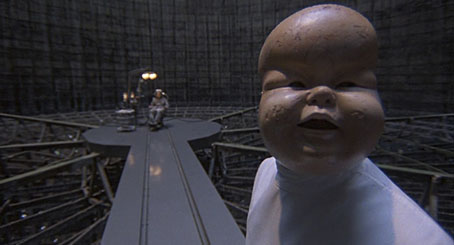
Brazil (1985), dir: Terry Gilliam.

Having watched Brazil again recently I was struck by how much it resembles the popular view of Kafka’s worlds rather than the Orwellian nightmare which Terry Gilliam first intended. The story is powered by a bureaucratic error caused by a crushed insect, after all, and Gilliam follows Welles in mashing up the styles and motifs of an authoritarian century to create a hybrid world he described as being “on the Belfast/Los Angeles border”. Tom Stoppard had a hand in the screenplay, and there’s another great cast with Jonathan Pryce, Katherine Helmond and Ian Holm. Also a nod to an Orson Welles role with the character named Harvey Lime.

insuranceman.jpg

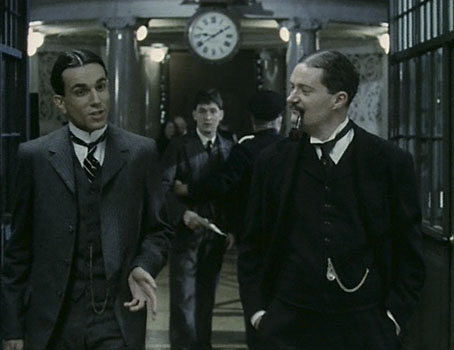
The Insurance Man: Daniel Day-Lewis, Robert Hines & Jim Broadbent.

The Insurance Man (1986), dir: Richard Eyre.

Jim Broadbent played a plastic surgeon in Brazil; here he’s a clerk in the offices of the Worker’s Accident Insurance Institute in Prague. Writer Alan Bennett was preoccupied with Kafka in the mid-1980s: his stage play, Kafka’s Dick (the title does indeed refer to the writer’s penis), was staged the same year as this TV film directed by Richard Eyre, a 70-minute drama which sees a young factory worker trying to find a cure for an industrial illness at the Insurance Institute where one “Doctor Kafka” is employed. Needless to say, his quest for health and some measure of justice becomes Kafkaesque. Kafka here is portrayed by Daniel Day-Lewis in a typically enthralling performance which is never mannered but makes him seem a stranger creature (and a more sympathetic clerk) than his fellow workers. Most of this was filmed in Liverpool in some wonderful old office buildings using a sombre blue/grey palette. As with all Bennett’s dramas the dialogue is a treat. The film is now available on DVD in the Alan Bennett at the BBC collection.

metamorphosis.jpg

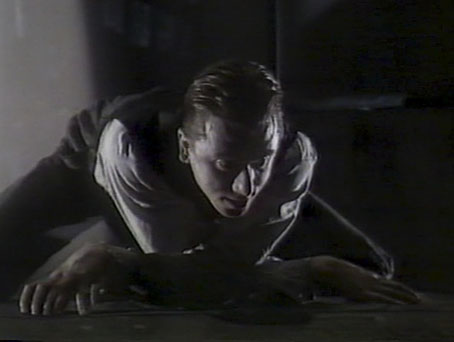
Tim Roth as Gregor Samsa.

Metamorphosis (1987), dir: Jim Goddard.

Another TV drama based on one of Steven Berkoff’s three stage adaptations of Kafka in which he also plays the part of Mr Samsa. Berkoff’s preference for physical theatre means there are no insect suits or special effects here, Gregor Samsa’s insectile nature is conveyed entirely through Tim Roth’s energetic performance, with shrieks, twisted limbs, and a climbing frame for when he needs to scuttle up the wall or hang from the ceiling. Not available on DVD but it’s scattered around YouTube if you can be bothered.

berkofftrial.jpg

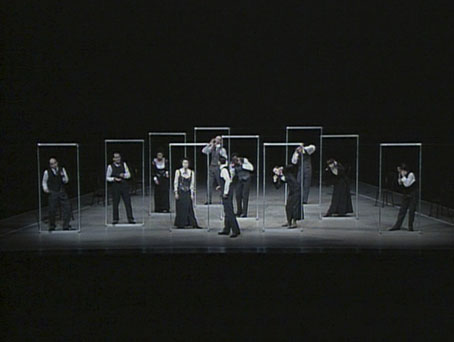
The Trial (1991), dir: Steven Berkoff.

Another Berkoff adaptation which is available on DVD from his own company. As with his Salome, this is a filmed stage performance and highly recommended for its fidelity to the book, although of the two I prefer the Oscar Wilde play. Berkoff’s great innovation is the bare stage where the only props are a couple of chairs and a number of tall metal frames, one for each performer, which the actors use to create doors, windows, picture frames and even a series of moving corridors. Berkoff himself plays Titorelli the painter as a hyperactive Dalí type.

kafka2.jpg

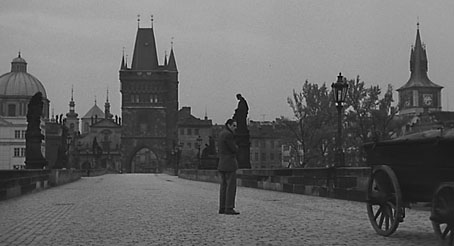
Kafka (1991), dir: Steven Soderbergh.

A cult film of mine which I’ve written about before so there’s no need to go into great detail. It’s a shame that Daniel Day-Lewis couldn’t have played Kafka in this one instead of Jeremy Irons who does a decent job but always seems slightly wrong for the part. Ian Holm in Brazil had a role named after Terry Gilliam’s MAD-magazine mentor Harvey Kurtzman; here Holm is named after one of the great silent film directors in the role of the enigmatic Doctor Murnau. Shot on location in Prague.

franzkafka.jpg

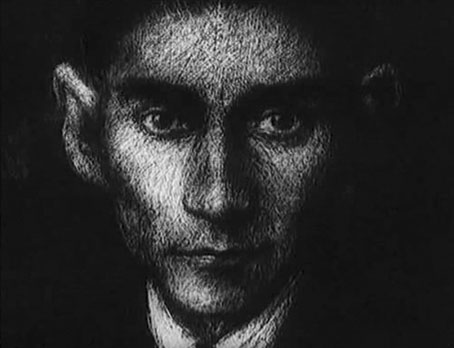
Franz Kafka (1992), dir: Piotr Dumala.

After all the fake Kafkas, something which is at least close to genuine article in a short and wordless animated film by Piotr Dumala. Can be watched in its entirety here.
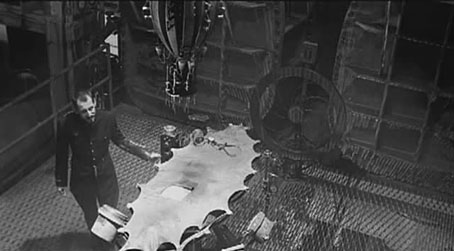

zoetrope.jpg

Zoetrope (1999), dir: Charlie Deaux.

Kafka’s In the Penal Colony is moved from its sun-blasted location to what looks like the interior of a power station in Charlie Deaux’s frenetic adaptation. The emphasis is very much on the industrial with the film nodding as much to David Lynch as Franz K. (And whatever happened to David Lynch’s proposed adaptation of The Metamorphosis?) The rumbling, clanging soundtrack by Lustmord provides the requisite Alan Splet-like atmospherics. Available on DVD from Soleilmoon.

Previously on { feuilleton }
Die Andere Seite by Alfred Kubin
Designs on Kafka
The Hourglass Sanatorium by Wojciech Has
Kafka’s porn unveiled
A postcard from Doctor Kafka
Alexandre Alexeieff and Claire Parker
Hugo Steiner-Prag’s Golem
Steven Soderbergh’s Kafka
Kafka and Kupka

Weekend links 75

darde.jpg

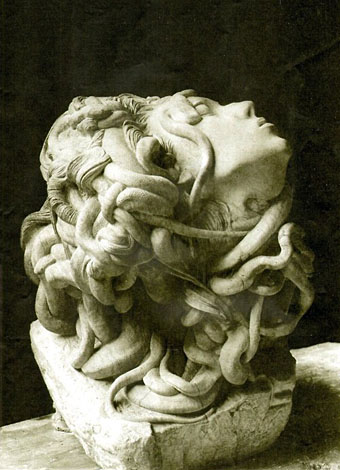
Eternal Pain (1913) by Paul Dardé. (And also here)

Rain Taxi caused a stir this week with its savaging of Hamlet’s Father by science fiction writer Orson Scott Card. The book is another of Card’s blatherings about the hell of being homosexual dressed in garments stolen from the unfortunate William Shakespeare. Rain Taxi made the obvious point about many of Shakespeare’s sonnets being homoerotic. For my part I was more appalled by the quoted extract which reduced one of the greatest plays in the language to that lifeless, cardboard-character-speak which is endemic in bad genre writing. News of the travesty quickly spread to gay news blogs, The Outer Alliance and elsewhere, ensuring that what’s left of Card’s reputation continues to spiral down a Mel Gibson-shaped black hole.

• “Sounds only like itself, like no one before or after.” Julian Cope on Tago Mago by Can which will be reissued in a new edition in November. Nice to see the return of the original sleeve design, something I saw once in a record shop then didn’t see again for years. For a long time I thought I’d imagined it. Related: two German art exhibitions inspired by the group.

The Responsive Eye (1965), a catalogue for the MoMA exhibition that launched Op Art. Also at Ubuweb: La femme 100 têtes, a film by Eric Duvivier based on the collage work by Max Ernst.

• More apocalyptic art: William Feaver on John Martin whose exhibition will be opening at Tate Britain later this month. There’s a trailer here.

Borges and I, an essay by Nandini Ramachandran. Related: Buenos Aires: Las Calles de Borges, a short film by Ian Ruschel.

• “Who was JG Ballard? Don’t ask his first biographer,” says Robert McCrum.

Biologically-inspired fabric and material design by Neri Oxman.

• Cross-pollinating subgenres: “Steampunk ambient” at Disquiet.

In the Shadow of Saturn, a photo by the Cassini spacecraft.

• The art and fashion designs of Alia Penner.

Fleet of hybrid airships to conquer Arctic.

• RIP Jordan Belson, filmmaker.

• Ten years of Ladytron whose new album is released on the 12th of September: Playgirl (2001), Seventeen (2002), Destroy Everything You Touch (2005), Sugar (2005), Ghosts (2008), Ace Of Hz (2011).

Weekend links 74

johnnyyesno.jpg

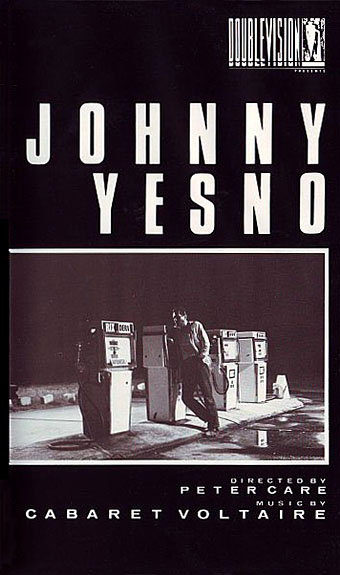
Johnny YesNo video cover, 1983. Design by Neville Brody.

Being a Cabaret Voltaire enthusiast of long standing it was good to hear last week about the imminent reappearance of Johnny YesNo, an hour-long film by Peter Care for which the Cabs provided the soundtrack. Mute Records will be releasing Care’s debut on DVD in a set which includes two versions of the film together with two music CDs. I never got to see the original release on CV’s VHS label, Doublevision; for most of the 1980s I didn’t even have a colour TV never mind a video recorder so I missed all CV’s videocassettes aside from Gasoline In Your Eye. The new edition will be available in November. Brainwashed has a list of the contents while The Quietus posted a clip from the new “redux” version. (And before anyone tells me it’s on YouTube…yeah, everything is on YT in shitty quality and barnacled with the misanthropy-inducing drivel which passes there for comment. If I’m going to watch something for the first time I’d prefer it to be on a shiny disc, thanks.)

• The world has noticed Terrence Malick again following the release of The Tree of Life. Malick’s second feature is returning briefly to UK cinema screens, an event which prompted David Thomson to ask Is Days of Heaven the most beautiful film ever made?

• This week in imaginative art: S. Elizabeth on The Fantastical Fairy Tale Art of Sveta Dorosheva, AS Byatt on the strange paintings of Richard Dadd (there’s another Dadd article here), and Rick Poynor on Chris Foss and the Technological Sublime.

Ethan Hein demonstrates how Alan Lomax came to have copyright control over many songs he had nothing to do with simply by recording traditional music.

Visual Vitriol:  The Street Art and Subcultures of the Punk and Hardcore Generation, a book by David Ensminger.

• More Club Silencio: Inside David Lynch’s Paris nightclub and a gallery of photos.

Histoire un-Naturelle, selected works by Ruth Marten.

Come hither: The deceptive beauty of orchids.

Facsimile Dust Jackets.

• More Peter Care: Just Fascination (1983) by Cabaret Voltaire | Sensoria (1984) by Cabaret Voltaire | Rise (1986) by Public Image Ltd.