
Viddy well: Back in the Chelsea Drug Store

drugstore.jpg

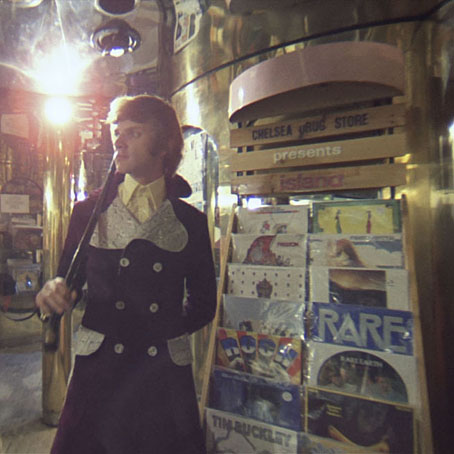
The Chelsea Drug Store, 49 King’s Road, London, circa 1970.

How quickly things change. It was almost six years to the day that I posted an unapologetically sedulous analysis of the record shop scene in Stanley Kubrick’s A Clockwork Orange, something that’s still one of the most regularly visited of all the entries here. That post concerned the excitement of being able to at last scrutinise on DVD a single shot whose details had earlier been obscured by no end of noise and interference, the embargoed film having previously been available in the UK on various bootleg videos. Fuzzy warbles indeed. The DVD wasn’t ideal, however, and many of the frame enlargements looked pretty shoddy. Last month I acquired a box of Blu-ray Kubrick films so all the images on that post have now been upgraded. There isn’t a great deal more to see in a shot that lasts all of sixty-six seconds, but John Alcott’s wide-angle photography is now crystal clear.

As for the location of the record shop, I noted in the original post that the famous Chelsea Drug Store building is now a McDonald’s. A place that once sold music and magazines becomes another outlet for an international burger chain; that’s the real future horror, not rampaging youth. See it up close on Google’s Street View.

alex.jpg

Alex and the sounds of 1970.

Previously on { feuilleton }
Kubrick shirts
A Clockwork Orange: The Complete Original Score
Juice from A Clockwork Orange
Clockwork Orange bubblegum cards
Alex in the Chelsea Drug Store

Weekend links 101

cabat.jpg

Kraken from Ernie Cabat’s Magical World Of Monsters (1992) at Monster Brains.

“I think for a lot of people who don’t read pulp growing up, there’s a real surprise that the particular kind of Pulp Modernism of a certain kind of lush purple prose isn’t necessarily a failure or a mistake, but is part of the fabric of the story and what makes it weird. There’s a big default notion that ‘spare,’ or ‘precise’ prose is somehow better. I keep insisting to them that while such prose is completely legitimate, it’s in no way intrinsically more accurate, more relevant, or better than lush prose.” China Miéville at Weird Fiction Review expressing an opinion that few in the literary world ever articulate, never mind agree with. Far more common is (to pick a recent example) Ursula K Le Guin dismissing Cormac McCarthy for “pretentious prose”.

• “Militant feminist scientists brainwash a research subject to assassinate the Welsh Minister of Prostitution. Meanwhile World War III is being fought and the USA has been invaded.” The IMDB précis for Taking Tiger Mountain (1983), a feature film directed by Tom Huckabee from a script by William Burroughs, and featuring a 19-year-old pre-Aliens/Near Dark Bill Paxton. The director discusses the film’s production at Screen Slate and attends a rare screening at Spectacle, Brooklyn, NYC, today (March 25th). YouTube has a three-minute clip. Surprising this has remained buried for so long. When can the rest of us get to see it?

• Prestel have published the catalogue for In Wonderland: The Surrealist Adventures of Women Artists in Mexico and the United States. AnOther previewed some of the contents. The exhibition runs at the LACMA, Los Angeles, until 6th May.

…gays only make up about 3% of the population so we spend our whole lives “translating” straight movies, books, ballets into gay terms and studying the heterosexuals around us—we know much more about them than they know about us, just as blacks know a lot about whites but whites know virtually nothing about blacks.

Edmund White (again) interviewed by Frank Pizzoli at Lambda Literary Review.

• New on Caroline True Records: Jon Savage’s “Fame”, Secret History of Post-Punk 1978–81. “Some of it doesn’t sound like anything that has happened since,” says Savage. Indeed. FACT has the track list which I was pleased to see includes Chrome among the usual suspects. Hear a 12-minute promo mix at Soundcloud.

guerin.jpg

The Colossi of Memnon by Jules Guerin. From Egypt and its Monuments (1908) by Robert Hichens at Golden Age Comic Book Stories.

Gay Life Stories, “a colourful compendium of same-sex love through the ages” by Robert Aldrich. Reviewed here. Related: Alice Dreger asks “Are straight people born that way?”

• Clive Hicks-Jenkins created a series of designs for a Washington DC performance of Stravinsky’s The Soldier’s Tale. Follow their evolution in reverse order at his blog.

• Hocus Pocus: Margaret Eby on the brief epistolary relationship between Harry Houdini and Arthur Conan Doyle.

Rick Poynor on more cover designs for JG Ballard’s Crash.

London, city of dreams and rivers, caught on Polaroid.

• Photo prints by Thom Ayres for sale at Society6.

B*tches in Bookshops

• Meet You In The Subway (1979) by Chrome | New Age (Version III) (1980) by Chrome | Danger Zone (1981) by Chrome | Firebomb (1982) by Chrome.

Creel Pone

creel1.jpg

One of the many surprises for me about Enter the Void was finding recordings by electronic composer Jean-Claude Eloy mixed into its droning soundscape, namely extracts from his 1979 album, Shànti. I’d been listening to this a week or so before watching the film after having downloaded a large quantity of obscure electronic releases on the bootleg Creel Pone label.

creel3.jpg

Flowers Of Evil (1969) by Ruth White.

The Creel Pone project by Keith Fullerton Whitman began with the intention of reissuing in a limited form 100 albums of electronic or electro-acoustic music dating from the period 1947 to 1983 (or 1952 to 1984 according to the label seal); The Analogue Age, in other words. Most of the albums were long out of print, and few had ever been available on CD when the project began although some have since had official reissues. The recordings were transferred from vinyl then burned to 50 CD-Rs per album, each release coming in a CD-sized facsimile of the original cover. Simon Reynolds wrote a piece about the label for The Wire in 2010 but I first encountered the releases a couple of years earlier via an acquaintance who was one of the collectors trying to accumulate the entire run. The run finished some time ago so the reissues themselves will soon be as difficult to find as the releases they made available, hence the recourse to mp3, and this cache of almost the entire catalogue. I haven’t listened to everything there yet (iTunes tells me this would take 2.2 days, non-stop)—and I find my patience often runs out with tape-collage electro-acoustic compositions unless I’m in the mood—but some of these albums are so good, the Thomas Köner-like Shànti among them, you have to wonder why they were overlooked for so long. A few of the uploads have tracks missing, and they’re all variable quality, but you won’t find this amount of Creel Pone material anywhere else in a hurry. (There’s also no guarantee they’ll be there for long so don’t complain to me if you’re visiting this post after they’ve all been deleted.)

creel6.jpg

Musique Pour Le Futur (1970) by Nino Nardini.

Discogs has an incomplete catalogue listing. Several of Jean-Claude Eloy’s albums are now available on CD. Gil Mellé’s excellent soundtrack for The Andromeda Strain was given a limited CD release two years ago but is out of print again. For some recordings it seems, the struggle to reach an audience is a continual one.

creel4.jpg

The Andromeda Strain: Original Electronic Soundtrack (1971) by Gil Mellé.

creel7.jpg

Pythagoron (1977) by Pythagoron™

creel5.jpg

Reflecting On The First Watch, We Uncover Treasure Buried For The Blind (1978) by Cellutron & The Invisible.

creel2.jpg

Shànti (1979) by Jean-Claude Eloy.

Previously on { feuilleton }
Enter the Void
Cristalophonics: searching for the Cocteau sound
The Avant Garde Project

Philippe Druillet album covers

druillet1.jpg

Docteur Faust (1971) by Igor Wakhévitch.

Philippe Druillet: album cover artist. As with John Martin, I’m surprised there aren’t more examples. Once again, Discogs.com proves incomplete so I’ve added a couple more including the first on this list, Docteur Faust. If you know of any others, please leave a comment.

Igor Wakhévitch’s berserk masterpiece is a cult item in this house, and something I’ve written about already. The cover art is the icing on an unclassifiable cake.

druillet10.jpg

Grail (1970) by Grail.

The cover is the opening page of The Wild Wind Isles, one of Druillet’s Lone Sloane stories. Produced by Rod Stewart; did you notice? “We are sailing…”

druillet4.jpg

Electric Ladyland (1975) by The Jimi Hendrix Experience.

A gatefold sleeve for a series of four Hendrix reissues on the Barclay label. The other covers were provided by Moebius, Jean Solé and an artist unidentified on the link above but it looks to me like the work of Philippe Caza.

druillet3.jpg

Black Sun (1978) by Black Sun.

Black suns are a regular feature of Druillet’s work (and mine, ahem) so the artist at least suits the title. The debut album of a short-lived French funk/soul group.

East/West (1980) by Richard Pinhas.

The French equivalent of Krautrock doesn’t have a name but Richard Pinhas is one of its leading practitioners. This is still my favourite among his solo works, not least because it’s more successfully musical than other albums which feature great slabs of guitar or synth doodling. In addition to a cover of David Bowie’s Sense Of Doubt there’s also science fiction author Norman Spinrad ranting through a vocoder on the opening and closing tracks. The great cover art is a page from Druillet’s 1980 adaptation of Flaubert’s Salammbô.

Continue reading “Philippe Druillet album covers”

Weekend links 99

moebius.jpg

From the Crystal Saga portfolio (1986) by Moebius. Via Quenched Consciousness.

Moebius: A while ago, [science fiction] was filled with monstrous rocket ships and planets; it was a naive and materialistic vision, which confused external space with internal space, which saw the future as an extrapolation of the present. It was a victim of an illusion of a technological sort, of a progression without stopping towards a consummation of energy. But we’ve completely changed that vision. It’s been a sharp, radical change, and somewhat brutal.
HM: Why brutal?
Moebius: Because all those beautiful projects we believed in are gone. But the real sense of science fiction is the discovery that the voyage is interior, and the real energy, the rockets of the past, is what is contained in people’s spirits.
HM: One doesn’t have to read other people’s visions then, one can make the discovery oneself?
Moebius: Well, that, and also the fact that the “new planet” of old science fiction is right here: it’s the Earth.

The Moebius Interview by Diana K. Bletter, Heavy Metal, August 1980.

RIP Jean Giraud, aka Moebius, one of the great artists of the 20th century. My approach to drawing comics was almost wholly derived from the illustrational style of the French, Belgian and other artists being published in Heavy Metal magazine in the late 1970s/early 1980s. Many of the stories were appearing in English for the first time, and for me they revitalised a medium in which (undergrounds aside) I’d lost all interest. It wasn’t only the exceptional artwork that was attractive. The narratives of Moebius, Druillet, Bilal and co. presented a more sophisticated approach to science fiction and fantasy than the simple-minded fare filling the superhero titles or the pages of 2000 AD. Moebius’s work was wittier, sexier and far more imaginative than any American comics I’d seen up to that time. Some of the stories read like graphic equivalents of New Worlds-era science fiction so it came as no surprise to find Moebius drawing a strip called The Airtight Garage of Jerry Cornelius (the title was later amended at Moorcock’s request) while Druillet in his September 1980 Heavy Metal interview mentioned enjoying books by William Burroughs, Michael Moorcock and Thomas Disch, and singled-out Ballard’s Crash as a favourite novel. Without the examples of Druillet and Moebius (and the intoxicating inspiration of the October 1979 issue of Heavy Metal) I wouldn’t have spent 17 months adapting The Call of Cthulhu as a comic strip.

Hasko Baumann’s 2007 documentary, Moebius Redux: A Life in Pictures (some of which can be seen on YouTube) is a good place to start when trying to appraise Jean Giraud’s extensive career. The film is now available on DVD.

Update:
The hour-long cut of Moebius Redux has been posted to Vimeo
An obituary by Kim Thompson at The Comics Journal
The Moebius posts at But Does It Float

moebius2.jpg

From Les Yeux du Chat (1978) by Jodorowsky & Moebius. Via Quenched Consciousness.

• “Naked Lunch,” Ballard wrote later, “was a grenade tossed into the sherry party of English fiction.” The criss-crossing careers of JG Ballard and William Burroughs are examined in detail at RealityStudio. Related: The Discipline of D.E. (1982) by Gus Van Sant and The Unlimited Dream Company (1983) by Sam Scoggins.

• Dr John’s forthcoming album, Locked Down, has been produced by The Black Keys‘ Dan Auerbach. Those of us who favour the Doctor’s voodoo-inflected early albums are hoping this might mean he gets groove back after wandering for years in an MOR swamp. One of the new recordings, Revolution, sounds promising.

I don’t think sexuality is fixed anymore. I think more from the gay male side than the lesbian side, there is often a wish for things to be fixed. I heard Lady Gaga’s Born This Way and I don’t know why they like it. Maybe, they need more certainty than girls do. For me, it’s like why do you care anyway? Maybe you were, maybe you weren’t. What’s the big deal? I can’t connect to that emotionally, so it baffles me.

Jeanette Winterson talks to Sassafras Lowrey.

• “In [Jacob’s Room], [Virginia] Woolf makes the subject matter not Jacob himself but the ways in which we know and don’t know each other – the gaps in our knowledge.” Alexandra Harris on Modernism in art and literature.

• The Northwest Film Forum in Seattle hosts Magick in Cinema on 5th April, an evening of occult-themed short films which includes a rare screening of Curtis Harrington’s Wormwood Star.

• John Bertram’s Lolita cover competition from 2009 is due to appear in June as a book-length study entitled Recovering Lolita. Bertram previews the contents here.

• “Erotic fiction is having a steamy renaissance and its hottest authors are women.”

LSD helps to treat alcoholism.

• The other Moebius (Dieter): News (1980) by Moebius & Plank | Tollkühn (1981) by Moebius & Plank | Conditionierer (1981) by Moebius & Plank.