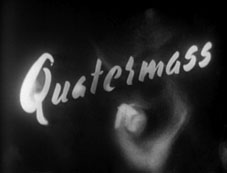
The man who saw tomorrow

quatermass_2.jpgNigel Kneale created reality TV without realising it. Comedian Mark Gatiss recalls his turbulent relationship with the ‘TV colossus’ who died this week.

When Big Brother began on Channel 4 in 2000, I took a principled stand against it. “Don’t they know what they’re doing?” I screamed at the TV. “It’s The Year of the Sex Olympics! Nigel Kneale was right!”

In 1968’s The Year of the Sex Olympics, Kneale, a pioneering writer of TV drama who died this week, ingeniously predicted the future of lowest-common-denominator TV. The programme kept a slavering audience pacified with such blackly funny concepts as The Hungry/Angry Show (in which senile old men throw food at one another), the titular Olympics, and the ultimate programme, in which a family are marooned on an island and then watched on camera, 24 hours a day. Yesterday’s satire is today’s reality. Or today’s reality TV.

A few years ago I tried to persuade The South Bank Show to devote an edition to Kneale, only to be told he wasn’t a “big enough figure”. This was doubly dispiriting, not only because, to anyone interested in TV drama, Kneale is a colossus, but because it seemed to confirm all the writer’s gloomy predictions regarding the future of broadcasting. Couldn’t the medium celebrate one of its giants?

Continued here.
It’s a pulp, pulp, pulp world

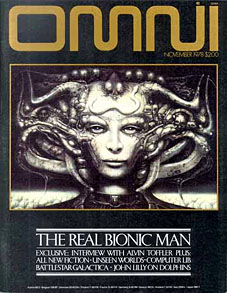
omni_7811.jpg

The (low-res) digitisation of the past continues apace on this site which is accumulating cover scans from a host of American sf and fantasy magazines. Oddly enough, I’d been looking for a place with pictures of the early Omni covers just recently, but this site didn’t come up on Google, or if it did, I missed it. I bought most of the first year’s run of Omni so it’s interesting seeing which covers I remember and which I’d forgotten about. Now, where is there a site with a complete run of New Worlds covers? Link via Strange Attractor.

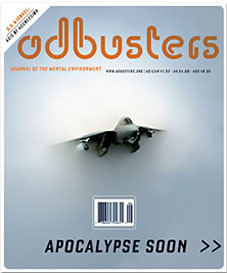
adbusters.jpg

And an item of contemporary magazine news:
Jonathan Barnbrook designs the latest issue of Adbusters.

Previously on { feuilleton }
• A few thousand science fiction covers
• Vintage magazine art II
• Neville Brody and Fetish Records
• View: The Modern Magazine
• Vintage magazine art
• Oz magazine, 1967–73

Penguin book covers

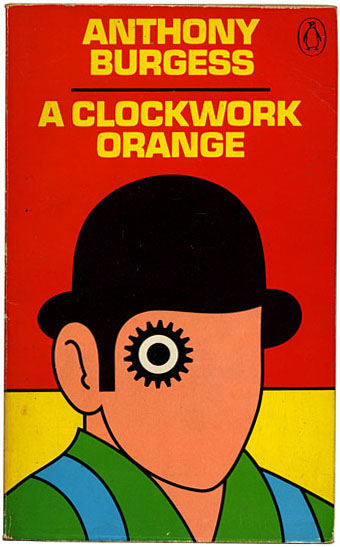
clockwork_cover.jpg

Nice collection of old covers for Penguin Books on Joe Kral’s Flickr pages. Looking over these, many of which are very familiar even though I’ve never owned them, makes me aware of how many hours of my life must have been spent in secondhand bookshops. The David Pelham cover for A Clockwork Orange has always been a favourite Penguin design. Pelham did a number of great covers for Penguin’s SF titles in the 1970s but the Burgess volume proved the most durable, unusually for a cover design surviving many reprintings. Via Boing Boing.

Elsewhere on { feuilleton }
• The book covers archive

Sans Soleil

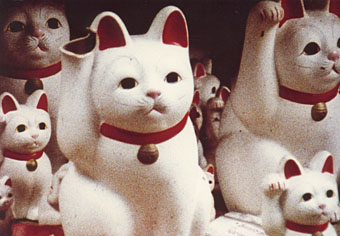
sans_soleil.jpg

Chris Marker might be considered the Borges of cinema if that designation didn’t seem limiting, with its implication that literature is superior to cinema, that filmmakers only receive true qualification as artists through comparison to more venerable creators, and so on. Marker, then, is Marker, although who Marker is remains obscure, as this article notes:

Some say his father was an American soldier, others that he (Marker) was a paratrooper in the Second World War. Still others, that he comes to us from an alien planet. Or the future. Throughout his career, he has rarely been interviewed, and even more rarely photographed. It is said that he responds to requests for his photograph with a picture of a cat – his favorite animal.

The possibility that he comes from the future is a compelling conceit when his most famous work, La Jetée, is a very subtle film about time travel (later remade with a huge budget and no subtlety at all by Terry Gilliam as Twelve Monkeys). JG Ballard and others have enthused about La Jetée for years but my favourite Marker film remains Sans Soleil, a meditation on time, memory, travel and culture, blending documentary images with a semi-fictional (?) voice-over narrative that resists easy summary. In this respect it parallels some of Borges’ essays or “ficciones”; like many of Borges’ best works it manages to be both personal and universal, drawing connections which seem obvious until you realise that no one has pointed them out in quite that way before. An equally fascinating companion to Sans Soleil is Marker’s CD-ROM, Immemory, a Mac-only release that’s already out-of-date in software terms (and since Classic stopped working on my Mac even I can’t use it for the time being).

This site presents a critical reading of Sans Soleil as a rather disjointed web experience. And you can read the text of the film here. Needless to say, none of these are very satisfying at all without the accompaniment of Marker’s images.