Weekend links 325

beeple.jpg

08-30-16 from the Everydays series by Beeple.

• “Monsieur de Bougrelon is a unique character: loquacious, proud, a leftover from an earlier age, wearing garish outfits and makeup that drips. To his speechless audience, he waxes nostalgic about his life as an exile in Holland, as well as what he calls “imaginary pleasures” – obsessions with incongruous people, animals, and objects. These obsessions are often sexual or border on the sexual, leading to shocking, surreal scenes. Monsieur de Bougrelon also enthuses over his beautiful friend Monsieur de Mortimer, making this novella one of the rare works of the nineteenth century to broach homosexuality in a meaningful way, years before Jean Cocteau and Jean Genet.” Monsieur de Bougrelon (1897) by Jean Lorrain will receive its first English publication by Spurl Editions in November.

• “…The Future seems in retrospect to have been no more than a spectacle, created by the optimistic few for the optimistic many, the readily gulled multitudes who had faith in technological seers just as an earlier generation had had faith in Great Men.” Jonathan Meades reviews Last Futures: Nature, Technology and the End of Architecture by Douglas Murphy.

In the Woods & On the Heath is a collection of 48 pieces of erotic prose and poetry by 24 writers, all of them illustrated by Van Rijn.

Borneman was widely read in European literature and, once settled in London, wasted no time bringing himself up to speed with developments in English-language writing, discovering a particular affinity with Hemingway and Joyce, not to mention American crime writers such as Carroll John Daly and Dashiell Hammett. This presumably explains the distinctive, sometimes highly eccentric style of The Face on the Cutting-Room Floor, which despite being set in an English film studio of the 1930s (which evokes images, perhaps, of genteel musical comedies performed in perfect RP accents), combines laconic, hardboiled dialogue with extended stream-of-consciousness passages, all filtered through the skewed phraseology of someone whose acquisition of English was still, to some extent, a work in progress.

Jonathan Coe on the mysteries of The Face on the Cutting-Room Floor, a novel by “Cameron McCabe” (Ernest Borneman)

• How Oscar Wilde paved the way for gay rights in the arts. Wilde will be honoured with a major exhibition in Paris later this month.

Noisy Rain is a free online publication dedicated to “artists working with the male figure and homo-eroticism”.

Dennis Cooper’s blog returns. The truth about Google’s deletion of the Blogspot account has finally emerged.

Peel Away The Ivy by The Pattern Forms will be release number 26 on the Ghost Box label in October.

• Glam Rock & Yorkshire Occult: Ben Myers on his novel Turning Blue.

• Mix of the week: Secret Thirteen Mix 195 by Jake Meginsky.

• At Phantasmaphile: Unarius: We Are Not Alone.

Blokdust is a browser-based musical instrument.

• Official trailer for David Lynch: The Art Life.

Future Dub (1994) by Mouse On Mars | Future Proof (2003) by Massive Attack | Future Past Perfect pt 01 by Carsten Nicolai
Weekend links 321

miyabi.jpg

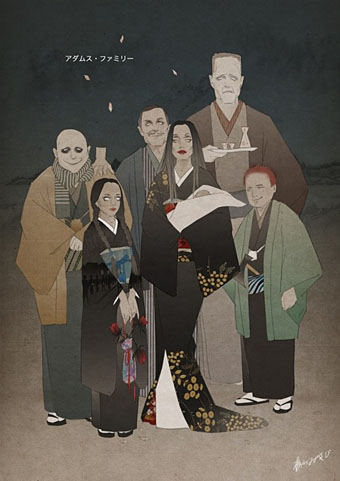
The Addams Family In Kimonos by Matsuyama Miyabi. Via S. Elizabeth.

• “They’re not the men you’ll walk down the street and lock eyes with, or that you’ll spot at a bar casually. They’re a fantasy.” Michael Valinsky reviewing Tom House: Tom Of Finland In Los Angeles edited by Michael Reynolds. Related (and almost a polar opposite): Nick Campbell on The Life to Come and Other Stories by EM Forster.

Randall Dunn, musician (Master Musicians of Bukkake), producer (Sunn O))), Earth, etc), engineer, discusses making and recording music.

John Waters brings back Multiple Maniacs: “Of course I went a little too far.” he says. Waters also talked about the film at Gawker.

Q: Most cherished book on your shelves? Why?

A: Depends on the day. Today it’s Blood Meridian by Cormac McCarthy. Blood Meridian is an indictment of Manifest Destiny, the Westward Expansion, of Hollywood and its portrayal of the west; it’s confrontational and bellicose. The sheer brutality of it affected me like I’d swallowed poison or taken a shot to the liver that I didn’t remember. Blood Meridian is a reminder that literature isn’t always tame. It can bite you.

Laird Barron talking to Smash Dragons about favourite writers and his own fiction

• In East Tower Dreaming Howlround, aka Robin the Fog, processes the sounds of a former BBC office building.

• At The Headless Hashasheen: Magic Mirrors and Specters: Paschal Beverly Randolph, Hashish, & Scrying.

• At Dangerous Minds: The astonishingly beautiful three-colour photography of Bernard Eilers.

Samm Deighan on Gothic Film in the ’40s: Doomed Romance and Murderous Melodrama.

• On a scale from 1–100, Milton Glaser rates every single Olympic logo design in history.

• The overwhelming A/V experience of Paul Jebanasam and Tarik Barri.

Patrick Feaster describes how to “play back” a picture of a sound wave.

• Mix of the week: Secret Thirteen Mix 192 by Shadows.

COLLAGE—The London Picture Archive

Madrigal Meridian (1978) by Tangerine Dream | Meridian Moorland (1979) by Peter Baumann | Meridian (2009) by Espers

The Mountain of Dead Selves

bradburn.jpg

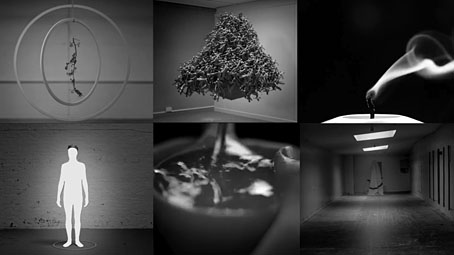
John Bradburn, an artist/filmmaker who also performs as Ferric Lux, notified me recently about his David Bowie-related project, The Mountain of Dead Selves, a video piece that was showing earlier this month at Vivid Gallery, Birmingham. Bradburn’s video, part of a group show, Constructing The Self: David Bowie, takes the occult influences of the Station To Station album as its subject. A short version of the video may be seen here although the gallery version was a looping piece which would no doubt appear very different when seen in situ.

Back in January I linked to some of the posthumous theorising around Bowie’s final album, Blackstar, including musings which looked back to Station To Station‘s Kabbalistic elements. It used to seem that discussion of Bowie and the occult would remain fixed on the 1970s so one of the many surprises about his final statement was the way the esoteric was brought to the fore again. The Mountain of Dead Selves won’t be the last exploration of this. There’s more from Ferric Lux here.

Weekend links 315

knights.jpg

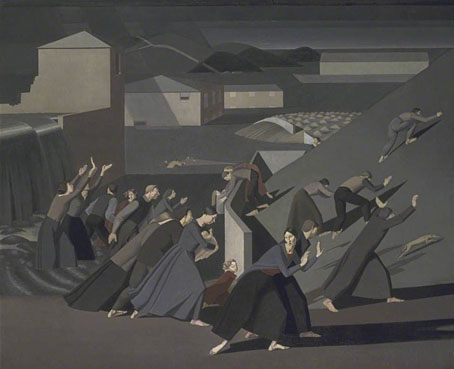
The Deluge (1920) by Winifred Knights.

Dennis Cooper‘s favourite fiction, poetry, nonfiction, film, music, art & internet of 2016 so far. (Thanks again for the nod to this blog!)

• At Literary Hub: Jonathan Russell Clark on Jorge Luis Borges, and Jon Sealy on why indie presses [in the US] are opening bookstores.

• “It’s not just about the music.” A conversation on the occult practices in the arts between poet Janaka Stucky and Peter Bebergal.

• Daisy Woodward talks to Andreas Horvath about Helmut Berger, Actor, a documentary about Visconti’s muse and lover.

• More Fritz Leiber: Brian J. Showers on his decision to republish Leiber’s horror novel, The Pale Brown Thing.

• Mixes of the week: Sextape 4 by Drixxxe, and Radio Oscillations #96 (Richard Pinhas/Heldon) by Iron Blu.

• The 5th Young One: Pay No Attention to the Girl Behind the Sofa; John Reppion on a television mystery.

• More reading suggestions: Cheerless beach reads for gloomsters and saddies by S. Elizabeth.

• Never the same film twice: Seances by Guy Maddin, Evan Johnson, Galen Johnson.

• How painter Winifred Knights became Britain’s “unknown genius”.

• The Journey & The Destination: An interview with Hawthonn.

Robert Latona goes in search of the grave of Constance Wilde.

• Invisible by Day: photos by Mikko Lagerstedt.

• A Queer Lit Q&A with Evan J. Peterson.

• RIP Michael Herr and Bernie Worrell.

Bridget Riley: The Curve Paintings.

• The typography of Blade Runner.

Japanese matchbox labels

SOS by Portishead

A Rainbow In Curved Air (1969) by Terry Riley | The Great Curve (1980) by Talking Heads | Dangerous Curves (2003) by King Crimson

Weekend links 314

alderslade.jpg

Avebury Kite (2006) by David Alderslade.

• “Klaus Mann, son of Thomas Mann, author of Mephisto, was one of the first in Germany to write gay novels and plays.” Walter Holland reviews Cursed Legacy: The Tragic Life of Klaus Mann by Frederic Spotts.

The Pale Brown Thing, a shorter/alternate version of Fritz Leiber’s supernatural masterwork, Our Lady of Darkness, is given a limited reprinting by Swan River Press next month.

• “Not only is metal not directly harmful to adolescent minds, as the thinking goes, it may actually be helpful.” Christine Ro on the reappraisal of a once-suspect musical genre.

Something of that tension between past and future is visible in Beardsley’s work. It is the art of a dying era peering, with a mixture of excitement and trepidation, into the next. For all the prancing and bravado, Beardsley’s art was really about finding something in which to believe—and if Beardsley came to believe in anything it was the deep black line. Shading held little interest for Beardsley, and color fascinated him not at all. The black line and white space were all he needed.

Morgan Meis on Aubrey Beardsley

• More of my art for Bruce Sterling’s forthcoming Dieselpunk novella, Pirate Utopia, has been revealed. Tachyon will be publishing the book in November.

• “Secretly, though, I frequent junk shops because I am wishing for some kind of transcendence,” says Luc Sante.

• Mixes of the week: Gizehcast #28 by Christine Ott, and a mix for The Wire by Asher Levitas.

• “It took centuries, but we now know the size of the Universe.” Chris Baraniuk explains.

Barnbrook Studios creates identity for Kubrick exhibition at Somerset House.

• Watch a haunting video from Subtext Recordings and Eric Holm.

• Folklore Tapes: A Rum Music Special by Joseph Burnett.

Brion Gysin’s Dreamachine is on sale again.

Rhys Chatham’s favourite albums.

A Guide to Occult London

Skulls and Bones

Zero Time (1979) by Chrome | Zero-Gravity (1996) by Sidewinder |  Zero Moment (2016) by Contact