El Lissitzky record covers

genx.jpg

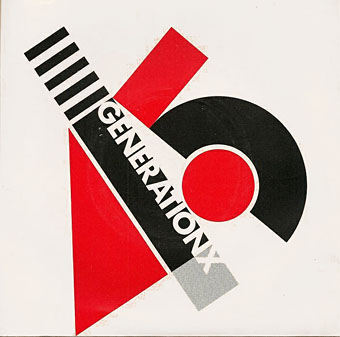
Your Generation (1977) by Generation X. Design by Barney Bubbles.

Continuing an occasional series about the work of particular artists or designers being used on record sleeves. El Lissitzky (1890–1941) is an interesting candidate in this area since his pioneering abstractions have greatly influenced subsequent generations of graphic designers. As a result of this you’re just as likely to find his Suprematist style being pastiched on an album cover as find one of his paintings decorating the sleeve. Pastiches are difficult to locate unless you already know they exist—or unless the album credits acknowledge the style they’re imitating—so this list will no doubt be incomplete.

Barney Bubbles’ design for the debut single by Generation X is the earliest example I’m aware of that makes use of the El Lissitzky style. It was also one of Bubbles’ first sleeves for a punk band, and a significant break with his often florid hippy designs.

kraftwerk1.jpg

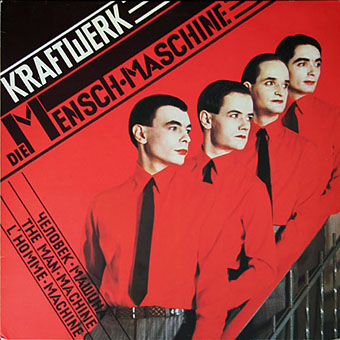
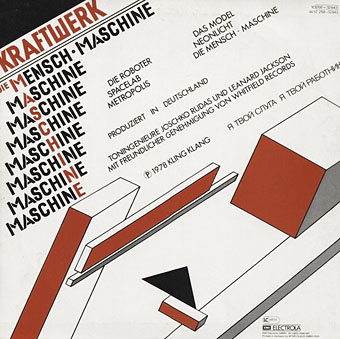
Die Mensch Maschine (1978) by Kraftwerk. Design by Karl Klefisch, “inspired by El Lissitzky”.

Kraftwerk’s seventh album uses Lissitzkian typography and graphics on its front and back covers. A very popular album with the post-punk crowd that would have been the first introduction for many people to El Lissitzky’s name. Kraftwerk still use that vibrant arrangement of black, red and white in their stage shows.

kraftwerk2.jpg

sakamoto1.jpg

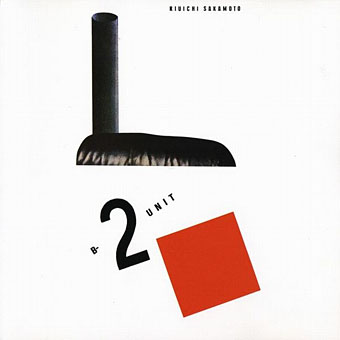
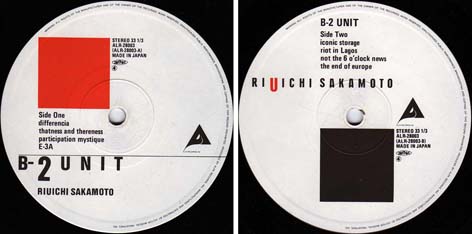
B-2 Unit (1980) by Riuichi Sakamoto. Design by Tsuguya Inoue.

More pastiche, this time borrowing from El Lissitzky’s Suprematist book for children: About Two Squares: In 6 Constructions: A Suprematist Tale (1922). The book’s two characters of a red square and a black square appear on the vinyl labels. This is a great album, incidentally, still my favourite by Sakamoto.

sakamoto2.jpg

Continue reading “El Lissitzky record covers”

Weekend links 221

cornell.jpg

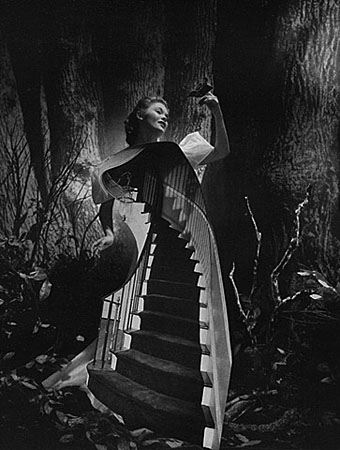
Untitled (Penny Arcade Portrait of Lauren Bacall) (1946) by Joseph Cornell.

• Having been a Bernard Szajner enthusiast for many years it’s good to see his music receiving some belated reappraisal. David McKenna talked to Szajner about his Visions Of Dune album (which is being reissued by InFiné next month), laser harps, The (Hypothetical) Prophets, and working with Howard Devoto.

• Priscilla Frank posts some big views of Marjorie Cameron’s occult paintings as a preview of the forthcoming exhibition at MOCA Pacific Design Center, Los Angeles.

• Fascinating reading in light of the recent kerfuffle over True Detective, Christopher Loring Knowles on the possible sources of HP Lovecraft’s Cthulhu Mythos.

Those who set up oppositions between the electronic technology and that of the printing press perpetuate Frollo’s fallacy. They want us to believe that the book—an instrument as perfect as the wheel or the knife, capable of holding memory and experience, an instrument that is truly interactive, allowing us to begin and end a text wherever we choose, to annotate in the margins, to give its reading a rhythm at will—should be discarded in favor of a newer tool. Such intransigent choices result in technocratic extremism. In an intelligent world, electronic devices and printed books share the space of our work desks and offer each of us different qualities and reading possibilities. Context, whether intellectual or material, matters, as most readers know.

Alberto Manguel, lucid as always, on the act and import of reading.

• “It’s time to give prog rock’s artist-in-residence Roger Dean his due,” says Amber Frost. No argument there, I did my bit in 2010.

• “Why do the covers of so many self-published books look like shit?” asks B. David Zarley.

• Mixes of the week: FACT mix 455 by Airhead, and Secret Thirteen mix 225 by Clock DVA.

• At Core77: Rain Noe chooses favourite skyscraper photos by Russian urban explorers.

• “O, Excellent Air Bag”: Mike Jay on the nitrous oxide fad of the early 19th century.

Nick Carr goes in search of Manhattan’s last remaining skybridges.

Lauren Bacall at Pinterest.

• Shaï Hulud (1979) by Zed (Bernard Szajner) | Welcome (To Death Row) (1980) by Bernard Szajner | Person To Person (1982) by The (Hypothetical) Prophets

Weekend links 220

waliszewska.jpg

Untitled painting by Aleksandra Waliszewska.

• Ben Wheatley’s forthcoming film of High-Rise by JG Ballard now has its own Tumblr. This will no doubt be spoilerific so I won’t keep on visiting but it’s there if you require it. More Ballardianism: “Worshipping the Crash” at BLDGBLOG.

• “Aickman wandered through the sixties fantasy landscape like some curmudgeonly fetch, returning from the fin de siècle heyday of the ghost story.” Boyd Tonkin profiles Robert Aickman, writer of peerless “strange stories”.

• At Dangerous Minds: “Raise a glass to Cthulhu at the Lovecraft Bar”. Looks more like a Captain Nemo bar to me (not that there’s anything wrong with that) but I appreciate the gesture.

But to demand that a work be “relatable” expresses a different expectation: that the work itself be somehow accommodating to, or reflective of, the experience of the reader or viewer. The reader or viewer remains passive in the face of the book or movie or play: she expects the work to be done for her.

Rebecca Mead on The Scourge of Relatability

• “Space as a paranoid, static rumble featuring: 20jfg, Ben Frost & Daníel Bjarnason, Coil & Eduard Artemiev”. 20 Jazz Funk Greats on the pleasures of the Solaris soundtrack.

• What do Hawkwind, Harry Nilsson, Stereolab and The Supremes have in common? David Stubbs examines the legacy of Neu! and Klaus Dinger’s “Dingerbeat”.

• A reminder that A Year in the Country features a host of worthwhile links and associations for the Hauntologically persuaded.

Rouge Louboutin, an ad by David Lynch. Related: An improptu biscuit ad by the Eccentronic Research Council.

• Mix of the week (a year old but no matter): JG Ballard Zoom Lens Mix by Bernholz.

• At 50 Watts: More illustrated sheet music covers by Einar Nerman.

Five book cover designers and the books that inspire them.

Tove Jansson would have been 100 this week.

Pangaea with modern borders

Solaris: Dream (1990) by Edward Artemyev [sic] | Solaris (2000) by Photek | Simulacra I (2011) by Ben Frost & Daníel Bjarnason

Synthesizing

synths1.jpg

Tangerine Dream’s Chris Franke, 1973.

Following yesterday’s post, more synth-mania with an emphasis on the Analogue Seventies. YouTube is laden with this stuff but the best things often take some searching out.

Tangerine Dream, Paris, 1973
This is one I’d not seen before, Tangerine Dream when they were still in their Krautrock phase prior to signing to Virgin. The music sounds like outtakes from the Atem album, and as usual with these films it’s great to see what instruments are being used.

synths2.jpg

Tangerine Dream at Coventry Cathedral, 1975
Baumann, Franke and Froese again performing one of their cathedral concerts. Tony Palmer directed this but the sound was lost so the 27-minute film has edits of the Ricochet album as the soundtrack. (See Voices in the Net.) Ricochet was compiled from live recordings from the same period so it’s not so inappropriate.

synths3.jpg

Klaus Schulze, 1977
Klaus Schulze played drums on the first Tangerine Dream album, Electronic Meditation (1970), but was never an official member of the group. This lengthy improvisation is typical of the swathes of beatless music he was producing for much of the 1970s.

synths6.jpg

Laurie Spiegel, 1977
Laurie Spiegel demonstrates one of the earliest digital synthesizers. Spiegel’s 1980 album, The Expanding Universe, was reissued in 2012, and is well worth seeking out. There’s more rare analogue and digital synthesis on her YouTube channel.

synths4.jpg

Vangelis, 1978
Vangelis in the studio recording the China (1979) album. If you can overlook the Chinoiserie clichés there’s some very good music on this release, some of which looks forward to the Blade Runner soundtrack.

synths7.jpg

3-2-1 Contact, 1980
A great little film with Suzanne Ciani demonstrating synthesizers for a show on the Children’s Television Workshop. Featuring an oscilloscope and a Prophet 5.

synths5.jpg

The Original New Timbral Orchestra
Malcolm Cecil and Robert Margouleff made their name as Tonto’s Expanding Head Band, “Tonto” being Cecil’s custom-built TONTO (The Original New Timbral Orchestra) synthesizer. Cecil shows off his analogue gear in this short film.

Previously on { feuilleton }
Tangerine Dream in Poland
Electronic Music Review
Tonto’s expanding frog men
A Clockwork Orange: The Complete Original Score
White Noise: Electric Storms, Radiophonics and the Delian Mode

Tangerine Dream in Poland

td1.jpg

The conjunction this month of the Sorcerer reissue and Celestite, the latest album from Wolves In The Throne Room, has had me listening to a lot of electronica from the 70s and 80s. This in turn led to the discovery of a Polish TV broadcast of the concert Tangerine Dream played in Warsaw on 10th December, 1983, the end of a lengthy world tour which included a date in Manchester on 1st November, 1982, that I was fortunate enough to see. Anyone familiar with the Johannes Schmoelling period of the group will probably know the Logos album, a recording of the concert played at the Dominion theatre, London, a few days after the Manchester gig. At this point the group was playing the same set (with minor variations) at each performance. The Poland event, by contrast, was a special concert taking place in what was still a part of the Soviet bloc for which the group composed over two hours of entirely new music. The full concert was documented on a double-vinyl set, Poland, released a year later, an album I used to play regularly, so it’s fascinating seeing the first half hour being performed here. Also good to see the Schmoelling line-up in action; there’s a fair amount of film of the group from the 1970s but this is the first substantial footage I’ve seen from the 1980s. The TV producers seemed a little confounded by how to present this unorthodox music, so between shots of the group there are cutaways to showroom dummies (shades of Kraftwerk), Polish street scenes, and a woman dancing around in a manner that seems hopelessly naive to a jaded Western viewer. The blue triangle stage set was a nod to the White Eagle album sleeve.

td82.jpg

Tour programme.

Poland was the last Tangerine Dream album I enjoyed wholeheartedly. The final studio release with Schmoelling, Le Parc (1985), had some high points but was more like one of the soundtrack albums the group were producing in increasing numbers at the time. I saw them perform again in 1986 when Paul Haslinger had replaced Schmoelling and the concert sent me to sleep for a minute, after which I decided that it was time for Tangerine Dream and I to go our separate ways.