A playlist for Halloween

rethel.jpg

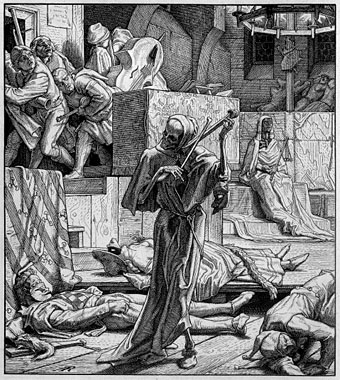
Der Tod als Erwürger (1851) by Alfred Rethel.

It’s a fact (sad or otherwise) that a substantial percentage of my music collection would make good Halloween listening but in that percentage a number of works are prominent as spooky favourites. So here’s another list to add to those already clogging the world’s servers, in no particular order:

Theme from Halloween (1978) by John Carpenter & Alan Howarth.
What a surprise… All John Carpenter‘s early films have electronic scores and great themes, Halloween being the most memorable, and one that’s gradually infected the wider musical culture as various hip hop borrowings and Heat Miser by Massive Attack demonstrate.

Monster Mash (1962) by Bobby “Boris” Pickett.
The ultimate Halloween novelty record. A host of imitators followed the success of this single while poor Bobby struggled to be more than a one-hit wonder. It wasn’t to be, this was his finest hour. Available on These Ghoulish Things: Horror Hits for Halloween with some radio spots by Bobby and a selection of other horror-themed rock’n’roll songs.

The Divine Punishment (1986) & Saint of the Pit (1988) by Diamanda Galás.
Parts 1 & 2 of Galás’s Masque of the Red Death, a “plague mass” trilogy based on the AIDS epidemic. These remain my favourite records by Ms Galás; on the first she reads/sings passages from the Old Testament accompanied by sinister keyboards, making the Bible sound as steeped in evil and metaphysical dread as the Necronomicon. On Saint of the Pit she turns her attention to French poets of the 19th century (Baudelaire, Gérard de Nerval & Tristan Corbière) while unleashing the full power of her operatic vocalizations. Einstürzende Neubauten’s FM Einheit adds some thundering drums. “Correct playback possible at maximum volume only.” Amen to that.

The Visitation (1969) by White Noise.
An electronic collage piece about a ghostly lover returning to his grieving girlfriend. White Noise were David Vorhaus working alongside BBC Radiophonic Workshop pioneers Delia Derbyshire and Brian Hodgson to create an early work of British electronica and dark psychedelia. The Visitation makes full use of Derbyshire and Hodgson’s inventive tape effects and probably accounts for them being asked to score The Legend of Hell House a few years later. Immediately following this is the drums and screams piece, Electric Storm In Hell; play this loud and watch the blood drain from the faces of your Halloween guests.

Zeit (1972) by Tangerine Dream.
Subtitled “A largo in four movements”, Zeit is Tangerine Dream’s most subtle and restrained album, four long tracks of droning atmospherics.

The Masque of the Red Death (1997) read by Gabriel Byrne.
From Closed On Account Of Rabies, a Poe-themed anthology arranged by Hal Willner. The readings are of variable quality; Christopher Walken’s The Raven is effective (although I prefer Willem Defoe’s amended version on Lou Reed’s The Raven) while Dr John reads Berenice like one of Poe’s somnambulists. Gabriel Byrne shows how these things should be done.

De Natura Sonoris no. 2 (1971) by Krzysztof Penderecki.
More familiar to people as “music from The Shining“, this piece, along with much of the Polish composer‘s early work, really does sound like music in search of a horror film. His cheerily-titled Threnody For The Victims Of Hiroshima is one piece that won’t be used to sell cars any time soon. Kubrick also used Penderecki’s equally chilling The Dream of Jacob for The Shining score, together with pieces by Ligeti and Bartók.

Treetop Drive (1994) by Deathprod.
Helge Sten is a Norwegian electronic experimentalist whose solo work is released under the Deathprod name. “Electronic” these days often means using laptops and the latest keyboard and sampling equipment. Deathprod music is created on old equipment which renders its provenance opaque leaving the listener to concentrate on the sounds rather than be troubled by how they might have been created. The noises on the deceptively-titled Treetop Drive are a disturbing series of slow loops with squalling chords, anguished shrieks and some massive foghorn rumble that seems to emanate from the depths of Davy Jones’ Locker. Play it in the dark and feel the world ending.

Ouroborindra (2005) by Eric Zann.
Another collection of sinister electronica from the Ghost Box label (see this earlier post), referencing HP Lovecraft and Arthur Machen’s masterpiece, The White People. Spectral presences haunting the margins of the radio spectrum.

Theme from The Addams Family (1964) by Vic Mizzy.
Never the Munsters, always the Addams Family! If you don’t know the difference, you must be dead.

Happy Halloween!

Previously on { feuilleton }
• The music of the Wicker Man
Ghost Box

ghost_box.jpg

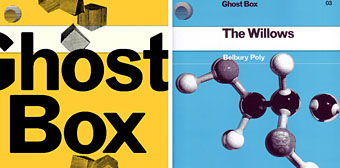
Q: What do you get when you cross analogue synthesizers, samples from obscure public information films, the graphic design of Pelican Books, Arthur Machen, HP Lovecraft, Algernon Blackwood, CS Lewis, Hammer horror, the Wicker Man and the music from Oliver Postgate’s animated films for children?

A: the CD releases by artists on the Ghost Box label. Ghost Box describe themselves as “an independent music label for artists that find inspiration in library music albums, folklore, vintage electronics, and the school music room” which, if you’re familiar with the reference points, is exactly what you get. A rather wonderful blend it is too, some of the tracks on Belbury Poly’s The Willows (named after Algernon Blackwood’s stunning horror tale) are how I expected Stereolab to sound until I heard them and was rather disappointed.

Favourite of the Ghost Box releases I’ve heard to date is (perhaps inevitably) Ourobourindra by Eric Zann (the “artist” here is named after Lovecraft’s haunted musician from The Music of Erich Zann). The website description—”Eric Zann’s radios, oscillators and recordings conjure eldritch, echoing spaces and invoke the voices of the dead that whisper within them”—again is a pretty accurate summation of this atmospheric and sinister audio collage. “Sinister” is a term that can be applied to much of this music and the Ghost Box founders, Julian House and Jim Jupp, declare in a Wire feature this month that matters spectral are of particular concern, hence the label name. Ourobourindra works especially well in this regard, sounding like the product of someone working through a trauma caused by viewing the seance scene from Dracula AD 1972 at too young an age. This is one I’ll be playing on Halloween.

Ghost Box music can be purchased online here.

Elsewhere on { feuilleton }
• The album covers archive

Previously on { feuilleton }
• Penguin book covers
• The music of Igor Wakhévitch
• The music of the Wicker Man
• The Absolute Elsewhere

The Photophonic Experiment

photophonic.jpgElectric light orchestra
Light bulbs. Biscuits. A 10,000-volt charge. The only thing you won’t find making music at a Photophonic Experiment gig is guitars and pianos, says Maddy Costa.

Maddy Costa
Friday, October 20, 2006
The Guardian

Ceinws in north Wales is the kind of tiny, bucolic town where nothing unusual is supposed to happen. And possibly it didn’t before Mark Anderson moved in. A sound-artist, instrument-maker and pyrotechnic with the performance group Blissbody, he has a workshop opposite the village pub that appears perfectly innocent from the outside, but inside could pass for a laboratory from a Frankenstein movie. Glass tubes and dangerous-looking electrical contraptions clutter the floor. Wires coil across a table. A standing lamp looms in the corner. “Watch this,” says Anderson, as excited as a five-year-old setting fire to a box of tissues. He points a mysterious black cone at the lamp and turns a dimmer switch to activate the bulb. Slowly, the lamp illuminates, and a sound fills the room: a low buzz at first, but growing painfully high-pitched as the light reaches full brightness. This really is white noise.

Remarkably, what Anderson is demonstrating isn’t an instrument of torture but a “photo-synth”, a device that converts light into sound. It’s a key element of the Photophonic Experiment, a bizarre, potentially fascinating collaboration between Anderson and like-minded musicians Pram and Kirsten Reynolds that tours the UK from next week. And if the people of Ceinws think Anderson is odd, they should hear what his associates get up to.

Continue reading “The Photophonic Experiment”

Generative culture

eno_tokyo.jpg

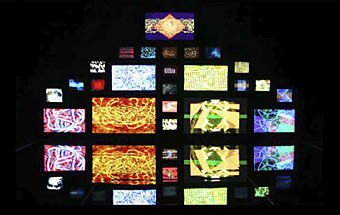
77 Million Paintings by Brian Eno, Laforet Museum, Harajuku, Tokyo.

Brian Eno is in the latest Wire talking about his forthcoming DVD-ROM, 77 Million Paintings. He also mentions coining the term “generative music” in 1995 to a resounding silence. 77 Million Paintings continues the generative project:

This will be available later in the year as a DVD-ROM (which will play on most modern computers) and a DVD featuring Brian talking about the project. It also includes an extensive booklet covering Brian’s long and successful career as a visual artist.

The name 77 Million Paintings comes from the possible number of images that can be created from a huge number of combinations. Anyone familiar with Brian’s audio-visual installations will instantly recognise the inspiration behind the project. The music is from Brian’s installation collection.

Ambient stuff for the eyes, in other words. I’d be looking forward to this if I still had a TV (mine packed up a few years ago) as I used to program my primitive Spectrum computer (which still works!) to generate simple patterns, turning the TV screen into an abstract artwork for a few hours. The difference with Eno’s project, of course, is the greater variety, quality and degree of intent involved. I saw one of his installation works, The Quiet Club, at the Hayward Gallery in 2000 which used similar audio and visual processes. With 77 Million Paintings you’ll be able to turn your living room into a quiet club of your own.

In a similar generative vein, there’s WolframTones: “A New Kind of Music – Unique cellphone ringtones created by simple programs from renowned scientist Stephen Wolfram’s computational universe.” Too complicated to explain; go and play around with it.