Weekend links 845

belbury.jpg

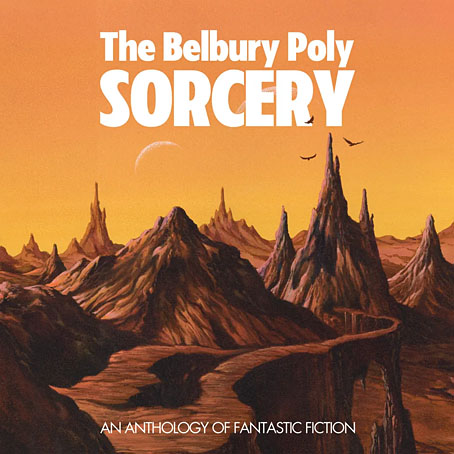
Cover design by Jim Jupp, art by Arik Roper.

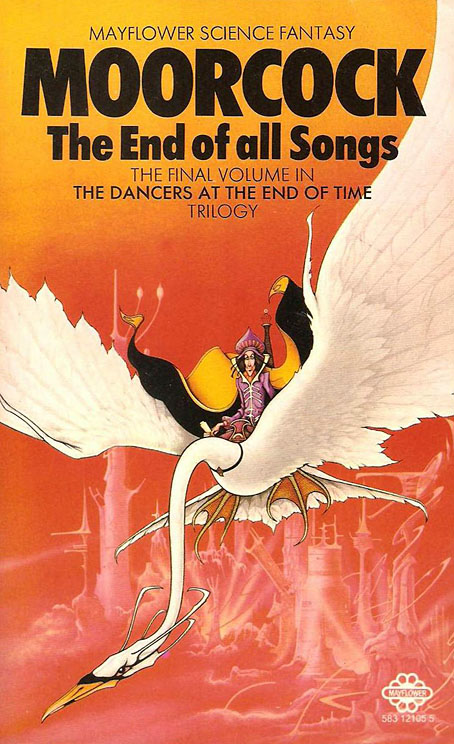
• New music: Sorcery by Belbury Poly, or “The Belbury Poly” as the credit on the cover art has it. The description of the forthcoming release says “it grew from [Jim] Jupp’s love of early to mid-80s electronic music and a rediscovery of how that music had soundtracked his childhood love of all things sci-fi and fantasy. It’s moody and melodramatic electronica rendered in bright and evocative 80s sounds.” And concerning the cover art there’s this: “Some may notice the typographical nod to Mayflower Books’ Michael Moorcock novels.” Indeed.
matthews.jpg

Cover art by Rodney Matthews, 1977.

• Among the new titles at Standard Ebooks, the home of free, high-quality, public-domain texts: The Mummy! A Tale of the Twenty-Second Century (1827) by Jane C. Loudon, and The Place Called Dagon (1927) by Herbert S. Gorman.

• More new music: Materia by Julia Holter; Avaeken by Stephen O’Malley; Witchcraft & Black Magic In The United Kingdom by Various Artists.

• The Natural History Museum presents competition photos from Wildlife Photographer of the Year.

• This week I drew a new header design for the Endless Bookshelf website.

• At the BFI: Brogan Morris chooses 10 great films about screenwriters.

• At Dennis Cooper’s it’s Palimpsest Day.

• RIP Tim Curry and Yayoi Kusama.

Sorcery #1 (1974) by Jack DeJohnette | Sorcerer (1977) by Tangerine Dream | Return Of The Sorcerer (2011) by The Wounded Kings
Ghost Box and The Infinity Box

yuggoth.jpg

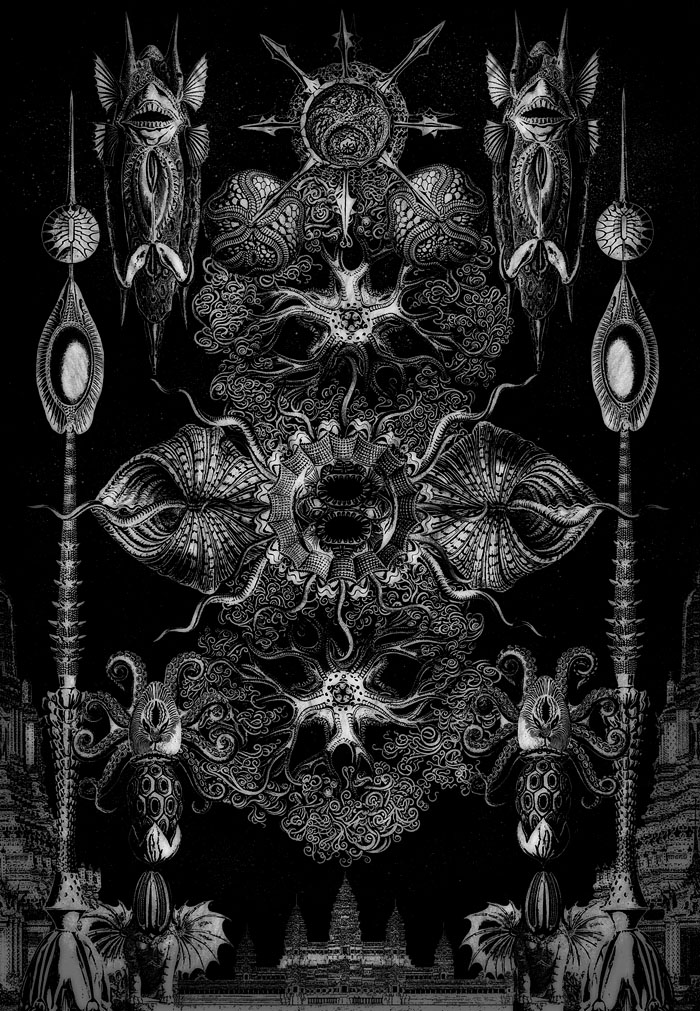
It’s less of a surprise than it may seem to go searching for the source of a quote only to find yourself immediately faced with one of your own artworks. The posts here go back almost 15 years, and when so many of them cover niche interests any attempt to further explore a particular niche can circle back to something I’ve already posted. The latest example is an unusual one, however. The picture above is the Haeckel collage I created for the Starry Wisdom collection of Lovecraftian fiction in 1994, a piece that was later digitally refashioned for The Haunter of the Dark book. The quote I was pursuing is as follows:

“Inside the infernal box are impossible spaces, dark screens and mirrors, terrible traces of light, calcified thought forms and endless idiot mutterings. The switch is thrown and the magnetic coils begin to generate their obscene flickering images. This contraption might have been conceived by the Old Ones long before it was assembled by human hands.”
—The Infinity Box, Alan Causley & MB Devot

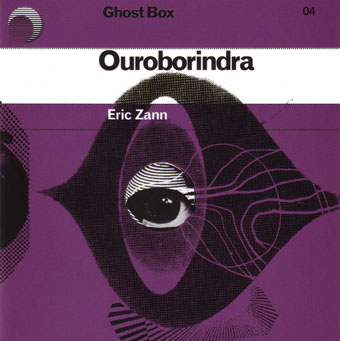
The description appears together with a dialogue extract from Nigel Kneale’s The Stone Tape on the fourth Ghost Box release, Ouroborindra (2005) by Eric Zann, a one-off album of spooky sample soundscapes created by a pseudonymous Jim Jupp in between his Belbury Poly albums. All the Ghost Box releases feature significant quotes, most of which are genuine extracts from stories, novels, non-fiction works, etc. The description of the Infinity Box raised my suspicion about its authenticity when the only references to either it or Causley and Devot are in listings for the Eric Zann album. My Yuggoth collage appears on this page which further compounds the confusion by making it seem that my art is somehow connected to Causley and Devot and their mysterious box. This isn’t a complaint but it doesn’t help clarify the situation. Alan Causley has no credits anywhere outside the quote but there is another Causley, the celebrated poet, Charles, whose poems are sampled on later Ghost Box releases by The Focus Group, aka Ghost Box co-founder Julian House. Scrutiny of the other Ghost Box albums reminded me that quotes from MB Devot’s writings appear elsewhere on the early releases but I hadn’t bothered to look up the name until now.

ouroborindra.jpg

It’s often the case with posts such as this that mild curiosity turns into deeper intrigue. The web of connections becomes more tangled on the first Ghost Box release, Sketches And Spells by The Focus Group, which has a Devot quote from a text with the apt title The Tangled Beams, and a final track with the title Starry Wisdom. Devot is described by reviewers as either a fictional writer or an authentic scholar, the latter designation being supported by a Wikipedia page. Wikipedia may be prone to errors but it isn’t known for fake entries so this was a surprising discovery; Devot is also referenced on the page for parapsychologist TC Lethbridge who happens to be another source of Ghost Box quotes. Suspicion returns when you try to search for any of Devot’s listed publications, none of which turn up in WorldCat or similar catalogues. One of the Wikipedia print sources is an issue of Fortean Times from 1989 but there’s nothing about Devot listed in the contents of that issue. Issue 53 was a crop circle special, however, so it certainly fits the Ghost Box interest in the paranormal as it manifests in the British countryside. We now know that crop circles were man-made, not the product of flying saucers or other phenomena, so this may be fitting as well.

devot.jpg

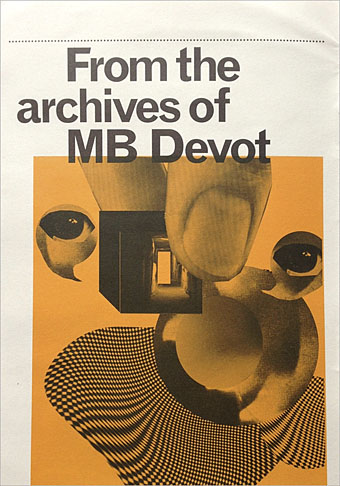
I would have left the search there but I did find one further Devot connection that I might otherwise have missed. Folklore and Mathematics is the title of a one-off Ghost Box periodical published in 2007 for people subscribed to the label’s mail order service. It’s a typically fine Julian House artefact that complements the Sketches And Spells album in both its title and its graphics. Inside we find “From the archives of MB Devot”, and discover another reference to the Infinity Box. Apparently the black-and-white graphics that cover all the early Ghost Box discs are vibration patterns—”verberations”—created by Devot’s occult apparatus.

otherwhere.jpg

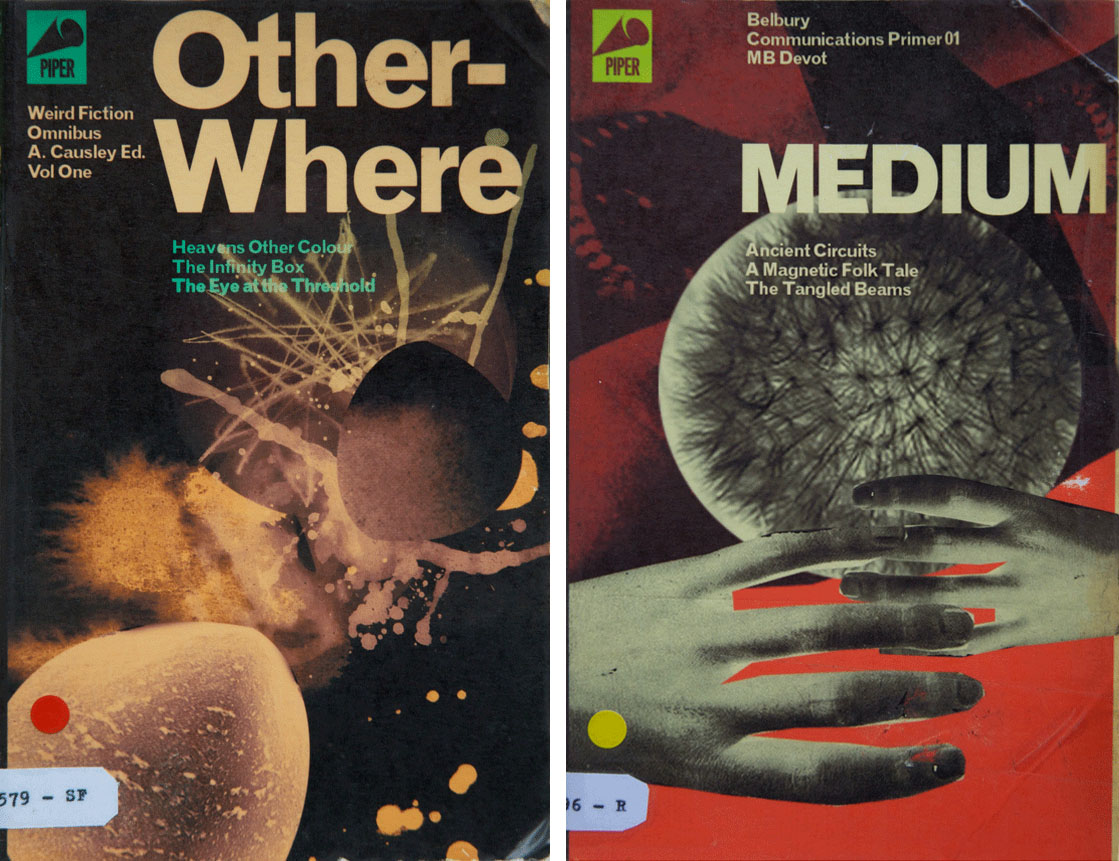
I wrote above that “any attempt to further explore a particular niche can circle back to something I’ve already posted” so I wasn’t too surprised to have all these explorations finding their way back here. In 2009 Julian House exhibited three invented books as part of The New Spirit Happening, an exhibition of Ghost Box-related work at the Architect’s Gallery in Teddington. I posted two of the covers after the exhibition but couldn’t recall who the books were credited to. The authors are—inevitably—”A. Causley” and “MB Devot”, and the volumes feature by-now familiar phrases: “The Tangled Beams”, “The Infinity Box”. Also more Lovecraftian verberations: “Heavens Other Colour”, “The Eye at the Threshold”. So Causley and Devot have been lurking here for the past decade, in which case having my artwork attached to their names no longer seems like an arbitrary association. “Inside the infernal box are impossible spaces, dark screens and mirrors…”. Indeed there are.

Previously on { feuilleton }
Unearthly tones
Owls and flowers
The White People by Arthur Machen
Stone Tapes and Quatermasses
The Ghost Box Study Series
A playlist for Halloween: Hauntology
Forbidden volumes
The Séance at Hobs Lane
Ghost Box

Weekend links 517

magritte.jpg

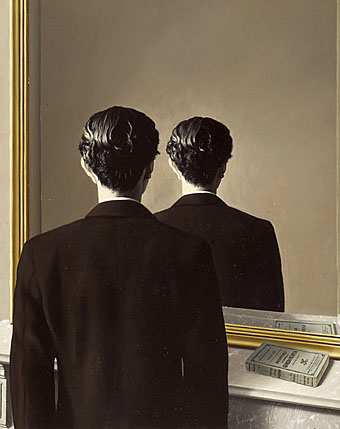
Edward James by René Magritte; La Reproduction Interdite (1937).

• “James was filmed in the late 1970s, striding round Las Pozas in a sweater and a tattered dressing-gown, surmounted by parrots (The Secret Life of Edward James can be seen on YouTube). When asked what motivated him, he replied: ‘Pure megalomania!’ He was having his second childhood, he said, though he wasn’t sure the first had ever ended.” Mike Jay on lifelong Surrealist, Edward James (1907–1984), and the concrete fantasia he built in the Mexican jungle.

• “I found the roots of electronic music in a cupboard!” Musician Paul Purgas (one half of Emptyset) on the discovery of early electronic music from India’s National Institute Of Design. Related: Purgas talks about his discovery with Patrick Clarke.

• RIP Phil May. Here’s The Pretty Things in their guise as psych band “Electric Banana” for an appearance in What’s Good for the Goose (1969). A decent moment in an otherwise terrible film.

• Music is a memory machine: David Toop explores how the transmission of music between disparate cultures can be a tool against populism and prejudice.

• Kraftwerk’s remarkable journey, and where it took us: Bob Boilen and Geeta Dayal discuss the tanzmusik of Düsseldorf.

• At Dangerous Minds: Acid Drag & Sexual Anarchy: Fifty years ago The Cockettes turned drag upside down.

Hua Hsu on the secret lives of fungi: “They shape the world—and offer lessons for how to live in it”.

• The great writer who never wrote: Emma Garman on the flamboyant Stephen Tennant.

• Cult 1998 PlayStation game LSD: Dream Emulator is finally playable in English.

Jim Jupp of Ghost Box records talks about the Intermission compilation album.

Jonathan Moodie on psychoactive cinema and sacred animation.

Alex Barrett on where to begin with Akira Kurosawa.

• At Dennis Cooper’s: Skeletons.

Skeleton Makes Good (1982) by Captain Beefheart & The Magic Band | Red Skeletons (1996) by Coil | Kids Will Be Skeletons (2003) by Mogwai

Weekend links 501

ashman.jpg

Cover art by Michael Ashman, 1979.

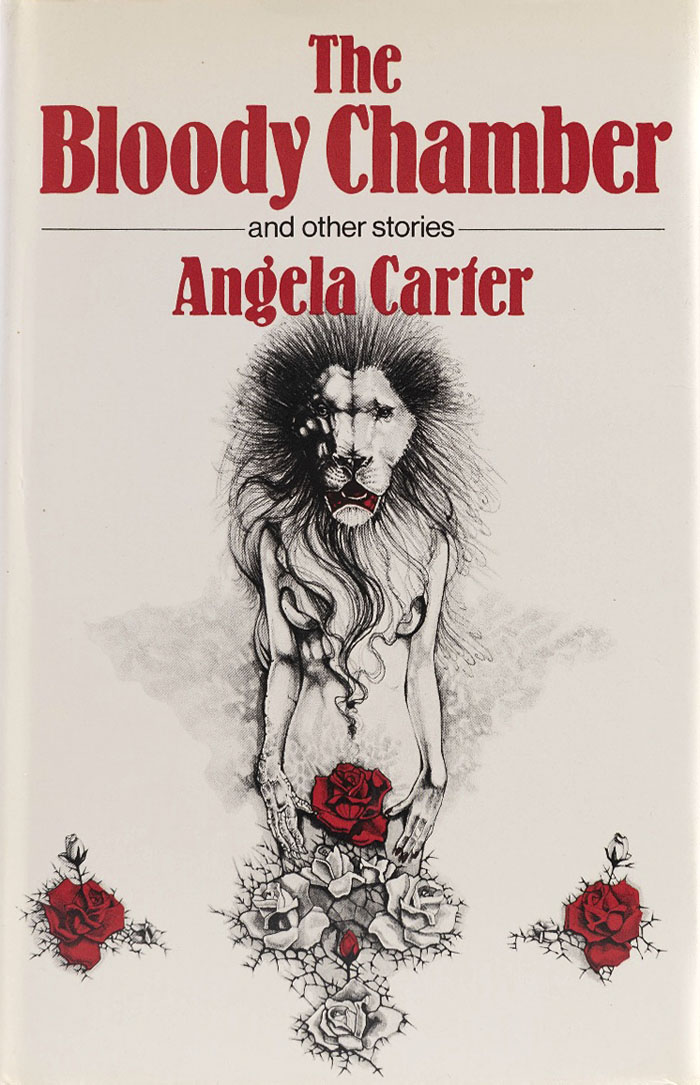
• RIP Terry Jones, not only a writer, actor and director but also a presenter of the BBC’s short-lived Paperbacks series in 1981, a programme that included Angela Carter among its guests. Related: The Box (1981), a short film directed by Micky Dolenz, based on a play by Terry Jones and Michael Palin.

• “[David] Lynch in a suit and tie that echoes the formal dress of Twin Peaks’ FBI Agent Cooper, presses a small capuchin monkey, called Jack Cruz, to confess to the murder of Max.” What Did Jack Do?

• The week in Ghost Box: Flying Lotus and Julian House collaborate on a promo for the Moog Subsequent 25 synthesizer, while at Grave Goods Jim Jupp answers questions from beyond.

Bruce Sterling: “This is an essay about lists of moral principles for the creators of Artificial Intelligence. I collect these lists, and I have to confess that I find them funny.”

• A campaign to protect and maintain Derek Jarman’s Prospect Cottage.

• Winners of the Wiki Loves Monuments 2019 photo competition.

• Mix of the week: Sehnsucht by The Ephemeral Man.

• Susan Schulten on Emma Willard’s Maps of Time.

• At Dennis Cooper’s: Roland Topor’s Brains.

• At Strange Flowers: 20 books for 2020.

Beat Box (1984) by Art Of Noise | Glory Box (1994) by Portishead | Black Box (1995) by Scorn

Weekend links 443

gorey.jpg

• Yet more Gorey: Mark Dery’s biography of the artist prompted The New Yorker to unearth a piece of cover art that Edward Gorey submitted 25 years ago. In the same magazine Joan Acocella reviews Dery’s book and examines Gorey’s life and art. At Expanding Mind, Erik Davis talks with Mark Dery about Surrealism, the gay voice, Penny Dreadfuls, and the occult and Taoist influences in Gorey’s work.

Moving Through Old Daylight: Mark Fisher, Jim Jupp & Julian House of Ghost Box Recordings, and Iain Sinclair in conversation at the Roundhouse, Camden, London, 5 June 2010. Topics under discussion included Nigel Kneale, TC Lethbridge, John Foxx, BBC Radiophonic Workshop, alchemies of sound, the homogenisation of culture, imagining space and the impersistence of memory.

• “A radical retelling of our relationship with the cosmos, reinventing the history of astronomy as a new form of astrological calendar.” The Space Oracle by Ken Hollings.

There was a deliberate, almost prickly quality to Fisher’s writing and thinking that is rare nowadays, when criticism is more likely to involve open-minded rationalizing than steadfast refusal. He was not one to frolic in ambiguity or irony. “Just because something is current doesn’t mean it is new,” he writes in K-Punk, as he wonders if a time traveller from the nineties would find any contemporary music as radical as post-punk or jungle had once seemed to him. When everything is cheerfully “retro,” Fisher argued, we lose our grasp on history—and, without a sense of why the past happened the way it did, our anything-goes embrace of “happy hybridities” is an empty gesture. “What pop lacks now is the capacity for nihilation, for producing new potentials through the negation of what already exists,” he writes.

Hua Hsu on Mark Fisher’s K-Punk

• At Wormwoodiana: Mark Valentine on The Wind Protect You (1946), a novel by Pat Murphy which Mark describes as a forgotten precursor of Watership Down.

• “At once tiny and huge: what is this feeling we call ‘sublime’?” Sandra Shapshay explores the Romantic aesthetic.

Dennis Cooper‘s favourite fiction, poetry, non-fiction, film, art, and internet of 2018. Thanks again for the link here!

• Mixes of the week: XLR8R Podcast 572 by Nastia, and FACT Mix 683 by Casino Versus Japan.

A Child’s Voice (1978) by David Thomson, an overlooked ghost story starring TP McKenna.

• Jean Cocteau’s Orphée returns from the underworld via BFI blu-ray next month.

Rated SAVX: The Savage Pencil Scratchbook

Orpheus (1967) by The Walker Brothers | Orpheus (1987) by David Sylvian | Overture To Orpheus (2003) by Colin Booth