Flowers: A Pantomime for Jean Genet

flowers.jpg

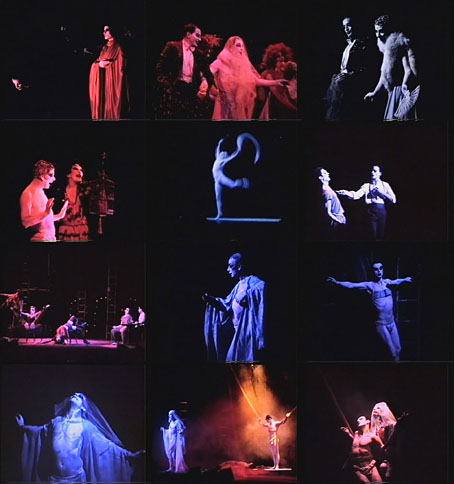
Flowers (1986) by the Lindsay Kemp Company. Photos by Maya Cusell.

Weidmann appeared before you in a five o’clock edition, his head swathed in white bands, a nun and yet a wounded pilot fallen into the rye one September day like the day when the world came to know the name of Our Lady of the Flowers. His handsome face, multiplied by the presses, swept down upon Paris and all of France, to the depths of the most out-of-the-way villages, in castles and cabins, revealing to the mirthless bourgeois that their daily lives are grazed by enchanting murderers, cunningly elevated to their sleep, which they will cross by some back stairway that has abetted them by not creaking. Beneath his picture burst the dawn of his crimes: murder one, murder two, murder three, up to six, bespeaking his secret glory and preparing his future glory.

A little earlier, the Negro Angel Sun had killed his mistress.

A little later, the soldier Maurice Pilorge killed his lover, Escudero, to rob him of something under a thousand francs, then, for his twentieth birthday, they cut off his head while, you will recall, he thumbed his nose at the enraged executioner.

Finally, a young ensign, still a child, committed treason for treason’s sake: he was shot. And it is in honour of their crimes that I am writing my book.

(Our Lady of the Flowers by Jean Genet. Translation by Bernard Frechtman, 1963)

Lindsay Kemp’s all-male version of Oscar Wilde’s Salomé has been the subject of several earlier posts, a production staged in the mid-70s with Kemp himself playing the part of Wilde’s femme fatale. Kemp’s company produced a related work in 1974, Flowers: A Pantomime for Jean Genet, a stage adaptation of Genet’s first novel, Our Lady of the Flowers (1942), in which Kemp played the part of drag queen Divine. Wilde and Genet aren’t so far removed from each other artistically although I can’t imagine them getting on in person. Both men were prisoners, of course, and Our Lady of the Flowers was famously written in prison, the first copy being discovered by a warder and destroyed. There’s a more direct connection in Fassbinder’s Querelle during the scenes where Lysiane (Jeanne Moreau) sings “Each man kills the thing he loves”, the most famous line from Wilde’s The Ballad of Reading Gaol which refers to (among other things) one of Genet’s obsessions: the prisoner condemned to death. Wilde would no doubt appreciate Genet’s poetic reimagining of his fellow prisoners, and his use of flowers as symbols; what Genet would have made of Lindsay Kemp’s typically extravagant and rather camp stage creation is anyone’s guess. He did write several plays but in later years evaded questions about them or his novels by claiming to have forgotten all his works. By the 1970s Genet was much more interested in the political struggles of the Black Panthers and the Palestinians.

Much as I like Wilde’s play, given the choice I think I’d prefer to see the Genet staging. Salomé is familiar enough from various stage and film adaptations whereas Flowers was unique. There is a video record of the latter from 1982 but the copy uploaded by Lindsay Kemp has had its soundtrack removed following the usual annoying copyright complaints about the music. So there’s the frustrating choice of watching the whole thing with no sound or watching this 28-minute video compilation of still photos by Maya Cusell from a 1986 performance with music that may be the original live score. One thing the photos show is how close in appearance is Kemp’s Divine to his dancer at the beginning of Derek Jarman’s Sebastiane (1976). In 2012 Kemp talked to Paul Gallagher about his film and stage career, Flowers included.

Update: As noted by radioShirley below, there is a copy of the 1982 performance with full soundtrack!

Previously on { feuilleton }
Querelle de Brest
Jean Genet, 1981
Un Chant d’Amour (nouveau)
Jean Genet… ‘The Courtesy of Objects’
Querelle again
Saint Genet
Emil Cadoo
Exterface
Penguin Labyrinths and the Thief’s Journal
Un Chant D’Amour by Jean Genet
Querelle de Brest

querelle01.jpg

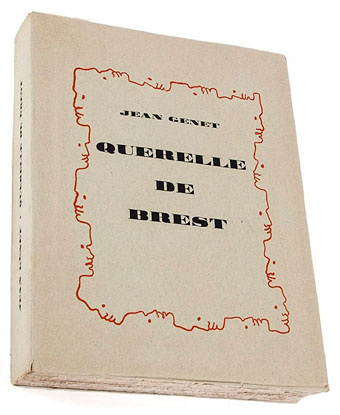
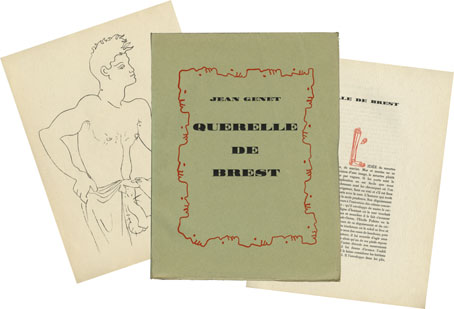
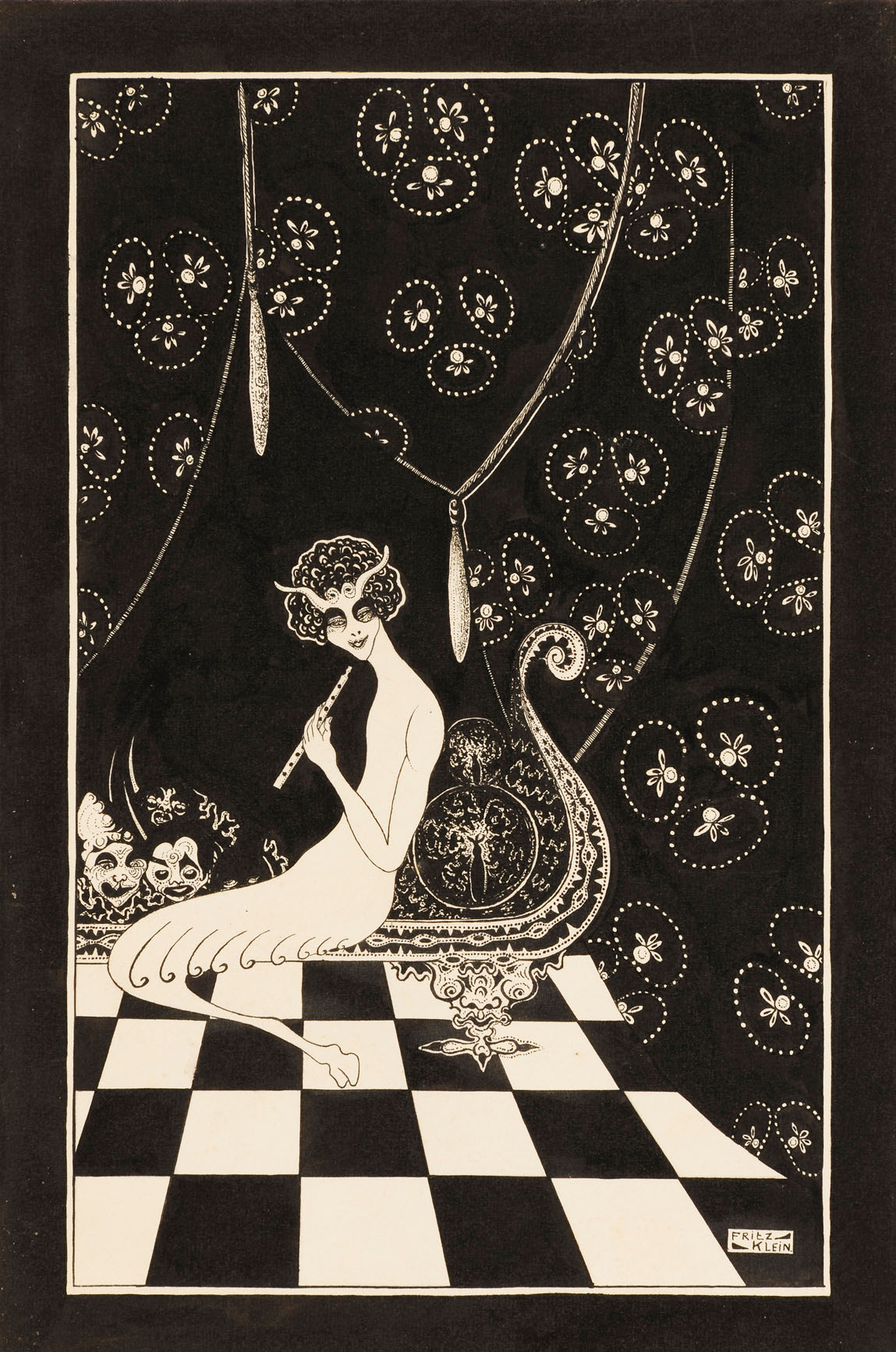
Querelle de Brest (1947) by Jean Genet. Cover design by Jean Cocteau.

This weekend’s viewing was Fassbinder’s Querelle (1982) which is marvellous in its new Blu-ray transfer, and a great improvement on the muddy picture of the earlier DVD release. The film is still only the briefest sketch of Genet’s novel (although Genet biographer Edmund White enjoyed it) but I like the overheated atmosphere, the phallic set designs, Franco Nero (hey, it’s Django Gay!), and the film as a whole is a fitting memorial to Brad Davis, everyone’s favourite sweating matelot. So in honour of all that, here’s a small collection of Querellerie past and present.

querelle02.jpg

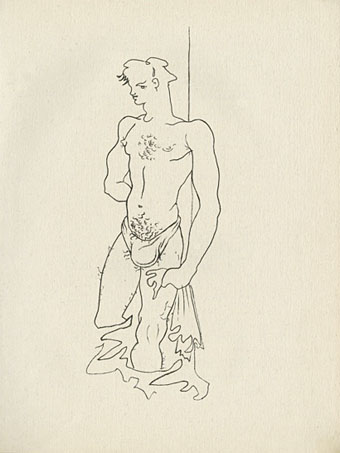
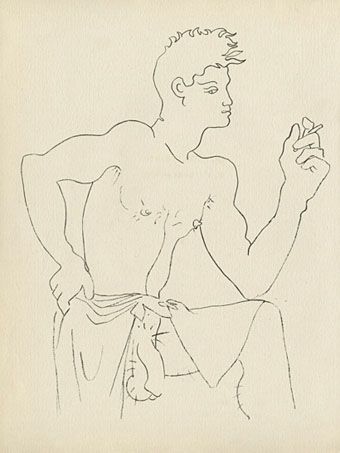
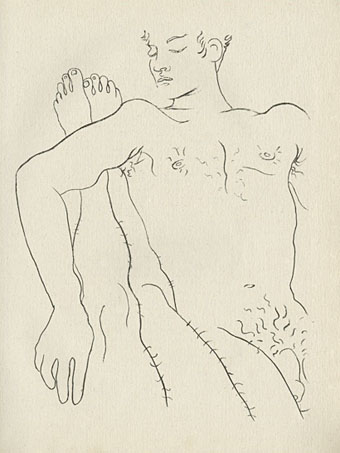
Querelle de Brest was published in a limited edition of 525 copies illustrated throughout by Jean Cocteau who didn’t avoid the pornographic details. Even though copies were seized by the authorities, and the author fined, Cocteau’s involvement did little to harm his public reputation, something that’s impossible to imagine happening elsewhere. A few of the illustrations follow below, many more of the series can be found scattered across various websites.

cocteau1.jpg

cocteau2.jpg

cocteau3.jpg

Continue reading “Querelle de Brest”

Weekend links 219

balbusso.jpg

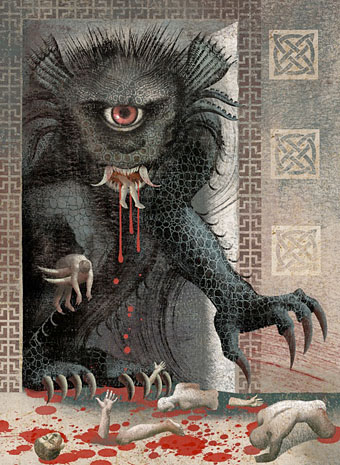
Grendel Monster (2013) by Anna & Elena Balbusso.

Rick Poynor looks at the Guide de la France mystérieuse (1964), a fantastic (in every sense) doorstop of a volume whose collage alphabet by Roman Cieślewicz can be seen on the cover of Carnival In Babylon (1972) by Amon Düül II.

• Boolean mathematics, Charles Howard Hinton, The Voynich Manuscript, and the effects of surveillance on the political process: Adam Curtis firing on all cylinders as usual.

• At Strange Flowers: The Picture of John Gray, remembering the minor fin de siècle figure who gave Oscar Wilde a surname for his most famous creation.

In “32 Cardinal Virtues of Dennis Cooper,” Wayne Koestenbaum remarks: “Cooper’s quest for the unseeable is virtually religious. I mean: sedulous, abstract, perpetual, unrewarded, unreasonable.” There’s much more to be said of Gone, its power, its pain, its odd intrigues, but perhaps it will suffice to say that it is revealing: unlike Burroughs’ scrapbooks hidden away by some private collector, never to see the light of day, Gone (and its sister texts at the Fales Library) illuminate in perpetuity Cooper’s obscure quest for the unseeable.

Diarmuid Hester looks at Dennis Cooper’s scrapbooks

The Sallow Tree, a single by Lutine. More music: An hour of Julia Holter‘s St John’s Sessions performance.

• At Dangerous Minds: Christian televangelists listen to Stairway To Heaven forwards.

• Cathy Camper reviews Fearful Hunter, a graphic novel by Jon Macy.

• Mix of the week: FACT mix 452 by Claude Speeed.

Roman Cieślewicz at Pinterest.

The Adobe Illustrator Story

The House of Julian

Unofficial Britain

• Amon Düül II singles: Rattlesnakeplumcake (1970) | Between The Eyes (1970) | Light (1971) | Lemmingmania (1971)

Gockinga’s Bacchanal and an unknown portrait of Fritz Klein

bacchanal.jpg

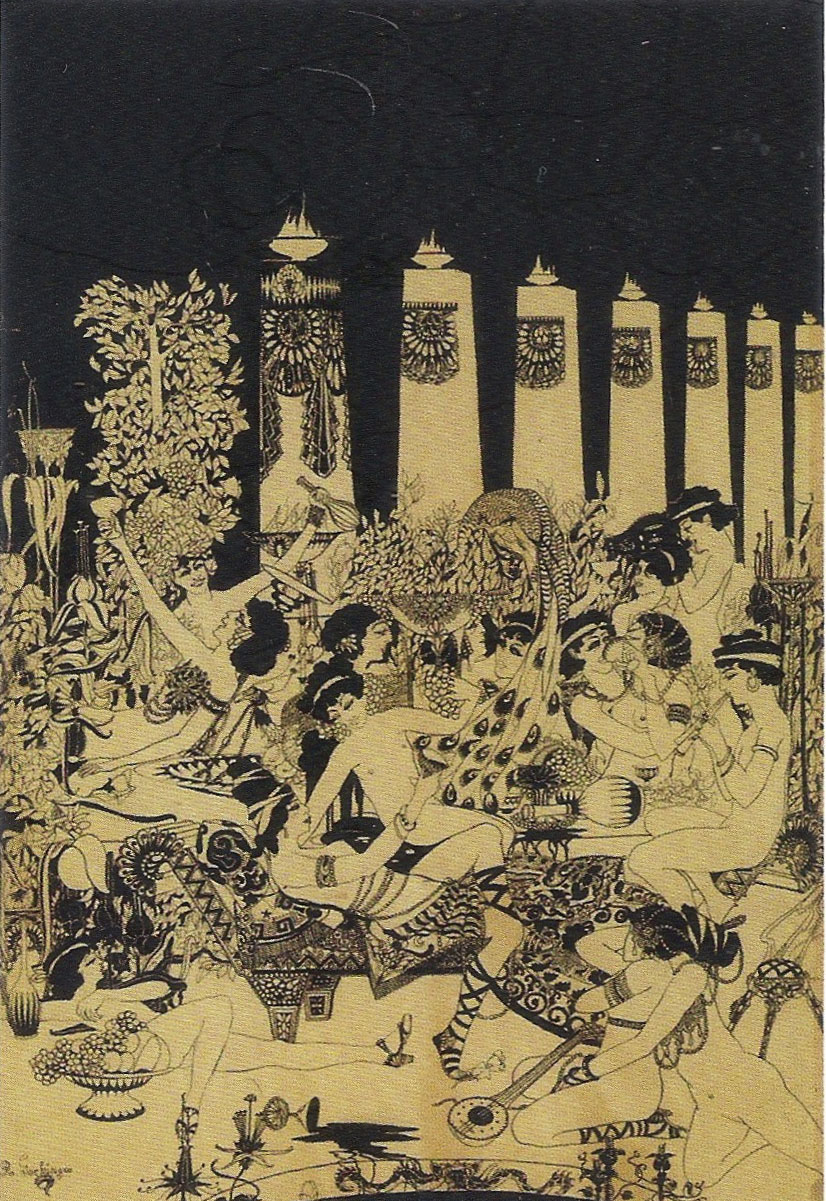
Bacchanal by René Gockinga.

A guest post today by Sander Bink who generously translated his latest piece of research into the Dutch artists of the early 20th century who took the Beardsley style as a foundation for their own black-and-white delineations. As with this earlier post on the subject, many of these drawings are very good but the artists are less well-known than the Beardsley followers in other countries who were their contemporaries. Here’s Sander.

* * *

Ladies and gentlemen, welcome to another episode of ‘Droomkunst’. This time we’ll discuss our cult hero Joseph René Gockinga who has a drawing exhibited at the Singer Museum Droomkunst exhibition. An obvious choice, because how often do you see his work—which I wrote about more in detail here—in a museum? Almost never. In 1976, two works by Gockinga were shown in the Kunstenaren der Idee exhibition but unfortunately I was only just born that year. The current locations of these works by the way is still unknown to me.

salome.jpg

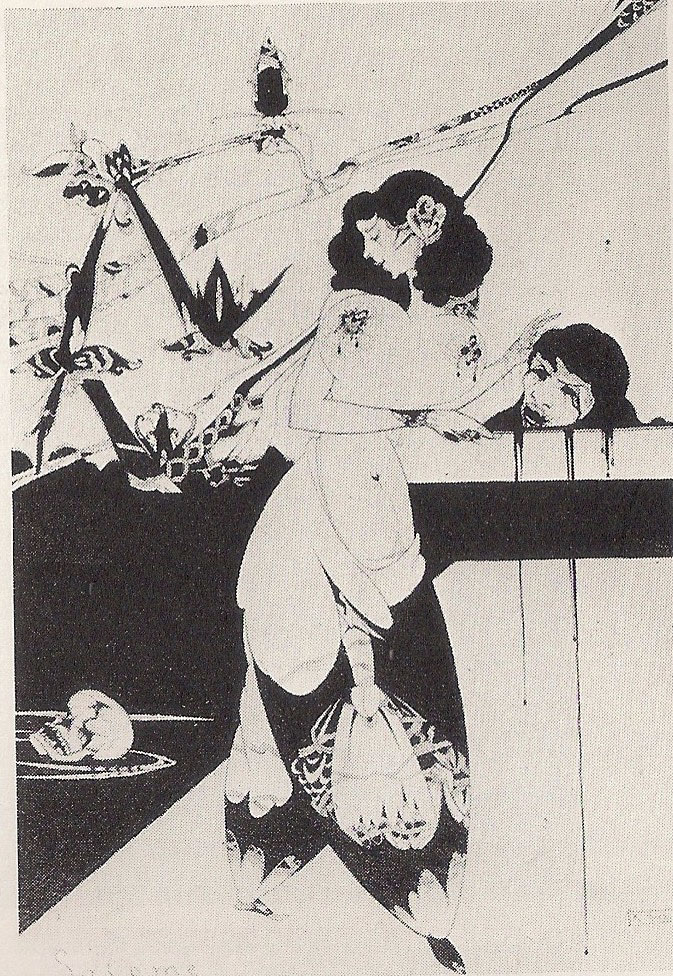
Salomé by René Gockinga.

One of them, however, Gockinga’s version of Salomé, resurfaced in 1995 but I don’t know the current location either. And the acclaimed Louis Couperus Museum last year showed an unknown Couperus illustration of Gockinga from a private collection (no, not mine). In Droomkunst now hangs a small but fine work in a similar style: the Bacchanal already mentioned here. The Droomkunst catalogue dates the work about 1915. I would dare to date is somewhat earlier, I think 1913.

In his opening speech Singer director de Lorm compared Gockinga’s Bacchanal with the work of Erwin Olaf because of the hedonistic, decadent parallels between the two works. If I remember correctly, de Lorm also talked about certain places preferred by these artists, in addition to the perverse, decadent, decayed Amsterdam also Indonesia and especially Java, which was known as a kind of international gay colony.

Now, our Gockinga has also dwelled there; I do not know exactly where and when, but—and this is information that surfaced after my earlier mentioned article was published—he lived in the late thirties in Bali for a while in the home of the renowned painter W.G. Hofker. And in a recent study Imagining Gay Paradise: Bali, Bangkok, Singapore and cyber-Singapore we read that Gockinga was one of the victims of a scandal; he was arrested because of his homosexuality in December 1938 in Denpasar. Here, the comparison with the 2000 generation of artists limp, which, after all, in Amsterdam and elsewhere were partying without having fears of being arrested for lewd behaviour.

klein.jpg

Fritz Klein by René Gockinga.

Where several generations of artists do come together is in the following, in our humble opinion a very nice item that was sent us last year. The majority of Gockinga’s Beardsley and the Nérée-like drawings from around 1917 are still unfortunately lost. Probably the “immoral” nature of his work is the main reason. So the item presented here is, as far as we know for the first time, is a new discovery.

It is a Beardsley-like portrait from 1917 or thereafter and it portrays none other than the painter Fred (Fritz) Klein (1898–1990), father of the famous and important Yves Klein.

Huh? What? How can that be? Well, that is of course very well possible. They were more or less contemporaries (Klein was born in 1898, Gockinga in 1893), were both born in the Dutch East Indies and were back in The Netherlands in 1913. They shared a great interest in art. In 1920, Klein moved to France, where he would make his sunny canvases that he became known for. Before that, he was apparently also in The Hague, where he visited his friend Gockinga. That friend has now made a special and somewhat decadent portrait of Klein: a kind of mythological half-man, surrounded by masks and, as I said, in a nice Beardsley-style. You could interpret the masks and the mix of male/female characteristics in a certain way but I leave that to the viewer. In any case, a special drawing can be added to the mysterious oeuvre of the Dutch Symbolist. Big thanks to the Klein relatives that allowed me to write about and portray it, of course.

Sander Bink

Previously on { feuilleton }
Antony Little’s echoes of Aubrey
Aubrey in LIFE
Beardsley reviewed
Aubrey Beardsley in The Studio
Ads for The Yellow Book
Beardsley and His Work
Further echoes of Aubrey
A Wilde Night
Echoes of Aubrey
After Beardsley by Chris James
Illustrating Poe #1: Aubrey Beardsley
Beardsley’s Rape of the Lock
The Savoy magazine
Beardsley at the V&A
Merely fanciful or grotesque
Aubrey Beardsley’s musical afterlife
Aubrey by John Selwyn Gilbert
“Weirdsley Daubery”: Beardsley and Punch
Alla Nazimova’s Salomé

Weekend links 218

white.jpg

The End of a Thousand Years (2014) by Hilary White. Via Phantasmaphile.

• It’s taken a while to shamble into the world but A Mountain Walked, an anthology of Cthulhu Mythos stories edited by leading Lovecraft scholar ST Joshi, will be published by Centipede Press next month. The publisher’s page for the book shows that my contribution will be facing Joshi’s introduction which is something I wasn’t aware of until this week. It also says the 692-page limited edition is sold out, although book dealers often buy collectible volumes such as this to sell on after adding their own markup. Be warned that it was listed on Amazon at $160 so if there are copies available anywhere they won’t be cheap.

• It’s not such a surprise to hear that magic mushrooms were an inspiration for Frank Herbert’s Dune. David Lynch’s film of Dune receives passing mention in this profile by Jeremy Kay of Lynch and the Twin Peaks film/TV series.

• “Whitechapel station is one of Giambattista Piranesi’s imaginary prisons, colonised by frantic electrical engineers and watched over by CCTV.” Will Wiles on the chaos and tangled energy of modern cities.

The word perfume comes from the French root “fume”—smoke—and where there’s smoke, there’s fire! I think most people are turned on sexually by scents and smells. Certain body odours can be very sexually stimulating. We purposefully chose certain ingredients for my Obscenity perfume that are associated with occult or religious rituals, including vetiver, labdanum, and oud, and others that are considered aphrodisiacal, including patchouli and sandalwood. The point of Obscenity is that there is no conflict between the religious and the sexual, and in fact they should be completely complimentary. The fragrance is meant to stimulate you sexually, but it also literally contains water from Lourdes, so it also has religious notes and perhaps even healing properties!

Bruce LaBruce talks to Kathy Grayson about his new fragrance, Obscenity

The Baffler, “a journal of iconoclastic wit and cultural analysis” relaunches with full access to its archives from 1988 to the present.

Pineal, the new album by Othon, is dark and “properly, brilliantly queer,” says David Peschek.

• At Core77: How to improve the audio quality of vinyl records with wood glue.

• P. Adams Sitney interviews Kenneth Anger on WNYC’s Arts Forum (1972).

• At BibliOdyssey: Le Bestiaire Fabuleux by Jean Lurçat.

• Mix of the week: Secret Thirteen mix 123 by Evol.

Meawbin the Creepy Cat

Perfumed Metal (1981) by Chrome | Fragrance (Ode To Perfume) (1982) by Holger Czukay | The Perfume (2006) by Johnny Klimek, Reinhold Heil, Tom Tykwer