The Immortal by Jorge Luis Borges

immortal1.jpg

“This City” (I thought) “is so horrible that its mere existence and perdurance, though in the midst of a secret desert, contaminates the past and the future and in some way even jeopardizes the stars.”

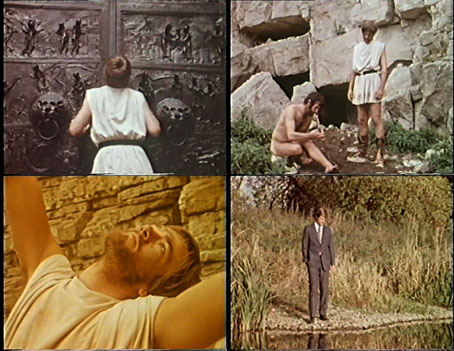
This is the kind of thing I love to find: a BBC adaptation of a story by Jorge Luis Borges which I didn’t even know existed until this week. The Immortal was written in 1947 and published in the fourth collection of the writer’s fiction, El Aleph, in 1949. Anglophone readers will be more familiar with the story from Labyrinths, the most popular Borges collection, and the book I always recommend to those curious about his work. (And with the usual nagging proviso: avoid the Andrew Hurley translations if you can.)

Borges’ immortal is a Roman soldier during the reign of Diocletian whose life is recounted via a manuscript discovered in 1929 inside a volume of poetry. (The volume is Pope’s translation of The Iliad; Homer is never far away in Borges-land, especially in this story.) Disappointed by his military career, the soldier leaves his legion to go in search of the legendary City of the Immortals which is reputed to lie somewhere in the African desert; he finds the city, of course, and also (inevitably) receives more than he bargained for. Borges’ other fictions are seldom as traditionally fantastic as this, although the story’s philosophical musings are enough to set it apart from similar tales, as is the author’s habit of owning up to his recondite literary borrowings, like a magician revealing the secret of a trick at the end of a performance. Even so, The Immortal was generic enough to turn up in an American paperback collection in 1967, New Worlds of Fantasy edited by Terry Carr, along with stories by Roger Zelazny, John Brunner, JG Ballard and others. The Ballard story, The Lost Leonardo, is an uncharacteristic piece about another immortal character, Ahasuerus, the Wandering Jew, cursed to roam the world until the Second Coming of Christ. Ahasuerus was a popular character in the 19th century, whose legend and predicament was enough to sustain Eugène Sue for 1400 pages in a ten-volume historical saga, Le Juif Errant. Borges alludes to Ahasuerus via the name “Joseph Cartaphilus” although this is one obscure reference that he doesn’t explain for the reader. By contrast with the logorrhoeic Monsieur Sue, Borges requires a mere 15 pages to deal with 2000 years of history.
immortal2.jpg

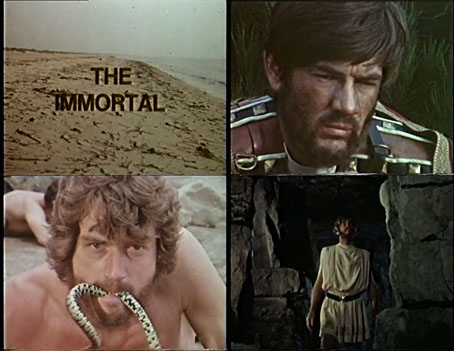
Given the challenges of staging a complex historical drama on a TV budget Carlos Pasini’s film is little more than a 22-minute sketch of its source material, but Borges adaptations are scarce enough that there’s a thrill in seeing the material presented at all, as with the brief dramatisations in the Arena documentary, Borges and I. The Immortal was given a single broadcast on 20th November, 1970, as part of a now-forgotten BBC 2 arts programme, Review, where it was intended as an introduction to the author’s writing following the UK publication of The Book of Imaginary Beings. Mark Edwards plays the Roman soldier whose narration is taken verbatim from the story. Borges’ international reputation had reached a plateau of popularity at this time, after growing steadily during the 1960s. 1970 was also the year that Donald Cammell & Nicolas Roeg’s Performance was released, a film that quotes verbally and visually Borges’ Personal Anthology while also featuring a photo of the man himself. A year later, Michael Moorcock’s first Jerry Cornelius collection, The Nature of the Catastrophe, included the dedication “For Borges”; Jerry Cornelius is another immortal (or timeless) character, one of whose progenitors may be “Joseph Cartaphilus”. Pasini’s adaptation can’t compete with these heavyweights but as a taster of Borgesian prose and ideas it serves its purpose. The director has made it available for viewing here.

Previously on { feuilleton }
Borges on Ulysses
Borges in the firing line
La Bibliothèque de Babel
Borges and the cats
Invasion, a film by Hugo Santiago
Spiderweb, a film by Paul Miller
The Library of Babel by Érik Desmazières
Books Borges never wrote
Borges and I
Borges documentary
Borges in Performance

Weekend links 531

miller.jpg

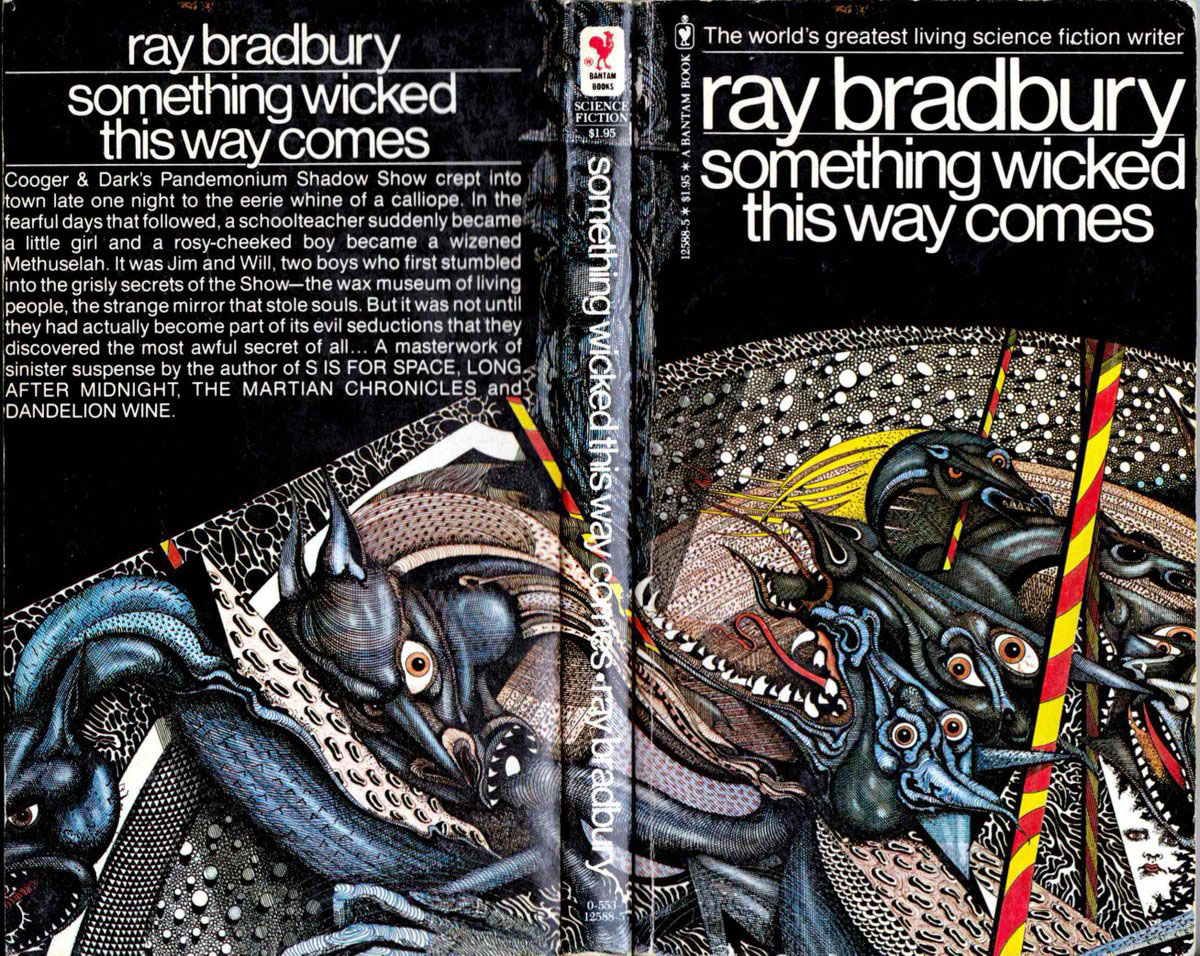
Cover art by Ian Miller, 1979.

• Ray Bradbury was born 100 years ago today. Emily Temple expresses surprise that Truman Capote encouraged the publication of a Bradbury short story at Mademoiselle in 1946. I’m more surprised that Bradbury was paid $400 for his work; no wonder he was so eager to write for the non-genre magazines. Elsewhere: Ray Bradbury—The Illustrated Man: the BBC’s Omnibus arts strand profiled Bradbury in 1980 with enthusiastic assistance (narrating/reading/performing) from the man himself; Ray Bradbury book and magazine covers at Flickr.

Anna Smith asks whether Linda Fiorentino was the greatest femme fatale ever in The Last Seduction (1994). A substantial claim, especially for a neo-noir playing so self-consciously with the theme, but it’s a very good film, and one I’d like to see again.

• “Bad as a work of art, and morally bad…” Vladimir Nabokov’s Lolita being reviewed by Kingsley Amis, a writer who preferred the peerless prose and stainless morals of Ian Fleming. Dan Sheehan looks at other contemporary reactions to Nabokov’s novel.

• At Dennis Cooper’s: Mary Ellen Bute Day, and (how could I avoid it?) ClicketyClack presents…Brothers Quay Day.

• More from The Art of the Occult: S. Elizabeth offers a glimpse of the contents of her forthcoming book.

• Make the letter bigger: John Boardley on the development of the illuminated capital.

• In 1987 Anne Billson talked to Nicolas Roeg about his latest film, Castaway.

• Five controversial arthouse features from Japanese filmmaker Sion Sono.

• It’s that group again: Joe Banks on the strange world of Hawkwind.

C82: Works of Nicholas Rougeux.

Fahrenheit 451 (1982) by Hawkwind | Something Wicked This Way Comes (1996) by Barry Adamson | The Martian Chronicles (2007) by Dimension X

Weekend links 490

stoer.jpg

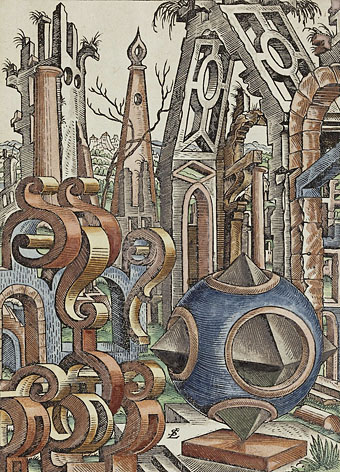
An engraving from The Geometric Landscapes of Lorenz Stoer (1567).

• Curtis Harrington’s cult horror film, Night Tide (1961), receives a lavish blu-ray reissue from Powerhouse in January. The limited edition will include an extra disc of Harrington’s early short films which encompass Poe adaptations and also Wormwood Star, his portrait of occult artist (and actor in Night Tide) Marjorie Cameron.

• “He was the first American representative of an electronic sound that was largely coming from Europe, from bands like Kraftwerk, or producers like Giorgio Moroder and Pete Bellotte…” Jude Rogers on Patrick Cowley.

Clive Hicks-Jenkins examines Hans Poelzig’s and Marlene Moeschke’s work on Paul Wegener’s 1920 film of The Golem. Wegener’s film is released this month in a restored blu-ray edition by Eureka.

• “Conrad was uncompromising in his beliefs until the end, sticking to his ideals with tenacious fervor.” Geeta Dayal on Tony Conrad: Writings, edited by Constance DeJong and
Andrew Lampert.

• At Dennis Cooper’s: 47 dead films. One of the films, Hu-Man (1975), a French science-fiction drama starring Terence Stamp, isn’t as dead as was assumed.

• The Danske Filminstitut has made a collection of Danish silent films available to watch for free online.

• The Last Time I Saw John Giorno, an Extraordinary Performance Poet by Mark Dery.

• “Like looking through butterfly wings”: Ira Cohen’s Mylar chamber—in pictures.

Callum James reviews the Early Poetical Works of Aleister Crowley.

• Drawing the Gaze: Revisiting Don’t Look Now by Jesse Miksic.

• Mix of the week: FACT Mix 745 by Visible Cloaks.

Mind Warp (1982) by Patrick Cowley | Go-Go Golem (1986) by Golem Orchestra | Night Tide (1995) by Scorn

Weekend links 441

jakuchu.jpg

Red Parrot on the Branch of a Tree (c.1771) by Ito Jakuchu.

• Reporter John Stapleton (later a fixture of BBC TV) visits the Portobello Road offices of British underground newspaper Frendz for newsreel service British Pathé. The date says 1969 but it’s probably 1971 since earlier that year the magazine had changed its name from Friends. Among the unidentified interviewees is Rosie Boycott, later the founder of Britain’s first feminist magazine, Spare Rib, and now Baroness Boycott. She may have predicted the former in 1971 but I doubt she would have expected a seat in the House of Lords.

• At Expanding Mind: Erik Davis talks with martial artist and psilocybin explorer Kilindi Iyi about African martial arts, high dose psilocybin work, African-American psychedelia, Dr. Strange, and the metaphysics of darkness.

Bloom, the generative music app by Brian Eno and Peter Chilvers, is given a tenth-anniversary relaunch this month. The new app will also (finally) be available for Android as well as Apple machines.

Early on, I realized my interest in [William] Burroughs’ work was less to do with the cut-up novels and more with the documented research and investigation of the human condition, technology, control, travel, dreams, drug culture, shamanism, and Hassan-I Sabbah. Books like The Job, The Electronic Revolution and especially, The Third Mind with Brion Gysin were particularly important to me. […] As for integrating Burroughs’ work into the music, it’s not about the history of a literary collaboration, but rather the complete fusion in a praxis of two subjectivities that metamorphosize into a third. From this collusion, a new author emerges—an absent third person, invisible and beyond reach, recording the silence.

From 2017: Bill Laswell in a satisfyingly lengthy interview with Anil Prasad

Secret Satan, 2018: being the annual Strange Flowers “round-up of giftable cultural history with which you can unmistakably signal your degenerate cosmopolitan values”.

• Laurie Spiegel’s second album of electronic music, Unseen Worlds, was never given a proper release in 1990. This situation will be rectified in January.

• Mixes of the week: Secret Thirteen Mix 272 by Paulie Jan, and XLR8R Influences Podcast 12 by Ripperton.

• More Gorey: biographer Mark Dery and design historian Steven Heller discuss Edward Gorey’s life and work.

Rumsey Taylor on Roger Excoffon’s Choc, “the mystery font that took over New York”.

• More Nicolas Roeg: David Thompson on one of Britain’s greatest film directors.

John Waters picks his films of the year.

• RIP Bernardo Bertolucci

In Bloom (1991) by Nirvana | Bloom (2001) by Brian Eno & J. Peter Schwalm | Violet Bloom (2010) by John Foxx

Weekend links 440

roeg.jpg

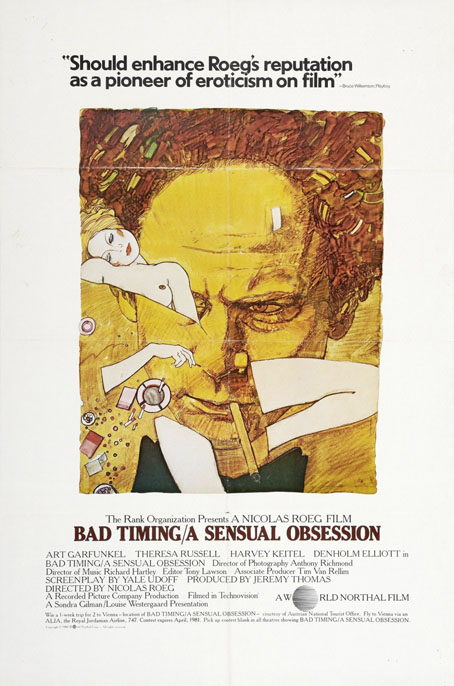
The title of that film was originally different [Illusions]… I woke up one day and thought of Bad Timing which sounds exactly like the right title—for my career. Now there was a film I really thought was one to which there would be a different response. Whilst filming I felt sure that this was one for the streets, one that people would really want to see. — Nicolas Roeg

So long to the great Nicolas Roeg, always one of my favourite film-makers. Roeg’s works were naturally attractive when I was a teenager because he’d made a horror film and a science-fiction film; when these eventually turned up on TV it was evident that this was a director working on a level that had more in common with Continental Europe than Hollywood. Beyond the generic content it was his approach to directing that made his films essential: a fragmented editing style derived from Alain Resnais via Richard Lester (see below), a cosmic perspective almost entirely absent from the parochial concerns of British cinema, and a seemingly effortless ability to find visual rhymes in anything. Despite the “bad timing” comment above Roeg was fortunate to be working throughout the 1970s when having an approach that ran counter to the prevailing trends wasn’t an obstacle to maintaining a career; as with Ken Russell, you watch some of the films today and are amazed and grateful that they were made at all. When reading the forthcoming plaudits it would be worth remembering that even the films regarded now as Roeg’s best struggled for acceptance: Pauline Kael dismissed Don’t Look Now as “trash”, US screenings of The Man Who Fell To Earth provided explanatory notes for the hard-of-thinking, Bad Timing was described by its own distributors as “a sick film made by sick people for sick people”, while the distributors of Eureka hated the film so much that for a time it could only be screened in the UK if the director was also present.

• Related: Where to begin with Nicolas Roeg, and Nicolas Roeg: It’s About Time (2015), a 59-minute documentary for the BBC directed by David Thompson. Previous Roeg-related postings on this site include: The Nicolas Roeg Guardian Lecture, 1983 (Roeg discusses Eureka and other films with Philip Strick); Beyond the Fragile Geometry of Space (charting the recurrence of a book title from Don’t Look Now); Canal view (using Google Street View to find the church in Don’t Look Now); and Petulia film posters (designs for a Richard Lester film from 1968 that was photographed by Roeg, and whose fragmentary editing style prefigures the familiar Roeg technique).

• Edward Woodward’s greatest screen role wasn’t a prudish policeman or a mysterious vigilante but was David Callan, a conflicted assassin working for a division of the British Secret Service. Joseph Oldham explains.

• Mixes of the week: A mix for The Wire by Jing, FACT Mix 681 by Kelly Moran, and Crépuscules d’Automne, a seasonal mix by Stephen O’Malley.

• More Gorey: in 1978 Jeremy Brett was playing Dracula in the touring version of the Edward Gorey-designed play.

• Liberated from the LRB paywall for a brief time: George Melly writing in 1992 about René Magritte.

• Welcome to the witch capital of Norway: Chelsea G. Summers investigates.

Space colony artwork from the 1970s.

• At I Love Typography: Magic printed.

Memo From Turner (1970) by Mick Jagger | Wild Hearts (1985) by Roy Orbison | Be Kind To My Mistakes (1987) by Kate Bush