Weekend links 142

bowie.jpg

Gratifying this week to see album cover art under discussion even if the heat-to-light ratio was as unbalanced as it usually is when pop culture is the subject. Jonathan Barnbrook, who also designed the Heathen (2002) and Reality (2003) packaging for David Bowie, wrote about the thinking behind the new cover on his blog. (And for the time being let’s note that this is still only a cover design, we don’t know what else is on its way.)

For my part I’ll point out that the artist-as-cover-image is the great cliché of album design, and the bigger the name the more the rule applies; Neville Brody complains about this in the first book of his work, as does Storm Thorgerson in the Hipgnosis books. In Bowie’s case the rule has been applied almost universally since his debut album in 1967, the only variations being illustrational ones or slight dodges like having his feet appear on the front of Lodger and his back facing the viewer on Earthling. Consequently the new design is a radical gesture from an artist who could have got away with a photo of himself du jour. By way of contrast, consider that Rod Stewart is a year older than David Bowie and presented the world with this artefact in October 2012.

Related: Hard Format responds to the cover, Chris Roberts on “Picasso resurrected in a Rolf Harris era“, and Alexis Petridis on The inside story of how David Bowie made The Next Day.

The Quicksilver typeface, designed by Dean Morris when he was only 16, bought by Letraset and now an indelible feature of pop design from the 1970s. Morris describes his experience here (“they shunned rapidographs!”) and collects examples of the print history here.

When the days are short, we are closest to the medieval world. To the avoidance of mirrors where death improves our portraits every morning with a few more lines and shadows. What would once have been a sermon, a conjuring of hellfire, a phantom slide show, is now an entertainment. But before we can begin again, we have to kick free of the embrace of our inconvenient predecessors, that compost legion of the anonymous dead. They come uninvited, requiring us to sign up for what the late Derek Raymond called the general contract: a brief turn in the light, then extinction. Eternal darkness. How to live with such knowledge? William Burroughs admired the unswerving bleakness of Beckett’s gaze, the way he reduced compensatory illusions to zero. Nowhere left to crawl. And nothing to crawl on. Last breath is last breath. Stare into the abyss and the abyss will stare right back.

Iain Sinclair reviews The Undiscovered Country: Journeys Among the Dead by Carl Watkins

Broadcast’s James Cargill on Morricone, Minidiscs and Scoring Berberian Sound Studio. Related: Melmoth the Wanderer posts a new mix, The Curious Episode of the Wizard’s Skull, and more spooky sounds are on their way from The Haxan Cloak.

• A Firm Turn Toward the Objective: Joanne Meister on meeting the great Swiss designer Josef Müller-Brockmann.

duchess.jpg

Twitter user @thisnorthernboy reworked Paul Emsley’s portrait of Kate Middleton. @barnbrook approved.

• The Beatles of Comedy: David Free on the Monty Python team.

• The history of the London Underground poster.

Impossible Architecture by Filip Dujardin.

• At Pinterest: Art Dolls & Sculpture

• Grace Jones’ Nightclubbing album has been on repeat play this week: Warm Leatherette/Walking In The Rain | I’ve Seen That Face Before (Libertango) | Demolition Man

TV Wipeout

tvwipeout1.jpg

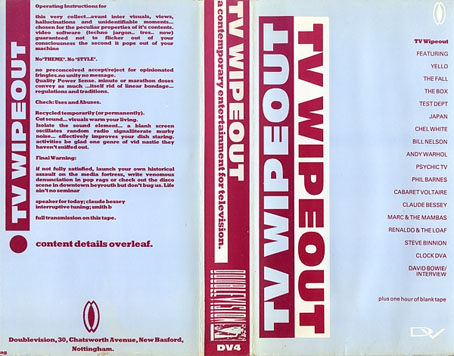
Another of the videocassette releases on Cabaret Voltaire’s Doublevision label, TV Wipeout was released in 1984 as a “video magazine”. This and Johnny YesNo were the two Doublevision releases I was most interested in, and I did get to see some of the former release when Cabaret Voltaire’s first appearance at the Haçienda in 1983 was preceded by an hour of “Doublevision Presents…”. The most memorable sights from that screening were the weird and scary Renaldo & The Loaf film and the video for Terminus by Psychic TV, a very Wild Boys-esque piece directed by Peter Christopherson. The Cabs’ Stephen Mallinder explained why the contents of the tape tended to be more commercial than other releases on the label:

Q: The next Doublevision was the TV Wipeout video which was a sort of disposable magazine compilation. It contained a fairly wide variety of contributors, from people like The Fall and Test Dept to some more mainstream groups like Bill Nelson and Japan.

Mal: The point was that Virgin Films were quite happy to work with us; they even gave us money in the form of advertising revenue for using some film clips from the Virgin catalogue. We were then able to camouflage them into the whole set-up and make them look as if they were part of the whole nature of the video compilation.

Q: One of those clips was a particularly inane interview with David Bowie. Was its inclusion merely a selling point?

Mal: Yes, it was purely that. There are a lot of people who will buy anything with David Bowie on it. So we said “Fuck it, why not use that as a selling point!” Actually the interview is appalling, it’s terrible. Our including it was almost like a piss-take. We were saying “you really will buy anything with David Bowie on it if you buy this”.

From Cabaret Voltaire: The Art of the Sixth Sense by M. Fish and D. Hallbery

Unlike some of the other Doublevision releases this one doesn’t seem to have been uploaded anywhere but since much of the content was music videos it’s possible to compile an incomplete playlist. The Paul Morrissey films (Heat and Flesh), Eating Raoul and Plan 9 from Outer Space were cult items that weren’t being screened on TV so this was an opportunity to see them outside a cinema. Some of the other selections—the Chel White, Steve Binnion and Space Movie—are still a mystery. Lost Possibilities Of Modern Dreams was footage of a painting exhibition by Phil Barnes soundtracked by the Cabs. The Claude Bessy piece is the only one from the original tape, a short film of the Haçienda’s VJ shot by Ikon Video’s Malcolm Whitehead in the basement of the club.

Bill Nelson: Flaming Desire
Bill Nelson interview
Plan 9 from Outer Space excerpt
Clock DVA: Resistance
Chel White: Industrial Park
Cabaret Voltaire: Just Fascination
Steve Binnion: Mediaevil
Renaldo & The Loaf: Songs For Swinging Larvae
David Bowie interview for Merry Christmas, Mr. Lawrence
Andy Warhol: excerpt from Heat
The Fall: Live at The Venue (1983) with documentary footage
Space Movie excerpt
The Box: Old Style Drop Down
IKON FCL advertisement featuring various groups on the Factory label
Japan: excerpt from Oil On Canvas
Andy Warhol: excerpt from Flesh
Test Dept: Shockwork
Dieter Meier interview
Yello: excerpt from Jetzt Und Alles
Eating Raoul excerpt
Psychic TV: Terminus
Phil Barnes featuring Cabaret Voltaire: Lost Possibilities Of Modern Dreams
Marc & The Mambas: Caroline Says
Claude Bessy: Operating Instructions

Previously on { feuilleton }
Seven Songs by 23 Skidoo
Elemental 7 by CTI
The Crackdown by Cabaret Voltaire
Network 21 TV

Weekend links 125

cme.jpg

Coronal Mass Ejection from the surface of the Sun, August 31st, 2012.

• “Most of the main parts were recorded in a single day using Vangelis’s famous technique: try to play as many synths as possible at once.” Simon Drax on the prolific musical output of Zali Krishna. The new Krishna opus is Bremsstrahlung Sommerwind, free to download at the Internet Archive.

• The Northants International Comics Expo (N.I.C.E.) opens on September 22nd. Among the many attendees there will be Mr Alan Moore making his first convention appearance since 1987.

• “Isolated for one night in a boat overlooking the Thames, Geoff Dyer explores representations of reality through the lens of Joseph Conrad’s Heart of Darkness.”

Now seems the right time to revisit this secret archive of public broadcasting. It’s an antidote to the celebrity-led, format-driven nature of so many arts documentaries made today. It shows that it’s possible to produce TV that is both populist and experimental. And it also refutes the cliché that the 1970s was a decade only of crisis and downturn. “Feminism, political theatre, Ways of Seeing: I wasn’t thinking, ‘what a terrible time’. It was very dynamic, activist, political. Creatively it was very exciting. Yet all they show on those television retrospectives are episodes of Top of the Pops.”

Sukhdev Sandhu talks to Mike Dibb, the director of Ways of Seeing.

• From 1999: Colm Tóibín reviews A History of Gay Literature: The Male Tradition by Gregory Woods.

What We See: a song by Julia Holter & Nite Jewel with a film by Delaney Bishop & Jose Wolff.

Rick Poynor on The crash test dummy: from subcultural fringes to pop culture mainstream.

In his 1973 book on Joyce, Joysprick, Burgess made a provocative distinction between what he calls the “A” novelist and the “B” novelist: the A novelist is interested in plot, character and psychological insight, whereas the B novelist is interested, above all, in the play of words. The most famous B novel is Finnegans Wake, which Nabokov aptly described as “a cold pudding of a book, a persistent snore in the next room.” The B novel, as a genre, is now utterly defunct; and A Clockwork Orange may be its only long-term survivor.

Martin Amis on A Clockwork Orange, fifty years on. My old post about the film’s record shop scene continues to be one of the most popular pages here.

• Wild Boys: David Bowie and William Burroughs in 1974, hand-coloured by DB.

Alfred Kubin‘s illustrations for Haschisch (1902) by Oscar AH Schmitz.

• Revolution off: industrial ruins photographed by Thomas Jorion.

• Tetrahedra of Space: 22 pulp illustrations by Frank R. Paul.

The Blue Boy Studiolo: a Tumblr.

Marina Warner visits Hell.

• The art of Casey Weldon.

RainyMood.com

Third Stone From The Sun (1967) by The Jimi Hendrix Experience | Sunrise In The Third System (1971) by Tangerine Dream | 3rd From The Sun (1982) by Chrome.

Weekend links 124

despont.jpg

Couple with Clock Tower (2011) by Louise Despont.

Assuming such a thing doesn’t already exist, there’s a micro-thesis to be written about the associations between the musicians of Germany’s Krautrock/Kosmische music scene in the early 1970s and the directors of the New German Cinema. I’d not seen this clip before which shows the mighty Amon Düül II jamming briefly in Fassbinder’s The Niklashausen Journey, a bizarre agitprop TV movie made in 1970. More familiar is the low-budget short that Wim Wenders helped photograph a year earlier showing the Düül performing Phallus Dei. Wenders later commissioned Can to provide music for the final scene of Alice in the Cities. And this is before you get to Werner Herzog’s lengthy relationship with Popol Vuh which includes this memorable moment. Any others out there that I’ve missed?

Album sleeves in their original locations. And speaking of album sleeves, photo prints of some very famous cover designs by Storm Thorgerson will be on display at the Public Works Gallery, Chicago, throughout September and October.

Crazy for kittehs: the quest to find the purring heart of cat videos: Gideon Lewis-Kraus goes where few journalists dare to tread. Also at Wired, the same writer explores the Cat Cafés of Tokyo.

The City of Rotted Names, a “shamelessly Joycian cubist fantasy” by Hal Duncan, available to read in a variety of formats on a pay-as-thou-wilt basis until Monday only.

• Jailhouse rockers: How The Prisoner inspired artists from The Beatles to Richard Hawley.

How To Survive A Plague, a documentary about HIV/AIDS activism in the US.

• Deborah Harry: hippy girl in 1968, punk in 1976, and Giger-woman in 1981.

Alan Garner answers readers’ questions about his new novel, Boneland.

• For steampunk aficionados: ‘COG’nitive Dreams by Dana Mattocks.

• David Bowie, Iggy Pop, Madonna & Asparagus: Kraftwerk in 1976.

• New music videos: Goddess Eyes I by Julia Holter | Sulphurdew by Ufomammut | Warm Leatherette by Laibach.

Weekend links 114

bowie.jpg

David Bowie’s cigaretted fingers and bulging silver crotch point the way to the future. This summer sees the fortieth anniversary of the Ziggy Stardust album’s release. The Melody Maker ad above can be found with a wealth of other Ziggy-related material at the very thorough Ziggy Stardust Companion site. For me the definitive artefact isn’t the album itself but DA Pennebaker’s film of the final concert from the 1973 tour; the songs really come alive and Bowie’s performance is overwhelmingly electric. Related: Cracked Actor, the BBC documentary from 1975 about Bowie’s post-Ziggy life on and off the stage.

• The week in books: Amanda Katz described the remarkable history of a single copy of The War of the Worlds by HG Wells then asked “Will Your Children Inherit Your E-Books?” | Bosnian novelist Aleksandar Hemon in The Browser’s FiveBooks interview put Blood Meridian on his list. | “Call me the greatest American novel”: Christopher Buckley on Moby-Dick. | The Brit Lit Map.

• For another anniversary, the Alan Turing centenary, there’s The Strange Life and Death of Dr Turing (part two here) and Breaking the Code (1996), Derek Jacobi playing the tragic genius in a biographical drama.

Commissioner of Sewers (1991) a William Burroughs documentary by Klaus Maeck in which the author reads some of his work and endures a Q&A session with surprising equanimity.

• Music, flesh and fantasy: When Mati Klarwein’s hyperactive paintings stole the psychedelic show.

• Move Over Casio: Teenage Engineering’s OP-1 Portable Synth Looks Cool, Does Everything.

• A retrospective of art by Madge Gill (1882–1961) at The Nunnery, London.

• “Art is unavoidably work”: Terre Thaemlitz interviewed.

• A trailer for Document: Keiji Haino.

WB Yeats, Magus

Pathétique 1 (1994) by Fushitsusha | Pathétique 2 (1994) by Fushitsusha.