Weekend links 180

andrew.jpg

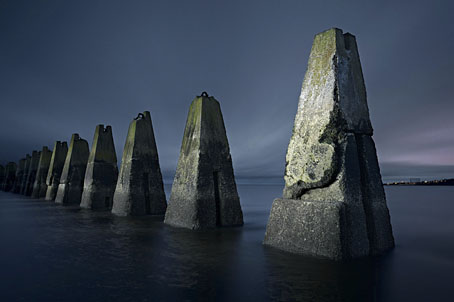
One of Jonathan Andrew‘s photos of coastal bunkers and concrete defences from the Second World War. In 2006 JG Ballard looked at the way these structures embody the functional nature of Modernist architecture.

• “Utamaro, whose prints of famous courtesans were regarded as the very models of sober beauty by 19th-century Western collectors, in fact produced more Shunga books and albums than non-erotic works.” Adrian Hamilton on the Shunga: Sex and Pleasure in Japanese Art exhibition.

• “…in Samoa, as in many traditional cultures around the world, androphilic males occupy a special transgendered category.” Alice Dreger on gay male couples and evolution.

• Robert Fuest’s film of Michael Moorcock’s first Jerry Cornelius novel, The Final Programme (1973), is out on (Region 2) DVD this month.

Masked by reticence and cloaked in tweeds, [Herbert] Read was the unexpectedly ardent and frighteningly prolific champion of nearly everything that was radical in the first half of the twentieth century: Imagism, Surrealism, abstraction, the Bauhaus, Marxism, anarchism, Freud and Jung, progressive education, Gandhian nonviolent resistance. Though now somewhat dimly remembered, he was, for decades, the Victoria Station of the arts, England’s primary explainer of the modern.

Eliot Weinberger introduces Herbert Read’s strange fantasy novel, The Green Child (1935).

• KW Jeter’s steampunk novel Fiendish Schemes is published (with my cover art) by Tor on the 15th. There’s an extract here.

• Mix of the week: An early Halloween mix (and interview) from Joseph Stannard of The Outer Church.

• At Dangerous Minds: Codex Seraphinianus: A New Edition of the Strangest Book in the World.

A trailer for the forthcoming Blu-ray release of Murnau’s Nosferatu: A Symphony of Horror.

• Kenneth Halliwell: lover, killer… artist? Philip Hoare on the collages of Joe Orton’s partner.

• Clive Hicks-Jenkins looks back at Cocteau’s La Belle et la Bête here, here and here.

Anastasia Ivanova‘s photo portraits of lesbian couples in Russia.

Christopher Fox on electronic music’s sound of futures past.

• At Strange Flowers: Melchior Lechter’s book designs.

Vaughan Oliver‘s favourite 4AD album covers.

Swinging Sixties Japanese film posters.

John Foxx’s favourite albums

Beauty And The Beast (1977) by David Bowie | Slow Motion (1978) by Ultravox | I Am The Green Child (2000) by Coil

Kirlian photography

kirlian1.jpg

quarter3 (2006) by nebamix.

Thinking recently about the resurgence of interest in the various forms of parapsychological and occult phenomena that were so popular in the 1970s, I’m surprised not to see more mention of Kirlian photography, or the capturing of high-voltage coronal discharges on photographic plates. In the 70s the idea was that Kirlian photographs depicted auric fields, and the phenonemon was widespread enough for a while enough to attract the attention of (among others) David Bowie. From a purely aesthetic point of view I’ve always enjoyed the appearance of these photographs. Flickr has a Kirlian photography pool with a variety of examples (fewer than I’d hope) while there are more to be seen at the Full Spectrum site where they specialise in high-quality Kirlian images. While browsing the pictures you could maybe listen to Kirlian Photograph by Cabaret Voltaire, a track from their still strange and unsettling debut album, Mix-Up, itself a product of the 1970s.

kirlian2.jpg

A negative discharge (1896).

Previously on { feuilleton }
Thought-Forms and Auras

Weekend links 158

soderberg.jpg

Pan II (2012) by Fredrik Söderberg.

• “Aubade was a surprise success, selling some 5000 copies and going into a second printing and an edition published in America.  Martin was immediately a minor celebrity, being interviewed for articles that couldn’t mention what his book was actually about.” Rediscovering the works of Kenneth Martin.

• “I can’t stand covers which imitate other covers, or which slavishly look like whatever their designated genre is supposed to look like.” Ace cover designer Peter Mendelsund is interviewed.

• At The Outer Church Isablood & Henry of Occult Hand are interviewed about their mixtape.

I’d decided to pay my respects in an unorthodox way, by time-travelling into the period of Thatcher’s pomp, when she occulted the light, alchemised the bad will of the populace and did her best to choke the living daylights out of the awkward, sprawling, socially coddled essence of metropolitan London. Hers was a tyranny of the suburbs operating from a position of privilege at the centre: she might have invested in a Dulwich retirement property, but she couldn’t sleep in it.

Iain Sinclair visits Tilbury on the day of the Thatcher funeral. Related: Iain Sinclair and Jonathan Meades in Conversation, Oxford Brookes University, March 2013.

Ormond Gigli’s best photograph: women in the windows in Manhattan. See it full size here.

Balzac and sex: How the French novelist used masturbation to fuel his writing process.

• At Dangerous Minds: Kenneth Williams and John Lahr discuss Joe Orton in 1978.

• Yet more Bowie: Sukhdev Sandhu reviews Ziggyology by Simon Goddard.

The Spectacular, Wild World of Tenjo Sajiki and its Posters.

• In 1967 Susan Sontag made lists of her likes and dislikes.

Stephen Sparks on fin de siècle author Marcel Schwob.

Day Jobs of the Poets by Grant Snider.

James Turrell’s Ganzfeld Experiment.

The Pan Piper (1960) by Miles Davis & Gil Evans | Panorphelia (1974) by Edgar Froese | Pandora (1984) by Cocteau Twins

Weekend links 152

mackenzie.jpg

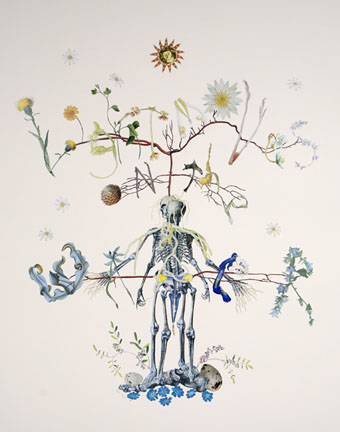
Light Moves on the Water (2010), a collage by Alexis Anne Mackenzie.

“[She] stated, emphatically and more than once, that pornography cannot and should not be linked to LGBT rights…When a gay man lives somewhere where his identity is threatened, it’s clear how sex – including pornography – and sexuality are intertwined. His sexual imagination, which is criminalized, matches the sexual images of gay pornography (which are also criminalized). Since acting out his imagination through sex would be to risk his life, the access to the images is safer. The images, created by gay men wherever it’s legal to create them, provide empowerment and diminish alienation.” An important piece by Conner Habib who asks “Why are we afraid to talk about gay porn?”

• Florida’s Parallel Universe: “The abandoned Nike Missile Site, surrounded by the Everglades, is a reminder of when humans almost destroyed the world and a warning that we could still lose everything today.” By Stefany Anne Golberg.

• In Search of Divine: A Retrospective by Katherine McLaughlin. Related: Jeffrey Schwarz, director of a new documentary, I Am Divine, talks about Divine’s career, and his film to Polari Magazine.

When Brendan Behan’s Borstal Boy was banned in 1958, it was said that a man in a pub asked him how much the book weighed, then offered to bring two thousand copies across the border instead of his usual smuggled butter. We might have called it the Black North, for being dark with Protestants, but when I was a child in the 1960s, Ulster was the place British sweets came from: Spangles, Buttons and, most notably, Opal Fruits. It was across this border that the feminists of “the condom train” staged a mass importation of illegal contraceptives in May 1971. When they arrived from Belfast into Connolly Station, the customs men “were mortified”, Mary Kenny, one of the participants, remembered, “and quickly conceded they could not arrest all of us, and let us through”.

Anne Enright on censorship in Ireland.

• Open Culture posts a copy of Nigel Finch’s 1988 Arena documentary about Robert Mapplethorpe.

The Fall of Communism Through Gay Pornography: A video by William E. Jones.

• Surrealism Made Fresh: Sanford Schwartz on the drawings of the Surrealists.

• Cult Classic: Defining Katherine Mansfield by Kirsten O’Regan.

Jonathan Barnbrook (again!) on David Bowie (again!).

Sydney Stanley illustrates Algernon Blackwood

20 Haunting Ghost Towns of the World

• At Pinterest: The Male Form

The Life Divine (1973) by Santana and McLaughlin | The Rhythm Divine (1987) by Yello feat. Shirley Bassey | Divine (2000) by Antony and the Johnsons

Brecht and Bowie

baal2.jpg

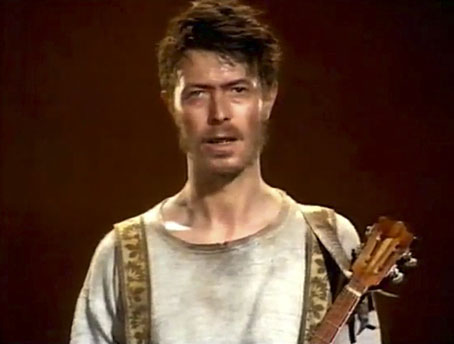
While David Bowie is still making the news it’s worth revisiting Baal, an hour-long BBC TV adaptation of the Bertolt Brecht play broadcast in 1981. Bowie stars as the title character, a thoroughly disagreeable poet and café singer who ruins the lives of those around him. This caused a stir at the time more for Bowie’s presence than for the content although Brecht wasn’t exactly a popular choice for evening entertainment. Prior to this most of Bowie’s acting had been in films, with his television appearances being limited to song performances or chat show discussions. The Man Who Fell to Earth aside, I’ve been somewhat dismissive of Bowie’s acting at times, his accent and the sheer weight of his musical persona overwhelm whatever role he’s given, but he’s good in this. He throws himself into the role, and is more convincing than I remember him being a couple of years later in Merry Christmas Mr Lawrence.

baal.jpg

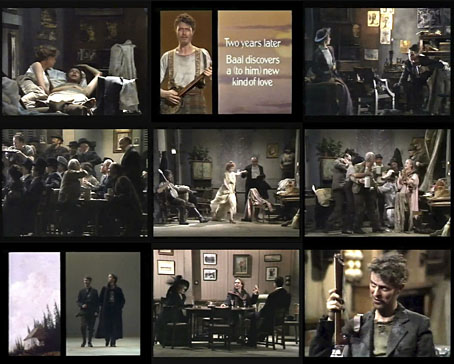
For many people Bowie will be the sole attraction in Baal but for me there’s also the presence of the great Alan Clarke as director and co-adaptor (with John Willett). Clarke directed the cult TV play Penda’s Fen in 1974, and was later responsible for a handful of other notable TV films including Scum, Made in Britain, Road, Elephant (1989), and The Firm, all of which are distinguished by a singular intensity and dramatic power the likes of which is usually only found in the best feature films. Compared to those plays Baal is a minor piece, filmed entirely in the studio, and made deliberately stagey to honour Brecht’s Verfremdungseffekt. The cameras keep their distance from the performers, and Brechtian distance is also achieved by the use of split-screen, title cards, and Bowie’s direct addresses to the viewer. If this seems like challenging material for a general audience (never mind the singer’s fans) consider that Baal was broadcast in primetime on BBC 1 when there were only three television channels in the UK. This would not happen today.

Previously on { feuilleton }
Penda’s Fen by David Rudkin