Weekend links 319

hibert.jpg

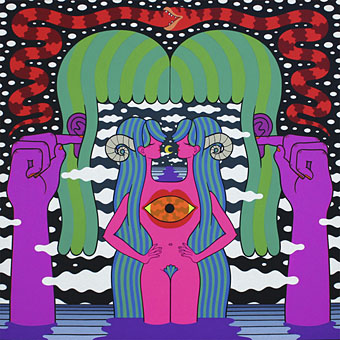
The Sapphic Sleep Web by Oliver Hibert.

• “Google isn’t willing to say whether or not it’s censorship. That they don’t have to even address this is what’s so shocking, It seems like cowardice.” Dennis Cooper talking to Andrew Durbin at Frieze about Google’s unexplained deletion of his long-running blog. Cooper’s case has been covered by arts sites and some newspapers but I’ve yet to see any mention at all on the main US gay news sites despite Cooper being a notable gay author. I’ve cast aspersions at those sites in the past for their obsession with terrible pop acts and off-topic trivia (one site still reports every last fart of Britain’s Royal Family as “news”); this recent issue only reinforces their irrelevance.

• Creating Jerusalem: Alan Moore on the most important book he has written. Related: Alan Moore uses nine-year-old’s fan letter on new book’s cover.

• “Whatever side of the aisle you’re on, HL Mencken is as relevant as ever,” says Paula Marantz Cohen.

To say that Goodbar is an obsessive and symbolically overdetermined film would be an understatement: the film compulsively reiterates themes, visual motifs and parallel narratives, a relentless and repetitive reiteration of ideas that lends that film the aspect of a Freudian dream landscape, a baroque, Boschian sequence of fantasies, projections and illusions.

Bruce LaBruce on Richard Brooks’ film of Looking for Mr. Goodbar

Mare Teno by Michel Redolfi, performed by Thomas Bloch, Susan Belling & Michel Redolfi.

• From 2015: Suicide’s Alan Vega Talks Fiery Record With Big Star’s Alex Chilton.

• Mix of the week: The Takeover with Front & Follow & The Geography Trip.

• Psychic Spaces & Neon Nirvana: The Art of Oliver Hibert by S. Elizabeth.

• How William Burroughs‘s drug experiments helped neurology research.

Yello, absurdist Swiss pop pioneers, return with a new video, Limbo.

• Morphologies Masterclass: Ramsey Campbell on HP Lovecraft.

Cliff Martinez on horror, homage and The Neon Demon.

• A City of Dust: photos of London by Lewis Bush.

Dust To Dust (1986) by Ginger Baker | Neon Sisters (1992) by Thomas Dolby | Limbo (1992) by Sandoz
Weekend links 317

mucha.jpg

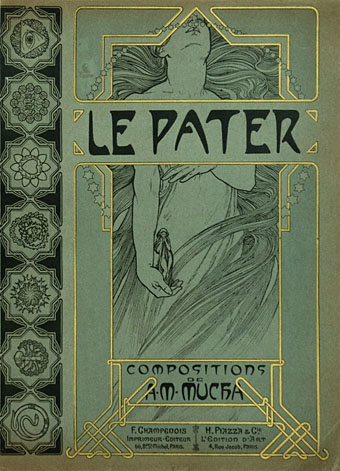
Alphonse Mucha’s Le Pater, a book of mystical Symbolism written, designed and illustrated by the artist, was published in a limited edition in 1899. The book has been out of print ever since but Thomas Negovan at Century Guild will be reprinting it later this year.

• “Five axioms to define Europe: the coffee house; the landscape on a traversable and human scale; these streets and squares named after the statesmen, scientists, artists, writers of the past; our twofold descent from Athens and Jerusalem; and, lastly, that apprehension of a closing chapter, of that famous Hegelian sunset, which shadowed the idea and substance of Europe even in their noon hours.” George Steiner explores his idea of Europe.

Journey To The Edge Of The Universe by Upper Astral, 43 minutes of cosmic ambience, is a cassette-only release from 1983. The album has never been reissued so secondhand copies command excessive prices but it may be downloaded here.

• Mixes of the week: Three hours of ambience by Gregg Hermetech, XLR8R Podcast 446 by [Adrian] Sherwood x Nisennenmondai, and Secret Thirteen Mix 190 by Shxcxchcxsh.

Today [Angela] Carter is well known, widely taught in schools and universities, and much of what she presaged—in terms of recycling and updating (“old wine in new bottles”, she called it), or gender role play and reversal—has become commonplace in the culture. Despite this, many critics find it difficult to situate her work properly. This is partly because Carter is so sui generis (she has literary offspring but few antecedents), and partly because many struggle with the relationship of politics and aesthetics in her writing.

Kate Webb reviews two new books about Angela Carter

• Words that will forever pursue us: Tim Page on the late Michael Herr, “rock’n’roll voice of the Vietnam War”.

• From 2015: Luigi Serafini on how and why he created an encyclopedia of an imaginary world.

James Campbell on Ginsberg, Kerouac and Burroughs: celebrating the Beats in Paris.

Fragile Beasts, an exhibition of grotesque print ornaments at Cooper Hewitt, NYC.

• Not before time, Guy Gavriel Kay wants to see an end to the plague of writing tips.

• David Bowie and Buster Keaton by Steve Schapiro.

Tom Charity on the films of Michael Cimino.

Alison Goldfrapp: photographer.

Golem Mecanique

European Man (1981) by Landscape | Europe After The Rain (1981) by John Foxx | Trans Europe Express (1994) by The One You Love

Weekend links 315

knights.jpg

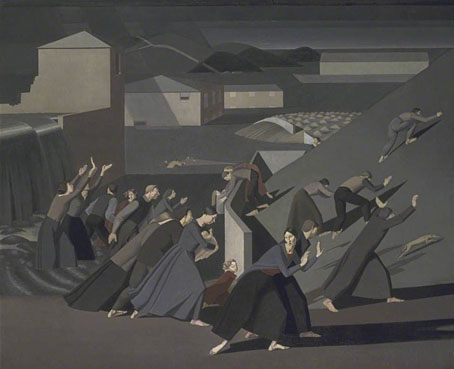
The Deluge (1920) by Winifred Knights.

Dennis Cooper‘s favourite fiction, poetry, nonfiction, film, music, art & internet of 2016 so far. (Thanks again for the nod to this blog!)

• At Literary Hub: Jonathan Russell Clark on Jorge Luis Borges, and Jon Sealy on why indie presses [in the US] are opening bookstores.

• “It’s not just about the music.” A conversation on the occult practices in the arts between poet Janaka Stucky and Peter Bebergal.

• Daisy Woodward talks to Andreas Horvath about Helmut Berger, Actor, a documentary about Visconti’s muse and lover.

• More Fritz Leiber: Brian J. Showers on his decision to republish Leiber’s horror novel, The Pale Brown Thing.

• Mixes of the week: Sextape 4 by Drixxxe, and Radio Oscillations #96 (Richard Pinhas/Heldon) by Iron Blu.

• The 5th Young One: Pay No Attention to the Girl Behind the Sofa; John Reppion on a television mystery.

• More reading suggestions: Cheerless beach reads for gloomsters and saddies by S. Elizabeth.

• Never the same film twice: Seances by Guy Maddin, Evan Johnson, Galen Johnson.

• How painter Winifred Knights became Britain’s “unknown genius”.

• The Journey & The Destination: An interview with Hawthonn.

Robert Latona goes in search of the grave of Constance Wilde.

• Invisible by Day: photos by Mikko Lagerstedt.

• A Queer Lit Q&A with Evan J. Peterson.

• RIP Michael Herr and Bernie Worrell.

Bridget Riley: The Curve Paintings.

• The typography of Blade Runner.

Japanese matchbox labels

SOS by Portishead

A Rainbow In Curved Air (1969) by Terry Riley | The Great Curve (1980) by Talking Heads | Dangerous Curves (2003) by King Crimson

Weekend links 313

oneill.jpg

The Sullen Son (1921) by Rose O’Neill from her Sweet Monsters series (also here).

10 hours of Popcorn (1972) by Hot Butter. Related (and linked here before) 79 different versions of Gershon Kingsley’s original. If that’s not enough, there’s at least 100 more out there.

• Mixes of the week: Touristica Mystica Sigillistica by Gregg Hermetech, FACT Mix 554 by The Body, and Secret Thirteen Mix 187 by Dalhous.

• Another electronic cover version: Trans Europe Express by Cobby & Mallinder.

In the 1950s people like Pierre Schaeffer and John Cage were saying: “But there are all these sounds in the world, and if you listen to them carefully enough you will hear the music that they speak.” This immediately opened up a new world; it’s enriching once you’ve educated your ear to that, because when you’re annoyed by the sound of the street you can make music out of it. You can make music out of almost everything!

Eliane Radigue discussing her career with Paul Schütze

Patricia Highsmith’s Snail Obsession and Two Weird Tales of Monstrous Mollusks.

Youth and Alex Patterson remember the making of Little Fluffy Clouds by The Orb.

Strange Flowers pursues Sheila Legge and other Phantoms of Surrealism.

• Revealed: Cambodia’s vast medieval cities hidden beneath the jungle.

Alan Moore describes the cover of epic novel Jerusalem.

Ashgabat: the city of the living and the city of the dead.

• In praise of the tram by Christian Wolmar.

Taxidermists at DC’s

Brian The Snail (1982) by Pigbag | Slow Loris Versus Poison Snail (1996) by David Toop & Jon Hassell | Popcorn (2000) by Gershon Kingsley

Weekend links 310

monogenis.jpg

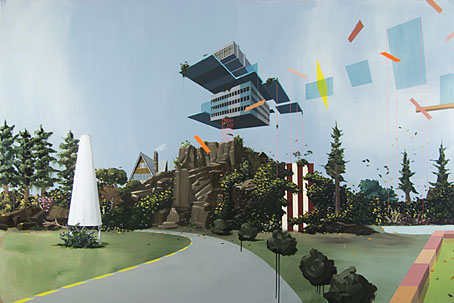
Parkland (2012) by Dean Monogenis.

• “The Story Behind the Planet’s Most Influential Road Map of ‘Weird Music’“. Gustavo Turner investigates the enduring influence of The Nurse With Wound List. Related: A Discogs list of links to all the NWWL discographies, and a recommended listening guide by Ultima Thule.

Tokyo Melody: Un film sur Ryuichi Sakamoto (1985) by Elizabeth Lennard features Sakamoto at work on Illustrated Musical Encyclopedia, together with Akiko Yano, Haruomi Hosono and Yukihiro Takahashi.

• “We wanted to fuse the aesthetics, histories and values of witchcraft, the traditional ideas with a contemporary edge,” says editor and creative director of Sabat magazine, Elisabeth Krohn.

There is a very seductive and very dangerous demon: the demon of generalities. He captivates man’s thought by marking every phenomenon with a little label, and punctiliously placing it together with another, similarly carefully wrapped and numbered phenomenon. Through him a field of human knowledge as changeable as history is turned into a neat little office, where this many wars and that many revolutions sleep in folders – and where we can pore over bygone ages in complete comfort. This demon is fond of words such as “idea”, “tendency”, “influence”, “period”, and “era”. In the historian’s study this demon reductively combines in hindsight the phenomena, influences and tendencies of past ages. With this demon comes appalling tedium – the knowledge (utterly mistaken, by the way) that, however humanity plays its hand or fights back, it follows an implacable course. This demon should be feared. He is a fraud. He is a salesman of centuries, pushing his historical price list.

Vladimir Nabokov in a previously unpublished lecture, On Generalities

• More Tom Phillips: 20 Sites n Years, a film by Jake Auerbach & David Thorp about the artist’s long-term urban photography project, is showing at Camberwell College of Arts next month.

• Mixes of the week: Sass In Pocket by Abigail Ward, Near Mint, 17th May 2016 by Robin the Fog & Hannah Brown, and Secret Thirteen Mix 184 by Andi Stecher.

• Grey Dog Tales talks to Brian J Showers of Swan River Press about horror and supernatural fiction.

• “Magic mushrooms lift severe depression in clinical trial.” But their use is still illegal in the UK.

• “Your brain does not process information, and it is not a computer,” says Robert Epstein.

Cliff Martinez’s theme for Nicolas Winding Refn’s forthcoming The Neon Demon.

Diamanda Galás, Still Wild and Primal, Returns to the New York Stage.

Janae Corrado on the photography of Joel-Peter Witkin.

Alastair Gee on gay home movies from the 1940s on.

People Laugh At Me (Coz I Like Weird Music) (1980) by The Instant Automatons | Weird Caravan (1980) by Klaus Schulze | Call It Weird (1983) by Xymox