Weekend links 306

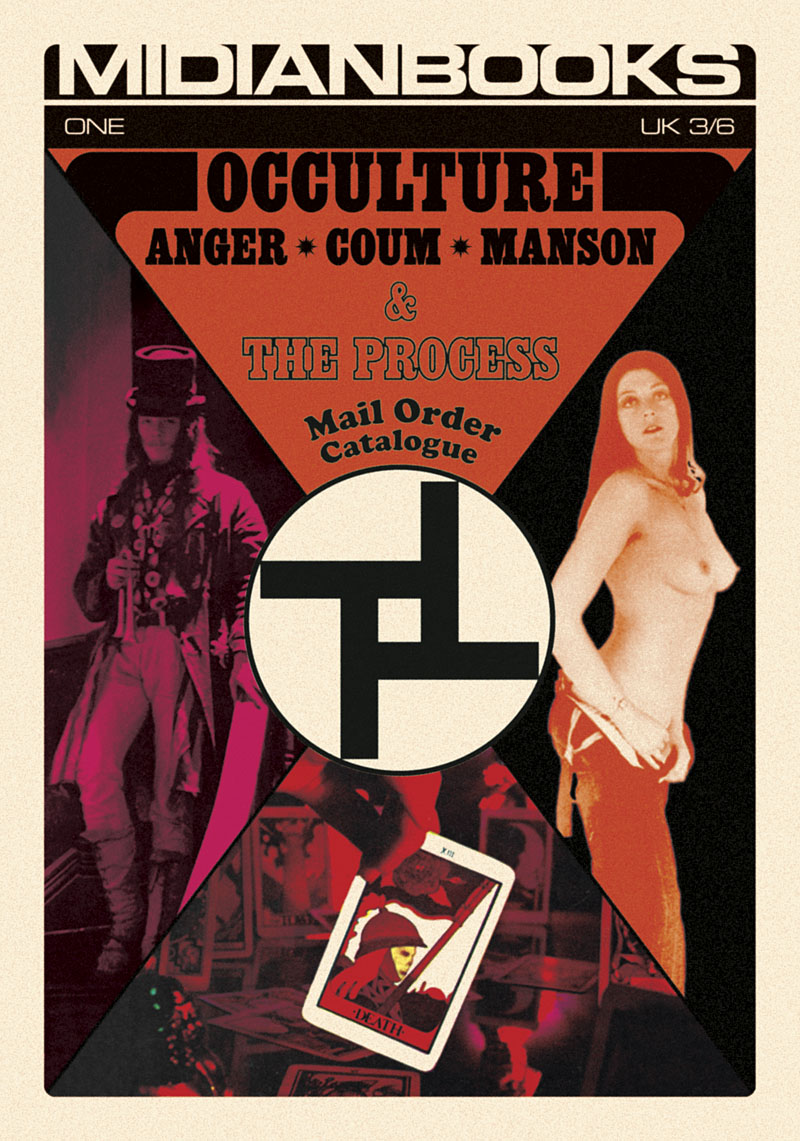
midian.jpg

• The Midian Books Occulture catalogue launched this week sporting a cover that I pieced together for Midian’s Jonathan Davies. The design pastiches the look of the Process Church magazines of the early 1970s; inside there’s a haul of Process material on sale together with COUM/Throbbing Gristle ephemera (that’s Cosi Fanni Tutti on the right, as seen on her modelling business card), Kenneth Anger ephemera (that’s Bobby Beausoleil on the left) and much more.

• More occulture: Lost Envoy: The Tarot Deck of Austin Osman Spare launches on 11 May at Camden Arts Centre, Arkwright Road, London NW3 6DG, from 7–9pm. All are welcome.

• Out this week: Close To The Noise Floor – Formative UK Electronica 1975–1984: Excursions in Proto-Synth Pop, DIY Techno and Ambient Exploration.

• Mixes of the week: Spin Doctor’s All Vinyl Prince Tribute Mix, and the Rum Music Mix by Russell Cuzner.

David Gentleman’s illustrations for New Penguin Shakespeare books, 1967–1977.

• More electronica: Walberswick by Jon Brooks is now available in a digital edition.

• Blown up: Steve Rose on how cinema captured the dark heart of the swinging 60s.

• Six Quietus writers choose favourite Prince songs. Related: The A–Z of Prince

A Timeline of Slang Terms for Male Homosexuality by Jonathan Green.

Berenice Abbott’s views of New York streets then and now.

• Jan Švankmajer is crowd-funding his next film, Insects.

Laurie Anderson on the creation of O Superman.

• Blood Ceremony: The Great God Pan (2011) | Oliver Haddo (2011) | Ballad Of The Weird Sisters (2013) | Let It Come Down (2014)

Weekend links 305

marchbank.jpg

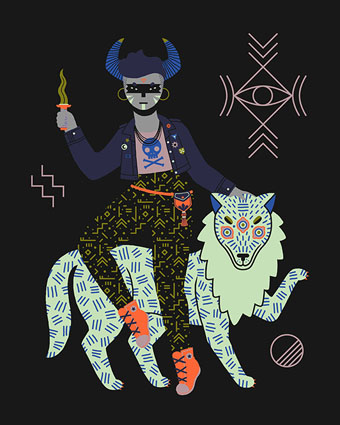
Threads of Fate—The Weird Sisters from Macbeth (2013) by Fiona Marchbank.

• The week in books: Claire Cameron on the difference between US & UK cover designs | Jason Diamond asks “Why do cats love bookstores?” | Alan Moore’s cover art for his forthcoming novel, Jerusalem, has been revealed | Brian Phillips on the typefaces used by New English Library for their Dune covers in the 1970s.

• On writing: Poetry and horror “share a universally human quest toward intimacy” says Evan J. Peterson | “The best work neither shows nor tells: it says by being, not by saying,” says M. John Harrison.

• At the BFI this week: Where to begin with Jerzy Skolimowski, and 10 overlooked British horror films of the 1970s. Both lists include Skolimowski’s excellent The Shout (1978).

Cultures do not, and cannot, work through notions of ‘ownership’. The history of culture is the history of cultural appropriation—of cultures borrowing, stealing, changing, transforming.

Nor does preventing whites from wearing locks or practicing yoga challenge racism in any meaningful way. What the campaigns against cultural appropriation reveal is the disintegration of the meaning of ‘anti-racism’. Once it meant to struggle for equal treatment for all. Now it means defining the correct etiquette for a plural society. The campaign against cultural appropriation is about policing manners rather than transforming society.

Kenan Malik on ill-considered complaints against “cultural appropriation”. Malik isn’t the first to note the intersection of such complaints with those of white supremacists who also want cultural purity and segregation

OUT, DEMONS, OUT!: The 1967 Exorcism of the Pentagon and the Birth of Yippie! An oral history by Larry “Ratso” Sloman, Michael Simmons and Jay Babcock.

• The long-overdue republication of Moebius’s work in English will begin with a new edition of The World of Edena (1985).

• More from radioactive Russia: Nadav Kander’s photographs of Soviet nuclear test sites.

• Comic artist and illustrator Kris Guidio in conversation with Jonathan Barlow.

• Francesca Gavin meets Tadanori Yokoo, “the Grandmaster of Pop-Psych Art”.

• “LSD’s impact on the brain revealed in groundbreaking images”

• Mix of the week: Secret Thirteen Mix 182 by Paul Jebanasam.

• A trailer for Nicolas Winding Refn’s The Neon Demon.

• Tony Conrad: 1940–2016 by Geeta Dayal.

Brian Eno’s favourite records

Neonlicht (1994) by Mitja VS (with Enzo Fabiani Quartet) | On Demon Wings (2000) by Bohren & Der Club of Gore | Shout At The Devil (2002) by Jah Wobble & Temple Of Sound

Heavy-Light, a film by Adam K. Beckett

beckett.jpg

In the early 1990s the UK’s Channel 4 still operated as an avant-garde television channel, broadcasting films, dramas and documentaries that the other channels would be unlikely to show. Late nights were often filled out with resolutely uncommercial fare, as was the case when Abstract Cinema was shown in 1993, a 50-minute documentary by Keith Griffiths that traced the history of abstract cinematic experimentation from the animations of Oskar Fischinger to the growing field of computer graphics. The documentary was followed by an additional 25 minutes of abstract shorts, one of which, Heavy-Light (1973) by Adam K. Beckett, is a particular favourite.

Most of Beckett’s films are free-form doodles, hand-drawn and dreamlike in their endlessly shifting and often erotic metamorphoses. Heavy-Light is different for being the product of some optical process that sends billowing waves of vivid colour blooming out of darkness. The effect is very similar to Jordan Belson’s films where the realisation is equally mysterious and the result equally (that word again) psychedelic; a bonus in Beckett’s film is the excellent score by Barry Schrader. Beckett died young at the age of 29 so there isn’t much of his work to see although a few of the animated films are also on YouTube at the moment (see here, here, here and here). They may not remain there for long so watch them while you can.

Elsewhere on { feuilleton }
The abstract cinema archive

Weekend links 295

dupre.jpg

Untitled (2014) by Lola Dupré. Via.

Announcement of the week (if not the month/year) is the news that the BFI will be releasing all of the BBC dramas directed by Alan Clarke on DVD/Blu-ray in May. In addition to the long-awaited appearance on disc of Penda’s Fen (1974) we can expect a previously unseen director’s cut of Clarke’s last TV film, The Firm (1989), the DVD premier of Baal (1982) with David Bowie, plus many other works including some from the 1960s that were believed lost. (And it should be noted that this isn’t everything of Clarke’s; he also worked occasionally for ITV and later directed feature films for Channel 4.)

The BFI attention is a tribute to an exceptional director that’s overdue. Clarke has long been a cult figure among the British actors who worked with him, and among directors such as Harmony Korine and Gaspar Noé, but the tendency of TV to give one-off dramas a single screening has meant that much of his best work has been unavailable for years outside old VHS tapes. Clarke is important for having persistently chosen difficult subjects which he directed with a flair and intensity usually only found in cinema. When he died in 1990 the BBC repeated a handful of his films but the only ones given repeated DVD release have been the violent dramas with the big names attached: Scum (1979, with Ray Winstone), Made in Britain (1982, with Tim Roth), and The Firm (with Gary Oldman). Clarke’s oeuvre is much more than a parade of nihilistic villains, as will become evident later this year.

• A psychedelic video directed by Peter Strickland for Liquid Gate (ft. Bradford Cox) by Cavern of Anti-Matter. The debut album from Cavern of Anti-Matter, Void Beats/Invocation Trex, will be out later this month.

Celebrating Dusseldorf, the city that birthed Krautrock. (Article loses points for not mentioning producer Conny Plank.)

All Rivette’s features might be regarded as different kinds of horror films; Céline et Julie vont en bateau is his first horror comedy. The anxiety and despair of Paris Nous Appartient and La Religieuse, L’Amour Fou and Spectre seem relatively absent, yet they perpetually hover just beyond the edges of the frames. We still have no privileged base of ‘reality’ to set against the fictions, each of which is as outrageous as the other; and along with Borges, we can’t really say whether it’s a man dreaming he’s a butterfly or a butterfly dreaming he’s a man—although we may feel, in either case, that he and we are just on the verge of waking.

Jonathan Rosenbaum on work and play in the house of fiction: Jacques Rivette’s Out 1 and Céline and Julie Go Boating

• Mixes of the week: Finders Keepers Radio Show Krautrock Special, and The Ivy-Strangled Path Vol. XV by David Colohan.

• At Dangerous Minds: Super strange sculptures (by Shary Boyle) only the dark and demented could love.

• Beautiful Brutalites: S. Elizabeth questions Arabella Proffer about her paintings.

KTL is a musical collaboration between Peter Rehberg and Stephen O’Malley.

• Why study art when you can make it? The strange world of…This Heat.

Sarah Galo on the explicitly sexual female artists that feminism forgot.

Irmin Schmidt‘s favourite music (this week).

• LSD: My life-saving drug by Eric Perry.

The Occult Activity Book

Twenty Tiny Cities

Der LSD-Marsch (1970) by Guru Guru | Krautrock (1973) by Faust | Düsseldorf (1976) by La Düsseldorf

Single sleeves

singles01.jpg

A septet of 7-inch single sleeves from Eastern Bloc Songs, a small but well-selected repository of sleeve art from the record labels of the Eastern Bloc. I’d looked at the album art before but had missed the singles, some of which feature more impressive designs than their 12-inch counterparts. Of special interest are designs that show how the psychedelic styles of the decadent West were transmuted for a Communist audience. The Nautilus sleeve above dates from 1969, and uses the lettering adapted by Wes Wilson from a much earlier design by Alfred Roller. Elsewhere the generic sleeves from venerable Czech label Supraphon stand out for their modish graphics. (Via Record Envelope and Things Magazine.)

singles02.jpg

singles03.jpg

Continue reading “Single sleeves”