Orphic Egg album covers

orphic12.jpg

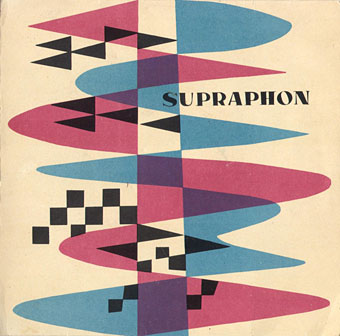
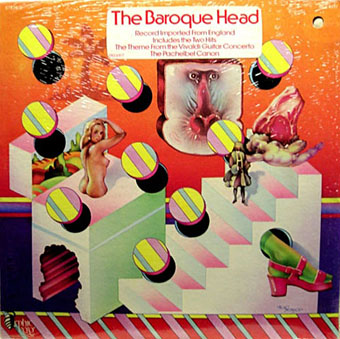
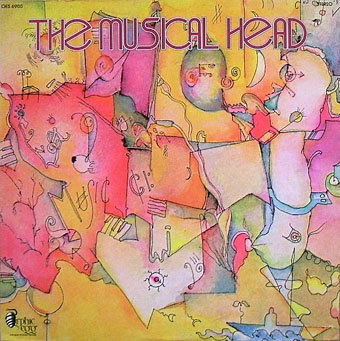
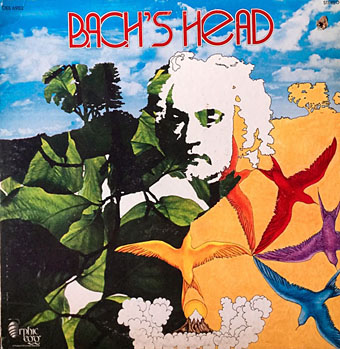
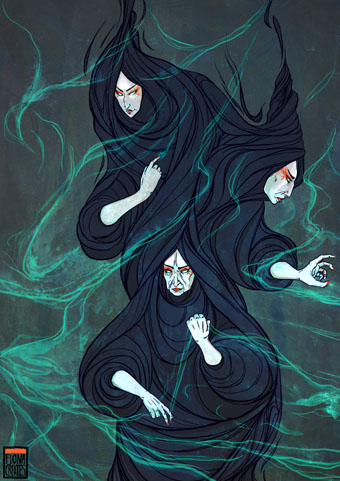
This is a record label I’d not come across before. According to this page Orphic Egg “was a subsidiary label for London Records which was formed in 1972 and lasted about a year. The label was formed to try to capture classical music for the counterculture youth of the time (often called ‘heads’). Liner notes were written by hip rock critics respected by the youth.” According to Discogs the first release, The Baroque Head, was 1971. The covers below follow in chronological order through to 1973. With the exception of the Edgard Varèse album all the releases are compilations of older recordings grouped by composer or theme.

orphic01.jpg

Discogs doesn’t give credits for all the cover art but the series was the work of several different illustrators with George McGinnis being responsible for the design. Jason Roberts’ cover for the Mussorgsky album is a suitably wild piece of late psychedelia for a collection that includes Night On Bald Mountain. There’s a nod there to the Chernobog from Disney’s Fantasia, while the Scriabin cover is an overt swipe from an original piece by Jean Delville. The Mussorgsky album is also notable for the bizarre and unique conjunction of music conducted by Herbert von Karajan and liner notes by Lester Bangs. I have to wonder what the haughty maestro of the Berlin Philharmonic would have made of the sleeve if he ever saw it.

orphic03.jpg

Continue reading “Orphic Egg album covers”

Weekend links 287

hugo.jpg

Cover by Valentine Hugo for Contes Bizarres (1933) by Achim d’Arnim. See Hugo’s interior illustrations here.

• “In spite of the blood-drinking pursuits of Rollin’s protagonists, there’s very little in the way of body horror to be found. His undead are sensual, romantic creatures that are frequently delicate of mind and body. These movies attempt to evoke nuanced emotional responses with their mixture of romance, loss, eroticism, and tragedy.” Tenebrous Kate on Sex, Death, and the Psychedelic Madness of Jean Rollin.

• “Late at night, [Melville] ‘turned flukes’ down Oxford Street as if he were being followed by a great whale, and thought he saw ‘blubber rooms’ in the butcheries of the Fleet Market.” Philip Hoare on Herman Melville’s time in London.

Haunted by Books, a new collection of writings by Mark Valentine, “explores the more curious byways of literature.” Full details at the home of the esoteric, Tartarus Press.

I am completely an elitist, in the cultural but emphatically not the social sense. I prefer the good to the bad, the articulate to the mumbling, the aesthetically developed to the merely primitive, and full to partial consciousness. I love the spectacle of skill, whether it’s an expert gardener at work, or a good carpenter chopping dovetails, or someone tying a Bimini hitch that won’t slip.

Art critic Robert Hughes quoted in a review by Siri Hustvedt of The Spectacle of Skill: Selected Writings of Robert Hughes

• “Art, art – I couldn’t give a crap about art.” Oscar Wilde’s nephew, Arthur Cravan, puts in another appearance at Strange Flowers.

• “The Tarot is utterly fascinating,” says Evan J. Peterson discussing his Tarot-inspired writing with Tarot Poetry.

Manuel Göttsching: “A lot of crazy music happened at the end of the ’60s, very strange, and very curious…”

• Mixes of the week: Secret Thirteen Mix 169 by Chra, and 28th November 2015 by The Séance.

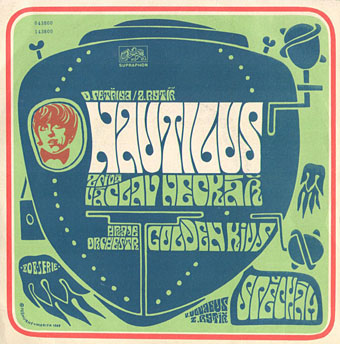
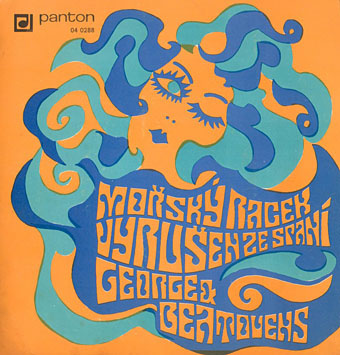
Czech Artists’ Radical Book Designs of the Early 20th Century

• Ten things you might not know about Yayoi Kusama.

• More megaliths: Francis Pryor on ritual landscapes.

Peaches gets wild in the desert: Rub (uncensored).

Irmin Schmidt‘s favourite records (this week)

Mount Etna erupts

Rituals (1981) by Bush Tetras | Ballet For A Blue Whale (1983) by Adrian Belew | Etna (2006) by Boris & Sunn O)))

Mati Klarwein, peintre Américain, a film by Fabienne Strouvé

mati1.jpg

And speaking of the 1970s and Ernst Fuchs and Mati Klarwein… Fabienne Strouvé’s Mati Klarwein, peintre Américain is a 25-minute portrait of Mati Klarwein and family made in 1979. Despite being filmed in New York City most of the conversation is in French—the Klarweins being fluent speakers—but if you like Klarwein’s art this is still a wonderfully insightful film. I always wonder about the size of paintings and other technical details so it’s good to see that, yes, many of Klarwein’s later works are larger than you might expect from reproductions, and it’s also instructive to see him at work with a portion of his painting covered by masking tape. Ernst Fuchs makes a couple of appearances (speaking French—“psychédélique!”), and you get a brief Mati guide to some of the paintings that comprise the incredible Aleph Sanctuary.

mati2.jpg

(Video link updated.)

Elsewhere on { feuilleton }
The fantastic art archive

Previously on { feuilleton }
Ernst Fuchs, 1977
The art of Mati Klarwein, 1932–2002

Hold On

holdon1.jpg

More rubble from Rubble. This isn’t as revelatory as In The Past but I like the evolution. Two of these versions of Hold On are featured on the Rubble series while the original by Rupert’s People may be heard on other psych compilations.

Rupert’s People was the name that freakbeat group The Fleur De Lys adopted for a handful of psychedelic releases in 1967; the name Rupert probably refers to the Daily Express‘s Rupert Bear, a comic-strip character who famously lost his innocence three later in the Schoolkids’ Issue of Oz magazine. Fleur De Lys appear on Rubble 13 playing Gong With The Luminous Nose, their musical setting (with inevitable retitling) of Edward Lear’s poem The Dong with a Luminous Nose. Hold On was the B-side of Reflections Of Charles Brown, and is very much a hangover from the beat period: a good song but it doesn’t stand out the way the next version does.

holdon2.jpg

Sharon Tandy left South Africa for London where she recorded a number of songs with The Fleur De Lys as her backing group. Her ace version of Hold On was also the B-side of Stay With Me in the UK but the French and US releases flipped the songs. This version and another Tandy/Fleur De Lys collaboration, the tremendous Daughter Of The Sun, leap out of Rubble 8. There’s a great clip of Tandy performing Hold On for Beat Club. The searing guitar solo is by Bryn Haworth.

holdon3.jpg

The third version appears on Rubble 3, and may also be heard on another excellent psych collection, Insane Times: 25 British Psychedelic Artefacts From The EMI Vaults. Rock music was getting heavier by 1969 so this version subjects the song to high-pitched vocals, wah-wah pedal, incipient riffing and what might be a synth drone. Despite a band name indicative of magickal accomplishment Ipsissimus didn’t record anything else.

Previously on { feuilleton }
Digging the Rubble
Out Of Limits
In The Past

Digging the Rubble

rubble01.jpg

1: The Psychedelic Snarl.

A few words in praise of Rubble, the 20-disc collection of (mostly) British psychedelic singles released by the Bam Caruso label from 1984 to 1991. A reader of Rob Chapman’s Psychedelia and Other Colours would find the Rubble series an indispensable companion to the second half of the book which explores the unique styles of British psych. Ideally you’d read the book while having these and other compilations close at hand, something I didn’t manage so I’ve been going through the discs myself this week, listening out for some of the many singles that Chapman discusses. The Rubble title is a nod to Lenny Kaye’s 1972 collection Nuggets: Original Artyfacts from the First Psychedelic Era, 1965–1968, the first reappraisal of the garage/psych era whose success spawned Nuggets II: Original Artyfacts from the British Empire and Beyond, 1964-1969, a not-so-good attempt to do the same for the UK, and Children of Nuggets: Original Artyfacts from the Second Psychedelic Era, 1976-1995. The original Nuggets was followed by the long-running Pebbles series which sprawls over 28 discs collecting obscure garage singles.

rubble02.jpg

2: Pop-Sike Pipe Dreams.

What I like about the Rubble series, apart from its covering a favourite zone of musical history, is the way that each volume is titled in a suitable manner beyond a mere number: the title of volume 8, All The Colours Of Darkness could have been used by Coil during their LSD period. Then there’s the sleeve designs by the great Phil Smee, one of the founders of Bam Caruso, the collector of many of the featured singles, and a first-rate artisan of psychedelic graphics: there’s a Louis Wain cat on volume 2, and more of those letterforms by Roman Cieślewicz on volume 10. Smee deserves a post of his own but covering such a lengthy career would be a daunting task: Discogs lists 784 separate releases, and that’s only his design work. The design on the first run of Rubble albums was credited to “Harvey S. Williams”, a Smee pseudonym playing on the name of Elektra Records art director William S. Harvey. Harvey S. Williams was also the designer of the short-lived and rather wonderful Bam Caruso magazine, Strange Things Are Happening, issues of which are advertised in the inner sleeves of the early Rubble albums. (The magazine borrowed its title from a 1968 single by Rings and Things which is featured on Rubble 4.)

rubble03.jpg

3: Nightmares In Wonderland.

The Rubble series has been reissued on CD many times, and is currently available as The Rubble Collection, a glossy cube containing all 20 discs in card sleeves together with two booklets that reprint Phil Smee’s original sleeve notes and band photos. The Rubble albums sound a little rough today when many of the songs which were taken directly from old singles have been resurrected and can be heard elsewhere in better quality. Subsequent compilations have also cherry-picked many of the better selections but this is still the ideal place to start if you want to immerse yourself in the toyshop/kitchen sink surrealism that is British psychedelia.

• See also: Richard Norris reminiscing about working at Bam Caruso, and choosing 20 favourite British psych records.

rubble04.jpg

4: The 49 Minute Technicolour Dream.

Continue reading “Digging the Rubble”