Keiichi Tanaami record covers

tanaami01.jpg

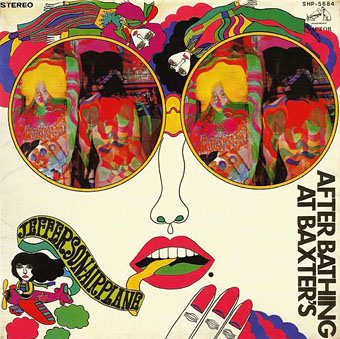
After Bathing At Baxter’s (1968) by Jefferson Airplane (front).

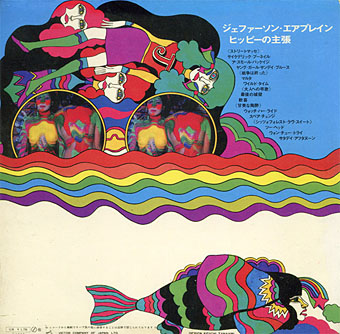
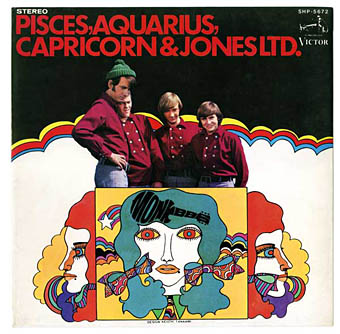
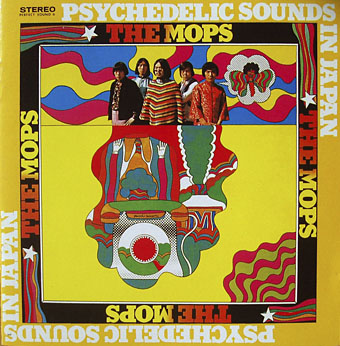
More psychedelia, although Ernst Fuchs could be considered psychedelic to some degree, and I did give him a mention in the piece I wrote for Communication Arts earlier this year. Keiichi Tanaami is less well-known in the west than Tadanori Yokoo despite the pair being contemporaries. This is only a partial discography, there may be more to find as Tanaami’s cover work isn’t always credited properly on Discogs. The Jefferson Airplane and Monkees covers were done specially for the Japanese releases. In the case of the Airplane one I much prefer the cover to Ron Cobb’s literal drawing of an aircraft.

tanaami02.jpg

After Bathing At Baxter’s (1968) by Jefferson Airplane (back).

tanaami03.jpg

Pisces, Aquarius, Capricorn & Jones Ltd. (1968) by The Monkees.

tanaami04.jpg

Psychedelic Sounds In Japan (1968) by The Mops.

Continue reading “Keiichi Tanaami record covers”

Psychedelia and Other Colours by Rob Chapman

psychedelia.jpg

My mother thought well enough of The Beatles in the 1960s to buy two of their albums—Beatles For Sale and Help!—and she continued to enjoy the Fab Four’s songs up to the point when (in her words) “they went funny”, by which she meant the period after Rubber Soul when they dropped the beat stylings, picked up sitars and took to recording drums and guitars in reverse. They were also taking drugs, of course, hence the funniness, and this rapid evolution—from loveable moptops to freaked-out weirdos in a matter of months—is the subject of Rob Chapman’s huge study of psychedelia as a cultural phenomenon, the period from around mid-1965 to late 1969 when Western youth “went funny” en masse.

This isn’t an undocumented era but Chapman’s book provides an overdue counterweight to the American focus of earlier studies such as Jay Stevens’ Storming Heaven: LSD and the American Dream (1987). Psychedelic art evolved in San Francisco but it’s an irony of the form that many of the wildest, most typically psychedelic concert posters were promoting acts that were only marginally psychedelic in their sound or, in the case of the older jazz, soul and blues acts, weren’t psychedelic at all. Chapman is more interested in the multi-media light shows than the poster art, and he reaches back in his early chapters to the origin of the San Francisco light shows in the avant-garde art of the Modernist era (especially László Moholy-Nagy’s Light-Space Modulator of the 1920s) and the art schools of the 1950s; he also traces the familiar journey of LSD from the Sandoz laboratories in Switzerland and the clinics of America to the front pages of newspapers and magazines. One of the most remarkable and unlikely aspects of psychedelia was the way in which a short-lived poly-cultural phenomenon maintained an aura of danger and illegality late into the 1960s even while psychedelic aesthetics were filtering into every facet of mainstream life: films, fashion, decor, advertising, even children’s television—all bloomed briefly with vivid colours and melting typography.

playboy.jpg

Playboy gets hip to the trip, December 1967. Art by Wes Wilson.

Chapman touches on all of this but the bulk of his study is concerned with the music which was always the core of psychedelic culture, even if many of the artists involved were only following a trend (or, to be less charitable, jumping on a bandwagon). American groups are given their due, and Chapman has some smart things to say about the often neglected surf boom of the early 60s; as noted here last month, the first piece of popular music to use “LSD” in its title was LSD-25 (1960), a surf instrumental by The Gamblers. Surf bands and garage bands mutated into psychedelic groups but there was often little change in the overall sound beyond adding an effect or two to the instrumentation. Adulterated or processed sound is what I usually look for in psychedelic music, the psychedelic experience being one of distorted or exaggerated perception. Adulteration (or lack of it) is the most obvious factor that differentiates American psych from its British equivalent: White Rabbit by Jefferson Airplane is a great song (its final line is fixed to every page of this blog) but is psychedelic only as a result of its lyrical context. Musically, the song is a simple rock bolero next to which Strawberry Fields Forever sounds like a broadcast from another planet.

Continue reading “Psychedelia and Other Colours by Rob Chapman”

Oz magazine online

oz1.jpg

Oz 4. Cover art by Hapshash and the Coloured Coat.

From a television series out of time to a magazine very much of its time. The Prisoner and Oz magazine are exact contemporaries: issue 4 of Oz (June 1967) would have been on sale when Patrick McGoohan and co. were busy turning Portmeirion into The Village. In the past anyone interested in Oz had to either scour eBay for expensive paper copies or content themselves with the incomplete scans made available several years ago. But no longer, thanks to the University of Wollongong and editor Richard Neville who have made the entire run available as downloadable PDFs. These are much better quality than the previously available copies, and they also have poster inserts available as separate downloads. The wonderful set of Tarot designs created by the late Martin Sharp for issue 4 were faded and torn in the old scans so it’s a real pleasure to see this and other artwork looking so good.

oz2.jpg

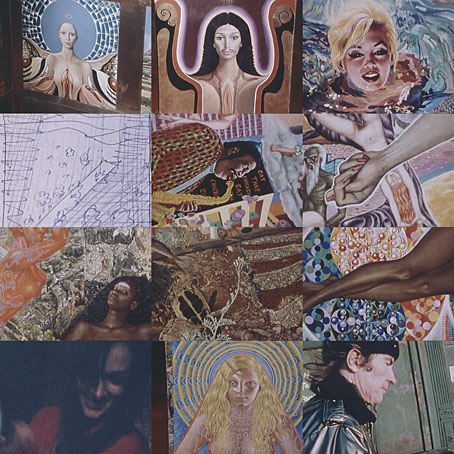
Tarot designs from Oz 4 by Martin Sharp.

Continue reading “Oz magazine online”

Elaine Hanelock’s Hollywood stars

hanelock04.jpg

The essay I wrote about psychedelic art for Communication Arts earlier this year had a word limit so there was little mention of the way the psychedelic style was swiftly co-opted by advertising and commercial art as a means of reaching a youthful audience. This is a really a subject in itself, the way in which an aesthetic that was countercultural in 1965 was becoming mainstream by 1968, and was still rippling through the world of graphic design in the early 1970s.

Elaine Hanelock’s posters of Hollywood stars of the 1920s and 30s were published by Royal Screen Craft Inc, Los Angeles, in 1968, and combine two trends: psychedelic art and the nostalgia for old Hollywood that emerged in the mid-60s. There are ten posters in the set: The Marx Brothers, Clara Bow (the “It Girl”), Mae West & WC Fields, Laurel & Hardy, John Barrymore, Charlie Chaplin, Clark Gable, Jean Harlow, Will Rogers, and Wallace Beery & Marie Dressler. Nobody seems to know anything about Elaine Hanelock’s career elsewhere but her posters continue to find an audience among collectors.

hanelock07.jpg

hanelock01.jpg

Continue reading “Elaine Hanelock’s Hollywood stars”

LSD-25 by The Gamblers

lsd25.jpg

A post last year concerned some of the songs that have flaunted their acid credentials by incorporating the letters L-S-D in their titles, the most famous being (of course) Lucy In The Sky With Diamonds. While it might be an idea to follow that post by tracking down songs with the word LSD in their title, a quick glance at Discogs shows an entire blotting pad of potential candidates. So I’ll let someone else do the leg-work on that one.

This post is less ambitious, prompted by a brief history of surf music in Rob Chapman’s Psychedelia and Other Colours. The Gamblers receive a mention for being the first group to record a piece of music with LSD in the title: LSD-25 was the B-side of their first single, Moon Dawg!, released in 1960. Moon Dawg! has the distinction of also being one of the first (if not the first) surf singles, and was later covered by The Beach Boys on their debut album, Surfin’ Safari (1962). With its hyperactive drums and twanging guitar Moon Dawg! certainly sounds like a surf number, whereas LSD-25 is more like one of Link Wray’s smouldering instrumentals. I’d heard the A-side on a Cramps-related singles compilation, Loose Lips Might Sink Ships, but hadn’t heard LSD-25 before so this is a welcome discovery. Someone had to be first with the LSD reference (chosen at random by a studio engineer according to Chapman), and we could have done much worse than this.

The Gamblers only recorded one more single before disbanding but guitarist Eliot Ingber had a distinguished career playing with Frank Zappa’s Mothers of Invention, Little Feat, Captain Beefheart (as Winged Eel Fingerling), and (I didn’t know this) as a member of The Peter Peter Ivers Band (sic) on Terminal Love (1974). You may not know Ivers’ name but you’ll probably know his voice when it appears in David Lynch’s Eraserhead in the guise of the Lady in the Radiator singing In Heaven.

Previously on { feuilleton }
More trip texts
Trip texts
Acid albums
Acid covers
Lyrical Substance Deliberated
The Art of Tripping, a documentary by Storm Thorgerson
Enter the Void
In the Land of Retinal Delights
Haschisch Hallucinations by HE Gowers
The art of LSD
Hep cats