The art of Frieda Harris, 1877–1962

harris01.jpg

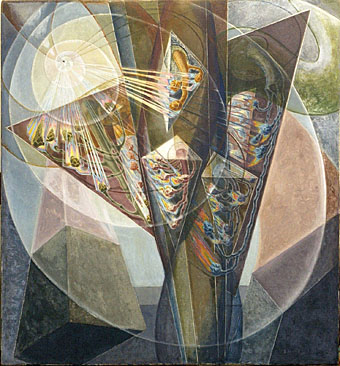
Searching around for artwork by Frieda Harris turned up a few examples I hadn’t seen before including the marvellous painting above which is unfortunately untitled and undated. Harris is very familiar to Aleister Crowley aficionados and those with an interest in the Tarot via her paintings for the Thoth Tarot deck, a project that she and Crowley worked on during the 1930s. The deck is justly celebrated for its modernising of the Tarot symbolism, and for its radical art style which wasn’t afraid to combine some of the developments in 20th-century art with Harris’s studies of Projective Synthetic Geometry.

harris05.jpg

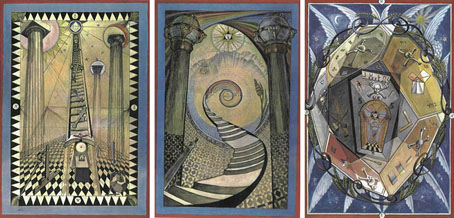
Masonic Tracing Boards.

Less familiar is her work away from the Tarot deck, some of which can be seen here. Prior to meeting Crowley, Harris was involved with Freemasonry for which she produced three designs for the Masonic teaching aids known as Tracing Boards. (See larger copies here.) I used to think these looked like outtakes from the Tarot deck but seeing them in the light of the mysterious painting above it’s evident that the Tarot style wasn’t unique to that set of cards.

harris04.jpg

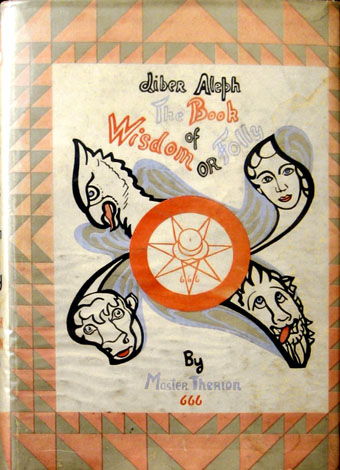
Liber Aleph vel CXI: The Book of Wisdom or Folly (1918) by Aleister Crowley.

A book cover which pre-dates the Tarot designs. The heads are the traditional embodiments of the four elements but with one change: the human figure has a feminine face rather than the usual masculine features. The same figures appear on her painting for the final Tarot Trump, The Universe (below), but in a more traditional guise.

Continue reading “The art of Frieda Harris, 1877–1962”

Konx om Pax

konx1.jpg

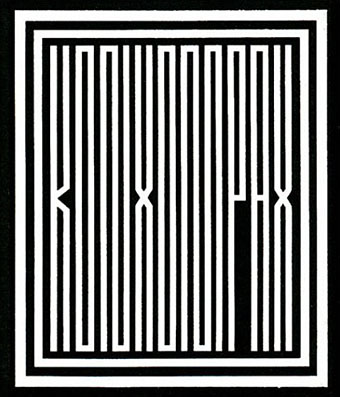
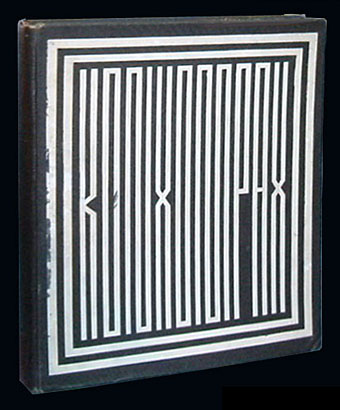
Not the musician but the book of “Essays in Light” published by Aleister Crowley in 1907. I’ve been familiar with this for years but only via the many reprints. It was only recently that I discovered the striking cover design of the first edition which, we’re told, was designed by Crowley himself during a hashish bout. I’ve not been able to find the source for this piece of information but it’s not in the chapter of his autobiography where he discusses the writing of the book. (Matters aren’t helped by Konx om Pax not being listed in the index.) If anyone has the relevant details then please leave a comment.

konx2.jpg

In design terms this cover might seem radical for 1907 but if Crowley did design it I’d guess he was thinking of a quite common geometric variation of Kufic script. Crowley travelled East as far as China, and had an abiding interest in languages of all kinds. Konx om Pax opens with a quote in Arabic from the Qur’an which is followed by a succession of quotes in different languages including Hebrew, Chinese, Ancient Greek, Sanskrit and hieroglyphic Egyptian.

konx3.jpg

Konx om Pax (2011) by Fredrik Söderberg.

Crowley’s lettering turns up much later in this painting by Fredrik Söderberg. The phrase was also referenced during the 1990s on many of Bill Laswell’s recordings, often by cryptic phrasing on CD stickers. The name forms part of one of the tracks on Laswell’s Axiom Ambient album from 1994, an album which includes a sample of Crowley’s voice. Also in the 1990s, Laswell was making frequent use of what MacGregor Mathers claimed was the English translation of the Egyptian origin of the phrase: “Khabs am Pekht” or “Light in extension”. One of Laswell’s many dub projects, Divination, released two compilation albums called Light In Extension, while the phrase “Khabs am Pekht” (which had me mystified for years) appears on the back of Material’s magnificent Hallucination Engine (1994). One of my favourite albums, which also includes a portion of a Crowley Tarot card in its James Koehnline artwork.

Previously on { feuilleton }
Burroughs at 100
Aleister Crowley: Wandering The Waste
Brush of Baphomet by Kenneth Anger
Rex Ingram’s The Magician
The Mysteries of Myra
Aleister Crowley on vinyl

Weekend links 219

balbusso.jpg

Grendel Monster (2013) by Anna & Elena Balbusso.

Rick Poynor looks at the Guide de la France mystérieuse (1964), a fantastic (in every sense) doorstop of a volume whose collage alphabet by Roman Cieślewicz can be seen on the cover of Carnival In Babylon (1972) by Amon Düül II.

• Boolean mathematics, Charles Howard Hinton, The Voynich Manuscript, and the effects of surveillance on the political process: Adam Curtis firing on all cylinders as usual.

• At Strange Flowers: The Picture of John Gray, remembering the minor fin de siècle figure who gave Oscar Wilde a surname for his most famous creation.

In “32 Cardinal Virtues of Dennis Cooper,” Wayne Koestenbaum remarks: “Cooper’s quest for the unseeable is virtually religious. I mean: sedulous, abstract, perpetual, unrewarded, unreasonable.” There’s much more to be said of Gone, its power, its pain, its odd intrigues, but perhaps it will suffice to say that it is revealing: unlike Burroughs’ scrapbooks hidden away by some private collector, never to see the light of day, Gone (and its sister texts at the Fales Library) illuminate in perpetuity Cooper’s obscure quest for the unseeable.

Diarmuid Hester looks at Dennis Cooper’s scrapbooks

The Sallow Tree, a single by Lutine. More music: An hour of Julia Holter‘s St John’s Sessions performance.

• At Dangerous Minds: Christian televangelists listen to Stairway To Heaven forwards.

• Cathy Camper reviews Fearful Hunter, a graphic novel by Jon Macy.

• Mix of the week: FACT mix 452 by Claude Speeed.

Roman Cieślewicz at Pinterest.

The Adobe Illustrator Story

The House of Julian

Unofficial Britain

• Amon Düül II singles: Rattlesnakeplumcake (1970) | Between The Eyes (1970) | Light (1971) | Lemmingmania (1971)

More Songs for the Witch Woman

cameron1.jpg

This month I’ve been enjoying the latest quality publication from Fulgur, Songs for the Witch Woman, the centrepiece of which is a cover-to-cover reproduction of the book of occult poetry and art created by Jack Parsons and Marjorie Cameron in the early 1950s. It’s been a great pleasure in recent years seeing the welling of interest in Cameron’s work. In 2001 when I was compiling notes for an abandoned study of occult cinema, Cameron as artist, witch or mere human being was a shadowy presence about whom nothing substantial seemed to have been written; her art was impossible to see anywhere, all one had were fleeting references in books, and her appearances in The Inauguration of the Pleasure Dome and Curtis Harrington’s Night Tide, a pair of films that only exaggerated her mystique. The intervening years have seen a lifting of successive veils so we’re now able to watch Curtis Harrington’s film portrait, The Wormwood Star, and see her work in books and exhibitions like this one (also titled Songs for the Witch Woman) which will be showing at the Pacific Design Center in Los Angeles from mid-October. As an early precursor to that there’s this feature by Robert Garrova at SPRC which includes comments about the exhibition from organisers Scott Hobbs and Yael Lipschutz.

cameron2.jpg

Pan: art by Cameron, poem by Parsons.

Previously on { feuilleton }
Songs for the Witch Woman
More Cameron
Inauguration of the Pleasure Dome: The Eldorado Edition
The Wormwood Star
Street Fair, 1959
House of Harrington
Curtis Harrington, 1926–2007
The art of Cameron, 1922–1995

Weekend links 217

scaphandrier.jpg

Le Petit Journal, June 16, 1912. Via Beautiful Century.

Occult art by Nicomi Nix Turner, Daniel Martin Diaz, Amy Earles and William Crisafi. Related: Illustrations by Ernest M. Jessop for The Witches Frolic by Thomas Ingoldsby.

• “Our definition of ‘Industrial’ then was a very broad one, it’s definitely not so much now.” Chris Carter & Cosi Fanni Tutti on 20 Jazz Funk Greats by Throbbing Gristle.

• At Dangerous Minds: the Amok Assault Video (1988), an hour of the bizarre, the extreme and the outré which will probably get yanked from YouTube before too long.

I’ve always thought the exchange of words for money is no more and no less problematic than any other kind of prostitution—and it’s important that we prostitutes control a certain amount of our production (and reproduction, for that matter). If I’m writing a book and I’m warned, “Oh, this is unsaleable, you need to make it shorter,” or, “It has to be this, or that,” I’m proud to say I don’t pay attention.

Though this is becoming more difficult. As large publishers turn into monopolies, and the MBAs who are running them—maybe editors used to run them before—are steadily tightening the screws, they feel more and more that they get to call the shots.

Writers can do anything, says William T. Vollmann

• Mixes of the week: Over two hours of Coil and other artists sequenced by Surgeon, and Secret Thirteen Mix 122 by DJ Skirt.

Alan Moore calls for a boycott of the “wretched” new Hercules film on behalf of his friend Steve Moore.

Joe Orton‘s first play, Fred and Madge, will receive its world premier in September.

tentacles.jpg

Ned Raggett found the drawing of mine that’s part of the Tentacles exhibition currently showing at the Monterey Aquarium, California. Thanks, Ned! There’s a sepia-toned version of the drawing in my Cthulhu calendar.

• “Weird is a wayward word,” says Erik Davis in an exploration of weirdness old and new.

• More details about the forthcoming Scott Walker + Sunn O))) collaboration.

• A trailer for a reissue of Robert Wiene’s The Cabinet of Dr. Caligari (1920).

A history of sex toys in pictures.

Books on Book Covers

Octopus’s Garden (1969) by The Beatles | The River (1970) by Octopus | Octopus (1970) by Syd Barrett