Weekend links 412

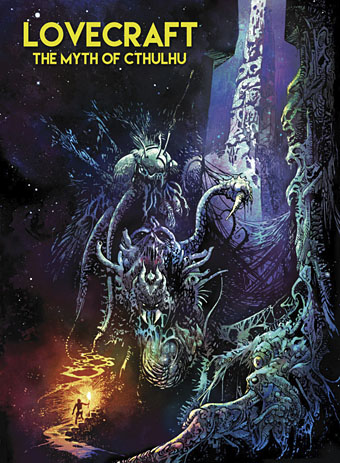
maroto.jpg

Lovecraft: The Myth of Cthulhu, an English-language edition of three comic-strip adaptations by Esteban Maroto, is now available from IDW.

The Coffin House, a short story by Robert Aickman that’s a taster for the new Aickman collection, Compulsory Games. Anwen Crawford wrote an introduction to Aickman’s world of “strange stories” for The New Yorker. Related: Victoria Nelson, editor of the new collection, chooses ten favourite horror stories.

• German music this week at The Quietus: Sean Kitching talks to Irmin Schmidt about his years with Can; and there’s an extract from Force Majeure, an autobiography by the late Edgar Froese, writing about the early days of Tangerine Dream.

• More German music at Carhartt WIP: a lengthy and revealing interview with guitarist Michael Rother about his time as one half of Neu!. There’s also a bonus Neu!-themed mix (and one of the mixes of the week) by Daniel Miller.

• From October last year, a Stereoklang interview with master synthesist Hideki Matsutake (Logic System, Yellow Magic Orchestra, et al).

• “When did you first get interested in esoteric studies?” Gary Lachman interviewed at The Astral Institute.

• At Sweet Jane: early illustrations by Wojtek Siudmak for Plexus magazine, 1969.

• 87 prints and drawings by MC Escher in zoomable high-resolution.

• Meet the Small Press: James Conway of Rixdorf Editions.

• Mix of the week: Goodbyes & Beginnings by Zach Cowie.

Derek Jarman on the trouble with shopping for clothes.

Person To Person (1981) by Logic System | Plan (1981) by Logic System | Prophet (1981) by Logic System
Weekend links 367

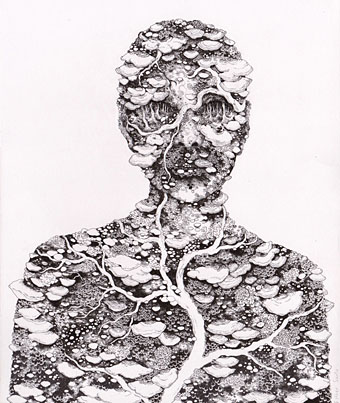
sarto.jpg

Human Nature by Esther Sarto.

I Feel Love: “Donna Summer and Giorgio Moroder created the template for dance music as we know it”. Bill Brewster on the creation of one of the greatest songs ever recorded.

The Tearoom by Robert Yang “is a (free) historical public bathroom simulator about anxiety, police surveillance, and sucking off another dude’s gun”.

Tim Walker’s Leonora Carrington-themed fashion shoot with Tilda Swinton reaches i-D‘s website at last. More pictures and in better quality.

Joe Dante on the legacy of Nigel Kneale. Related: We Are The Martians: The Legacy of Nigel Kneale, edited by Neil Snowdon.

Beth Comery‘s report on the progress of Gage Prentiss’s planned statue of HP Lovecraft for Providence, RI.

• The Plagiarist in the Kitchen: Jonathan Meades talks food and cooking with John Mitchinson.

• At Dangerous Minds: “Forget Louis Wain’s psychedelic cats, here are his crazy Cubist ceramics”.

• “Court orders Salvador Dalí‘s body be exhumed for paternity test.”

Flash the flesh: Manchester’s gay club heroes – in pictures.

Rick Poynor on the joy and sadness of dust.

MostlyCatsMostly

From The Tea-Rooms Of Mars…To The Hell-Holes Of Uranus: “Beguine”, “Mambo”, “Tango” (1981) by Landscape | I Feel Love (Patrick Cowley Mega Mix) (1982) by Donna Summer | Martian Sperm And Bagpipes (1991) by Helios Creed

Weekend links 363

sommers.jpg

The Constant Drumbeat of Terrible News (no date) by Allison Sommers.

• Nadia Khomami on Gay UK: Love, Law and Liberty, an exhibition at the British Library. Related: Simon McCallum‘s potted history of LGB characters on British screens. Elsewhere: writer and philanthropist Chuck Forester on gay sex in the 1970s.

The Panic Fables: Mystic Teachings and Initiatory Tales by Alejandro Jodorowsky. Finally available in English, a collection of all the comic strips written and illustrated by Jodorowsky when he was living in Mexico in the 1960s.

• A trailer for the restored print of The Fabulous Baron Munchausen (1961) by Karel Zeman. Related: collage designs by Graphic Manipulator for a Japanese collection of Zeman’s films.

• “Whether divining ancient wisdoms or elevating the art of cold reading, Tarot is a form of therapy, much like psychoanalysis,” says James McConnachie.

James Reith on “the Icelandic publisher that only prints books during a full moon – then burns them”.

• Mixes of the week: Wire 400 Mix #6 by Emptyset, and Secret Thirteen Mix 223 by Constantine.

• Mud And Flame: Penda’s Fen re-examined by Matthew Harle and James Machin.

Tilda Swinton in a Leonora Carrington-inspired fashion shoot for i-D magazine.

• At Dennis Cooper’s: Spotlight on William Burroughs’ The Wild Boys.

Applied Ballardianism: A Theory of Nothing by Simon Sellars.

• At Dangerous Minds: The Dark Rift by Jim Jarmusch’s Sqürl.

French Underground Rock: 1967–1980; a Discogs list.

Suzanne Ciani‘s favourite albums.

Infinite artwork: Untitled, 2017

Rip, Rig And Panic (1965) by The Roland Kirk Quartet | Panic (1984) by Coil | Flash Of Panic (1994) by Axiom Ambient

Weekend links 349

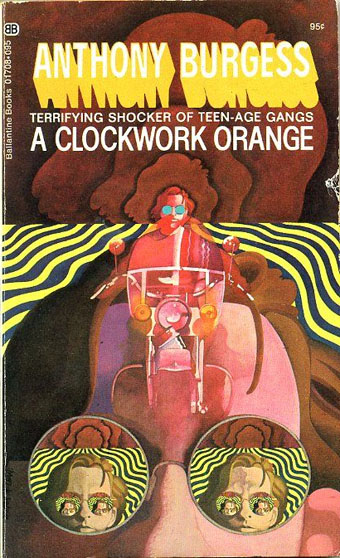
burgess.jpg

• Before Stanley Kubrick fixed an image of Alex and his droogs in the popular imagination, artists could get away with playing on the threat of biker gangs as Wilson McLean does in this vaguely psychedelic cover from 1969. (McLean’s interpretation may possibly derive from a 1965 edition.) LibraryThing has a collection of Clockwork Orange covers from around the world which run the gamut of cogs, orange hues and variations on David Pelham’s famous Penguin design from 1972. Meanwhile, AL Kennedy celebrates 100 years of Anthony Burgess by examining the writer’s career as a whole, although the web feature still manages to get a photo of Malcolm McDowell in there.

• “Even bad books can change lives,” says Phil Baker reviewing The Outsider by Colin Wilson and Beyond the Robot, a Wilson biography by Gary Lachman. I wouldn’t call The Outsider a bad book but Wilson’s more wayward opinions (and later works) are best treated with scepticism.

• “Murtaugh refers to his subject’s ‘pervasive sense of doom’ and Welch himself speaks of ‘the extraordinary sadness of everything.'” David Pratt reviewing Good Night, Beloved Comrade: The Letters of Denton Welch to Eric Oliver, edited by Daniel J. Murtaugh.

• At The Quietus this week: Tinariwen bassist Eyadou Ag Leche is interviewed by Richie Troughton, Jane Weaver unveils a new song from her forthcoming album, Modern Kosmology, and Danny Riley explores the strange world of Ben Chasny.

• “A micro-history of cultural gatekeeping: once told by the censors what we may read, then by critics what we should, we are now told merely what we can read.” Ben Roth writing against the use of “readability” as a literary value.

• Yayoi Kusama’s amazing infinity rooms are at the Hirshhorn Museum and Sculpture Garden, Washington DC, until May. For the rest of us, Peter Murphy’s panoramic photo is still online.

• More music: my friends Watch Repair have become visible enough to be interviewed by an Argentinian website. The group’s Bandcamp page recently made three new releases available.

• Yet more music: They Walk Among Us, a new song and video by Barry Adamson, and Anymore, a new song and video by Goldfrapp.

• Earth and The Bug announce Concrete Desert, a collaborative album inspired by Los Angeles and the fiction of JG Ballard.

• Bad Books for Bad People: Episode 7: The Incal – Epic French Space-Opera Comics.

• Mixes of the week: FACT Mix 589 by Aisha Devi, and Secret Thirteen Mix 212 by Qual.

Eduardo Paolozzi‘s forays into fashion and furnishings.

Cooking with Vincent [Price]

Moroccan Tape Stash

• Tin Toy Clockwork Train (1986) by The Dukes Of Stratosphear | Clock (1995) by Node | Clockwork Horoscope (2009) by Belbury Poly

Weekend links 308

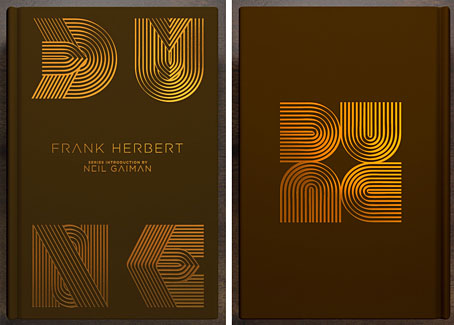
trochut.jpg

Frank Herbert’s Dune receives a new cover design by Alex Trochut together with other notable works of science fiction and fantasy for a new series from Penguin.

• “…poet, scholar and biographer Sandeep Parmar…has raised the possibility that a long poem by Hope Mirrlees, titled Paris and published by the Hogarth Press in 1919, was a strong influence on The Waste Land.” Alfred Corn on new TS Eliot scholarship.

• “[Evolution‘s] strain of body horror brings to mind an ethereal HP Lovecraft mixed with David Cronenberg.” Rachel Bowles talks to the film’s director, Lucile Hadžihalilović.

• Library music “is a sonic world of ‘weird beats, odd instrumentations, albums full of dark jazzy interludes or bizarre garage rock.'” Adrian Shaughnessy on innovation in banality.

Italy, which EM Forster called “the beautiful country where they say ‘yes’”, became another resort, especially the island of Capri, where a French poet staged a ceremonial flogging of his teenage Italian lover before the boy departed to do his military service and became the subject of a novel by his compatriot Roger Peyrefitte. In the Egyptian city of Alexandria, Forster observed the Greek poet Constantine Cavafy “standing absolutely motionless at a slight angle to the universe”, and the Australian novelist Patrick White met a local man who became his lifelong companion. For decades, the novelists Paul and Jane Bowles presided in Tangier, which Jack Kerouac was to call a “sinister international hive of queens”. William Burroughs arrived in 1954 with a teenage Spaniard named Kiki who, Woods writes, “was, famously, the boy who would blow smoke into his pubic hair and say ‘Abracadabra’ as his hardening cock emerged from the cloud”. Tangier was to figure in Burroughs’s novel Naked Lunch as a phantasmagoric, rubbery walled sex market called the Interzone.

Caleb Crain reviewing Homintern by Gregory Woods

• Beardsley biographer Matthew Sturgis reviews Aubrey Beardsley: A Catalogue Raisonné, a two-volume collection edited by Linda Gertner Zatlin.

• “He was the Bresson of Birkenhead.” Andrew Collins reviews the forthcoming collection of BBC dramas directed by Alan Clarke.

• “The postwar Hollywood western was more content to let strangeness be strange,” says Michael Newton.

• “Bosch’s work has always caused trouble for interpreters and critics,” says Morgan Meis.

Misplaced New York: a project by Anton Repponen and Jon Earle.

Wyrd Daze, Lvl2 Issue 6, is out, and as before is a free download.

Lessons we can learn from Robert Altman’s 3 Women.

• Mix of the week: FACT Mix 548 by Peder Mannerfelt.

Paris 1971 (1971) by Suzanne Ciani | Paris II (1987) by Jon Hassell | Dreaming Of Paris (2013) by Van Dyke Parks