Weekend links 68

dorosheva.jpg

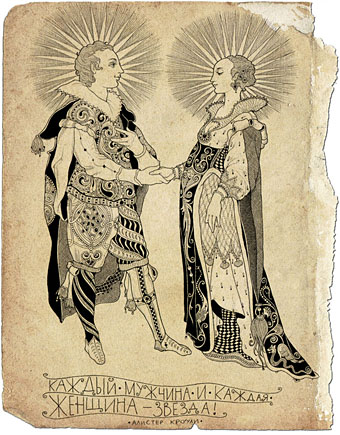
Every man and every woman is a star by Sveta Dorosheva.

• Matt Taylor (illustration) with Gregg Kulick and Paul Buckley (design) provide new Penguin covers for John Le Carré. I love the look which seems inspired by Daniel Kleinman’s title sequence for Casino Royale even if it doesn’t quite suit the shabby world of George Smiley and the Circus.

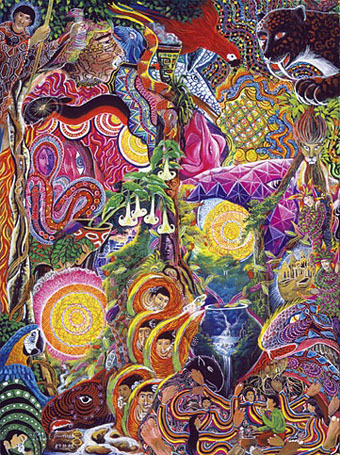
[Deborah Kass] told me that when she was going to art school in the ’70s, she tripped on LSD almost every week and she said she felt it was her “moral duty as an artist to take the trip.” […] I think psychedelic experience makes you think that there are multiple realities, that there isn’t just this one normal real world to which we’re supposed to conform, but that the reality changes depending on the state of consciousness that we’re in when we’re experiencing it. So, any different kind of art kind of posits a different reality. (more)

New York Times art critic Ken Johnson discussing his new book Are You Experienced?: How Psychedelic Consciousness Transformed Modern Art.

• “That got me thinking that evolution really isn’t survival of the fittest, when it comes to these things, it is more like survival of the interesting, survival of the beautiful, survival of the weird, cool stuff that managed to evolve.” Laurie Anderson and David Rothenberg discuss music and animals.

• Laura Cumming on the late Lucian Freud. And Stephen Heller on Alex Steinweiss, the originator in 1939 of the artistic record sleeve who also died last week.

• Alan Moore says “Think Locally: Fuck ‘Globally'”. He and Queen Calluz explain how Dodgem Logic magazine puts their ideas into practice.

Adam Curtis gets interviewed while Alan Bennett returns to Armley Public Library in Leeds.

Peacock’s Garden, a celebration of pavonine splendour.

• A visit to Seher Shah’s studio in Brooklyn, New York.

• Maximum androgyny at Epicenity, a Tumblr.

Does your god have a penis?

Chrysalide (1978) is an album of “cosmic” guitar instrumentals by Michel Moulinié which sounds at times like a French equivalent of Manuel Göttsching. It’s never been released on CD but a copy can be found here.

Mervyn Peake in Coronation Street

gormenghast1.jpg

First paperback edition of Titus Groan, 1968.

If you’re British then, no, it isn’t what you think. Having mentioned my hometown of Blackpool yesterday there’s one detail about the town I usually regard as an annex of Hell which, if not quite a saving grace, raises it into some lesser locus of perdition.

There are many Coronation Streets in Britain (and Coronation Roads, Terraces, etc), Manchester has several real ones besides the fake one which provides the setting for the world’s longest-running soap opera. Most are named after a royal event, of course, although I don’t know when the one in Blackpool was built, possibly around 1911 which would mean it takes its name from the coronation of George V. I remember it as being a very undistinguished street of shops, and had no idea all the time I was in Blackpool that Mervyn Peake had lived for a short period in that street (no. 62) with wife Maeve Peake (later Gilmore) and son Sebastian in 1940. Mervyn was in the Royal Artillery in the early years of the war, and was posted to Blackpool as part of an Anti-Aircraft Training Regiment. Once established he found there was little for him to do so he continued work on the manuscript of Titus Groan, still at that point being referred to as Goremenghast (with an extra “e”). Later on the family moved to Bloomfield Road, the home of Blackpool’s football club, before Maeve and Sebastian returned to London.

All this detail can be found in G. Peter Winnington’s Peake biography, Vast Alchemies (2000), and came as something of a shock to me. One thinks of Peake as an inhabitant of Sarke and London, not Blackpool, however brief his stay. But I was stunned most of all to hear about him writing there as well. Peake noted on his manuscript where the chapters were written so Winnington can tell us that some of Titus Groan was set down on the town’s North Pier. The piers are one of the few things I liked about Blackpool, North Pier most of all for being the longest structure with the best views of the sea. It’s also notable for me in being the place where I began my first (and strongest) acid trip in 1980. That’s nothing to do with Peake, of course, but the significance of these separate events tangles in a curious and unexpected way, so that I can’t think of that pier now, or of the early chapters of the Gormenghast trilogy, without this knowledge coming to the surface.

This year is the Peake centenary, and I wrote at the beginning of the month about some of the events and exhibitions being staged in the UK. One of these, Mervyn Peake: A Celebration, will take place at the British Library, London, on Tuesday, 26th July. Described as “an evening of words, memories and images with Peake’s associates, experts and family members”, the speakers will include Fabian Peake, Sebastian Peake, Clare Penate, Brian Sibley, Hilary Spurling and others, with a specially filmed contribution by Michael Moorcock. Further details here. Don’t expect Peake’s presence in Blackpool to be acknowledged this year; the philistine nature of the place is one reason I escaped as soon as I could.

Update: Mervyn Peake’s war paintings unveiled by National Archives.

• G. Peter Winnington’s Peake Studies

Previously on { feuilleton }
The Worlds of Mervyn Peake
A profusion of Peake
Joseph Cavalieri’s stained glass
Mervyn Peake at Maison d’Ailleurs
Peake’s Pan
Buccaneers #1
Mervyn Peake in Lilliput
The Illustrators of Alice

Weekend links 63

solaris.jpg

Polish poster by Andrzej Bertrandt for Andrei Tarkovsky’s 1972 film of Solaris.

• Stanisław Lem’s Solaris receives its first ever direct English translation by Bill Johnston (only on Audible for the moment), all previous editions having been sourced from a poor French translation. An all-too-common state of affairs for non-English fiction where bad or bowdlerised translations persist for years.

• Now that Minnesota politician Michelle Bachmann is running for US president it’s a good time to examine her views when (theoretically) her actions could one day impact on us all. The Daily Beast gathered together some of her worst pronouncements, including the following about gay people: “It’s a very sad life. It’s part of Satan, I think, to say that this is gay.” Her husband describes his attempts to counsel (ie: cure) gay teenagers with the words “Barbarians need to be educated.” It’s no surprise that both these people find confirmation of their views in the usual narrow interpretation of Christian doctrine. Not all American Christians are this ignorant or offensive, of course. The Heartland Proclamation calls for “an end to all religious and civil discrimination against any person based on sexual orientation and gender identity and expression”.

Journalist Andrew Sullivan in 2003 proposed a label for people like Bachmann: “I have a new term for those on the fringes of the religious right who have used the Gospels to perpetuate their own aspirations for power, control and oppression: Christianists. They are as anathema to true Christians as the Islamists are to true Islam.” It’s a term that ought to have more widespread use.

solaris-czech.jpg

Czech poster for Solaris. No designer credited.

• Probing the secrets of psilocybin: “Scientists at the Johns Hopkins University School of Medicine have zeroed in on the dose levels of the ‘sacred mushroom’ chemical capable of yielding positive, life-changing experiences, while minimizing the chance of transient negative reactions in screened volunteers under supportive, carefully monitored conditions.”

• Rick Poynor relates a visit to the Frederic Marès Museum, Barcelona, home to the 50,000 objects Marès collected over his lifetime. Further details of the collection can be found at the museum website.

In her 1969 essay “The Pornographic Imagination,” [Susan] Sontag insisted that Story of O could be correctly defined as “authentic” literature. She compared the ratio of first-rate pornography to trashy books within the genre to “another somewhat shady subgenre with a few first-rate books to its credit, science fiction.” She also maintained that like science fiction, pornography was aimed at “disorientation, at psychic dislocation.”

If so, that aim is far more interesting than what most generic “mainstream” novels set out to do. No one could describe O as predictable or sentimental. Its vision was dark and unrelenting; everything about it was extreme. Sontag also compared sexual obsession (as expressed by Réage) with religious obsession: two sides of the same coin.

Carmela Ciuraru on the story of The Story of O by Pauline Réage.

• “No hay banda! There is no band. It is all an illusion.” David Lynch will be opening a Club Silencio in Paris (Montmartre, of course). Facebook pages here and here.

• Sad to say that Chateau Thombeau is now closed but Thom has begun a more personal journal here.

• Picture galleries of the Vorticists at the Tate here and here. Related: Into the Vortex.

• Illuminated Persian pages from 1604 at BibliOdyssey.

• Tape drawings by Chris Hosmer.

• Miles Davis and co. at the Isle of Wight Festival, 1970: part 1 | part 2 | part 3 | part 4

Alchemy & Inquiry

tomaselli.jpg

The Dust Blows Forward, The Dust Blows Back (2011) by Fred Tomaselli.

Artistic alchemy has been thriving in New York for the past few weeks. Alchemy & Inquiry is a show which has been running at the Glyndor Gallery, Wave Hill, the Bronx, since April, featuring paintings by Philip Taaffe, Fred Tomaselli and Terry Winters. “Alchemy” here is used in its broadest sense:

The word “alchemy” in the exhibition title alludes to transformation on many levels: chemical, magical and spiritual. Creative powers are summoned to transform common elements physically and metaphorically into substances of great value. With practices and insights that prefigure many important discoveries in biology, chemistry and physics, alchemy likewise fascinated and continues to fascinate poets and painters, serving as an allegory for the physical manifestation of immaterial spirit. This tradition unites the work of Winters, Tomaselli and Taaffe. (more)

A PDF catalogue containing commentary by the always enlightening Peter Lamborn Wilson can be downloaded here. A sample:

Certain extra-formal aspects of art cannot be ruled out as irrelevant to our experience of that art or to our understanding of it. A visitor from Alpha Centauri would not know that Tomaselli’s paintings actually contain real pills, maryjane leaves, spore prints, or whatever—real illegal drugs. But we earthlings cannot fail to consider this witty provocation when thinking about Tomaselli’s works. To own one of his paintings—if the Feds ever wanted to make an issue of it—would be, simply, a crime. Is a crime, actually. This fact adds nothing formal to Tomaselli’s art. But, oh, how much it adds, let’s say, conceptually. How much weight? What an aura.

If proof were needed, contra all the puritan anti-drug fascists and priests, that genuine mystical drug states are accessible via entheogenic drugs and various (illegal) ditchweeds, then we could enter Tomaselli’s paintings as evidence. The point is that if drugs could not do this then there would be no reason to make them illegal. Imagine: icons that are also reliquaries, containing edible body parts of vegetable saints, forbidden by the Babylonian Ugly Spirit, the eternal Mind Police.

The NYT reviewed the exhibition but missed a trick in not connecting it to the Alchemically Yours group art show which has been running at Observatory, Brooklyn throughout the past month. That show ends this weekend; Alchemy & Inquiry runs until June 19th. Thanks to Jay for the tip!

Previously on { feuilleton }
Alchemically Yours
Laurie Lipton’s Splendor Solis
The Arms of the Art
Splendor Solis
Amphitheatrum Sapientiae Aeternae
Cabala, Speculum Artis Et Naturae In Alchymia
Vision Quest
Digital alchemy

Weekend links 61

knaus.jpg

Marbles and Butterflies (2011) by Jennifer Knaus.

• “Cutter’s Way is a cinematic masterpiece” says John Patterson. Yes, it is, and it’s often been difficult to see (although it’s now on DVD) being one of those cult films that rarely surfaced on TV or video. Another cult film surfacing at last is Jerzy Skolimowski’s Deep End (yes, again…) which will be out on DVD & Blu-ray next month. I missed this Telegraph piece about the film. You want more? Lint: The Movie is showing at the Kino Club, Brighton, later this month.

• This week’s Eno haul: Developing Your Creative Practice: Tips from Brian Eno; Eric Tamm’s 1995 study Brian Eno: His Music and the Vertical Color of Sound is now available for free at the author’s website; Imagine New Times is an outtake from Eno’s forthcoming Drums Between the Bells which can be downloaded here.

• Mixtapes of the week: Demdike Stare with a suitably sinister and eclectic mix are out-curated by Current 93’s David Tibet who mashes together a unique blend of folk, prog, riffs, choral works and glam rock.

I began to realize the hypocrisy about sexual freedom in the feminist establishment was as bad as it is in the religious right. They do whatever they want. They look at whatever they want, they masturbate to whatever they want, they fuck whoever and however they like. I couldn’t even say everything I know in the book because it would just be too cruel and personally invasive. But I’ve had it with their lying. I spent so long trying to have these earnest conversations and now I’m like, “Fuck you — you’re as bad as the Vatican!”

Susie Bright interviewed by Tracy Clark-Flory at Salon sounding as happy and positive as she always does.

The Gnostic #4 is out this month featuring Alan Moore’s essay on magic and related matters, Fossil Angels, and a piece examining the Gnostic influences on Cormac McCarthy’s Blood Meridian.

• “Nobody should be sent to prison for taking drugs,” says Richard Branson. Many politicians agree with him but they’re all too cowardly to do anything about it.

eng.jpg

Untitled work by Kilian Eng.

The Adventures of Jerry Cornelius, The English Assassin (1969–70). A comic strip written by Michael Moorcock & M John Harrison with art by Mal Dean & Richard Glyn Jones.

The Lavender Scare: The Cold War Persecution of Gays and Lesbians in the Federal Government by David K Johnson is available as a free ebook here.

• “If I was to try to write a mainstream book I would be constantly bumping my elbows up against the restrictions.” Tim Powers is interviewed by Alison Flood.

HOMO Online, Adventures in Homosexuality: Fiction, Fact, Art and Porn.

Your Rainbow Panorama, a new work by Olafur Eliasson.

Self Suck, a poem by Angelo Nikolopoulos.

Map Of Dusk (1987) by Jon Hassell | Lam Lam (1998) by Baaba Maal (with Jon Hassell & Brian Eno) | All Is Full Of Love (1999) by Björk (Guy Sigsworth mix featuring Jon Hassell).