
Weekend links 297

floridxfauna.jpg

Crimson Metallic Emergent Skull Crystal Pendant by Kristen Phillips aka Floridxfauna.

The Noise-Arch Backup at the Internet Archive is 30GB of mp3s from noise-arch.net, a collection of cassette-based releases and artwork: “material represented includes tape experimentation, industrial, avant-garde, indy, rock, diy, subvertainment and auto-hypnotic materials…” 30GB is an intimidatingly large amount of material so it’s better to browse The Noise-Arch Archive, a selection of 468 releases.

• The week in erotica: Claire Voon on Ancient Erotic Dreams and Explicit Scenes in the New York Public Library Collection; Melanie Porter on Great Grandporn: Hardcore Pornography of the Silent Era; Cathy Camper on The Comics of Dale Lazarov: Illustrated Explorations of Sexual Inventiveness.

Void Beats/Invocation Trex by Cavern of Anti-Matter (Holger Zapf, Joe Dilworth & Tim Gane) was released this week. The opening number is Tardis Cymbals. Tom Furse condensed the 73-minute album into a 17-minute mini-mix.

Indeed, if you had to “place” ­Williams—put him alongside writers with whom he had something in common—it would be with the mystical autodidacts, the backstreet Rosicrucians more than with the pipe-smoking, tweedy Inklings. To that extent, the only unsatisfactory thing about Grevel Lindop’s book is its title. True, Williams went to Oxford when war broke out and became friends with the famous circle around C. S. Lewis. But he was not an Inkling in spirit. He was not at home in Oxford, and his arrival, far from consolidating the Inklings, actually broke them up by bewitching Lewis, and making Lewis neglect the central friendship of his life, that with ­Tolkien. Another scholar of Old English literature, C. L. Wrenn, said that meeting Williams made you realize why inquisitors thought they had the right to burn people. Tolkien agreed: “Williams is eminently combustible.”

Certainly, Williams’s books had an influence on the Inklings. Lindop is right to say that the central plotline of Many Dimensions suggests the story of The Lord of the Rings. In the Williams novel, it is a stone of great power, rather than a ring, but it has the same effect on those who bear it: They become its possession, not its possessor.

AN Wilson reviews Charles Williams: The Third Inkling by Grevel Lindop

• Russ Fischer recommends five films by Andrzej Żuławski (RIP). Possession (1981) is still the easiest to find, and a good place to start. I enthused about On The Silver Globe (1977–87) last year.

England’s Hidden Reverse: A Secret History of the Esoteric Underground by David Keenan has been published in a revised and expanded edition by Strange Attractor.

The Preservation Man (1962): Artist and collector Bruce Lacey (RIP) filmed by Ken Russell for the BBC’s Monitor.

Barry Adamson: “I’ve been called the outsider’s outsider”.

• At Dangerous Minds: Six degrees of Marty Feldman.

• Mix of the week: FACT mix 536 by Not Waving.

• The Alan Clarke page at the BFI shop.

Umberto Eco (RIP): Porta Ludovica

Possessions (1980) by The Residents | Possessed (1992) by The Balanescu Quartet | Possessed (2001) by Sussan Deyhim & Shirin Neshat

Weekend links 296

invisiblecreature.jpg

Mars (variant design): one of three new posters for NASA by Invisible Creature.

• “If the point of Sade’s work was to marry sexual frustration and release to the practice of interpersonal violence, he could confidently gaze out on the landscape of our popular culture and declare it a fait accompli.” Hussein Ibish on The United Sades of America.

• Gravitational Waves Exist: The Inside Story of How Scientists Finally Found Them by Nicola Twilley. Sean Carroll explains the importance of the discovery.

• Another This Heat interview: Bruce Tantum interrogates Charles Bullen and Charles Hayward about being a group ahead of their time.

The English word comes ultimately from Greek magike (in which the original Persian word is spliced with tekhne, “art”), while the Persian magos “one of the members of the learned and priestly class” ultimately derives from magush, “to be able, to have power”, from which we may also derive the word “machine”. So my social hierarchy is your magic, and my magic might be your craft—or even your machinery. My religion is your magic. Your religion is my fairy lore. Or your religions might be a mass of fakery and trickery and foolery. Hence in making magic into an intellectual discipline, I theorize based on my observations, which might not be mine but those of others, heritable observations. But because what I do looks very like empiricism, as I examine materials for the tricks or fooleries, or for the real alterations, checking my results against descriptions of previous experiments, what I do feels like science, feels like the template for Baconian empiricism and its great instauration.

Diane Purkiss reviewing The Book of Magic: From Antiquity to the Enlightenment, edited by Brian Copenhaver

• The Strange World Of…The Residents: Sean Kitching talks to The Residents’ resident artist, Homer Flynn.

• At Strange Flowers: film of Natalie Barney in 1962 reminiscing about Oscar Wilde and Marcel Proust.

• From Battleship Potemkin to Baker Street: Ian Christie on Sergei Eisenstein’s trip to London.

• Mixes of the week: Krautrock Mix by Tarotplane, and Mix #15 (Transversales) by Jon Brooks.

• From Rock en Stock (France, 1973): Can and Agitation Free in live performance.

• Twenty classic British folk-horror stories: a selection by Kai Roberts.

Immemory: a Flash version of Chris Marker’s CD-ROM.

Cronenberg Valentines

Static Gravity (1980) by Chrome | Zero Gravity (2001) by Monolake | Gravity (2013) by Roly Porter

Aleister Crowley: Wandering The Waste revisited

ac1.jpg

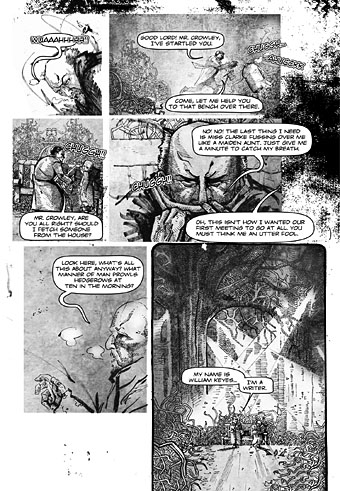
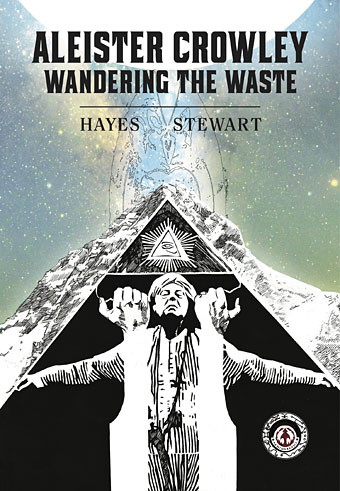
Martin Hayes was in touch this week with news of a reprint of his commendable comic-book biography of Aleister Crowley. Martin was the writer of Aleister Crowley: Wandering The Waste, and RH Stewart the artist. The first edition, which I reviewed in 2013, was a paperback whereas the new volume from Markosia will be a hardback with revised text and some new content:

Aleister Crowley: Wandering the Waste, the critically-acclaimed graphic novel by Martin Hayes, Roy Huteson Stewart, and Paul McLaren is re-launching at LSCC 2016. A meticulously researched exploration of the life of Aleister Crowley, with a foreword by renowned Crowley scholar Richard Kaczynski. This new edition has been revised and completely redesigned with a new cover and additional bonus content—fully annotated and complete with bibliography and rarities.

Aleister Crowley: Wandering the Waste is published by Markosia and will launch at London Super Comic Con in the Excel Centre on Saturday 20th of February, 2016.

Written by Martin Hayes, whose previous projects include the graphic novels Project Luna: 1947 and Abominable Glory, along with several serials for Aces Weekly. With art by Roy Huteson Stewart, who has illustrated for Vincent Price Presents and FutureQuake. Lettered by Paul McLaren. Aleister Crowley: Wandering the Waste is a meticulously researched, intricately illustrated autopsy on the life of the Great Beast. 140 pages.

Martin and Roy will be signing at the Markosia booth from 2–3pm on the Saturday of LSCC. Martin will be there from 11–12 on the Sunday.

ac2.jpg

Previously on { feuilleton }
Konx om Pax
Aleister Crowley: Wandering The Waste
Brush of Baphomet by Kenneth Anger
Rex Ingram’s The Magician
The Mysteries of Myra
Aleister Crowley on vinyl

Bosch details

bosch01.jpg

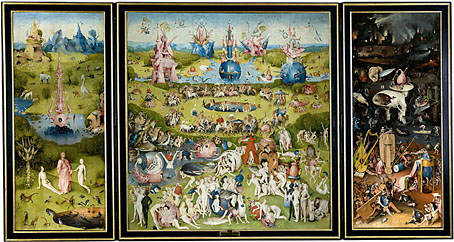
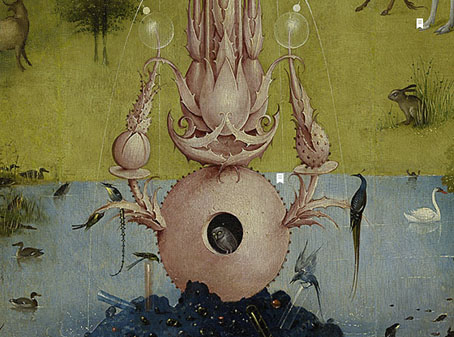
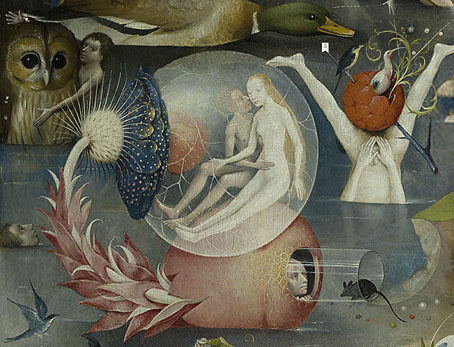
In which the indelible strangeness of Hieronymus Bosch’s triptych, The Garden of Earthly Delights (c. 1490–1510), is presented to us in the highest resolution. (I should say presented again since Google’s Art Project/Cultural Institute/whatever-it’s-called-this-week had a browsable version of their own in 2009 but this seems to have vanished. So much for the primacy of the Googleverse, etc, etc.) I’d always encourage people to see paintings in situ when possible but it remains a fact that very old and well-known works of art are difficult to study for any length of time in a crowded gallery. The more valuable works are also closely guarded by attendants who dissuade anyone from getting too close to those fragile surfaces, so it’s left to books or websites such as this one to give us the details. Not all paintings warrant this kind of attention, of course, but the crowded panels of Bosch and Brueghel the Elder certainly do. In addition to wandering among the figures you can also opt for a guided tour although bear in mind that the meaning (if any) of many of these details has never been resolved. Via MetaFilter.

bosch02.jpg

bosch03.jpg

Continue reading “Bosch details”

Weekend links 295

dupre.jpg

Untitled (2014) by Lola Dupré. Via.

Announcement of the week (if not the month/year) is the news that the BFI will be releasing all of the BBC dramas directed by Alan Clarke on DVD/Blu-ray in May. In addition to the long-awaited appearance on disc of Penda’s Fen (1974) we can expect a previously unseen director’s cut of Clarke’s last TV film, The Firm (1989), the DVD premier of Baal (1982) with David Bowie, plus many other works including some from the 1960s that were believed lost. (And it should be noted that this isn’t everything of Clarke’s; he also worked occasionally for ITV and later directed feature films for Channel 4.)

The BFI attention is a tribute to an exceptional director that’s overdue. Clarke has long been a cult figure among the British actors who worked with him, and among directors such as Harmony Korine and Gaspar Noé, but the tendency of TV to give one-off dramas a single screening has meant that much of his best work has been unavailable for years outside old VHS tapes. Clarke is important for having persistently chosen difficult subjects which he directed with a flair and intensity usually only found in cinema. When he died in 1990 the BBC repeated a handful of his films but the only ones given repeated DVD release have been the violent dramas with the big names attached: Scum (1979, with Ray Winstone), Made in Britain (1982, with Tim Roth), and The Firm (with Gary Oldman). Clarke’s oeuvre is much more than a parade of nihilistic villains, as will become evident later this year.

• A psychedelic video directed by Peter Strickland for Liquid Gate (ft. Bradford Cox) by Cavern of Anti-Matter. The debut album from Cavern of Anti-Matter, Void Beats/Invocation Trex, will be out later this month.

Celebrating Dusseldorf, the city that birthed Krautrock. (Article loses points for not mentioning producer Conny Plank.)

All Rivette’s features might be regarded as different kinds of horror films; Céline et Julie vont en bateau is his first horror comedy. The anxiety and despair of Paris Nous Appartient and La Religieuse, L’Amour Fou and Spectre seem relatively absent, yet they perpetually hover just beyond the edges of the frames. We still have no privileged base of ‘reality’ to set against the fictions, each of which is as outrageous as the other; and along with Borges, we can’t really say whether it’s a man dreaming he’s a butterfly or a butterfly dreaming he’s a man—although we may feel, in either case, that he and we are just on the verge of waking.

Jonathan Rosenbaum on work and play in the house of fiction: Jacques Rivette’s Out 1 and Céline and Julie Go Boating

• Mixes of the week: Finders Keepers Radio Show Krautrock Special, and The Ivy-Strangled Path Vol. XV by David Colohan.

• At Dangerous Minds: Super strange sculptures (by Shary Boyle) only the dark and demented could love.

• Beautiful Brutalites: S. Elizabeth questions Arabella Proffer about her paintings.

KTL is a musical collaboration between Peter Rehberg and Stephen O’Malley.

• Why study art when you can make it? The strange world of…This Heat.

Sarah Galo on the explicitly sexual female artists that feminism forgot.

Irmin Schmidt‘s favourite music (this week).

• LSD: My life-saving drug by Eric Perry.

The Occult Activity Book

Twenty Tiny Cities

Der LSD-Marsch (1970) by Guru Guru | Krautrock (1973) by Faust | Düsseldorf (1976) by La Düsseldorf