Weekend links 197

field.jpg

Posters by Jay Shaw for Ben Wheatley’s A Field in England which receives a US release this month.

Alvin Baltrop’s Gay New York: “the clandestine activities taking place under New York piers between 1975 and 1986”. AnOther samples some of the work on display at the Open Eye Gallery, Liverpool. Meanwhile, BUTT has some shots from Texas Porno Road Trip, a photo series by Mike McLeod. Related: HBO will show you anything but a male erection, says Justin Moyer.

• “[Robert] Desnos quickly proved himself to be one of the most gifted in these experiments – eventually known as ‘the period of sleeping fits’. He was capable of writing, speaking, drawing and composing entire fantastical narratives.” Eugene Thacker on the Surrealist séances of the 1920s.

• “It’s history, not a viral feed,” says Sarah Werner. A complaint about the way the ongoing decontextualisation of images is both pernicious and potentially lucrative.

His prose is a palimpsest of echoes, ranging from Eliot’s Preludes and Rhapsody on a Windy Night (lines like “Midnight shakes the memory / As a madman shakes a dead geranium” are Burroughsian before the fact) to Raymond Chandler’s marmoreal wisecracks and Herbert Huncke’s jive. I suspect that few readers have made it all the way through the cut-up novels, but anyone dipping into them may come away humming phrases. His palpable influence on JG Ballard, William Gibson, and Kathy Acker is only the most obvious effect of the kind of inspiration that makes a young writer drop a book and grab a pen, wishing to emulate so sensational a sound. It’s a cold thrill.

Peter Schjeldahl reviews Call Me Burroughs by Barry Miles.

• “Dance music was born in LGBT communities, but has this been forgotten?” Luis-Manuel Garcia on an alternate history of sexuality in club culture.

• Avant-Grade Hallucinogens: the Poetics of Psychedelic Perception in Moving Image Art by Stuart Heaney.

No Condition Is Permanent: weekly radio shows from Count Reeshard at LuxuriaMusic and iTunes.

The Golem: where fact and fiction collide. David Barnett on 100 years of Gustav Meyrink’s novel.

• Don’t Let Harlan Ellison Hear This: Nick Mamatas on a great writer.

• Mix of the week: the Ela Orleans Mix at A Sound Awareness.

Amon Düül II playing live on French TV, 1971 & 1973.

• A soundmap of London canals and minor rivers.

The Peculiar Underworld of Rare-Book Thieves.

• At Pinterest: William Burroughs and Phalluses.

Architecture of Doom

Hallucinations (1967) by Tim Buckley | Phallus Dei (1969) by Amon Düül II | Hallucinations (In Memory of Reinaldo Arenas) (1994) by Paul Schütze

The Art of Tripping, a documentary by Storm Thorgerson

aot1.jpg

How does this sound? 100 minutes of solidly informative documentary about the use of drugs by artists from the early 19th century on; a production that calls upon a remarkable cast of contributors (see below), with music by David Gilmour, and the whole thing “devised and directed” by Storm Thorgerson, better known as one third of the great Hipgnosis design team.

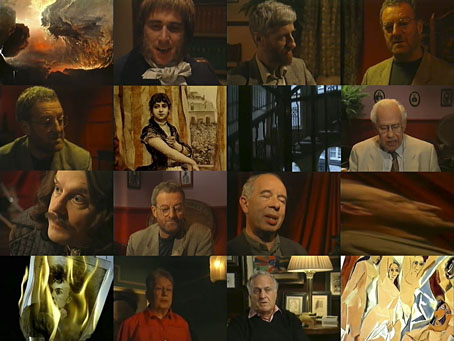
The Art of Tripping was broadcast in two parts in 1993 during the Without Walls arts strand on Channel 4 (UK). David Gale was the writer, with actor Bernard Hill playing the part of the narrator and guide. The programme managed to deal with a contentious subject without indulging in hysteria or insulting the intelligence of the audience, a rare thing today. Twenty years ago it was still possible to make a documentary about a popular subject without having any low-grade celebrity-du-jour offering their wretched opinion. The contributors here who aren’t medical people are almost all writers of one kind or another; Thorgerson and Gale punctuate the proceedings with a few actors who impersonate various historical figures.
aot2.jpg

Without Walls was a very good series on the whole but this for me was a real highlight (no pun intended). In addition to it being a rare example of Storm Thorgerson working in television, the direction showed how it was possible to match the theme without recourse to cliché or flashy visuals. There isn’t a single moment of archive footage either. Thorgerson’s history of “socially unacceptable” drugs is structured as a journey through the levels of a multi-storey building, from ground floor to roof; being familiar with the director’s free-associative working methods I can imagine this being a result of thinking about getting high. Bernard Hill encounters the various commentators in successive rooms, each of which is furnished and lit to suggestively imply the drug in question. The use of lighting as a key motif is a smart one, and another metaphor, of course, for literal and symbolic (or spiritual) illumination. Editing effects are also deployed to thematically correspond to the different substances.
aot3.jpg

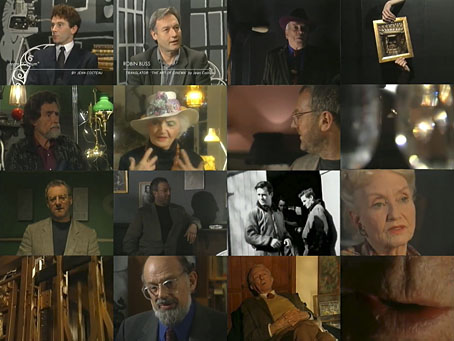
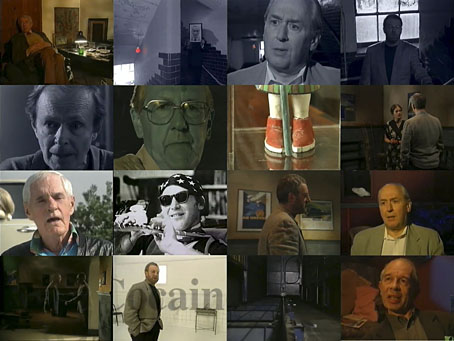
This would be very successful even without a wide range of contributors but Thorgerson and company assembled a stunning array of different writers, many of whom I’d never seen on TV before, and many of whom didn’t turn up again. Some of them fill dual roles, so JG Ballard is on hand to enthuse about Naked Lunch, and appears later talking about his bad LSD trip. Similarly, Brian Aldiss talks about Anna Kavan, and also about Philip K Dick. Below there’s a rough list of the drugs covered and the people involved. In the two decades since this was made many of the people involved have since died, the director included, so the film now has the feel of a historical artefact. The Art of Tripping can be see in full at YouTube. This is how good British television used to be.

Opium
Dr Virginia Berridge (author), Grevel Lindop (author), Marek Kohn (author), Dr EMR Critchley (author), Phil Daniels (as Thomas De Quincey), Dr Tony Dickenson (neuropharmacologist), Dr Ian Walker (author), Thom Booker (as Edgar Allan Poe), Dr Peggy Reynolds (author)
Hashish
Prof John Hemmings (author), Ronald Hayman (author), Patrick Barlow (as Theophile Gautier), John McEnery (as Charles Baudelaire), Jon Finch (as Gérard de Nerval), Bernard Howells (lecturer, King’s College, London), June Rose (author), John Richardson (author), Margaret Crosland (author), Danny Webb (as Jean Cocteau), Robin Buss (translator), David Gascoyne (poet), George Melly (collector, Surrealist art)
Mescaline
Prof Eric Mottram (University of London), Francis Huxley (nephew of Aldous Huxley), Jay Stevens (author), Laura Huxley (widow of Aldous Huxley),
Psilocybin
Brian Cory (as Robert Graves), Paul O’Prey (author)
Marijuana / Nitrous Oxide
Harry Shapiro (author), Carolyn Cassady (author), Prof Ann Charters (author), Allen Ginsberg (poet)
Kief
Paul Bowles (author)
Heroin
JG Ballard (author), Prof Avital Ronell (author), Hubert Selby Jr (author), Brian Aldiss (author)
LSD
Dr Oscar Janiger (experimental psychiatrist), Diana Quick (as Anaïs Nin), Prof Malcolm Lader (psychopharmacologist), Dr Timothy Leary (author), Todd Boyco (as Andy Warhol)
Amphetamine
Lawrence Sutin (author)
Cocaine
Robert Stone (author), Prof. Annette Dolphin (neuropharmacologist)
MDMA

Previously on { feuilleton }
Storm Thorgerson, 1944–2013
Hipgnosis turkeys
Enter the Void
Opium fiends
La Morphine by Victorien du Saussay
In the Land of Retinal Delights
Haschisch Hallucinations by HE Gowers
Storm Thorgerson: Right But Wrong
Demon rum leads to heroin
The art of LSD
Hep cats
German opium smokers, 1900

Weekend links 190

lipton.jpg

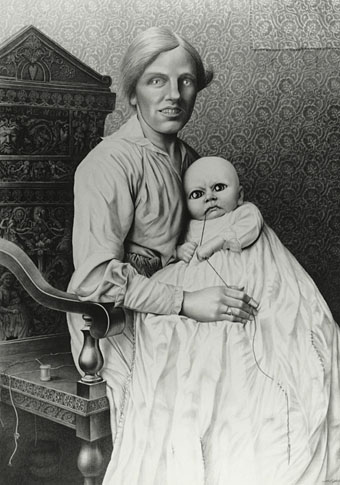
Seam Stress (1987) by Laurie LiptonThe Drawings of Laurie Lipton is out now from Last Gasp.

• The Quietus continues to be essential reading: John Doran talks to Richard H Kirk about Cabaret Voltaire | Sarah Angliss, musician and inventor of music machines, talks to Stuart Huggett | “…the most overt literary lodestar for The Art Of Falling Apart is John Rechy, trailblazing chronicler of the gay underbelly of hustlers and queens zig-zagging across America, and author of Numbers, the book from which Soft Cell’s song takes its name.” Matthew Lindsay looks back at Soft Cell’s second (and best) album.

• “The English have something of a tradition where they like to scare you out of your mind at Christmas, a kind of sobering up of the senses by forces that seem to be beyond them.” Colin Fleming on The Signal-Man by Charles Dickens. More ghosts: Lisa Kerrigan explains why she loves Nigel Kneale’s 1989 TV adaptation of The Woman in Black by Susan Hill, and the BFI resurrects The Mistletoe Bough (1904), “the oldest film version of a classic Christmas ghost story”.

• “…the story is filled with a whole mess of embarrassed and embarrassing euphemisms for (ahem) big dick—stiff language, so to speak, like ‘bludgeon,’ like ‘giant concupiscence’ and ‘ostentatious organ.'” Steven Cordova on A Visit to Priapus and Other Stories by Glenway Wescott.

• “Never produced, the screenplay for The Way to Santiago is credited to Orson Welles. A quick look at the text leaves no doubt it was the work of the Citizen Kane filmmaker when he was at the peak of his arrogant brilliance. The script begins: ‘My face fills the frame.'”

• If you’re at all interested in the current state of the British musical underground, the end-of-year lists at Ears For Eyes are worth your attention.

Pee-wee’s (Remastered) Christmas Adventure: An interview with Paul Reubens. Related: Grace Jones sings Little Drummer Boy for Pee-wee.

• “I’m like a drag queen at Halloween.” John Waters on his favourite time of year: Christmas.

• Mix of the week: Secret Thirteen Mix 099, an “(anti)Christmas mix” by Robert Curgenven.

• The British Library makes over a million free-to-use images available at Flickr Commons.

• Lost in Translation: Notes on adapting Ballard by Calum Marsh.

MR James at Pinterest.

Book Map by Dorothy.

Martin (1983) by Soft Cell | Ghost Talk (1985) by Cabaret Voltaire | For Laika (2011) by Spacedog

Eduardo Paolozzi at New Worlds

paolozzi00.jpg

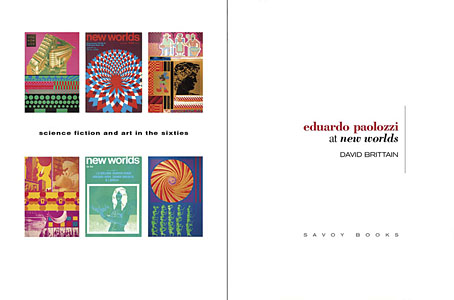
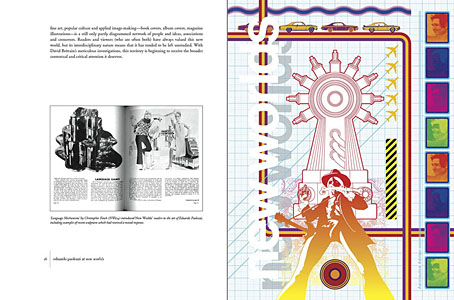
I was working on this book throughout the autumn, and it could hardly be more different to some of the visual extravagance that came before and after. Eduardo Paolozzi at New Worlds is published by Savoy Books this month. Predominantly an examination by David Brittain (no relation to David Britton) of the connections between artists such as Paolozzi and Richard Hamilton with New Worlds magazine in the 1960s, the book is also a rare study of the science fiction magazine when it was making its greatest impact in the late 60s and early 70s.

Brittain highlights many examples of Paolozzi’s sf-influenced art of the period, and examines the development of the magazine under Michael Moorcock’s editorship during which time New Worlds evolved from being a slightly moribund sf title in the early 60s to what JG Ballard later called “one of the most exciting magazines of any kind in this country”. An appendix features interviews with some of the key creators and contributors: editor Moorcock, designer Charles Platt, art editor Christopher Finch, contributor Michael Butterworth, and critic John Clute. Writer and illustrator Pamela Zoline created some original artwork for the endpapers. The introduction is by Rick Poynor.

paolozzi01.jpg

Despite being pressured for time I was very pleased to be designing this book. I’d liked Paolozzi’s work since I first encountered it in the Tate Gallery in the 1970s; a couple of years later I was buying up anthologies featuring New Worlds stories (I was too young for the 60s magazine), so discovering that Moorcock had made Paolozzi the magazine’s “Aeronautics Advisor” made perfect sense. In the past I’ve said that New Worlds ruined my taste for hard sf but that’s not really true since I never really liked the stuff beyond a few Arthur C. Clarke books. Too much bad writing, too many cardboard characters shuffling around between chunks of explanation about made-up technology. The discovery of New Worlds merely demonstrated that there were other ways of approaching sf, and you didn’t have to put up with the rubbish.

I also enjoyed the magazine’s bolshy attitude, a quality shared by Harlan Ellison in his Dangerous Visions anthologies. Moorcock says in Brittain’s interview that NW sympathised with the Underground of the late 60s but also tried to be more disciplined in its approach, especially where the design was concerned. You couldn’t have treated fiction to the semi-legible printing that Oz and Frendz often deployed. But the radical attitudes of the Underground can be discerned in the stance NW adopted. Some of the reviews and polemical articles by Moorcock (often under his “James Colvin” pseudonym), M. John Harrison and John Clute are bracingly vitriolic to a degree which if delivered today would probably see them ostracised for life.

paolozzi02.jpg

With the design the main intention was to present the information clearly and let the visuals speak for themselves. The book is heavily illustrated throughout, with many examples of Paolozzi’s marvellous prints. The layout nods obliquely to the period; before getting started I spent some time looking at the work of Erik Nitsche. I like the way Nitsche laid out the books he designed in the 1960s, and there’s also a connection in his work as a designer for the General Dynamics corporation: one of Paolozzi’s print series of the period is entitled General Dynamics F.U.N.

Being full-colour throughout, the print run for this book is smaller than usual so anyone interested is advised to move swiftly. Official publication is December 16th but it’s on sale now at Savoy and at Amazon.

paolozzi03.jpg

Continue reading “Eduardo Paolozzi at New Worlds”

Weekend links 181

eye.jpg

Cover of Eye no. 86 vol. 22, 2013, a type special. Detail from 1970s Letratone brochure, overprinted by character from the Marsh stencil alphabet.

The new edition of Eye magazine includes my essay on the evolution and aesthetics of steampunk. In the same issue Rick Poynor’s feature on the prints of Eduardo Paolozzi mentions a forthcoming book by David Brittain about the artist’s associations with New Worlds magazine in the 1960s. I designed the Paolozzi volume which will be published by Savoy Books in a few weeks’ time. More about that later.

Still on steampunk, KW Jeter notes its popularity among the younger crowd: “If some old fogey peering through his smudged bifocals can’t discern the cool and important stuff going on, such as the tsunami of anarchic multiculturalists using the steampunk scalpel to dissect the past and reassemble it like a two-dollar watch, that’s his loss; the readers are picking up on it.”

• Musicians interviewed: Rhys Chatham: “The reason I got into trumpet playing is because I wanted to play like [Black Sabbath guitarist] Tony Iommi.” | James Ginzburg: “One of the strongest feelings I had was that the act of sitting down and making dance music was like playing a video game…I felt disconnected from it…” | Julia Holter: “I love working with the voice, I love mystery, I love creating atmosphere.” | Roly Porter: “I sit at home and listen to folk and blues from before I was born. I listen to a lot of dub and reggae and classical music. These are all genres which to me seem really interlinked and influential.”

• At Kickstarter: From the director of Lovecraft: Fear of the Unknown, a short film entitled Do Not Disturb. “Two men are forced to share a motel room on a dark & stormy night. One man’s snoring starts to summon creatures into our world.”

The Notting Hill of the 1960s – with Moorcock’s marriage, children, celebrity, the editorship of New Worlds, the collaboration with JG Ballard, Brian Aldiss and the rest – became the proving ground for the shape-shifting Carnaby Street dandy Jerry Cornelius. But all the numerous Moorcock characters, those undying and born-again clones, have a part to play in his “multiverse”, a concept he developed alongside the earlier model suggested by John Cowper Powys. Moorcock’s astonishing catalogue of speculative fiction works to prove his key equation, which is based on meta-temporal parallel worlds drawn from HG Wells, Chaos Theory, String Theory, the Edgar Rice Burroughs of John Carter of Mars and the William Burroughs of Nova Express and the “Interzone”. Publishing all the strange rafts and pods of Moorcock’s prodigious science fiction and fantasy output, as Gollancz have done, is like assembling a ghost fleet, under the joint command of Dr John Dee and Admiral John Ford, with which to invade that uncertain continent we know as the past.

Iain Sinclair on the new series of Michael Moorcock editions from Gollancz.

• “What does science tell us about the relative dangers of drugs? Alcohol is by far the No. 1 most dangerous drug.” Some graphs from the American Enterprise Institute who no one would accuse of being a bunch of stoners.

• “I loved Eudora Welty, Flannery O’Connor, Katherine Ann Porter, Carson McCullers. There was a feeling that women could write about the freakish, the marginal.” Alice Munro at The Paris Review.

Elena Smith on Literary Parkour: @Horse_ebooks, Jonathan Franzen, and the Rise of Twitter Fiction. Related: Boris Kachka has a list of Everything Jonathan Franzen currently hates.

• Mixes of the week: Joseph Burnett compiles Adventures in Modern Jazz while Kier-La Janisse puts together a British Horror mix for Fangoria.

Explore the planet Mars, one giant image at a time.

• At BibliOdyssey: The Turner’s Manual.

A Crimson Grail (for 400 Electric Guitars) (2007) by Rhys Chatham | Arrakis (2011) by Roly Porter | City Appearing (2013) by Julia Holter | Debris (2013) by Faint Wild Light