Weekend links 196

wellcome1.jpg

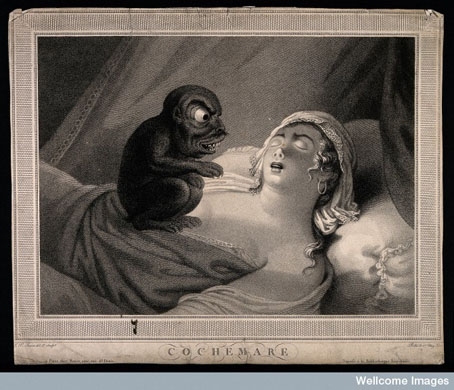
Cochemare (1810) by Jean Pierre Simon. One of 100,000 high-resolution images now available from Wellcome Images.

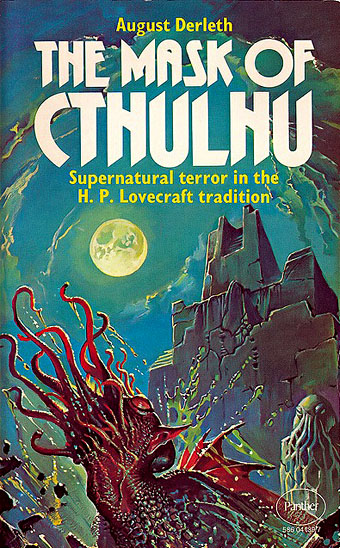
• Ted Morgan’s Literary Outlaw: The Life and Times of William S. Burroughs (1990) was a solid biography blighted by a bizarrely bad-tempered and judgemental attitude towards many of Burroughs’ friends and colleagues. Morgan says Burroughs disliked the book (he also says his subject died in 1993, not 1997…) so I’m looking forward to the new biography by Barry Miles, Call Me Burroughs: A Life. There’s a curious detail in Jeremy Lybarger’s piece about August Derleth, HP Lovecraft’s publisher and lifetime champion, causing a fuss after the Chicago Review published extracts from Naked Lunch in 1958. Burroughs enjoyed Lovecraft’s fiction but it’s unlikely that Lovecraft would have been anything other than appalled by Burroughs’s work. Barry Miles will be holding a Q&A session at the ICA, London, next month following a screening of Howard Brookner’s restored documentary, Burroughs: The Movie.

• Mix of the week: Secret Thirteen Mix 105 by Sturqen. At 3quarksdaily Dave Maier writes in praise of drones (the musical variety), and links to three mixes.

• Interviews: Haakon Nelson talks to Harold Budd, Joseph Burnett talks to William Basinski, John Stezaker talks to Nicolas Roeg.

Derek responded to an invitation to address [AIDS] hysteria by lining the gallery with a set of tarred and feathered mattresses loaded with the traces of queer love-making and then framing them against wallpaper made from Xeroxed, blood-spattered front pages. In the middle of all this he then constructed a makeshift barbed-wire cage that imprisoned and protected a pair of apparently naked lovers – usually a pair of handsome, sleeping boys, but for one afternoon at least Tilda Swinton dropped by, just to make the point that the boys didn’t have an exclusive stake in or artistic rights to this crisis. Between the walls and the cage, the air of the gallery was thick with tension and hatred – sometimes literally so, as visitors to the gallery objected vociferously to what they were seeing.

Neil Bartlett on celebrating Derek Jarman 20 years after his death.

• William Friedkin’s Wages of Fear remake, Sorcerer (1977), receives an overdue reissue on DVD/Blu-ray in April.

James Knowlson asks “What lies beneath Samuel Beckett’s half-buried woman in Happy Days?”

• The UK’s web filtering seems to be blocking common sense says Jane Fae.
wellcome2.jpg

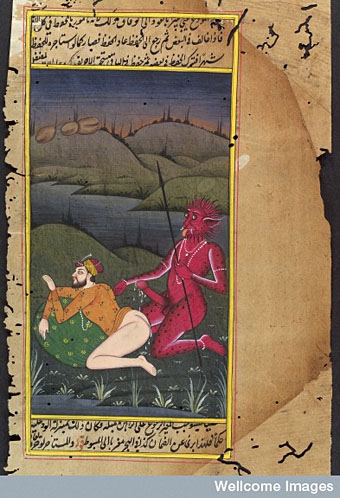
A devil buggering a man (19th century).

• The poetry of Hart Crane, from the American epic to personal belonging.

The Sonny Sharrock Quartet play Stupid Fuck, live 1988.

Pinterest nightmares

Borogoves

• Lutinemusic: Espera | Died Of Love | All I Have Is Gold
Weekend links 194

roberts.jpg

Untitled glass sculpture by Richard Roberts.

Lord Horror: Reverbstorm, my collaboration with David Britton, makes The Quietus list of Literary Highlights of 2013. At the same site there’s Russell Cuzner talking to English Heretic. “His methodology takes in magick, psychogeography and horror film geekdom, along with firm roots in Britain’s industrial music culture of the early 1980s, to form potent, novel topographies of an otherwise unconnected world of occultists and psychopaths.”

• A slew of London links this week: Geoff Manaugh on how the capital was redesigned to survive wartime blackouts, a piece which inadvertently explains why you see so much black-and-white street furniture in post-war films | Bob Mazzer’s photos of the London Underground in the 1970s and 1980s | Philipp Ebeling’s photos of the capital and its inhabitants today.

• “Science has become an international bully. Nowhere is its bullying more outrageous than in its assault on the phenomenon known as subjectivity.” David Gelernter on “The Closing of the Scientific Mind”. Related: “When Science Becomes Scientism” by Stanislav Grof.

• My favourite book about Orson Welles is This is Orson Welles (1992), a collection of Peter Bogdanovich’s interviews with Welles edited by Jonathan Rosenbaum. Bogdanovich’s interview tapes can now be heard at the Internet Archive.

• Brian Dillon on Dada collagist Hannah Höch who he calls “art’s original punk”, and Sean O’Hagan talking to another collage artist, Linder Sterling, who says “Lady Gaga didn’t acknowledge I wore a meat dress first”.

• One Hundred Years Of Weird Fear: Daniel José Older on HP Lovecraft’s literature of genealogical terror. More fear (and Lovecraft): Will Wiles on the growth of Creepypasta.

The Last Alan Moore Interview? A lengthy discussion with Pádraig Ó Méalóid. Shunning interviews hasn’t done Cormac McCarthy any harm so if I was Alan I wouldn’t worry.

• And speaking of Cormac McCarthy, the headline of the week: “Cormac McCarthy’s ex-wife busted after pulling gun from vagina during alien argument“.

• Where the bodies are buried: Mick Brown presents a potted biography of Kenneth Anger who offers a few reluctant quotes.

• A short animation for gore-obsessed kids: Pingu’s The Thing by Lee Hardcastle.

Helen Yentus designs a 3D-printed slipcase for a novel by Chang-rae Lee.

Ralph Steadman‘s illustrations for Alice’s Adventures in Wonderland.

• Mix of the week: Secret Thirteen Mix 103 by Lustmord.

Collage art at Pinterest.

No Escape (1966) by The Seeds | Pushin’ Too Hard (1966) by The Seeds | No Escape (1979) by Cabaret Voltaire | Pushin’ Too Hard (1982) by Paul Parker

The weekend artists, 2013

fournier.jpg

“Chloromgonfus detectis, a dragonfly that can detect volatile pollutants.” A speculative insect by artist Vincent Fournier.

The annual review of artists/designers/photographers featured in the weekend posts should have run at the end of December but MR James got in the way. Big thanks, and happy new year to Form is Void and Beautiful Century for pointing the way to many of these people.

strongowski.jpg

Two cover designs from Eliash Strongowski’s 30 Days—30 Covers project.

gebbie.jpg

Pink Boy by Melinda Gebbie.

lipton.jpg

Seam Stress (1987) by Laurie Lipton. The Drawings of Laurie Lipton is out now from Last Gasp.

blackwell.jpg

The Baron in the Trees (2011), a book-cut sculpture by Su Blackwell.

Continue reading “The weekend artists, 2013”

Nigel Kneale’s Woman in Black

wib1.jpg

The British television tradition of screening a ghost story at Christmas was filled in 1989 with Nigel Kneale’s adaptation of Susan Hill’s novel The Woman in Black. This isn’t one of the best contributions to the annual ghost drama but at 100 minutes it’s one of the longest, and it has its supporters, some of whom value it above the recent Hammer film production. Seeing as I’d re-watched Nigel Kneale’s major film and TV works earlier this year I thought I’d give The Woman in Black another look. It was better than I remembered although it still left me feeling unsatisfied.

I’ve not read Susan Hill’s book so can’t say how it compares to the television version in any detail. (Wikipedia has a spoiler-heavy list of the differences.) I did see Stephen Mallatratt’s play in 1988, however, the first adaptation of the book which has since become one of London’s most popular theatre productions. The play conjures an effective sense of dread but relies a little too much on loud noises to shock the audience at crucial moments. This is a cheap trick in bad horror films (Wes Craven does it a lot), and it’s just as cheap a trick on a stage. Nigel Kneale may have altered Hill’s story to a degree which apparently displeased her but he didn’t resort to any Craven tricks.

wib2.jpg

The BBC’s Christmas ghost stories have tended to be MR James stories, and The Woman in Black is very much a James pastiche which no doubt helped make it attractive to ITV. All the James hallmarks are there: a man of letters (solicitor rather than a scholar) visiting an isolated part of the English countryside; a lonely house; fearful locals; mysterious deaths; documentary evidence that requires examination; a haunting.

Adrian Rawlins is the young solicitor, Arthur Kidd, given the task of putting the estate of a dead woman in order. Rawlins would have been fine in a smaller role but he wasn’t a good choice for a central character, not when Kidd is on screen every minute of the running time. Far better is the always excellent Bernard Hepton as a genial landowner, a very different role to his sinister Fisher in Robin Redbreast. There’s a lot of solid period detail—Kneale’s dialogue fixes the date at around 1925—and the writing and direction manages to avoid insulting the intelligence. In place of the usual voiceover reading of letters we have Kidd listening to a succession of recording cylinders, an unlikely thing for an elderly woman to be using but it does give the film a connection back to Van Helsing’s device in Dracula. There’s even a surreptitious reference to Kneale’s “stone tape” theory when Kidd says that the ghostly sounds he keeps hearing are like a recording of a terrible event. Director Herbert Wise does some clever hide-and-seek business with the spectral woman, only fumbling things near the end when he makes the mistake of trying to imitate Jack Clayton’s The Innocents. So why does this version still remain unsatisfying?

Continue reading “Nigel Kneale’s Woman in Black”

Weekend links 189

wilson.jpg

The Outsider (1956), 1963 edition; The Occult (1971), 1973 edition.

The cover of the 1973 UK paperback of Colin Wilson‘s mammoth overview of occultism can still be offered as a pinnacle of hyperbole. The book itself is a very serious and informative study but its success set Wilson on a path as a writer about the paranormal where he’d previously been concerned with literature, philosophy and psychology. For many critics this finished his already shaky reputation as a serious thinker. He continued to write about philosophy and literature in subsequent books but dubious speculations about Atlantis are always more commercially attractive than studies of Nietzsche, hence the proliferation of lost continents in the later part of a bibliography which the Wilson website lists at 114 titles. Wilson was a maverick intellectual whose curiosity ignored many of the boundaries that restrained his metropolitan contemporaries; he was also an autodidact of a type that seems to irritate the university-educated. Mentions of his name in British newspapers were frequently couched in sneering or dismissive terms. His current reputation can be measured by the lack of attention the news of his death has prompted in the UK at the time of writing. (That said, dying on the same day as Nelson Mandela was unfortunate timing.)

Savoy Books published an edition of Wilson’s crime novel, The Killer, in 2002. I designed that volume, rather badly, I think. In 2004 Robert Meadley wrote a book-length reaction to Wilson’s autobiography, Dreaming to Some Purpose, which can be downloaded for free from Savoy. In it Meadley mounts a robust defence of Wilson against the broadsheet termagants. Elsewhere: the only newspaper obituary so far is at The Times (subscription required); Colin Wilson on Desert Island Discs in 1978; Gary Lachman interviewing Wilson for Fortean Times in 2004; musician Anthony Reynolds discussing his collaboration with Wilson.

• “Art, music and a mind-blowing voyage of discovery”: Richard Neville on the late Martin Sharp. At Design Observer Rick Poynor looks back at Sharp’s book and magazine illustrations of the 1960s. Of particular note is Sharp’s contribution to the “Magic Theatre” issue of Oz magazine, a unique combination of collaged visuals and text which Alan Moore often refers to as a favourite work. (See issue 12 of Moore’s Promethea, “The Magic Theatre of the Mind“.)

• “The naked woman in art isn’t unusual, but we have trouble viewing the male body as a sexual, or artistic, object,” says James Polchin.

But how can anyone be bored when there’s always death to think about? Every day. Every hour. Don’t you? All the rest is just evading or glossing the real subject of our lives. Beckett, again, the maestro of death: Never but the one matter. The dead and gone. The dying and the going. From the word go. I too shall cease and be as when I was not yet, only all over instead of in store.

Jenny Diski on death and dying.

• A teaser trailer for The Dreamlands, a film by Huan Vu (Die Farbe) based on HP Lovecraft’s Dream Cycle.

• “On Watching Wages of Fear with my 11-Year-Old Daughter” by Debra Morris.

Abram Games’ “bat wings” BBC logo is 60 years old. See it in action here.

• At Strange Flowers: Romaine Brooks‘ portraits of her famous friends.

• At Front Free Endpaper: Mervyn Peake illustrates Treasure Island.

The Great God Pan (plus satyrs and fauns) at Pinterest.

Dan Wilson on “Electric Music” on the Victorian stage.

• Mix of the week: Fact Mix 414 by Julianna Barwick.

• The BFI chooses 10 great British rural horror films.

Dunwich – The search for Britain’s Atlantis.

The Grand Canyon filled with fog.

• The Bells of Dunwich (1975) by Stone Angel | O.O.B.E. (1992) by The Orb (feat. Colin Wilson) | Why We Make It Difficult On Ourselves (2010) by Anthony Reynolds & Colin Wilson