Weekend links 233

casas.jpg

Alchemical Stone (2014) by Daniel Lasso Casas. Via full fathom five.

• “I am unsure if this reality is an everyday one. We don’t know if the universe belongs to a realist genre or a fantastic one, because if, as idealists believe, everything is a dream, then what we call reality is essentially oneiric.” Jorge Luis Borges in 1984 in conversation with Argentinian poet and essayist Osvaldo Ferrari.

• “I am transgender, so ‘he’ is not appropriate and ‘she’ is problematic. I’m what I think of as pure transgender.” Antony Hegarty talks to Cian Traynor about Turning, a new DVD and album project.

Unearthing Forgotten Horrors 2014 is a weekend festival of rural weirdness at the Star and Shadow Cinema, Newcastle-upon-Tyne.

Henry Darger, one of the most celebrated examples of an outsider artist (see: Vivian Girls), has been uniformly ignored by the literary firmament. Despite the success of his artwork, none of his fiction manuscripts have seen print. The language of literature is the language of privilege, in which even the stories of the working class are regularly clad in a bourgeois prose. The language of literature cannot be extricated from its white, genteel roots. Those of us without access to education are welcome to practice, but we must come in from the cold, adopt the house language. We must be civilized, scrubbed clean. Naiveté has no place in the colosseum of words.

Ravi Mangla on Coming in from the Cold: Outsider Art in Literature

Carel de Nerée tot Babberich en Henri van Booven, a collection of Beardsley-like drawings by a neglected Dutch artist.

Forever Butt is a new collection of the best of recent issues of BUTT magazine, still the best print mag for gay men.

Anne Billson’s guide to Brussels, another European city I’d like to visit some day.

• At BibliOdyssey: Schönschreibmeister, a calligraphy master’s album.

Third Ear Band live (and in colour!) on French TV in 1970.

• Mix of the week: Secret Thirteen mix 132 by Spatial.

• The Internet Archive now has an Internet Arcade.

Crazy Cat Lady Clothing

The Pattern Library

Stone Circle (1969) by Third Ear Band | Sacred Stones (1992) by Sheila Chandra | Stoned Circular I (1996) by Coil

Weekend links 214

/sfsound.jpg

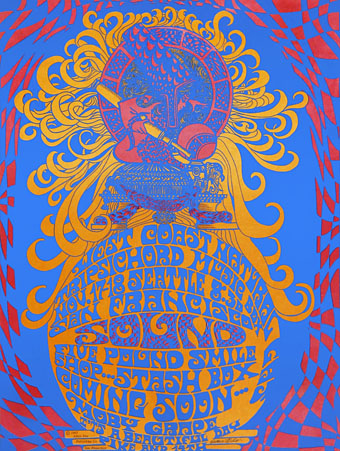
San Francisco Sound (1967). Art by Wallace Studio, Seattle.

• RIP gay porn pioneer Peter de Rome. BUTT posted de Rome’s surprisingly daring Underground (1972), a film in which two men have an unfaked sexual encounter on a New York subway train. That film and others are available on the BFI’s DVD collection. Related: Brian Robinson remembers a director of films whose supporters included Andy Warhol, William Burroughs and John Gielgud.

• “My stuff is implicitly critical of television as it is now,” explains Jonathan [Meades], “Television used not to be as openly moronic as it has become…” A lengthy and typically pugnacious Meades interview with Remy Dean.

Thurston Moore remembers the Burroughs-themed Nova Convention staged in New York in 1978. William Burroughs 100—Nova Convention is a retrospective exhibition running at Red Gallery, London, next month.

How are we expected to take seriously…any work which appears to have engaged less than the whole passionate attention of its author? To be fobbed off, at the last, with something which we feel to be less true than the author knew it to be, challenges the importance of the whole art of writing, and instead of enlarging the bounds of our experience, it leaves them where they are.

Katherine Mansfield was also a book reviewer.

• JG Ballard’s Crash is reissued in August by Fourth Estate with an introduction by Zadie Smith. There’s a tantalising extract from the intro at the NYRB or you can read the whole thing if you’re a subscriber.

• “Between 1959 & 1980 Shirley Collins changed the course of folk music in England & America. Thirty years after disappearing, she’s back.”

Photos by Anne Billson of one of the more attractive Parisian arcades. Related (in a flâneur sense): Christina Scholz‘s Vancouver dérive.

• “Why did Borges hate soccer?” asks Shaj Matthew. Related: George Orwell on the same subject.

• Mixes of the week: FACT mix 447 by Forest Swords, and Programme 13 from Radio Belbury.

• At Dangerous Minds: Roland Topor’s cheerfully violent illustrations from Les Masochistes.

• Rainy Day Psychedelia: Ben Marks on Seattle’s neglected 1960s poster scene.

• Strange Flowers looks at Oskar Schlemmer‘s Triadic Ballet designs.

• A Journey to Avebury: Stewart Lee interviews Julian Cope.

It’s All Over Now (1963) by The Valentinos featuring Bobby Womack | It’s All Over Now (1964) by The Rolling Stones | It’s All Over Now (1974) by Ry Cooder

Weekend links 206

komoda.jpg

Nova Express (2014) by Paul Komoda.

• Last week it was Kraftwerk, this week it’s Can in another astonishing 70-minute TV performance from 1970. For those who know where to look in the torrent world there are copies of these recordings circulating there.

JG Ballard: five years on. Extracts from introductions by John Gray, Hari Kunzru, Robert Macfarlane, Deborah Levy, James Lever, China Miéville and Michel Faber for a new series of Ballard editions.

• Mix of the week: Needle Exchange 147 by Inventions. Also at Self-Titled Mag: Suzanne Ciani on her Buchla beginnings, talking dishwashers, and why no one got electronic music in the ’70s.

• At Dangerous Minds: It’s So Far Out It’s Straight Down, a Granada TV documentary from 1967 featuring Paul McCartney, Allen Ginsberg, International Times, Pink Floyd et al.

The Wonderful World of Witches: Portraits of English Pagans. A photo-special from the 1960s at LIFE. Related: From 1974, the US TV ad for Man, Myth and Magic.

• Suspicious Minds: Adam Curtis on Stephen Knight, Jack the Ripper, squatters, heists, From Hell, and why people no longer trust those in authority.

• Here be men with beards and syntezators: Andy Votel‘s Top 10 Early Patch-Bay Polymaths From Eastern Europe.

The New York Public Library has made 20,000 maps available as free, high-res downloads.

• An oscilloscope video by Vincent Oliver & Steve Bliss for Riff Through The Fog by Clark.

Anne Billson interviewed Alejandro Jodorowsky in 1990.

• At BLDGBLOG: When Hills Hide Arches.

Do gay people still need gay bars?

Pixelord Dreams

I’m So Green (1972) by Can | Nova Feedback (1978) by Chrome | Gay Bar (2003) by Electric Six

Nigel Kneale’s Woman in Black

wib1.jpg

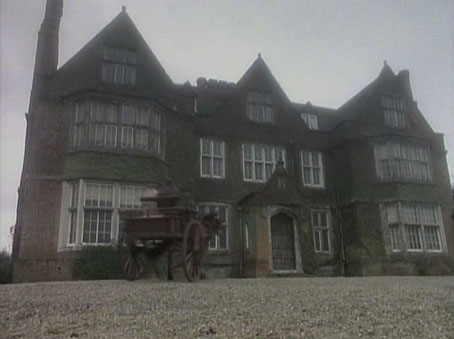
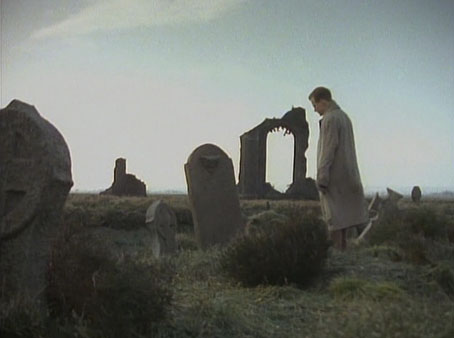
The British television tradition of screening a ghost story at Christmas was filled in 1989 with Nigel Kneale’s adaptation of Susan Hill’s novel The Woman in Black. This isn’t one of the best contributions to the annual ghost drama but at 100 minutes it’s one of the longest, and it has its supporters, some of whom value it above the recent Hammer film production. Seeing as I’d re-watched Nigel Kneale’s major film and TV works earlier this year I thought I’d give The Woman in Black another look. It was better than I remembered although it still left me feeling unsatisfied.

I’ve not read Susan Hill’s book so can’t say how it compares to the television version in any detail. (Wikipedia has a spoiler-heavy list of the differences.) I did see Stephen Mallatratt’s play in 1988, however, the first adaptation of the book which has since become one of London’s most popular theatre productions. The play conjures an effective sense of dread but relies a little too much on loud noises to shock the audience at crucial moments. This is a cheap trick in bad horror films (Wes Craven does it a lot), and it’s just as cheap a trick on a stage. Nigel Kneale may have altered Hill’s story to a degree which apparently displeased her but he didn’t resort to any Craven tricks.

wib2.jpg

The BBC’s Christmas ghost stories have tended to be MR James stories, and The Woman in Black is very much a James pastiche which no doubt helped make it attractive to ITV. All the James hallmarks are there: a man of letters (solicitor rather than a scholar) visiting an isolated part of the English countryside; a lonely house; fearful locals; mysterious deaths; documentary evidence that requires examination; a haunting.

Adrian Rawlins is the young solicitor, Arthur Kidd, given the task of putting the estate of a dead woman in order. Rawlins would have been fine in a smaller role but he wasn’t a good choice for a central character, not when Kidd is on screen every minute of the running time. Far better is the always excellent Bernard Hepton as a genial landowner, a very different role to his sinister Fisher in Robin Redbreast. There’s a lot of solid period detail—Kneale’s dialogue fixes the date at around 1925—and the writing and direction manages to avoid insulting the intelligence. In place of the usual voiceover reading of letters we have Kidd listening to a succession of recording cylinders, an unlikely thing for an elderly woman to be using but it does give the film a connection back to Van Helsing’s device in Dracula. There’s even a surreptitious reference to Kneale’s “stone tape” theory when Kidd says that the ghostly sounds he keeps hearing are like a recording of a terrible event. Director Herbert Wise does some clever hide-and-seek business with the spectral woman, only fumbling things near the end when he makes the mistake of trying to imitate Jack Clayton’s The Innocents. So why does this version still remain unsatisfying?

Continue reading “Nigel Kneale’s Woman in Black”

Weekend links 186

mutu.jpg

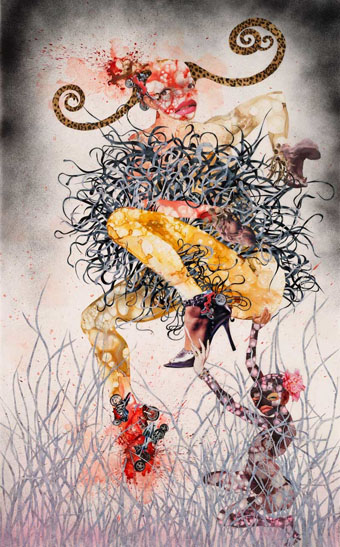
One Hundred Lavish Months of Bushwhack (2004) by Wangechi Mutu.

I wouldn’t be so bold as to call Benjamin Noys’ contribution to the recent The Weird conference at the University of London a highlight, but it was a surprise to find Lord Horror in general and the Reverbstorm book in particular being discussed alongside so many noteworthy offerings. Noys’ piece, Full Spectrum Offence: Savoy’s Neo-Weird, is now available to read online, a very perceptive examination of the tensions between the Old Weird and the New.

• Le Transperceneige is a multi-volume bande dessinée of post-apocalypse science fiction by Jacques Lob & Jean-Marc Rochette. Snowpiercer is a film adaptation by Korean director Bong Joon-ho featuring John Hurt, Jamie Bell, Chris Evans and Tilda Swinton. Anne Billson calls the director’s cut an “eccentric masterpiece” so it’s dismaying to learn that the film is in danger of being hacked about by the usual rabble of unsympathetic Hollywood distributors.

• This month marks the 100th anniversary of the publication of Proust’s À la recherche du temps perdu. Public Domain Review posted some of the paintings mentioned in Swann’s Way (or The Way by Swann’s as the latest translation so inelegantly has it).

How the Paris World’s Fair brought Art Nouveau to the Masses in 1900: a huge picture post about my favourite exposition.

• Mix of the week: “Sport of Kings” Mix by Ricardo Donoso. Related: Paul Purgas on five favourite records.

Ernst Reichl: the man who designed Ulysses. Related: Hear all of Finnegans Wake read aloud over 35 hours.

• “Why does Alain de Botton want us to kill our young?” A splendid rant by Sam Kriss.

• Love’s Secret Ascension: Peter Bebergal on Coil, Coltrane & the 70th birthday of LSD.

• Malicious Damage: Ilsa Colsell on the secret art of Joe Orton & Kenneth Halliwell.

• Just Say No to the Bad Sex Award, or the BS Award as Tom Pollock calls it.

• Lauren O’Neal’s ongoing PJ Harvey Tuesdays: One, Two, Three and Four.

Neville Brody on the changing face of graphic design.

A Brief History of the London Necropolis Railway.

Des Hommes et des Chatons: a Tumblr.

• At Pinterest: Androgyny

• Virgin Prunes: Pagan Lovesong (vibeakimbo) (1982) | Caucasian Walk (1982) | Walls Of Jericho (live at The Haçienda, Manchester, 1983; I’m in that audience somewhere)