Weekend links 338

lee.jpg

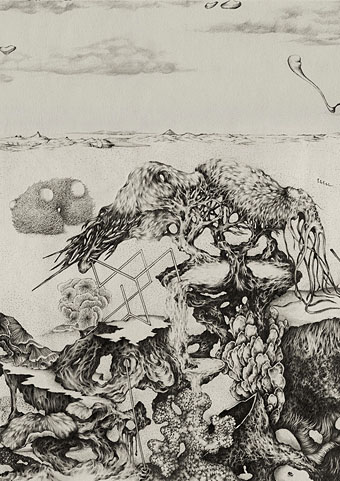
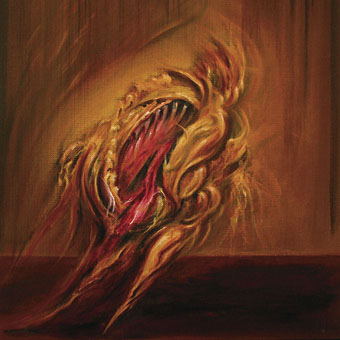
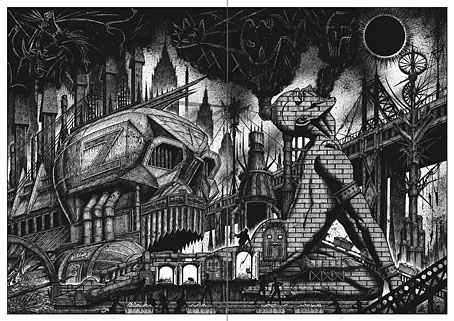
At the mountains of madness, fragment I (2014–16) by Céli Lee.

• Spirits of Place, edited by John Reppion: new writings from Bryndís Björgvinsdóttir, Vajra Chandrasekera, Maria J. Pérez Cuervo, Warren Ellis, Alan Moore, Silvia Moreno-Garcia, Kristine Ong Muslim, Dr. Joanne Parker, Mark Pesce, Iain Sinclair, Gazelle Amber Valentine and Damien Williams.

• “Are we wrong to neglect [Jean Cocteau]? We are.” Kevin Jackson reviews Jean Cocteau: A Life, a biography by Claude Arnaud that’s finally available in an English edition (translated by Lauren Elkin & Charlotte Mandell). Related: Jean Cocteau speaks to the year 2000.

• Void Beats / Invocation Trex by Cavern of Anti-Matter has been one of my favourite music releases this year. Tim Gane talks about the inadvertent origin of the group, and there’s also the welcome news of a reissue for the scarce first album, Blood Drums.

• Pauline Oliveros: 1932–2016; Geeta Dayal looks back on the life of US composer Pauline Oliveros, including reflections from, amongst others, Betsey Biggs, Fred Frith, Terry Riley, and Morton Subotnick.

• The relaunched Jayde Design website is selling copious Moorcock publications and ephemera, back issues of New Worlds magazine, and much else besides, including rare works of my own.

• New from Mute Records: Richard H. Kirk #7489 (Collected Works 1974–1989) and Sandoz #9294 (Collected Works 1992–1994).

• Drawings by Austin Osman Spare are on display for the next two weeks at the Atlantis Bookshop, London.

• The Architecture of the Overlap: Sir John Soane’s Museum, London, scanned in three dimensions.

• Mixes of the week: Secret Thirteen Mix 201 by Félicia Atkinson, and FACT mix 579 by Jenny Hval.

• “No one has the slightest idea what is and isn’t cultural appropriation,” says Fredrik deBoer.

• I’m never keen on end-of-year lists but I’ll read any list that John Waters writes.

• “The Driller Killer and the humanist behind the blood and sickening crunch”.

• More Lovecraft: Stories to make you say UGH! by Pete Von Sholly.

• Alan Moore talks to Stewart Lee.

• At The Mountains Of Madness (1968) by H.P. Lovecraft | Mountains Falling (2001) by Bluebob | Mountains Crave (2012) by Anna von Hausswolff

Weekend links 337

avery.jpg

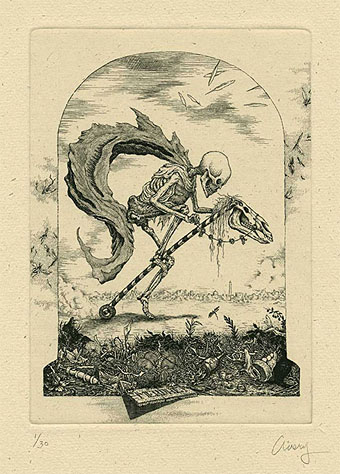
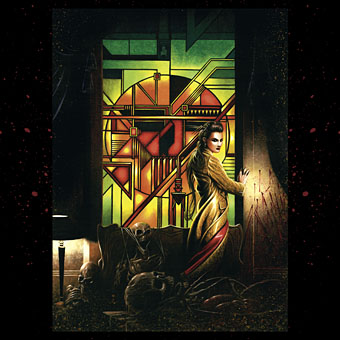
A Post-traumatic History Lesson (2009) by David Avery.

• Last week it was the teaser, this week it’s the full thing: When a New Trick Comes Out, I do an Old One / Exit Pantomime Control by Moon Wiring Club, 29-minutes of woozy and degraded psychedelic VHS weirdness.

• Over the summer I watched 32 Robert Altman films. When faced with such a diverse and unpredictable filmography it helps to have a guide; Geoff Andrew suggests where to begin.

• Some tools in the ongoing war against the Agents of the Control Virus: The Best Anonymous VPN Services of 2016.

Sky Blue Press bills Auletris as a work that “breaks many taboos.” Fans of [Anaïs] Nin know that she has covered plenty of salacious territory before: tubercular nymphomaniacs, exhibitionists, voyeurs, orgies, gender bending, bondage, bestiality, incest, hermaphroditism, etc. Nin was a pioneer of women’s sex writing in English, and all contemporary erotica authors are indebted to her, whether they realize it or not. In the 1940s, she wrote risqué stories for an anonymous private collector at the rate of a dollar a page. Despite how Nin downplayed her bespoke smut as “literary prostitution,” compared to other explicit writing of her time in English, hers was revolutionary. The two steamy volumes, Delta of Venus and Little Birds, were not published for the public until the ’70s, just after her death, but they were best sellers and set a new standard for erotica.

Laura Frost reviewing Auletris, a book of rare fiction by Anaïs Nin

• HP Lovecraft’s Fungi From Yuggoth and Other Poems, a new collection of readings by William E. Hart.

• The Harlan Ellison® Books Preservation Project is on the brink of achieving its Kickstarter target.

• The Haunted Ceiling, a neglected ghost story by HG Wells, is being published for the first time.

• A Quietus Hour Radio Special: Shirley Collins on her favourite songs.

• Kellie Woodson recommends “5 transgressive horror publishers”.

• Alice in Wonderland‘s engravings—a forgotten story in pictures.

• “Alan Moore’s Jerusalem is a moveable feast,” says Alan Wall.

• Musiceureka: “collecting vinyl in a special way”.

• At Dennis Cooper’s: Terrarium makers.

• RIP Pauline Oliveros.

• Bye Bye Butterfly (1965) by Pauline Oliveros | Lear (1989) by Pauline Oliveros / Stuart Dempster / Panaiotis | Silence Echoes (1997) by Pauline Oliveros & Randy Raine-Reusch

Weekend links 333

timeout.jpg

Time Out (London), no. 2403. No illustrator or designer credited.

• October isn’t all about the dark, there’s also psychedelia: Ned Raggett reviews a new collection of British psych, Let’s Go Down And Blow Our Minds: The British Psychedelic Sounds of 1967, while Floodgate Companion, a forthcoming collection of art by Robert Beatty, is previewed here.

• Mixes of the week (aside from my own, of course): Samhain Seance 5: Invasion of the Robot Witch by The Ephemeral Man, Thee Finders Kreepers Halloween Spezial, and Secret Thirteen Mix 199 by Blue Hour.

• “No diggin’ ‘ere!” Adam Scovell revisits the ghostly locations of the BBC’s A Warning to the Curious, and presents a short film based on the same.

• Stanley Kubrick’s film of The Shining has lost its shine through endless quotation and over-familiarity, says Anne Billson. Hard to disagree.

• Between Ballard’s Ears: in which two short stories by JG Ballard—Track 12 and Venus Smiles—are dramatised in binaural sound.

• John Carpenter talks to Adam Woodward about remakes, his love of early synthesisers and why nostalgia works in mysterious ways.

• Next month at the British Library: Brion Gysin: A Centennial Invocation with Alan Moore, Iain Sinclair, Barry Miles and others.

• Peter Bebergal on the Fraternity of the Rosy Cross, “a shadowy medieval brotherhood that probably didn’t exist”.

• Until The Hunter, a new album by Hope Sandoval and The Warm Inventions, is streaming here.

• San Fran-disco: Geeta Dayal on how Patrick Cowley and Sylvester changed dance music forever.

• A small portion of Bill Laswell‘s vast back catalogue is now on Bandcamp.

• At MetaFilter: The strange history of books bound in human skin.

• Italian composer Fabio Frizzi remembers 50 years of cult horror.

• Matthew Cheney on the strange horrors of Robert Aickman.

• Jóhann Jóhannsson’s favourite records

• Dark Start (1995) by ELpH vs Coil | Darkstalker (2000) by Bohren & Der Club Of Gore | Dark (2012) by Moritz Von Oswald Trio

Nightmares calendar

calendar14.jpg

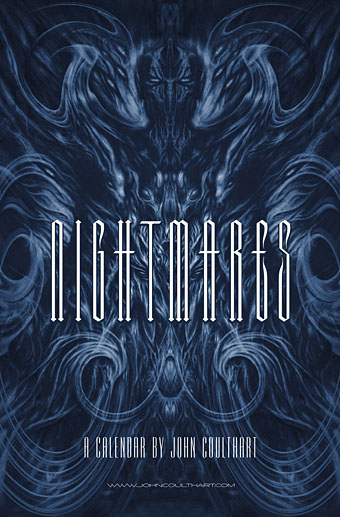
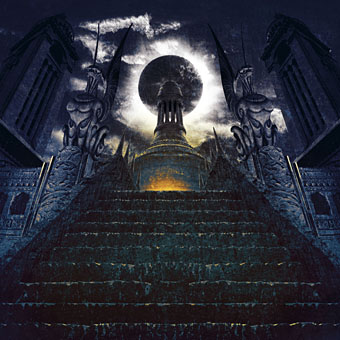
Presenting the latest Coulthart calendar. Last year’s Lovecraft-themed collection was well-received (and is on sale again this year) so I thought I’d try a similar accumulation of horror imagery. Much of the artwork this time is from my intensive painting period circa 1996–1998, and includes one piece—the red painting below—that hasn’t been made public before. Further traces of Lovecraft may be found in the tentacles of the Lord Horror canvas—HPL by way of Frank Frazetta—and the two panels of the Red Night Rites diptych. The latter was a large picture of Reverbstorm-level grotesquery done as a wraparound cover for The Unspeakable Oath, a Lovecraftian gaming journal. While working on it I had William Burroughs in mind as much as Lovecraft, and Burroughs happened to die while work was still in progress so the picture is dedicated to him. Also Lovecraftian is In Spaces Between, one of the pages from my Kabbalistic collaboration with Alan Moore, The Great Old Ones. Howl from Beyond is a title that some people may recognise from Magic: The Gathering. I painted over 20 pictures for the card game but most of them were done in haste, and not to my satisfaction. Howl from Beyond is one of the few I felt worked as intended.

As before, this calendar is available at Zazzle, and comes with black pages and a minimal layout for the dates. Larger images of the artwork may be seen here. I said last year that I’d move some of the other calendar designs to Zazzle (CafePress having discontinued the vertical format I’d been using for years) but I still haven’t done this. One day… And speaking of nightmares, earlier this year I was designing the interiors for another excellent collection of horror stories edited by Ellen Datlow which happens to bear this title. When I get some of that elusive spare time I’ll add the book to the website.

calendar01.jpg

January: Steps of Descent (digital, 2008).

calendar02.jpg

February: Untitled (acrylics on board, 1997).

calendar03.jpg

March: Waltzes and Whispers (acrylics on board, 1998).

Continue reading “Nightmares calendar”

Old Weird and New Weird

savdreams.jpg

Savoy Books, 1984.

A couple more recent arrivals that feature my work. These are of minority interest but worth noting since academic articles don’t always travel beyond a small audience of subscribers.

A recent issue of Foundation (The International Review of Science Fiction), Volume 45.1, number 123, contains an article by Mark P. Williams, Underground Assemblages: Savoy Dreams and The Starry Wisdom. This examines the legacy of New Worlds magazine under the editorship of Michael Moorcock (from 1964 to 1974) via two writing collections, Savoy Dreams (Savoy Books, 1984) and The Starry Wisdom (Creation Books, 1994). The two collections are very different: Savoy Dreams, edited by David Britton and Michael Butterworth, was an eclectic overview of Savoy’s publishing endeavours up to that point. Among the original writing there’s fiction by Butterworth, M. John Harrison (the first publication of the Viriconium story, Lords of Misrule) and others, plus a reaction by Michael Moorcock to William Burroughs’ Cities of the Red Night, a book that Savoy had contracted to publish before police harassment forced the company’s bankruptcy. The rest of the book is taken up with press reviews of Savoy books.

starrywisdom.jpg

Creation Books, 1994. Cover art by Peter Smith.

The Starry Wisdom should require less of an introduction since the book has been in print since 1994, and has a small, possibly notorious, reputation among HP Lovecraft enthusiasts. Editor DM Mitchell felt that the assembling of post-Lovecraftian fiction up to that point had been too cosy and insular: too many story collections were being edited and written by groups of friends in the genre fiction “community”, with the result that the stories were often stale and complacent. The startling newness of Lovecraft’s imagination in comparison to many of his contemporaries in Weird Tales seemed to have been bled away into pastiche, a process that began soon after Lovecraft’s death. Mitchell’s solution was to commission original pieces of Lovecraft-inspired work from writers outside the genre world, notably Alan Moore, Grant Morrison, and newcomer David Conway; he also reprinted pieces that would never appear elsewhere as Lovecraftian fiction, including Wind Die. You Die. We Die. by William Burroughs, and Prisoner of the Coral Deep by JG Ballard. Burroughs and Ballard connect directly to New Worlds, of course (Ballard wrote about Burroughs for the magazine), while the pair cast a shadow over many of Savoy’s book productions. Both Savoy Dreams and The Starry Wisdom featured comic strips; Tales of the Cramps by Kris Guidio appeared in Savoy Dreams, while The Starry Wisdom contained strips by Mike Philbin & James Havoc, Rick Grimes, and the first publication of my own adaptation of The Call of Cthulhu.

I was surprised—and pleased—that my comic strip receives a fair amount of scrutiny in Williams’ piece. My Lovecraft strips have received almost no attention from the comics world, a consequence of having been printed by book publishers and distributed to book shops. (A rare exception was this recent piece by Matt Maxwell.) When you’ve been overlooked in this manner it’s a surprise to find your work receiving serious evaluation from an entirely different quarter. Mark P. Williams’ essay examines the contents of both collections, my strip included, as “assemblages”. This is a valid critique in the case of the Cthulhu strip since Lovecraft’s story is itself an assemblage of what seems at first to be unrelated data. The comic adaptation assembles a range of cultural references—some genuine, others invented—to parallel the narrator’s investigation, and even uses genuine documents in places, including columns from The New York Times. I don’t know if Williams has seen the blog post I made that points out many of the cultural references but he notes some of the more overt ones, such as Joseph Conrad appearing as the doomed Professor Angell, Arnold Böcklin’s The Isle of the Dead, and so on. While I was drawing the strip I was trying to imagine the story as an RKO production, a hybrid of two island films—The Most Dangerous Game and King Kong—and Orson Welles’ unmade Heart of Darkness. These references, many of which aren’t very obvious, were largely for my own amusement. The series I created with David Britton that followed the Lovecraft strips, Reverbstorm, puts assemblage and cultural reference at the forefront.
genre.jpg

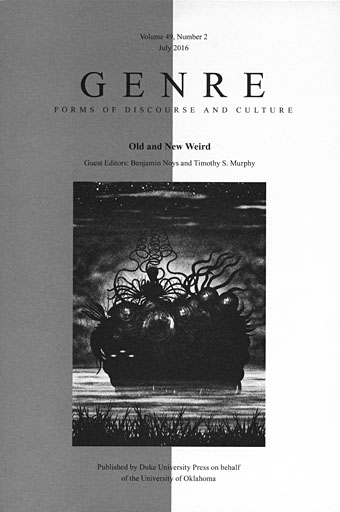
Cover art is my illustration for Remnants from Lovecraft’s Monsters, edited by Ellen Datlow.

The Cthulhu strip and the Reverbstorm series—now collected as Lord Horror: Reverbstorm—are the subject of a very perceptive piece by Benjamin Noys in the latest edition of Genre, an academic journal published by Duke University Press. This number of the journal is a kind of Weird special edited by Benjamin Noys and Timothy S. Murphy. Noys’ Full Spectrum Offence: Savoy’s Reverbstorm and the Weirding of Modernity is the final article in a publication that examines aspects of the “Old Weird” (ie: the Lovecraft-era Weird Tales) and contrasts it with the more recent “New Weird”. The latter was a short-lived label coined by M. John Harrison in 2003 for a range of fiction that was ignoring genre boundaries, and consciously developing the Weird as a project. China Miéville was one of the most visible proponents of the New Weird, and Harrison’s term emerged in part as a response to Miéville’s fiction. Miéville is interviewed in this issue of Genre where, as usual, he has some very worthwhile things to say. He prefers the term “haute Weird” for the original manifestation, possibly because it avoids the negative connotations of the word “old”.
reverbstorm.jpg

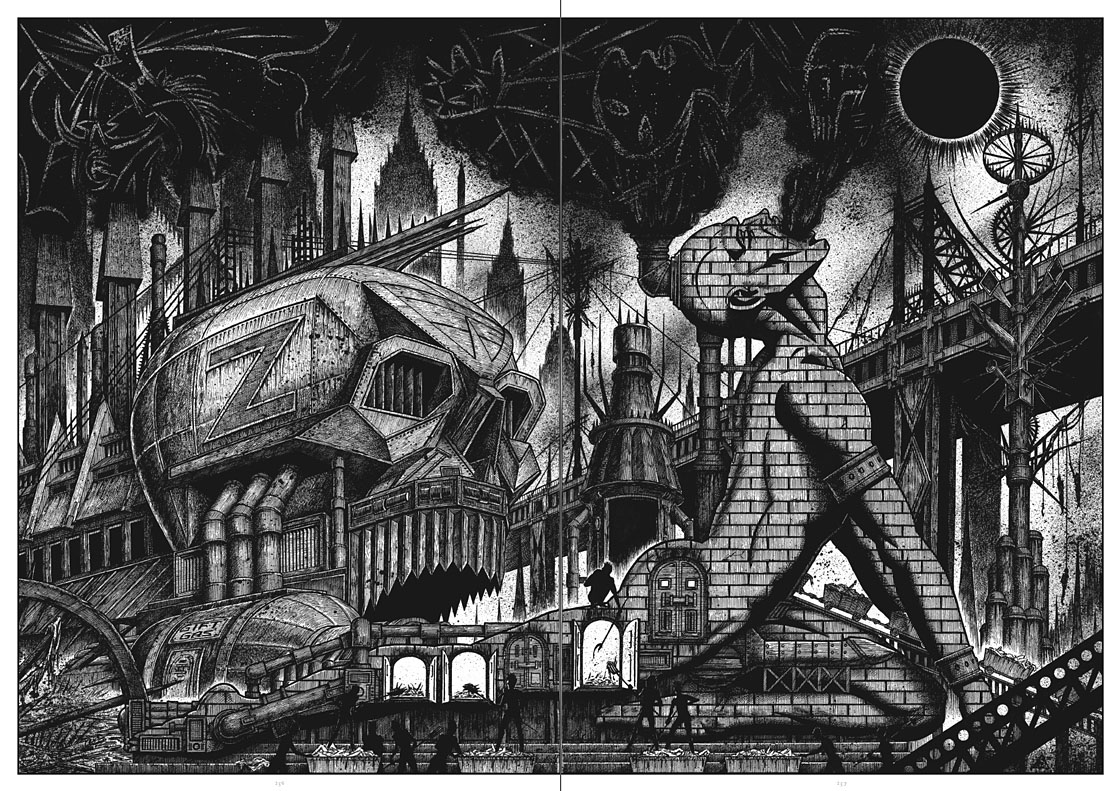
A spread from part 7 of Reverbstorm.

Benjamin Noys’ article is lengthy and resists easy summary, but it begins by investigating the way my work on the Lovecraft strips permeated the Lord Horror comics and dictated some of the imagery, in particular the architectural forms and eruptions of monstrosity. Later discussion concerns the way that Reverbstorm forces the Weird and Modernism together, a collision that I believe is still unique anywhere, never mind in the comics medium. Noys’ piece has given me a lot to think about, not least for its being the first substantial critical appraisal of Reverbstorm. The series is a difficult one, being deliberately excessive and avant-garde, and presenting the reader with a torrent of interrelating cultural references. Many of these are itemised in the appendix but the success (or not) of their working together, and the potential sparking of connections, depends very much on the prior knowledge of the individual reader. Noys is not only knowledgeable but adept at forging his own connections while situating the series in the larger context of the Weird, old (or haute) and new. Even without the inclusion of my work inside the journal and on the cover, I’d recommend this issue of Genre to anyone with an interest in the subject. One of the reasons I favour the Weird as a chosen work label is the way it evades (or ignores) generic boundaries. Years ago I realised that many of the things I liked the best in the arts were the chimeras, those works that transgress boundaries and created new hybrids. No surprise then that I enjoy a genre that refuses easy definition. There aren’t many masts I pin my colours to but the Weird is one of them.

Previously on { feuilleton }
• The Weird