Trip texts

trip1.jpg

I would have changed the subject today if it wasn’t for spotting a copy of David Solomon’s LSD: The Consciousness-Expanding Drug (1964) in Roger Corman’s notorious and rather creditable stab at psychedelia, The Trip (1967). Corman’s film is an oddity in his run of AIP exploitation films in being far less condemnatory than you’d expect (although Peter Fonda’s character isn’t always enjoying his experience), and must also be the only film in the whole AIP canon with signifying texts.

trip2.jpg

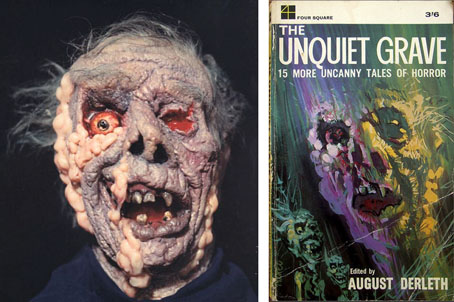
By the time Solomon’s book makes an appearance, Fonda’s character, Paul, has started freaking out but earlier on, during his conversations with John (Bruce Dern), we have Allen Ginsberg’s Howl and Other Poems (1956) shouting out of the frame. “I saw the best minds of my generation destroyed by madness…” Okay Rog, we get it.

trip3.jpg

There’s more, however. Behind Howl there’s another book whose identity eludes me, while behind that you can make out the red typography and white dorje symbol from the 1960 OUP edition of The Tibetan Book of the Dead. The only reason I recognised this is because I own that edition so the cover is very familiar. This would be a popular text in an acid-tripper’s apartment; John tells Paul to “Relax and float down stream”, a line that recapitulates the advice given in Leary, Metzner and Alpert’s The Psychedelic Experience: A Manual Based on The Tibetan Book of the Dead (1964). Most surprising for me about this inclusion is that The Tibetan Book of the Dead features a lot more prominently in that other major film about psychedelic experience, Enter the Void (2009). Am I the only person to have made this material connection? Probably. Does anyone care? Probably not, but I do like recording these associations.

trip4.jpg

tbotd.jpg

Cover design by Lawrence Ratzkin.

Previously on { feuilleton }
Acid albums
Acid covers
Lyrical Substance Deliberated
The Art of Tripping, a documentary by Storm Thorgerson
Enter the Void
In the Land of Retinal Delights
The art of LSD
Hep cats

Weekend links 206

komoda.jpg

Nova Express (2014) by Paul Komoda.

• Last week it was Kraftwerk, this week it’s Can in another astonishing 70-minute TV performance from 1970. For those who know where to look in the torrent world there are copies of these recordings circulating there.

JG Ballard: five years on. Extracts from introductions by John Gray, Hari Kunzru, Robert Macfarlane, Deborah Levy, James Lever, China Miéville and Michel Faber for a new series of Ballard editions.

• Mix of the week: Needle Exchange 147 by Inventions. Also at Self-Titled Mag: Suzanne Ciani on her Buchla beginnings, talking dishwashers, and why no one got electronic music in the ’70s.

• At Dangerous Minds: It’s So Far Out It’s Straight Down, a Granada TV documentary from 1967 featuring Paul McCartney, Allen Ginsberg, International Times, Pink Floyd et al.

The Wonderful World of Witches: Portraits of English Pagans. A photo-special from the 1960s at LIFE. Related: From 1974, the US TV ad for Man, Myth and Magic.

• Suspicious Minds: Adam Curtis on Stephen Knight, Jack the Ripper, squatters, heists, From Hell, and why people no longer trust those in authority.

• Here be men with beards and syntezators: Andy Votel‘s Top 10 Early Patch-Bay Polymaths From Eastern Europe.

The New York Public Library has made 20,000 maps available as free, high-res downloads.

• An oscilloscope video by Vincent Oliver & Steve Bliss for Riff Through The Fog by Clark.

Anne Billson interviewed Alejandro Jodorowsky in 1990.

• At BLDGBLOG: When Hills Hide Arches.

Do gay people still need gay bars?

Pixelord Dreams

I’m So Green (1972) by Can | Nova Feedback (1978) by Chrome | Gay Bar (2003) by Electric Six

Lyrical Substance Deliberated

beatles.jpg

Lucy In The Sky With Diamonds from Yellow Submarine (1968).

The advent of spring invariably gets me listening to favourite psychedelic songs, and this year has been no exception. Earlier this week I was idly wondering how many songs there are that follow the Beatles’ lead in telegraphing their drug metaphors by using the initials L-S-D in their titles. Wikipedia’s page for Lucy In The Sky With Diamonds (1967) relates John Lennon’s oft-repeated claim that the initialism in the title was a coincidence, and the song itself is really a bit of Lewis Carroll-like whimsy. This might be credible if works of art only ever carried one meaning but they don’t, of course, and the song is both a piece of Lewis Carroll-like whimsy as well as being a pretty obvious paean to the drug experience: “Climb in the back with your head in the clouds / And you’re gone”. Jefferson Airplane’s White Rabbit (1967) was similarly ambivalent with mushrooms/pills replacing acid.

Among the many things birthed by the enormous success of the Sgt Pepper album, a small flurry of songs or instrumentals have imitated Lennon’s initialism for their titles. The ones that came immediately to mind are detailed below, and they make a curious group. If anyone knows of any others—there must be others…—then please leave a comment.

hendrix.jpg

Burning Of The Midnight Lamp/The Stars That Play With Laughing Sam’s Dice (Aug, 1967).

The Jimi Hendrix Experience’s B-side not only alludes to LSD but also to STP. The song itself doesn’t go very far before collapsing into freakout mode.

trip.jpg

The Trip (1967).

Not a song but included here for that “Lovely Sort of Death” tag. Written by Jack Nicholson! With Dennis Hopper as the acid dealer! See the trailer here, then watch the whole film here.

power.jpg

Lost Soul In Disillusion (November, 1967).

Hard to imagine anyone in London would have heard this in 1967. The Power of Beckett were a Montreal garage group who only released two singles. Lost Soul In Disillusion turned up years later on compilation albums.

Continue reading “Lyrical Substance Deliberated”

Weekend links 205

lin.jpg

King’s Cloak (2012) by Alice Lin.

• The week in Finnegans Wake: illustrations by John Vernon Lord for a new Folio Society edition; The Guardian‘s review from 1939; Christina Scholz explores Joyce’s use of the Ant and the Grasshopper fable; Sheng Yun wonders when Dai Congrong will compete the first Chinese translation of the book; Stephanie Boland on riverrun, the latest theatrical adaptation.

• It’s Robert Aickman‘s centenary year so Faber are reissuing several volumes of his peerless “strange stories”. And it’s good to see the great Clark Ashton Smith finally receive the blessing of Penguin Classics.

• The Teenage Boyfriend of the Beat Generation: Marcus Ewart slept with Allen Ginsberg (who showed him how to give a proper blowjob), and had an eight-year relationship with William Burroughs.

Yet another advocate of shorter work time was JS Mill. He dismissed the ‘gospel of work’ proposed by Thomas Carlyle in part because it drew a veil over the real costs of work, including slave work that Carlyle sought to defend. Instead, Mill advocated a ‘gospel of leisure’, arguing that technology should be used to curtail work time as far as possible. This stress on technology as a means to shorten work time was later to feature in Bert­rand Russell’s 1932 essay, ‘In Praise of Idleness’.

David Spencer on The Case for Working Less

• More Steve Moore memorials: Mitch Jenkins put the pages from Unearthing online, while Pádraig Ó Méalóid posted a personal appreciation at The Beat.

Linda Marsa on how psychedelics are helping cancer patients deal with their illness.

• The Weird Album: art by Enrique Alcatena (including some Lovecraftian pieces).

• Didgeridoom: Director Ted Kotcheff talks to Robert Barry about Wake in Fright.

The Jealous God (1985), a comic strip by Alejandro Jodorowsky & Silvio Cadelo.

• The Dune in Your Head: Ethan Gilsdorf on the greatest SF film never made.

50 minutes of Kraftwerk on Rockpalast in 1970. Astonishing.

• At 50 Watts: Sheet-music covers from Sweden in the 1920s.

Harvard discovers old library books bound in human skin.

Same-sex marriage is now legal in England and Wales.

Wyrd Daze has reached issue 5.

Kaleidoscopes at Pinterest.

Flight From Ashiya (live on TV! 1967?) by Kaleidoscope (UK) | Lie To Me (1969) by Kaleidoscope (US) | Kaleidoscope (1984) by The Rain Parade

Eyetoon, a film by Jerry Abrams

eyetoon1.jpg

“Fuck for Peace” declares a title card at the end of Jerry Abrams’ Eyetoon, an 8-minute slice of psychedelia from 1968 whose second half has a hippyish couple doing exactly that as they run through a few hardcore Kama Sutra moves. The rest of the film is comprised of rapid editing and some brief animated overlays, together with street shots of the residents of what I’m guessing is San Francisco. The buzzing, twittering electronic score is by David Litwin. A year before this Abrams had documented the Human Be-In, the first major hippy gathering in Golden Gate Park in January 1967. His equally psychedelic film of that event can be seen here.

eyetoon2.jpg

Previously on { feuilleton }
Street Fair, 1959
San Francisco by Anthony Stern