The Use and Abuse of Books

savoy.jpg

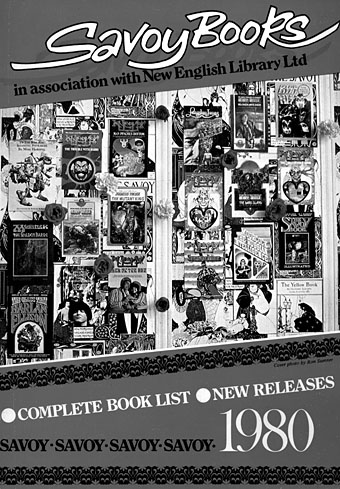
Savoy • Savoy • Savoy: The first wave of book covers pinned to the Beardsley wallpaper of the Deansgate office.

I often feel I’m in a minority in never having been desperate to see my work in a gallery. We are, after all, living in the Age of Mechanical Reproduction (thanks, Walter), and the idea of having to visit a physical location in order to see a work of art can seem like a rather antiquated affair. (Plenty of arguments counter this, of course, but I don’t create anything that needs to be experienced in situ, and I’m also not enmeshed in the art market.) So it’s been surprising this month to realise that examples of my work are currently on display in Monterey, California (the Tentacles exhibition), London (Comics Unmasked: Art and Anarchy in the UK at the British Library which ends today) and in Manchester (The Exhibition Centre for the Use and Abuse of Books at the International Anthony Burgess Foundation). If all goes according to plan, some of my steampunk book covers will also be exhibited in Beijing next month; more about that later.

dbmb.jpg

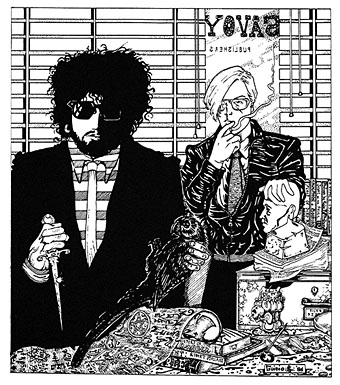
Britton & Butterworth by Kris Guidio (1986).

The Use and Abuse of Books is a necessarily brief overview of the 40-year history of Savoy Books, a notable moment in the life of the company since this is the first time any Manchester institution has acknowledged the existence of a local publisher with such a long, varied and often controversial history. In part this is a result of the cultural histories of Manchester concentrating almost exclusively on the music scene. Many of the books and features written about Manchester arts have been produced by DJs or ex-musicians who appear tone-deaf to literary culture despite the existence of Carcanet Press (established 1969), Savoy Books, and other more recent publishers who are happy to operate outside London. (The venerable Jon Savage gets a pass here.) Carping aside, The Use and Abuse of Books describes itself thus:

Featuring text, images and rare promotional content from Savoy’s infamous 1989 publication Lord Horror, the exhibition tackles the question of whether the depiction and description of horrific acts is justified in satire. In 1992 Lord Horror was declared by Judge Gerrard Humphries as ‘a glorification of racism and violence’ whereas writer Michael Moorcock believed the book to belong to ‘a tradition of lampoon, of exaggeration. Its purpose is to show up social evils, and the evils within ourselves.’ Displaying artwork from Sinister Legends and Meng and Ecker alongside other panels from rare comics and graphic novels (including Reverbstorm), The Use and Abuse of Books also examines the relationship between text and imagery within Savoy’s publications, revealing how artwork from John Coulthart, Kris Guidio and James Cawthorn supplements and enhances the storytelling through visual references to architecture, cultural figures or specific works of art. The exhibition will be open 10am–4pm weekdays and in the evenings during events from Friday 15th August until Friday 5th September. (more)

Some of my pages from Lord Horror: Reverbstorm have been printed large-size for the walls, and there’s also a life-size cardboard figure of my Beardsley-style Lord Horror. Savoy publications past and present are on display, including some of my book designs. It’s fitting that this should be taking place under the aegis of the Anthony Burgess Foundation; Burgess was a great Joycean and a champion of two Savoy favourites: William Burroughs and JG Ballard. I can’t imagine him getting too enthusiastic about many of Savoy’s publications but I’d hope he might have appreciated the spirit of Mancunian bloody-mindedness in which they were produced.

Intertextuality

cthulhu17.jpg

The Call of Cthulhu (1988): in the upper half there’s the big sun from Bob Peak’s poster for Apocalypse Now, in the lower half a radical reworking of Arnold Böcklin’s The Isle of the Dead.

In 1990, shortly after the first season of Twin Peaks had finished showing in the US, Video Watchdog magazine ran a feature by Tim Lucas which attempted to trace all the various cultural allusions in the character names and dialogue, references to old TV shows, song lyrics and the like. This was done in a spirit of celebration, with Lucas and other contributors welcoming the opportunity to dig deeper into something they’d already enjoyed. This week we’ve had a similar unravelling of textual borrowings in a TV series, only now we have the internet which, with its boundless appetite for accusing and shaming, can often seem like something from the grand old days of the Cultural Revolution.
cthulhu01.jpg

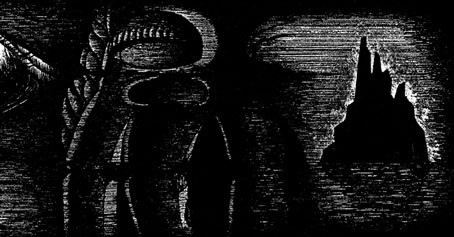
The Call of Cthulhu (1988): a more subtle allusion to Apocalypse Now.

The latest culprit ushered to the front of the assembly for the Great Internet Struggle Session is Nic Pizzolatto whose script for True Detective has indeed been celebrated for its nods to Robert Chambers and The King in Yellow. It’s also in the process of being condemned for having borrowed phrases or aphorisms from Thomas Ligotti’s The Conspiracy Against the Human Race (2011). See this post for chapter and verse.
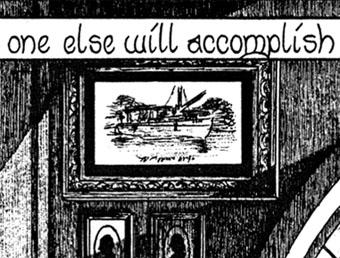
cthulhu02.jpg

The Call of Cthulhu (1988): It’s not very clear but that’s a boat from The Creature from the Black Lagoon.

If I find it difficult to get worked up over all this pearl-clutching it’s because a) it shows a misunderstanding of art and the way many artists work; b) True Detective was an outstanding series, and I’d love to see more from Pizzolatto and co; and c) I’ve done more than enough borrowing of my own in a variety of media, as these samples from my adaptation of The Call of Cthulhu demonstrate, a 33-page comic strip where there’s a reference to a painting, artist or film on almost all the pages, sometimes several on the same page.
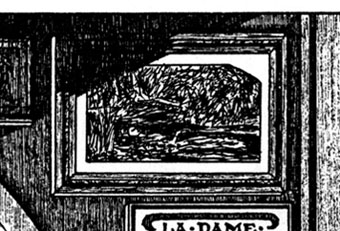
cthulhu03.jpg

The Call of Cthulhu (1988): Ophelia by Millais.

Cthulhu is a good choice here since Pizzolatto’s story edged towards Lovecraft via the repeated “Carcosa” references. You’d think a Lovecraft zine of all things would know better than to haul someone over the coals for borrowing from another writer when Lovecraft himself borrowed from Robert Chambers (and Arthur Machen and others), while “Carcosa” isn’t even original to Chambers’ The King in Yellow but a borrowing from an Ambrose Bierce story, An Inhabitant of Carcosa (1886). Furthermore, Lovecraft famously complained about his own tendencies to pastiche other writers in a 1929 letter to Elizabeth Toldridge: “There are my ‘Poe’ pieces and my ‘Dunsany pieces’—but alas—where are any Lovecraft pieces?”

Continue reading “Intertextuality”

Weekend links 218

white.jpg

The End of a Thousand Years (2014) by Hilary White. Via Phantasmaphile.

• It’s taken a while to shamble into the world but A Mountain Walked, an anthology of Cthulhu Mythos stories edited by leading Lovecraft scholar ST Joshi, will be published by Centipede Press next month. The publisher’s page for the book shows that my contribution will be facing Joshi’s introduction which is something I wasn’t aware of until this week. It also says the 692-page limited edition is sold out, although book dealers often buy collectible volumes such as this to sell on after adding their own markup. Be warned that it was listed on Amazon at $160 so if there are copies available anywhere they won’t be cheap.

• It’s not such a surprise to hear that magic mushrooms were an inspiration for Frank Herbert’s Dune. David Lynch’s film of Dune receives passing mention in this profile by Jeremy Kay of Lynch and the Twin Peaks film/TV series.

• “Whitechapel station is one of Giambattista Piranesi’s imaginary prisons, colonised by frantic electrical engineers and watched over by CCTV.” Will Wiles on the chaos and tangled energy of modern cities.

The word perfume comes from the French root “fume”—smoke—and where there’s smoke, there’s fire! I think most people are turned on sexually by scents and smells. Certain body odours can be very sexually stimulating. We purposefully chose certain ingredients for my Obscenity perfume that are associated with occult or religious rituals, including vetiver, labdanum, and oud, and others that are considered aphrodisiacal, including patchouli and sandalwood. The point of Obscenity is that there is no conflict between the religious and the sexual, and in fact they should be completely complimentary. The fragrance is meant to stimulate you sexually, but it also literally contains water from Lourdes, so it also has religious notes and perhaps even healing properties!

Bruce LaBruce talks to Kathy Grayson about his new fragrance, Obscenity

The Baffler, “a journal of iconoclastic wit and cultural analysis” relaunches with full access to its archives from 1988 to the present.

Pineal, the new album by Othon, is dark and “properly, brilliantly queer,” says David Peschek.

• At Core77: How to improve the audio quality of vinyl records with wood glue.

• P. Adams Sitney interviews Kenneth Anger on WNYC’s Arts Forum (1972).

• At BibliOdyssey: Le Bestiaire Fabuleux by Jean Lurçat.

• Mix of the week: Secret Thirteen mix 123 by Evol.

Meawbin the Creepy Cat

Perfumed Metal (1981) by Chrome | Fragrance (Ode To Perfume) (1982) by Holger Czukay | The Perfume (2006) by Johnny Klimek, Reinhold Heil, Tom Tykwer

Weekend links 217

scaphandrier.jpg

Le Petit Journal, June 16, 1912. Via Beautiful Century.

Occult art by Nicomi Nix Turner, Daniel Martin Diaz, Amy Earles and William Crisafi. Related: Illustrations by Ernest M. Jessop for The Witches Frolic by Thomas Ingoldsby.

• “Our definition of ‘Industrial’ then was a very broad one, it’s definitely not so much now.” Chris Carter & Cosi Fanni Tutti on 20 Jazz Funk Greats by Throbbing Gristle.

• At Dangerous Minds: the Amok Assault Video (1988), an hour of the bizarre, the extreme and the outré which will probably get yanked from YouTube before too long.

I’ve always thought the exchange of words for money is no more and no less problematic than any other kind of prostitution—and it’s important that we prostitutes control a certain amount of our production (and reproduction, for that matter). If I’m writing a book and I’m warned, “Oh, this is unsaleable, you need to make it shorter,” or, “It has to be this, or that,” I’m proud to say I don’t pay attention.

Though this is becoming more difficult. As large publishers turn into monopolies, and the MBAs who are running them—maybe editors used to run them before—are steadily tightening the screws, they feel more and more that they get to call the shots.

Writers can do anything, says William T. Vollmann

• Mixes of the week: Over two hours of Coil and other artists sequenced by Surgeon, and Secret Thirteen Mix 122 by DJ Skirt.

Alan Moore calls for a boycott of the “wretched” new Hercules film on behalf of his friend Steve Moore.

Joe Orton‘s first play, Fred and Madge, will receive its world premier in September.

tentacles.jpg

Ned Raggett found the drawing of mine that’s part of the Tentacles exhibition currently showing at the Monterey Aquarium, California. Thanks, Ned! There’s a sepia-toned version of the drawing in my Cthulhu calendar.

• “Weird is a wayward word,” says Erik Davis in an exploration of weirdness old and new.

• More details about the forthcoming Scott Walker + Sunn O))) collaboration.

• A trailer for a reissue of Robert Wiene’s The Cabinet of Dr. Caligari (1920).

A history of sex toys in pictures.

Books on Book Covers

Octopus’s Garden (1969) by The Beatles | The River (1970) by Octopus | Octopus (1970) by Syd Barrett

Weekend links 216

heathen.jpg

Why Do The Heathen Rage? (2014) by The Soft Pink Truth. Cover art by Mavado Charon.

Drew Daniel’s latest release as The Soft Pink Truth is Why Do The Heathen Rage?, a witty electronic riposte to the often reactionary attitudes of black metal music and the people who create it. (The album is dedicated to Magne Andreassen, a gay man stabbed to death by the drummer from Emperor.) Dorian Lynskey talked to Daniel about queering the metal world, as did Angus Finlayson at FACT. Daniel’s project has been receiving press everywhere but you wouldn’t know it to read US/UK gay news sites where the music coverage is relentlessly narrow and insular. To date, only BUTT magazine has mentioned Why Do The Heathen Rage? but then BUTT have always stood apart from their parochial contemporaries. Never mind, here’s another fucking article about “petite pop princess” Kylie Minogue.

• “By the letter of the law, Ulysses was obscene. Obviously, gratuitously, relentlessly obscene.” Josh Cook on censorship and dangerous books. One of my own dangerous publications, the fifth issue of the Lord Horror comics series, Hard Core Horror (declared obscene in a UK court in 1995), received a very belated review at The Comics Journal. More censorship: Judy Bloom on the perennial panics in US school libraries. Lest we feel superior to American prudery, Leena McCall’s painting of a semi-naked woman caused some consternation in a London gallery last week.

• “Over and over, we’re told that nobody buys [compact discs] anymore.” Steven Hyden on the latest obituaries being written for a music format. Ten years ago the death of vinyl was being confidently predicted: “The physical presence of the popular song is gone,” Paul Morley declared. Related: The death of mp3s.

There is nothing quite like Maryanne Amacher’s third ear music. It is alarming. Some of her fellow artists never quite believed that their ears were not being damaged. Third ear music invades you, wraps inside your body, your head, your eyes — just like she says. You can’t be sure, after a while, if the sounds you hear are those created by your ears or Maryanne Amacher.

Stefany Anne Golberg on the music of Maryanne Amacher

• At Dangerous Minds: Nothing Lasts Forever (1984), Bill Murray in a “lost sci-fi comedy set in a totalitarian New York City”.

• More Joyce (there’s always more Joyce): Humument Images to Accompany James Joyce’s Ulysses by Tom Phillips.

• Another celebration of Penda’s Fen by David Rudkin, and another reminder that it’s still not available on DVD.

• Stairway to Heaven: Atlas Obscura on the Gustave Moreau Museum, an essential stop if you visit Paris.

• Mix of the week: Secret Thirteen Mix 121 by Higher Intelligence Agency.

• MetaFilter has a wealth of links to pulp magazine archives.

Yan Nascimbene’s illustrations for Italo Calvino’s stories.

• Rebecca Litchfield’s Orphans of Time and Soviet Ghosts.

• RIP Charlie Haden

Going Home (1972) by Alice Coltrane (Charlie Haden, bass) | Earth (1974) by Joe Henderson Featuring Alice Coltrane (Charlie Haden, bass) | Malkauns (1975) by Don Cherry (Charlie Haden, bass)