Weekend links 136

tintenfisches.jpg

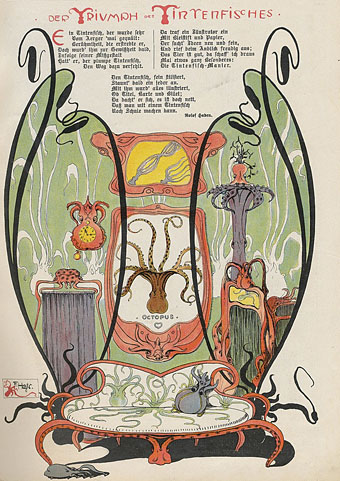
Der Triumph des Tintenfisches from Meggendorfer-Blätter (c. 1900). Via Beautiful Century.

Much dismay this week at the news that Coilhouse—the web and print magazine founded in 2008 by Nadya Lev, Meredith Yayanos and Zoetica Ebb—was closing its doors for the foreseeable future. I always loved what they were doing, and was delighted when S. Elizabeth interviewed me for the website two years ago. Looking at the list of their featured articles is like seeing the contents of my head laid bare. Have a browse and see what you may have missed. And fingers crossed they return soon.

• “I think we are just used to seeing naked women because they are used as objects of desire in advertisements and TV. Naked men are not that common—we are not used to seeing a penis. I think that is the main problem for people.” The shock of the (male) nude.

Michael Clarke asks “What Can Publishers Learn from Indie Rock?” Also: Michelle Dean on the value of used books.

Queers find themselves on both sides of the free speech question. Those of us who are writers want the freedom to write and say what we want. I know I do. Yet a preponderance of LGBT people have become part of the larger wave of those who would limit free speech. Because while we want to be able to say whatever we want about “them,” we do not want “them” to say whatever they want about us.

Victoria Brownworth on The Case Against Censorship

• Caspar Henderson re-reads The Book of Imaginary Beings by Jorge Luis Borges.

One hundred classic minimalism, electronic, ambient and drone recordings.

• BLDGBLOG visits the Chand Baori stepwell in Abhaneri, India.

Brion Gysin’s Dreamachine is launched in the UK.

Ken Hollings visits Ludwig II’s Venus Grotto.

• A guide to Meredith Monk‘s music.

• RIP Boris Strugatsky.

Maldorora: a Tumblr.

Stalker: Meditation (1979) by Edward Artemiev | Undulating Terrain (1995) by Robert Rich & B. Lustmord | Stalker (2004) by Shackleton.

Children of the Stones

cots1.jpg

“Pretty phantasmagorical!” says precocious teenager Matthew when he and his father drive into the fictional village of Milbury in the opening scene of Children of the Stones. Matthew’s father is a scientist whose work requires a three-month stay in a village built in the centre of a series of ancient ramparts and stone circles. Once settled, they find many of the villagers to be blandly cheerful, while Matthew discovers that his maths skills at the local school pale beside younger children who can solve complex equations with ease. Omnipresent characters in the village are Hendrick, a retired astronomer who owns the local manor house and acts as village squire; Margaret, a newly-arrived archaeologist who knows the history of the stones; and Dai, a vagrant poacher who lives outside the circle, and who seems eager to remain free of the Stepford-like happiness afflicting his neighbours.

cots2.jpg

Matthew (Peter Demin).

Matthew’s “phantasmagorical” epithet is directed at the neolithic mound outside the village but could easily apply to the whole of this seven-part serial which I watched again recently. HTV produced Children of the Stones which was first broadcast in early 1977. A mystery serial for children involving pagan history, folk rituals and an undercurrent of science fiction wasn’t such a surprising thing in the 1970s, this being a decade when a popular interest in the occult and the paranormal was more prevalent than at any time before or since. Children’s television reflected adult trends which is why we got to see an adaptation of Alan Garner’s The Owl Service, the occult adventure series Ace of Wands (with its hero named “Tarot”), The Tomorrow People (which occasionally strayed from science fiction to science fantasy) and others (see an earlier post, Occultism for kids). Children of the Stones was the most complex of all of these, a well-crafted drama with similarities to Nigel Kneale’s TV plays, The Wicker Man and The Prisoner. With a slight change of emphasis it would have worked just as well as a serial for adults. The best children’s serials of the period were usually adaptations of novels; Children of the Stones was an original work for television, written by Jeremy Burnham & Trevor Ray, and directed by Peter Graham Scott.

cots4.jpg

Adam (Gareth Thomas), Margaret (Veronica Strong) and Hendrick (Iain Cuthbertson).

Continue reading “Children of the Stones”

Weekend links 133

woods1.jpg

Lower Manhattan (1999) by Lebbeus Woods.

RIP Lebbeus Woods, an architect and illustrator frequently compared to Piranesi not only for his imagination and the quality of his renderings but also for the way both men built very little from a lifetime of designs. Lots of appreciations have appeared over the past few days including this lengthy piece by Geoff Manaugh at BLDGBLOG. (Geoff interviewed Woods in 2007.) Elsewhere: A slideshow at the NYT, Steven Holl remembers Lebbeus Woods and Lebbeus Woods, visionary architect of imaginary worlds. See also: Lebbeus Woods: Early Drawings and this post about Woods’ illustrations for an Arthur C Clarke story collection. Woods was at his most Piranesian with Gothic designs for an artificial planet that would have been the principal location in Vincent Ward’s unmade Alien 3.

Arkhonia draws to the end of a year of blogging about and around the Beach Boys’ errant masterwork, Smile (1967). Witty, discursive and frequently scabrous accounts of how Brian Wilson’s magnum opus was derailed and marginalised until it became convenient for commercial interests to exploit its reputation. Anyone following those posts won’t have been surprised by Wilson’s sacking from his own group by Mike Love in September.

• “We’ve been underground for 27 hours now. Everyone is caked in mud, with grit in their hair.” Will Hunt explores the catacombs and sewers of Paris.

I think the only remotely interesting drug was acid. I had a slightly peculiar attitude towards it I think. Just about everything about hippydom I hated. I liked the 60s up to about ’65 or ’66. I liked the mod clothes, I liked the look. I wasn’t a keen taker of speed because I didn’t like the comedown from it. Then everything changed and became looser, I didn’t like the clothes at all. I felt rather out of step with it. The acid thing was interesting though. I come from Salisbury and from the age of 12 I had a friend who was 30 years older than I was who I saw regularly up until when he died a couple of years ago, whose obituary I wrote in The Times. This man was called Ken James and he was deputy head at the chemical warfare unit at Porton Down [the MOD’s Defence Science and Technology Laboratory]. He then became head of the scientific civil service; he was the man who introduced computing into the civil service and he had taken acid as early as 1950. This was long before Aldous Huxley.

Sharp Suits And Sparkle: Jonathan Meades On Acid, Space And Place by John Doran. Marvellous stuff. Meades’ new book is Museum Without Walls.

• In New York later this month: A Cathode Ray Séance – The Haunted Worlds of Nigel Kneale.

• More acid: Kerri Smith talks to Oliver Sacks about his drug experiences.

• “It starts with an itch”: Alan Bennett (again) on his new play, People.

nymag.jpg

Lower Manhattan last Wednesday. Photo by Iwan Baan.

• Back issues of OMNI magazine can now be found at the Internet Archive.

• Alan Moore & Mitch Jenkins present their new film, Jimmy’s End.

• At BibliOdyssey: Atlas title pages part one & part two.

• Raw Functionality: An interview with Emptyset.

Athanasius, Underground

Vintage Caza

Stormy Weather (1979) by Elisabeth Welch.

Steampunk Revolution

srev01.jpg

The “S” word again. One of the jobs from earlier this year is now available for purchase from publishers Tachyon and other outlets. Steampunk Revolution is the third in a series of steampunk story collections edited by Ann VanderMeer (Jeff VanderMeer was co-editor on the first two volumes). I designed the previous title, Steampunk Reloaded, and was working on these pages whilst also putting together the cover for Lavie Tidhar’s The Bookman Histories. Tidhar’s trilogy is a steampunk affair (and this collection features one of his Bookman stories) so there’s some slight overlap between the two designs, notably the use of a typographic “charm” I took from a Victorian printer’s catalogue. I’ve since seen that shape used elsewhere so it’s evidently more common than I thought. Bah.

The title page design above can be added to my ongoing obsession with the Exposition Universelle of 1900. Malissa Kent’s story, The Heart is the Matter, ends with a scene at the Exposition so I had an excuse to use an elaborate banner which includes an Exposition medal. (The same medal, incidentally, that you still see on the labels of Campbell’s Soup). The illustration below is adapted from one of Walter Crane’s Socialist drawings, and I feel bad now that we didn’t credit him for it. Sorry, Walter.

srev05.jpg

srev03.jpg

srev04.jpg

Continue reading “Steampunk Revolution”

Weekend links 131

thingposter.jpg

Japanese poster (1982).

At The Quietus Steve Earles looks back at John Carpenter’s visceral and uncompromising The Thing which exploded messily onto cinema screens thirty years ago. It’s always worth being reminded that this film (and Blade Runner in the same year) was considered a flop at the time following bad reviews and a poor showing at the summer box office. One reason was The Thing‘s being overshadowed by the year’s other film of human/alien encounters, something called E.T. the Extra-Terrestrial. To The Thing‘s status as the anti-E.T. you can add its reversal of the can-do heroics of Howard Hawks’ The Thing from Another World (1951), an attitude out-of-step with Reaganite America. Carpenter’s film is not only truer to the original story but from the perspective of 2012 looks like one of the last films of the long 1970s, with Hawks’ anti-Communist subtext replaced by bickering, mistrust, paranoia and an unresolved and completely pessimistic ending that most directors would have a problem getting past a studio today.

I was fortunate to see The Thing in October of 1982 knowing little about it beyond its being a John Carpenter film (whose work I’d greatly enjoyed up to that point) and a remake of the Hawks film (which I also enjoyed a great deal). One benefit of the film’s poor box office was a lack of the kind of preview overkill which made E.T. impossible to avoid, and which a couple of years earlier did much to dilute the surprise of Ridley Scott’s Alien. I went into The Thing mildly interested and came out overwhelmed and aghast. For years afterwards I was insisting that this was the closest you’d get on-screen to Lovecraft’s At the Mountains of Madness. The correspondence is more than merely Antarctica + monsters when you consider this:

Lovecraft’s story was rejected by his regular publisher Weird Tales but was accepted by Astounding Stories in 1936 >> The editor of Astounding, John W. Campbell, published his own Antarctica + monsters story (under the pen-name Don A. Stuart), “Who Goes There?”, in the same magazine two years later >> Charles Lederer wrote a loose screen adaptation of Campbell’s story which Howard Hawks and Christian Nyby filmed as The Thing from Another World.

This isn’t to say that Campbell copied Lovecraft—both stories are very different—but I’d be surprised if Lovecraft’s using Antarctica as the setting for a piece of horror-themed science fiction didn’t give Campbell the idea.

More things elsewhere: Anne Billson, author of the BFI Modern Classics study of The Thing, on the framing of Carpenter’s shots, and her piece from 2009 about the film | Mike Ploog’s storyboards | Ennio Morricone’s soundtrack music, of which only a small percentage was used in the film.

• The week in music: 22 minutes of unreleased soundtrack by Coil for Sara Dale’s Sensual Massage | Analog Ultra-Violence: Wendy Carlos and the soundtrack for A Clockwork Orange | A Halloween mixtape by The Outer Church | Herbie Hancock & The Headhunters, live in Bremen, 1974: a 66-minute set, great sound, video and performances | Giorgio Moroder’s new SoundCloud page which features rare mixes and alternate versions | A video for Collapse by Emptyset.

One of the main themes of the book, and what I found in The Arabian Nights, was this emphasis on the power of commodities. Many of the enchanted things in the book are lamps, carpets, sofas, gems, brass rings. It is a rather different landscape than the fairy tale landscape of the West. Though we have interiors and palaces, we don’t have bustling cities, and there isn’t the emphasis on the artisan making things. The ambiance from which they were written was an entirely different one. The Arabian Nights comes out of a huge world of markets and trade. Cairo, Basra, Damascus: trades and skills.

Nina Moog talks to Marina Warner

John Palatinus, “one of the last living male physique photographers of the 1950s”, is interviewed. Related: the website of Ronald Wright, British illustrator for the physique magazines.

• “A classic is a work which persists as a background noise even when a present that is totally incompatible with it holds sway.” Italo Calvino’s 14 Definitions of What Makes a Classic.

Huge Franz Kafka archive to be made public. Related: Judith Butler asks “Who owns Kafka?”

• Geoff Manaugh’s Allen Ginsberg Photos & Ephemera, 1994–Dec 1996.

Magic mushrooms and cancer: My magical mystery cure?

Clark Ashton Smith Portfolio (1976) by Curt Pardee.

Jan Toorop’s 1924 calendar.

artQueer: a Tumblr.

• All The Things You Are (1957) by Duke Ellington | Things That Go Boom In The Night (1981) by Bush Tetras | Things Happen (1991) by Coil | Dead People’s Things (2004) by Deathprod.