The Time Machine

ttm01.jpg

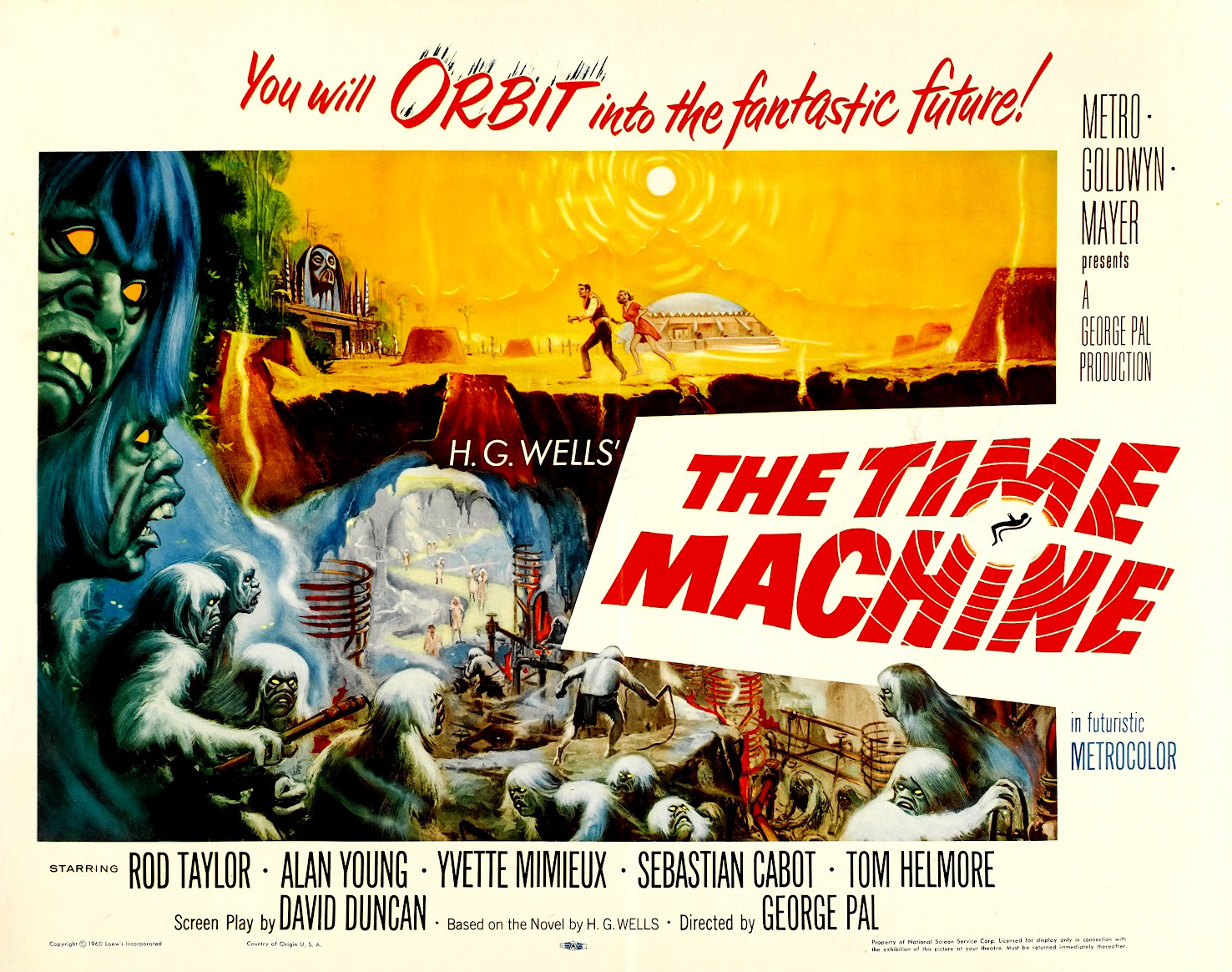
The Time Machine (1960).

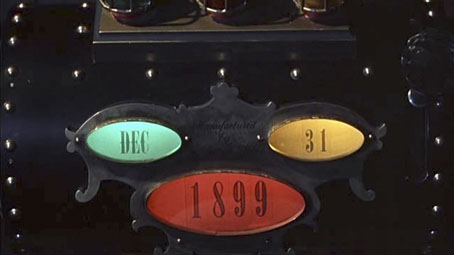
The turning over of the calendar from one year to the next makes this day the ideal moment to write something about HG Wells’ celebrated story. Having re-read The Magic Shop before Christmas I decided to refresh my reading habit—lapsed these past months due to pressure of work—by revisiting more of Wells’ short stories, many of which I haven’t looked at for years.

As I said in that earlier post, it was The Time Machine that led me to Wells’ written work after being excited at an early age by George Pal’s 1960 film adaptation. Reading the story again I’m still astonished by how advanced it is compared to everything else being published in 1895. Michael Moorcock’s excellent introductory essay, The Time of ‘The Time Machine’ (1993), notes that time travel per se wasn’t a new idea for Victorian readers, there were many novels and stories using the theme, most of them merely displacing a character from one age to the next in a very simple manner. Wells’ innovation was the idea of a machine which would give the user mastery of Time itself. Moorcock also notes that Wells considered this to be his one great idea which he always felt he never exploited as fully as he wished. The need to make a living forced him to set down the story in some haste when it was accepted for serialisation in WE Henley’s New Review. (Moorcock’s introduction can be found in a recent collection London Peculiar and Other Nonfiction).
ttm11.jpg

The other notable feature this time round—and this means more to me than it would to many other readers—was being struck by the way Wells’ story prefigures so much of the fiction William Hope Hodgson would be writing a decade or so later. It’s a commonplace among Hodgson scholars that The Night Land (1912) owes something to the scenes when the Time Traveller journeys beyond the age of the Eloi and Morlocks to a period when the Earth is dead and the Sun has swollen to a baleful giant. Some of the more cosmic moments of The House on the Borderland (1908) can also be traced back to these scenes. I’d argue that the Time Traveller’s earlier battles with the Morlocks prefigure and possibly influence similar battles in The Night Land, and the attacks of the Swine-Things in Borderland. There’s even a moment near the end of Wells’ story when the Time Traveller is menaced by giant crustaceans like those which infest Hodgson’s Sargasso Sea. This may not be a fresh observation but it’s not one I’ve seen elaborated before.

Regular readers will know it’s a habit here to seek out illustrations of favourite stories. In the case of The Time Machine there are hundreds to choose from so the following selection barely scratches the surface. Something I’d not noticed before when looking at comic strip adaptations is that none of the works derived from Wells’ story (George Pal’s film included) seem able to countenance the Time Traveller’s abandoning of Weena to the Morlocks when the pair become trapped outdoors at night; all show the Time Traveller doing his best to rescue her. William Hope Hodgson’s fiction is filled with rescues, sieges and the defence of the weak against marauding and inhuman forces; The Night Land concerns an epic and apparently suicidal rescue mission across the most inhospitable terrain imaginable. It may be stretching a point but it’s possible to see much of Hodgson’s fiction as being a riposte to this incident in Wells’ story.
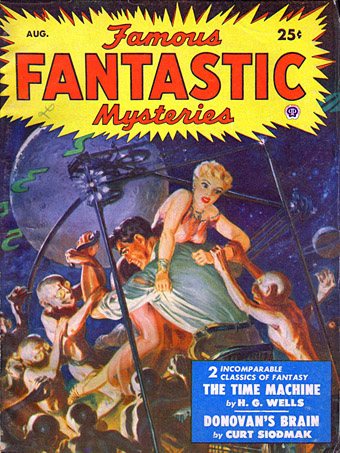
ttm02.jpg

Illustration by George Saunders (August, 1950).

Recurrent points of interest in illustrations of Wells’ story are i) How is the Time Machine itself depicted? (The author’s descriptions are evasive), and ii) How are the Morlocks depicted? Wells describes them thus:

‘I turned with my heart in my mouth, and saw a queer little ape-like figure, its head held down in a peculiar manner, running across the sunlit space behind me. It blundered against a block of granite, staggered aside, and in a moment was hidden in a black shadow beneath another pile of ruined masonry.

‘My impression of it is, of course, imperfect; but I know it was a dull white, and had strange large greyish-red eyes; also that there was flaxen hair on its head and down its back. But, as I say, it went too fast for me to see distinctly. I cannot even say whether it ran on all-fours, or only with its forearms held very low.

George Saunders’ small Gollum-like creatures are closer to Wells’ conception than many later depictions. Saunders’ Weena, on the other hand, is far too tall for the equally diminutive Eloi.
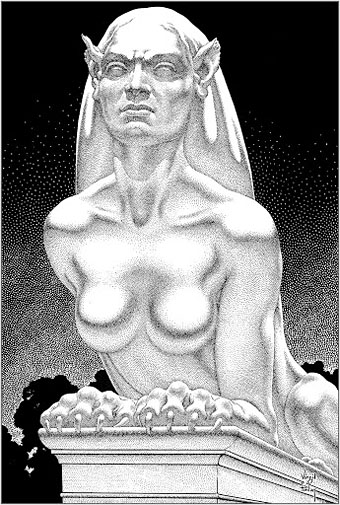
ttm03.jpg

Virgil Finlay (1950).

This is still my favourite Time Machine illustration but then Finlay has a tendency to beat everyone when it comes to these assignments. His illustrations appeared inside the August, 1950 issue of Famous Fantastic Mysteries. Wells’ sphinx has wings which I imagine Finlay might have included if he wasn’t restricted by the space allowed for his illustration. He also provided the illustration of a Morlock below.

Continue reading “The Time Machine”
The Magic Shop by HG Wells

magic.jpg

The Magic Shop (1964).

I discovered this TV adaptation by accident while looking for something else (more about the something else tomorrow). The Magic Shop is a 45-minute drama directed by Robert Stevens in 1964 for The Alfred Hitchcock Hour. Writer John Collier adapted a script by James Parish that’s loosely based on the short story by HG Wells. The story is one I know very well, having read it many times, but I hadn’t come across this TV version before. It’s a surprise finding it so close to Christmas since I first read the story in the only Christmas present that’s survived from childhood, a hefty collection of HG Wells’ short stories that I pestered my parents into buying me in 1973. I mostly wanted to read The Time Machine but the other stories seemed promising, especially the ones illustrated by Richard Gilbert on the (miraculously intact) dustjacket: The Sea Raiders (sailors attacked by octopuses), The Flowering of the Strange Orchid (man attacked by tentacular plant), The Valley of Spiders (attacking spiders falling from the sky), and so on. The book as a whole runs to over 1000 pages, and proved to be a revelation with Wells ranging through fantasy, science fiction, horror, and oddities which don’t fit any category other than Robert Aickman’s indispensable label, “strange stories”. The book made me a lifelong Wellsian, and also spoiled me a little when I moved on to more recent science fiction and found many of the alleged greats to be appalling writers. Wells’ prose can’t compete with Robert Louis Stevenson but it’s still well-crafted in that no-nonsense late Victorian manner familiar to readers of Arthur Conan Doyle.

wells.jpg

Design and illustration by Richard Gilbert (1970).

The Magic Shop is one of the strange stories, the shop in question being a mysterious establishment somewhere in Regent Street, London, one of those premises one discovers by accident then can’t find again. The narrator is informed by the proprietor that this is a Genuine Magic Shop, as distinct from the kind selling mere conjuring tricks. The meaning of this isn’t clear at first but while the narrator’s young son is being beguiled by the marvels on display we follow his father’s growing alarm when he realises there’s more to the shop than he anticipated, not all of it pleasant or fun. The story was published in Twelve Stories and A Dream in 1903, and can be read here.

The TV version takes the bare bones of the tale—curious shop, indeterminate location, friendly yet sinister proprietor—and blends it with the nasty-child-with-magic-powers theme that was dramatised so memorably by The Twilight Zone in It’s A Good Life. The Hitchcock show was made three years after the Twilight Zone episode so it’s easy to see It’s A Good Life as an influence. Leslie Nielsen is the father who takes his son, Tony (John Megna), to the fateful shop on his birthday. The proprietor informs the pair that Tony is “the right boy” since he found the shop in the first place, the subtext being that he’s also possesses the right character to be the recipient of some heavy voodoo abilities. The boy’s bad seed status has been telegraphed from the outset by a birthday gift from an uncle of a black leather jacket; throughout the scene in the shop he looks like a miniature hoodlum. More American anxiety about its troublesome youth? Maybe, although the episode ends so poorly that the whole thing comes across as a lazy piece of filler. This is, of course, a long, long way from the Wells story which is all the more effective for being elusive, understated and, yes, magical.

Previously on { feuilleton }
HG Wells in Classics Illustrated
The night that panicked America
The Door in the Wall
War of the Worlds book covers

Chronopolis by Piotr Kamler

chronopolis3.jpg

Another gem at Ubuweb, and nothing to do with JG Ballard’s SF story of the same name, Piotr Kamler’s Chronopolis (1983) is a 50-minute animated science fiction film, albeit science fiction of a much more abstract variety than one usually finds in cinema. I’m generally exasperated by the way film and TV SF does little more than play Cowboys & Indians in space so it’s refreshing to see something that’s unashamedly strange and doesn’t feel the need to explain itself. There is apparently a version of this with some English narration for those benighted American audiences everyone feels a need to pander to but the Ubuweb version is wordless, and if you can’t read French then you won’t understand the few lines of text prologue at the opening.

chronopolis1.jpg

Accompanying Kamler’s beautifully crafted and quite inexplicable scenes there’s an electronic score by composer Luc Ferrari, mostly analogue timbres whose origin is as mysterious as the events taking place on-screen. Kamler’s statuesque figures remind me of the gods and aliens that Moebius and co. were drawing in Métal Hurlant during the 1970s. Chronopolis was a French production begun in 1977 so it’s possible that French comics were an influence. Moebius himself worked on another animated SF film during this period, René Laloux’s Time Masters (1982). Chronopolis is closer in tone to the weirdness of Laloux’s earlier Fantastic Planet (1973), and all the better for it.

chronopolis2.jpg

Previously on { feuilleton }
Les Jeux des Anges by Walerian Borowczyk
Les Temps Morts by René Laloux

Weekend links 138

durette.jpg

Heartsick (2011) by Kelly Durette.

• Now that Scott Walker’s Bish Bosch album is out and causing the usual consternation, the spotlight-shy singer/composer has been doing a surprising amount of promotional interviews. Simon Hattenstone talked to him for the Guardian at the end of last month; this week it was John Doran’s turn at The Quietus. One quote from the latter piece stood out in the light of this week’s posts: “…the music we’re making is meant to be an aural version of the HR Giger drawings for Alien. It always sounds to me like those look.”

Satanica is a limited-edition publication curated by Gio Black Peter & Christopher Stoddard “for anyone who rejects societal norms, for those dedicated to a life of pleasure, excess and self-reflection”.

• Sci-Fi-O-Rama has put five years’ worth of blog pictures onto Pinterest. I don’t really need to do that, there’s already a diverse crowd of Pinterest users compiling their own selection of things posted here.

As Susan Sontag once observed, pornography is practical. It was designed as a marital aid, and its vocabulary should follow natural biological rhythms and stick with hot-button words in order to produce a predictable climax. It is not about sex but is sex. Whereas the great sex writers (Harold Brodkey, DH Lawrence, Robert Gluck, David Plante, the Australian Frank Moorhouse) have a quirky, phenomenological, realistic approach to sex. They are doing what the Russian formalists said was the secret of all good fiction – making the familiar strange, writing from the Martian’s point of view.

Edmund White on writing about sex in fiction

• When pirate DVDs of films by Cocteau, Bresson and Pasolini are on sale in a Mexican market, life in the 21st century increasingly resembles a William Gibson novel. Joanne McNeil investigates.

• Copies of City Fun, Manchester’s premier music fanzine/alt culture mag (founded 1978), can now be read online at the Manchester District Music Archive.

• Linked everywhere during the past few days, the astonishing map of bomb hits on London during the Blitz (October 1940 to June 1941).

• At 50 Watts: 30 Vintage Magazine Covers from Japan and Alfred Kubin’s illustrations for Lesabéndio: An Asteroid Novel (1913) by Paul Scheerbart.

• Earlier this year for Frieze Magazine Geeta Dayal talked to musical collaborators of the great German producer Conny Plank.

Invisible Ink by Christopher Fowler, “the extraordinary stories of over one hundred forgotten authors”.

Cynthia Carr talks about Fire in the Belly, her biography of American artist David Wojnarowicz.

• “Blasphemy, Filth, And Nonsense” More Aleister Crowley ephemera at Front Free Endpaper.

• At Strange Flowers: Surrealist art by Jindrich Heisler (1914–1953).

Vladimir Nabokov wrote to Alfred Hitchcock in 1964.

• Scott Walker’s four tracks from the Nite Flights album (1978): Shutout | Fat Mama Kick | Nite Flights | The Electrician.

The poster art of Vic Fair

fair1.jpg

The Man Who Fell to Earth (1976).

This weekend’s viewing was The Man Who Fell to Earth on Blu-ray, highly recommended for anyone who likes the film, Anthony Richmond’s photography looks better than ever. I’ve had this for a while on DVD and what’s notable about the old and new formats is that both UK editions use Vic Fair’s poster design as the cover art. It often seems a hit-or-miss affair whether the original poster gets used for home release. This tends to happen more with older films that have acquired an artistic reputation; the recent UK release of The Conformist by Arrow Films prints four different poster designs on the inlay, with the box enclosure having a clear window that allows one or other of the designs to be facing out. A great idea which makes owning the physical copy a little more worthwhile.

I’d known the poster for Nic Roeg’s film for years but until this weekend I’d never thought to find out who was responsible for the artwork. Vic Fair was a prolific artist for UK film releases during the 1970s and 1980s so this is a small selection of his work. Apparently he was so pleased with the Roeg poster that he signed it. As is often the case with film posters, there’s no record of the designers for these examples so we don’t know who was responsible for the type layouts.

fair5.jpg

Countess Dracula (1972).

The Countess Dracula art looks surprisingly similar to some of the promotional art that Roger Dean produced around this time for UK studios, Hammer included. A few examples appear in his Views book but it’s a side of his work that’s seldom seen or discussed. I recall being impressed by the Vampire Circus poster in the past (although the big cats look a little silly). One of the better Hammers of the 70s, with a cast including cult cutie John Moulder-Brown.

fair2.jpg

Vampire Circus (1972).

fair3.jpg

The Hireling (1973).

As with many posters of the 1970s, The Hireling is a great example of an approach that marketing departments would never allow today.

fair4.jpg

Castaway (1987).

Another Nic Roeg film, and another subtle design, possibly too subtle as I don’t recall seeing it used anywhere. First time I saw this was on the cover of a soundtrack album a few years back when I was putting together Jon Hassell’s website. There’s a piece of his music used in the film so we were trying to trace all the relevant cover art.

There’s more about Vic Fair and his contemporaries in British Film Posters: An Illustrated History by Sim Branaghan & Steve Chibnall, a book I think I ought to buy. If anything it may spare me the temptation to start collecting film posters again.

Previously on { feuilleton }
Petulia film posters
Lucifer Rising posters
Wild Salomés
Druillet’s vampires
Bob Peak revisited
Alice in Acidland
Salomé posters
Polish posters: Freedom on the Fence
Kaleidoscope: the switched-on thriller
The Robing of The Birds
Franciszek Starowieyski, 1930–2009
Dallamano’s Dorian Gray
Czech film posters
The poster art of Richard Amsel
Bollywood posters
Lussuria, Invidia, Superbia
The poster art of Bob Peak
A premonition of Premonition
Metropolis posters
Film noir posters