Sine Fiction

sine6.jpg

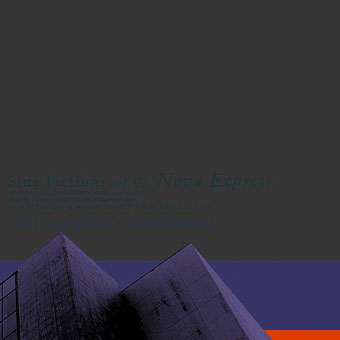
Sine Fiction VI: Nova Express (2003) by Eucci.

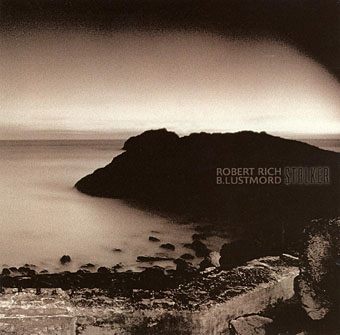
More Burroughsian music, and a selection that includes another interpretation of The Ticket That Exploded. Sine Fiction is a music project curated by Aimé Dontigny that commissions electronic artists to provide soundtracks to science fiction novels. The project has been running since 2000, and has so far managed twenty releases, the most recent of which—Dontigny’s own music for Ballard’s The Drowned World—appeared in 2011. In addition to three Burroughs titles there’s another work with considerable cult status, the Strugatsky Brothers’ Roadside Picnic, which Jos Smolders accompanies in a very minimal fashion. I’d still go for the gloriously doomy atmospheres of Stalker (1995) by Robert Rich & B. Lustmord but there’s room in the world for multiple interpretations.

All the Sine Fiction releases are available as free downloads at the No Type site or (if you prefer) at the Internet Archive.

sine7.jpg

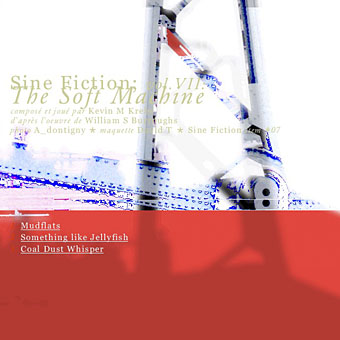
Sine Fiction VII: Soft Machine (2003) by Kevin M Krebs.

sine9.jpg

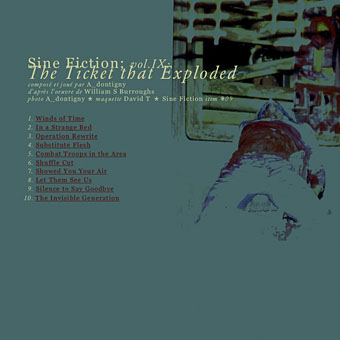
Sine Fiction IX: The Ticket That Exploded (2003) by A_Dontigny.

sine14.jpg

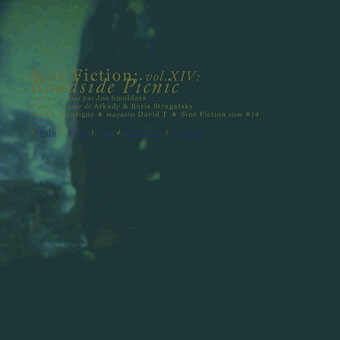
Sine Fiction XIV: Roadside Picnic (2004) by Jos Smolders.

Elsewhere on { feuilleton }
The William Burroughs archive

Previously on { feuilleton }
A playlist for Halloween: Drones and atmospheres

Le Voyage dans la Lune

melies.jpg

The title of Georges Méliès’Le Voyage dans la Lune (1902) is usually given the English translation of A Trip to the Moon, the word “trip” being an apt one when the lunar voyagers discover a landscape of giant mushrooms and crab-clawed inhabitants similar to the Selenites in HG Wells’ The First Men in the Moon (1901). I linked to a copy of this film years ago but these shots are from the recently reissued colour version, a print of which was discovered in 2002. The new version also includes a previously lost scene at the end. The soundtrack is by the French group Air. The more time elapses, the stranger these films seem. Queen Victoria had only been dead a year when this one was made; some of the young women here may have lived long enough to see the Apollo missions.

Previously on { feuilleton }
A Trip to Mars
Lunation: Art on the Moon
Somnium by Steve Moore
Blood on the Moon
Mushrooms on the Moon
Filippo Morghen’s Voyage to the Moon

Nothing Is

sunra.jpg

1: Nothing Is… (1966), an album of science fiction jazz by Sun Ra.

What does the empty space of that ellipsis imply?

beatles.jpg

2: Strawberry Fields Forever (1967), a single by The Beatles.

“Strawberry Fields / Nothing is real”

harrison1.jpg

Cover art by Sam Green.

3: Empty Space (2012), a science fiction novel by M. John Harrison.

Chapter 1: “Nothing is real,” he said.

harrison2.jpg

mbv.jpg

4: MBV (2013), an album by My Bloody Valentine which emerged from empty space at the weekend.

Track 8: Nothing Is.

Previously on { feuilleton }
Golden apples and silver apples

Nigel Kneale’s Nineteen Eighty-Four

1984-1.jpg

If I’d been more diligent I would have posted this yesterday which happened to be the UK’s first George Orwell Day. The Quatermass Experiment and this adaptation of Nineteen Eighty-Four are the two outstanding dramas from the very early days of British television. Both were written by Nigel Kneale and directed by Rudolph Cartier, an expatriate Austrian who brought to the small screen skills honed at the UFA studios before the war. The Quatermass Experiment was the first major collaboration between the pair after which they adapted Wuthering Heights. Nineteen Eighty-Four followed, a production that was screened twice in November 1954, and which caused considerable controversy at the time on account of its oppressive atmosphere and the scenes of Winston Smith’s torture.

1984-3.jpg

Kneale’s drama, which was performed live in the studio on both occasions, looks primitive compared to everything that’s followed but in many ways I prefer this adaptation to Michael Radford’s glossier feature film. For a start it has a great cast: Peter Cushing plays Winston Smith, Yvonne Mitchell is Julia, Donald Pleasence is Syme, and André Morell (who later played Professor Quatermass in the BBC’s Quatermass and the Pit) is O’Brien. Also among the cast there’s Wilfrid Brambell in two minor roles, one of them a precursor of the crusty old man he’d spend the rest of his life portraying. Neither Cushing nor Pleasence were known as film actors at this time; both would no doubt have been surprised to be told that their subsequent careers would involve a great deal of horror and science fiction.

1984-2.jpg

Cartier and Kneale didn’t have the budget to compete with feature films but for once the claustrophobic nature of a studio production works in the favour of a drama where there’s little intimacy or privacy. With the exception of a few filmed inserts almost everything is close shots. As the story grows more desperate so the shadows close in, until the final scenes are all spotlit faces in darkened rooms. The power of Cushing’s performance still resonates today, and gives an idea of how shocking this must have been to a home audience expecting little more than light entertainment on a Sunday evening. The YouTube copy is the entire 107-minute film, and is worth a watch if only to see Donald Pleasence when he had an almost complete head of hair.

• From 2009: Robert McCrum on The masterpiece that killed George Orwell.

Previously on { feuilleton }
The Stone Tape

Jon Finch, 1941–2012

finch1.jpg

Macbeth (1971).

There are few actors I’ve ever felt sufficiently cultish about who could make me watch films or TV dramas I wouldn’t otherwise be interested in. Orson Welles would be one (up to a point, he was in a lot of crap in later years), Patrick McGoohan another and Jon Finch most definitely a third. Having watched Finch just over a week ago in Roman Polanski’s superb adaptation of Macbeth it’s been a shock to discover that he’d died shortly after Christmas, the news of his funeral only being announced this week.

finch4.jpg

Frenzy (1972).

The cult status stems from the remarkable run of lead roles he was offered in the early 1970s: playing Macbeth for Polanski, the “wrong man” role in Hitchcock’s last great film, Frenzy, and a perfect Jerry Cornelius in Robert Fuest’s adaptation of Michael Moorcock’s The Final Programme. There were plenty of other roles, of course, but those three are standouts which also show something of his range: suitably brooding, weak and malevolent in Macbeth, in Frenzy a hounded man who seems disreputable enough for his friends to suspect he may be a murderer, in The Final Programme as smart and insouciant as Moorcock’s Cornelius ought to be.

finch2.jpg

The Final Programme (1973): Finch with Jenny Runacre (Miss Brunner).

I’m happier that Finch played Cornelius instead of James Bond, a role he was offered after Sean Connery quit. Jerry Cornelius, “the English Assassin”, in the first novel in Moorcock’s Cornelius quartet is a kind of anti-Bond, and there were few actors around in 1973 who would have possessed the necessary charisma and intelligence for the part. Mike Moorcock was friends with Finch around the time the film was being made so when I was visiting the Moorcocks in Paris a few years ago I asked him why Finch hadn’t done more with his career after such an impressive start. Mike says he was one of those actors who often preferred to be doing something else with his time.

finch3.jpg

Finch and Ronald Lacey (Shades) in The Final Programme.

finch5.jpg

On the set of Alien (1978).

Obituaries will no doubt regard Finch’s rejection of the Bond role as a missed opportunity but I wish we could have seen him as intended in Ridley Scott’s Alien where he’d been cast as Kane but had to drop out after contracting a severe case of bronchitis once shooting was underway. The photo and screen grab below are seldom-seen images from the Alien DVD extras. I’ve nothing against John Hurt in the role but with Finch playing the part it would have made a cult film a little more special. He did get to act for Ridley Scott eventually with a small role in Kingdom of Heaven in 2005.

finch6.jpg

An outtake from Alien.

finch7.jpg

As Count Sylvius in The Memoirs of Sherlock Holmes (1994).

finch8.jpg

Update: Found on an archive disc, this rare photo from the set of The Final Programme showing Finch as Jerry Cornelius facing off with his creator, Michael Moorcock. (Click for a larger copy.) That’s the Space Ritual line-up of Hawkwind in the background. Band and author appear for a fraction of a second in a shot during the film’s arcade scene. Considering how common it was to have rock bands in feature films during this time it still surprises me that Fuest and co. went to all this trouble then left them on the cutting-room floor. The photo was Moorcock’s own, as I recall, something we ran in one of the Savoy books.

Guardian obituary
Independent obituary
Telegraph obituary
Macbeth trailer
Frenzy trailer
The Final Programme trailer

Previously on { feuilleton }
Dan O’Bannon, 1946–2009
Patrick McGoohan and The Prisoner