Weekend links 52

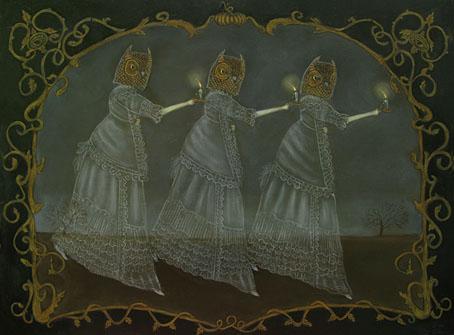
judd.jpg

Three Seekers (2009) by Kelly Louise Judd.

Kevin Sessums talked to Elizabeth Taylor in 1997 about Tennessee Williams, her AIDS activism and related matters. Other related matters: Catholics lead the way on same-sex marriage and Mahatma Gandhi was in love with a German body-builder named Hermann.

• Cray porn (the computer, that is) at Barnbrook Design as the CD package for Interplay by John Foxx and The Maths is unveiled.

Michael Rother and Friends Play the Music Of Neu! A stream of an hour-long concert from August 2010.

One of the tragedies of drug prohibition is that we have never developed a culture in which young people can learn how to use powerful drugs properly from older, wiser and more experienced psychonauts. I count myself lucky to have encountered such good teachers to guide me with such drugs as LSD, psilocybin, DMT, MDMA and mescaline.

Dr Susan Blackmore on using LSD.

Another Dispatch in a World of Multiple Veils, a new release by Arkhonia.

Micromachina by Scott Bain “examines what makes the insect world tick”.

Down with art!: the age of manifestos. Related: The Manifesto Manifesto.

• John Patterson: “We’re all living in the future as seen by Philip K Dick.”

Music To Play In The Dark: A Wake For Peter ‘Sleazy’ Christopherson.

Albert Einstein, Radical: A Political Profile.

Was “God’s Wife” edited out of the Bible?

Porn made for women, by women.

Hallogallo (1972) by Neu! | Opa-Loka (1975) by Hawkwind | Jenny Ondioline (1993) by Stereolab | Hallogallo (1997) by Porcupine Tree.

Weekend links 51

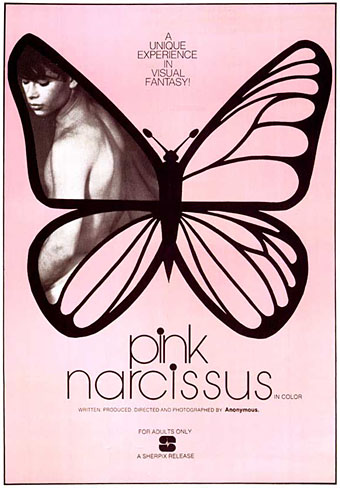
narcissus.jpg

James Bidgood’s luscious and erotic micro-budget masterpiece Pink Narcissus (1971) receives a screening at the IFC Center Queer/Art/Film festival, NYC, on Monday. The film is presented by Jonathan Katz, curator of the Hide/Seek gay art show whose controversial history was recounted here in December. The NYT ran a short piece about Bidgood, now 77 and not the first artist to be disappointed by his past work; they also have a Bidgood slideshow. Hide/Seek, meanwhile, is now a touring exhibition.

• Related: the delightful Drew Daniel of Matmos (and Soft Pink Truth) posing in a jockstrap at the Club Uranus, San Francisco circa 1990; he also used to go-go dance wearing a fish.

• The Isle of Man may have one of the oldest parliaments in the world but its laws have often been out of step with its neighbour across the Irish Sea. This week the island joined the rest of the UK in granting civil partnerships to its citizens. Now the name whose punning appeal so delighted James Joyce doesn’t seem as inappropriate.

Howard Jacobson: “The novelist Yukio Mishima posed pointing a Samurai sword to his chest and ultimately had himself beheaded in public. This is what’s called taking your art seriously.”

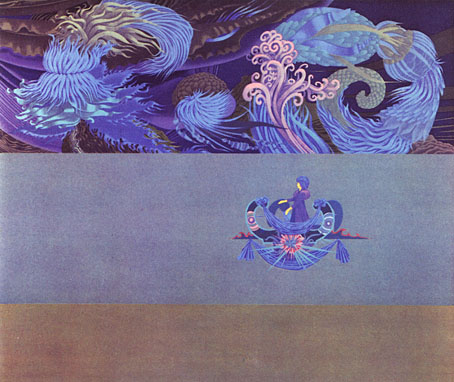
hutter.jpg

The Realm of the Queen of the Night (1974) by Wolfgang Hutter from Zauberflote at 50 Watts.

The revelatory operations of the chance encounter lie at the heart of le merveilleux (“the marvelous”)—the Surrealist conception of beauty. You find something marvelous in the world (an object, an image, a person, a place) that corresponds, like a piece clicking into a puzzle, to a deep inner need.

Slicing Open the Eyeball: Rick Poynor on Surrealism and the Visual Unconscious by Mark Dery.

Boy from the Boroughs: Alan Moore interviewed by Pádraig Ó Méalóid; Michael Moorcock interviewed at Suicide Girls.

• Illustrations from Quark, the anthology of speculative fiction edited by Samuel Delany & Marilyn Hacker in 1970.

The Residents, sans masks, filmed at their San Francisco home in the 1970s.

• Bach’s Toccata and Fugue in D minor played on a glass harp.

What art can do for science (and vice versa).

• You can never have too much Virgil Finlay.

• Lydia Kiesling reviews Lolita.

Alain Resnais film posters.

Red Mug, Blue Linen.

No GDM (dub version) (1979) by Gina X | L. Voag’s Kitchen (2004) by Soft Pink Truth.

Void City

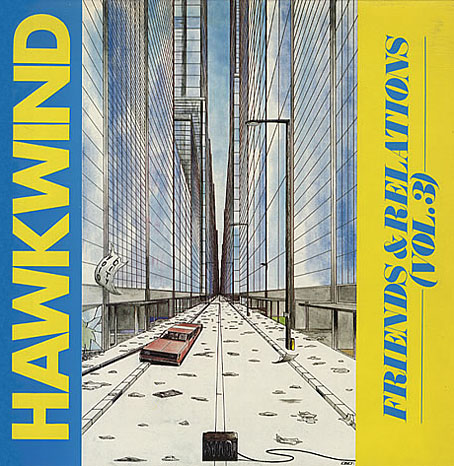
hawkwind.jpg

Friends & Relations Vol. 3 (1985) by Hawkwind.

Unless you assiduously collect everything you’ve ever worked on—which I don’t—you occasionally have to rely on the web to remind you of something you created years ago. This Hawkwind album is a good example, being one of the last releases by the band to use a piece of my artwork. (And I’ll quickly note that the accompanying type design was nothing to do with me; my design suggestions were always ignored, hence a growing frustration at that time with album cover work.) The album itself was the third in a series of odds and ends compilations gathering stray tracks by, yes, friends and relations of Mr Brock and co. Subsequent CD reissues used different packaging so the original vinyl is the only place you’ll see this illustration.

The reason I don’t have a copy is that the record label never sent me anything so unless Dave Brock put something in the post I had to buy them myself. (This happens more often than you’d expect.) I evidently didn’t think this one was worth it even though I much prefer the artwork to many of the earlier things of mine that were used. The drawing was a couple of years old, being inspired by the track Void City on the Choose Your Masques album from 1982. Void City is an atypical piece of electronica which I liked for its resemblance to some of the higher level synth pop and industrial music that was around in the early 1980s. 1982 to ’84 was the height of my JG Ballard obsession so Ballard is also a slight influence here. I had in mind his 1981 novel Hello America, which takes place in a post-apocalypse United States. And there’s also a trace influence from one of my early pieces of writing, a mercifully unpublished splurge of intense prose influenced by the New Worlds school of speculative fiction in which someone wanders around a vast and almost completely depopulated city. Looking at this drawing now it seems emblematic of my loss of interest in doing any kind of science fiction art; it also no longer seems futuristic. I produced my last album cover for Hawkind, The Chronicle of the Black Sword, in 1985; in January 1986 I started adapting HP Lovecraft’s The Haunter of the Dark. This took me out of the public eye for a few years but it was a more rewarding place to be for many other reasons.

Elsewhere on { feuilleton }
The album covers archive

Previously on { feuilleton }
Hawk things
The Sonic Assassins
New things for July

ICA talks archived

ica.jpg

I’ve linked to the British Library’s sound archive before but it was only recently that I had a browse through their collection of talks from the Institute of Contemporary Arts, London. The public discussions cover the period 1981–1994, and while there’s a wide range of contributors the lion’s share of interviewees are writers. Most of the talks run from 60–90 minutes. The following is a selection from some of the contents:

JG Ballard and Matthew Hoffman in conversation, 1984. Ballard discussing his latest novel, Empire of the Sun.

Derek Jarman and Ken Campbell in conversation, 1984. Jarman discussing his autobiography, Dancing Ledge which was also published that year. (A revised edition appeared in 1991.) If Ken Campbell seems an unusual interviewer it should be recalled that he appeared in Jarman’s 1979 film, The Tempest.

Alan Moore and Charles Shaar Murray in conversation, 1987. Mr Moore caught in the year when the world at large became aware of comics in general and his work in particular.

Whose Fantasy? Hosted by Neil Gaiman (uncredited) with M. John Harrison, Terry Pratchett, Geoff Ryman & Diana Wynne Jones, 1988. One of a series of events examining British genre fiction. Neil Gaiman was the host of each discussion but is uncredited on the site for several of the talks. This one concerns fantasy and science fiction.

Whose Fantasy? Hosted by Neil Gaiman (uncredited) with Clive Barker, Ramsey Campbell, Roz Kaveney & Garry Kilworth, 1988. The following day’s discussion was oriented more towards horror.

Laurie Anderson and Sarah Kent in conversation, 1990. Laurie Anderson’s latest album (and one of hers I like a great deal) Strange Angels is discussed.

Weekend links 46

finalprogramme.jpg

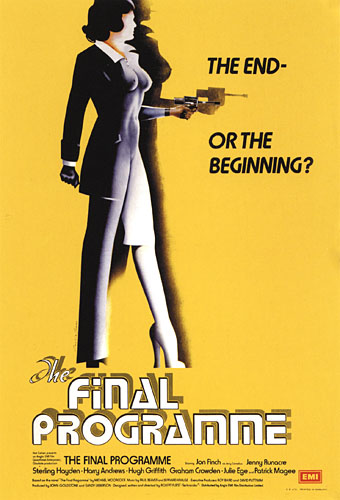
The Final Programme (1973). Philip Castle’s poster art implied the androgynous finale of Moorcock’s novel which the film itself evaded.

They were musty-smelling 10p messages from the futuristic past, complete with cover designs (and content) that were unlike anything I’d seen before. I’m fairly certain that this was how I first came across Michael Moorcock, in an early-70s Mayflower paperback, with a psychedelic cover by Bob Haberfield.

(…)

Moorcock steered New Worlds towards a set of concerns that chimed with the times; this was the period ruled by Marshal McLuhan and RD Laing, and the exploration of “inner space” seemed just as interesting as the “outer space” of satellites and moonshots. This turn was controversial, not just with die-hard pulp fans, but, surprisingly, with people such as the pop artist Richard Hamilton, another denizen of the London scene. “He thought we were turning science fiction into something namby-pamby, losing its roots,” Moorcock says. “He wanted explosions and spaceships and robots.”

When Hari Kunzru met Michael Moorcock, a major feature on a great writer and cultural catalyst. Kunzru posted the full transcript of their conversation here. Jovike’s Moorcock Flickr set has many of the lurid Mayflower covers.

• Moorcock is among the contributors to the forthcoming Thackery T. Lambshead Cabinet of Curiositities. io9 posted a list of contents (and one of my pics) while co-editor Jeff VanderMeer added some detail.

• So long to The White Stripes whose dissolution was announced earlier in the week. We know they’ll be back one day. Jay Babcock gave them their first major interview for the LA Weekly in 2000 which he’s reposted here.

Mister Blues (1962) by Lasry-Baschet aka Structures Sonores, a rare 7″ single showcasing the unique glass-and-metal sounds of the Cristal Baschet. Young Teddy Lasry on clarinet was playing in prog-jazz outfit Magma a few years later. Related: John Payne on Magma and The Mars Volta.

Here’s one thing that changed me: a close reading of Flannery O’Connor’s Mysteries and Manners. In it, she says that, “it is the business of fiction to embody mystery through manners,” manners being those concrete details — depictions of the real — in story. “Mystery through manners…” I had never heard a modern author seeking deep metaphysical mystery through realism before. Well, sure, Robert Musil, Bruno Schulz, Robert Walser, and a handful of other personal faves. By deep mystery I mean, mystery about our relationship with the planet, not anthropocentric mystery. I get sick of thinking about humans quickly, as we only constitute about 1% of what’s happening in our universe, if that much, and it was refreshing to me to hear O’Connor critiquing Henry James’ idea that modern people should aspire to know nothing of mystery, to be completely rooted in humanity. That notion makes me feel like hurling myself off a cliff. In her opinion, great literature seeks to embrace and express mystery through its mimicry of actual mannerisms. Mystery — fantasy — through the real. And with that, the borders between fantasy and realism were completely transgressed in my brain. Suddenly, I saw them as two good means to the same end. This made me excited to write real human situations again.

Trinie Dalton is interviewed here.

• And speaking of mystery through the real, there’s London Intrusion, a sequence of metropolitan adumbrations by China Miéville. Am I the only person to spot an intrusion of a different kind in the presence there of one of Eugène Atget’s Parisian views? There’s a doorway to Viriconium in that curious wedge of buildings but nobody can tell you where.

Rupert Murdoch—A Portrait of Satan. Adam Curtis on top form looking at the Dirty Digger’s career and a reminder of why some of us have always called one of his rags The Scum. A key point for me: Murdoch’s insecure railing against “elites”, a favourite term of aspersion on his Fox News network.

• Rick Poynor asks What Does JG Ballard Look Like? Related: “…only two people in Bucharest are going to read this.” Eduardo Paolozzi in conversation with JG Ballard and Frank Whitford, 1971.

How many days does Bill Murray’s character really spend reliving Groundhog Day?

• Silent Porn Star explores The Translucent Beauty of Androgyny.

Ballets Russes brought back to life on film, and also here.

Dewanatron Electronic Music Instruments.

RIP Tura Satana. Remember her this way.

Warm Leatherette (1978) by The Normal | Warm Leatherette (1982) by Grace Jones | Warm Leatherette (1998) by Chicks On Speed.