The fantastic and apocalyptic art of Bruce Pennington

pennington-pastel.jpg

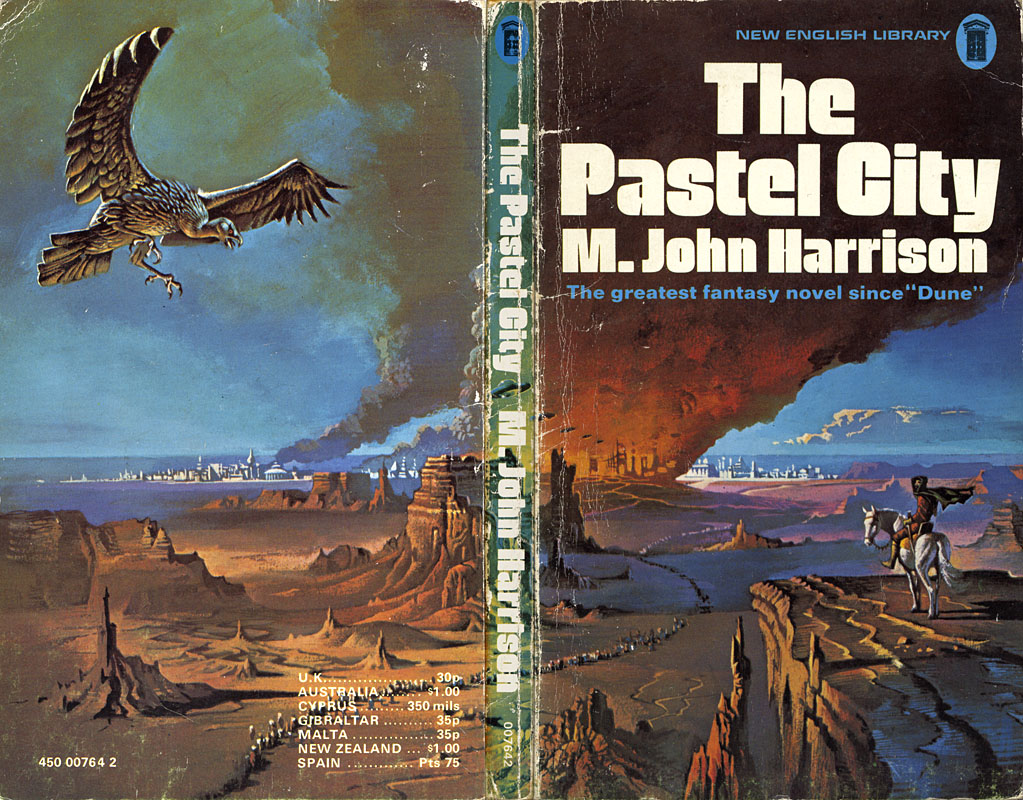
The Pastel City (1971), the first in M. John Harrison’s peerless series of Viriconium books.

Today’s post is another guest entry over at Tor.com. I’d been intending on writing something about Bruce Pennington‘s art for some time, having already covered the work of Ian Miller, my other favourite genre cover artist of the 1970s. (By coincidence both artists have illustrated the work of M. John Harrison and HP Lovecraft.) My hand was forced this month by the news of the first ever exhibition of Pennington’s paintings which is being held at Britain’s foremost occult book emporium, the Atlantis Bookshop in Museum Street, London. There’s a catalogue of the works on display here, many of which will be for sale. If I had the cash I’d consider buying one, Pennington’s work made a big impression on my imagination when I was reading many of the titles he’d illustrated for the first time. His art was unique for me in its occasionally Surrealist overtones, and as a cover artist he was unusual in working across a range of genres. Like Frank Frazetta his imagination and technique were able to suggest a great deal with a minimum of brush strokes.

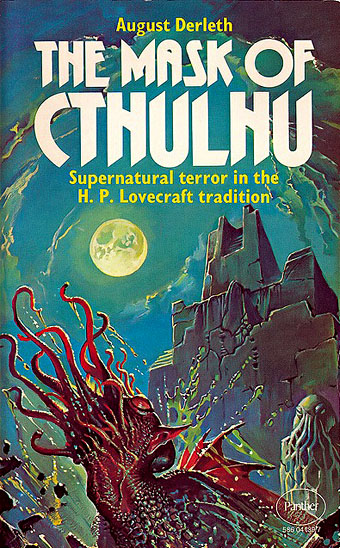
pennington-cthulhu.jpg

The Mask of Cthulhu (1976).

This post can be taken as an appendix to the Tor one which I didn’t want to overburden with pictures. The Derleth cover is purloined from Jovike’s excellent Flickr collection which includes several Pennington covers. Below are some pages from Pennington’s first book, Eschatus, a large-format collection of paintings interpreting the prophecies of Nostradamus as an apocalyptic science fiction narrative taking place in the 24th century.

Pennington has many examples of his work on his website, and there’s also a feature about his paintings in this month’s Fortean Times. The Atlantis exhibition runs to August 27th.

pennington-eschatus1.jpg

Eschatus (1976).

Continue reading “The fantastic and apocalyptic art of Bruce Pennington”

Les Temps Morts by René Laloux

temps1.jpg

Is Les Temps Morts a French figure of speech? The phrase translates as “idle periods” as well as the more literal “dead times”, so the title of this short film from 1964 may have some punning intent. This was René Laloux’s second film as director, and one I’d not seen before until it turned up on YouTube. It’s an oddly morbid piece not far removed in tone from yesterday’s The Apotheosis of War but a dose of Surrealism courtesy of Roland Topor’s minatory imagination rescues it from Vereshchagin’s moralising.

temps2.jpg

Between some documentary clips of children play-fighting, war scenes, bullfights and bird shoots, Topor’s scratchy ink drawings are brought to life with minimal animation. There’s also some narration in unsubtitled French. Laloux, Topor and soundtrack composer Alain Goraguer followed this with another, lighter short, The Snails (also on YouTube), in 1966, and joined forces again for Laloux’s first animated feature in 1973, the justly-celebrated Fantastic Planet, a science fiction film that’s a lot weirder than the usual Hollywood conceptions of the genre. That’s been on DVD for a while, and is essential viewing for Topor aficionados.

The schizophrenic cinema of René Laloux by Craig Keller.

temps3.jpg

Previously on { feuilleton }
Taxandria, or Raoul Servais meets Paul Delvaux

Hello Dali!

hellodali.jpg

Russell Harty and Salvador Dalí, 1973.

This would have been a real find if the quality wasn’t so poor. Hello Dali! was a 50-minute documentary film about Salvador Dalí broadcast in the UK in 1973 as part of the Aquarius arts strand. The whole thing is on YouTube chopped into five parts and is unfortunately blighted by severe ghosting throughout. Apart from that it’s perfectly watchable.

hellodali2.jpg

Some conversations are subtitled so viewers are better able to make sense of Dalí’s English/Spanish/French dialect.

Brits who are old enough may remember Aquarius, an ITV arts programme whose weekly slot was replaced in the late 1970s by The South Bank Show, episodes of which used the same format of a short studio introduction followed by a self-contained film. In place of the SBS’s Melvyn Bragg we have Humphrey Burton introducing a film directed by Bruce Gowers. Russell Harty is the front man, seen here in the days before he achieved greater fame as a gossipy chat-show host. I’d been wanting to see this for a long time, having lost a video tape of it years ago. I never saw the original broadcast but it was screened again after Dalí’s death in 1989, and I remembered it as being particularly good for showing a slightly more human side to the eccentric and occasionally annoying artist. So it is, giving us a brief portrait of Dalí in his 69th year, preoccupied at that time with the construction of his museum in Figueres. The value of Harty and Gowers coup in getting the artist to allow a film crew into his home can be found in subsequent UK documentaries, many of which use uncredited extracts from these interviews. It’s the brief moments of interview which make this even though they reveal little. It’s refreshing seeing Dalí talking conversationally in front of a camera instead of putting on a performance.

hellodali3.jpg

The early 70s saw the last flare of real interest in Dalí from the world at large. Dalí and Surrealism in general had a resurgence of popularity in the late 60s as a consequence of psychedelic culture. A number of books by or about the artist were published or reprinted, among them Peter Owen’s 1973 revival of Hidden Faces, a novel which Dalí had written in 1944. Alejandro Jodorowsky was circling the Dalí camp around the same time, trying to inveigle the artist into portraying the Emperor in his planned film adaptation of Dune. One detail worth noting in the conversation with Russell Harty is mention of a golden toilet, something which Jodorowsky says Dalí wanted as his throne if he was going to appear in the feature film. We never got to see Jodorowsky’s Dune but it’s good to find this documentary available once again. Here’s hoping a better copy turns up eventually.

Hello Dali! Pt 1 | Pt 2 | Pt 3 | Pt 4 | Pt 5

Previously on { feuilleton }
Dalí and the City
Dalí’s Elephant
Dalí in Wonderland
Alejandro Jodorowsky’s Dune
Dirty Dalí
Impressions de la Haute Mongolie revisited
Dalí and Film
Salvador Dalí’s apocalyptic happening
Dalí Atomicus
Impressions de la Haute Mongolie

Weekend links 67

hofstatter.jpg

Neutron Drip (2011) by Amrei Hofstätter.

The Lavender Scare is “the first feature-length documentary film to tell the story of the U.S. government’s ruthless campaign in the 1950s and ’60s to hunt down and fire every Federal employee it suspected was gay”. A film by Josh Howard based on the book by David K Johnson which the author has made a free download here.

• “Annette Peacock, the avant garde American composer, collaborator with Salvador Dalí, friend of Albert Ayler and Moog-synth pioneer, brought this seismically influential session out in 1972…” John Fordham reviews Annette Peacock’s I’m The One which can be purchased here.

• Writer and graphic design historian Steven Heller looks at The Steampunk Bible (edited by SJ Chambers & Jeff VanderMeer) in his column for The Atlantic. He also talks to Galen Smith about the book’s design.

M John Harrison reveals more about his forthcoming sf novel Pearlent, a partial sequel to Light and Nova Swing. I just re-read Light, and I’m currently In The Event Zone with the follow-up, so I’m looking forward to this one.

The Raven, a book by Lou Reed & Lorenzo Mattotti (and Edgar Allan Poe). A Journey Round My Skull previewed this in 2009.

Orson Welles’ Falstaff film, Chimes at Midnight, emerges into the light once more. When do we get a decent DVD release?

• More of the usual concerns: Iain Sinclair’s struggles with the city of London and Erik Davis talks to Alan Moore about psychogeography, John Dee, comic gods, and the art of magic.

Eddie Campbell takes a tip from Jim Steranko. Related: “Hey! A Jim Steranko effect!

Lambshead Cabinet: Win Jake von Slatt’s Mooney & Finch Somnotrope!

• Tilda Swinton is The Woman Who Fell to Earth.

XXth Century Avantgarde [sic] Books at Flickr.

Sound sculptures & installations by Zimoun.

I’m The One (1972) by Annette Peacock.

Chernobyl’s zone of alienation

prypiat.jpg

Chernobyl/Pripyat (2011) by Paul Curry.

Everyone’s favourite irradiated town, Pripyat in Ukraine, has been in the news again now that twenty-five years have passed since the the Chernobyl nuclear disaster. This photo of the area by Paul Curry is part of a panorama (with the nuclear plant in the distance) taken from a rootop on a clear day. Most photos of the site show the now-familiar abandoned buildings, empty playgrounds and so on; Curry’s view taken on 29th May this year is remarkable for showing how overgrown the place has become.

Chernobyl has become indelibly twinned with Andrei Tarkovsky’s masterwork of grimy science fiction, Stalker (1979), and the novel upon which the film was based, Arkady and Boris Strugatsky’s Roadside Picnic, a mesh of connections I explored in an earlier post. Darren Nisbett’s series of photos currently showing at the Rhubarb and Custard gallery, Berkshire, are good examples of how Stalker-like the place is now looking. Nisbett calls his series, many of which are infra-red views, Chernobyl’s Zone of Alienation although there’s no indication of whether he’s alluding to the hazardous Strugatsky/Tarkovsky “Zone”. The photos are on display until the end of this month, and the prints are for sale. The Independent has a gallery feature about the exhibition here.

Update: Simon Sellars from Ballardian alerts me to this blog which is currently running reports from a visit to the Chernobyl exclusion zone.

Previously on { feuilleton }
Rerberg and Tarkovsky: The Reverse Side Of “Stalker”
The slow death of modernism
The Stalker meme