Weekend links 490

stoer.jpg

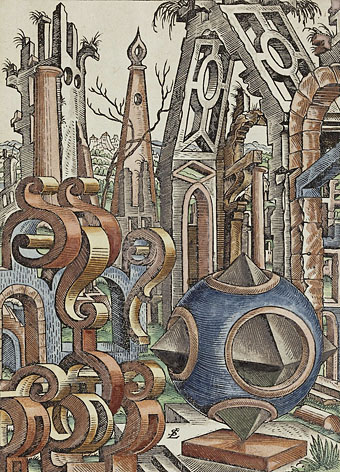
An engraving from The Geometric Landscapes of Lorenz Stoer (1567).

• Curtis Harrington’s cult horror film, Night Tide (1961), receives a lavish blu-ray reissue from Powerhouse in January. The limited edition will include an extra disc of Harrington’s early short films which encompass Poe adaptations and also Wormwood Star, his portrait of occult artist (and actor in Night Tide) Marjorie Cameron.

• “He was the first American representative of an electronic sound that was largely coming from Europe, from bands like Kraftwerk, or producers like Giorgio Moroder and Pete Bellotte…” Jude Rogers on Patrick Cowley.

Clive Hicks-Jenkins examines Hans Poelzig’s and Marlene Moeschke’s work on Paul Wegener’s 1920 film of The Golem. Wegener’s film is released this month in a restored blu-ray edition by Eureka.

• “Conrad was uncompromising in his beliefs until the end, sticking to his ideals with tenacious fervor.” Geeta Dayal on Tony Conrad: Writings, edited by Constance DeJong and
Andrew Lampert.

• At Dennis Cooper’s: 47 dead films. One of the films, Hu-Man (1975), a French science-fiction drama starring Terence Stamp, isn’t as dead as was assumed.

• The Danske Filminstitut has made a collection of Danish silent films available to watch for free online.

• The Last Time I Saw John Giorno, an Extraordinary Performance Poet by Mark Dery.

• “Like looking through butterfly wings”: Ira Cohen’s Mylar chamber—in pictures.

Callum James reviews the Early Poetical Works of Aleister Crowley.

• Drawing the Gaze: Revisiting Don’t Look Now by Jesse Miksic.

• Mix of the week: FACT Mix 745 by Visible Cloaks.

Mind Warp (1982) by Patrick Cowley | Go-Go Golem (1986) by Golem Orchestra | Night Tide (1995) by Scorn

Weekend links 486

magma.jpg

Magma concert poster, 2017. Art by Jofre Conjota.

The Dream Foundry is a new venture with a mission “to bolster and sustain the nascent careers of professionals working in the field of speculative literature.” This includes artists as well as writers, and to this end I was asked to answer a few questions about my work as a creator of book covers. I also offer some advice about visibility as an artist which I tried not to hedge with too many caveats. Related: my cover for The Resurrectionist of Caligo by Wendy Trimboli & Alicia Zaloga was one of the covers of the month at Muddy Colors.

• “…for a band that were so compositionally advanced, they were adept at producing primordially insistent and hypnotic rhythms.” John Doran on Magma (again), appraising the band’s music and history before presenting Christian and Stella Vander with questions from appreciative musicians.

• Mixes of the week: FACT mix 731 by Meemo Comma, mr.K’s Soundstripe vol 2 by radioShirley, The Ivy-Strangled Path Vol. XIX by David Colohan, and The Pumpkin Tide by Haunted Air.

• At Dangerous Minds: Roddy McDowall reads HP Lovecraft’s The Outsider and The Hound. Related: David McCallum reads HP Lovecraft’s The Dunwich Horror and The Haunter of the Dark.

• “Mathematics is not unique in drawing out charlatans and kooks, of course…” David S. Richeson on cranks, past and present.

• “I plan to take psychedelics again…” Helen Joyce, the finance editor of The Economist, takes a trip.

• The City of Light and its shadows: Brassaï’s Paris.

• At Dennis Cooper’s: Dennis Hopper Day.

Paris (1958) by Perez Prado And His Orchestra | Paris 1919 (1973) by John Cale | Paris 1971 (1971) by Suzanne Ciani

Weekend links 478

trip.jpg

Poster by Tadanori Yokoo for The Trip (1967).

• Post of the week is this long-overdue introduction by Warren Hatter to the French rock and electronic music of the 1970s and 80s, a variety of Continental culture which has never commanded the same level of interest in the Anglophone world as its German equivalent. The music made in Germany in the 1970s became popular in Britain thanks to record labels UA and Virgin, and support from enthusiasts like John Peel, but the label “Krautrock” demonstrates how even a favourable form could be promoted in a manner not much better than a tabloid slur. French underground music, as Hatter notes, was never recognised enough to be explicitly labelled although the term “Eurorock” was common for a while in the UK music press, useful for avoiding the slurs while also ignoring national boundaries. Now that German music of the period has been thoroughly explored, resurrected and plundered, more attention may be given to the musicians across la Manche.

Related: Eurock, the long-running distributor/publisher/website/podcast; David Elliott’s Neumusik fanzine, 1979–82; Richard Pinhas: Electronique Guerilla – A Profile by Tony Mitchell; and (linked here before) a Discogs list, French Underground Rock—1967/1980.

• More music: The Flower Called Nowhere, a previously unreleased instrumental version by Stereolab, and Midsummer’s Queen by Meadowsilver.

• Hard Time for the Hardcore: Nick Pinkerton on the pleasure of long feature films, and a decent article once you’re past the stupid sub-heading.

• Coming soon from Strange Attractor Press: Bass, Mids, Tops, An Oral History of Sound System Culture by Joe Muggs & Brian David Stevens.

Anthony Quinn reviews It Gets Me Home, This Curving Track, Ian Penman’s collection of music essays.

Bajo el Sigo de Libra on the art of Touko Valio Laaksonen, better known as Tom of Finland.

• Territory of Dreams: Becca Rothfeld on the world of Bruno Schulz.

• Mix of the week: XLR8R Podcast 601 by Sa Pa.

• RIP Richard Williams, master animator.

A trailer for The Trip. RIP Peter Fonda.

The Trip (1966) by Donovan | Trippin’ Out (1967) by Something Wild | The Trip (1968) by Park Avenue Playground

Weekend links 473

spectra.jpg

“Spectra of various light sources, solar, stellar, metallic, gaseous, electric”, print by René Henri Digeon; plate IV in Les phénomènes de la physique (1868).

• More polari: Thom Cuell this time with another review of Fabulosa!: The Story of Polari by Paul Baker. Good as it is to see these articles, one thing they all share is paying tribute to the polari-enriched radio series Round the Horne without crediting its writers, Barry Took and Marty Feldman.

• “…with its conspiracy theories, babbling demagogues and demonised minorities, Bahr’s investigation is sadly all too relevant today.” Antisemitism (1894) by Hermann Bahr, is the latest new translation from Rixdorf Editions.

Isao Tomita in 1978 showing a presenter from NHK around his tiny studio. Japanese-only but the discussion reveals that the words “synthesizer”, “tape recorder” and “mixer” sound the same as they do in English.

Ben Frost talks to Patrick Clarke about his music for German TV series, Dark.

• PYUR composes a guide through limbo with Oratorio For The Underworld.

• Steven Heller on Don Wall’s book design for a Paolo Soleri retrospective.

• Coming soon from Fulgur Press: Ira Cohen: Into the Mylar Chamber.

Will Harris compiles an oral history of Q: The Winged Serpent.

• Mix of the week: a mix for The Wire by Overlook.

• At Dennis Cooper’s: Magic Shop Internationale.

Shadow In Twilight by Pram.

The Feathered Serpent Of The Aztecs (1960) by Les Baxter | The Serpent (In Quicksilver) (1981) by Harold Budd | Black Jewelled Serpent Of Sound (1986) by The Dukes Of Stratosphear

Weekend links 471

maclean.jpg

Pink Floyd, Lee Michaels, Clear Light (1967) by Bonnie MacLean.

• Electronic musician Mort Garson has been subject to a revival of interest recently, with reissues of his works as Ataraxia (The Unexplained), and Lucifer (Black Mass). The latest reissue is Mother Earth’s Plantasia (1976), an album released under Garson’s own name, and one of several works of plant mysticism from the 1970s (see Stevie Wonder’s Journey Through The Secret Life Of Plants, and Green by Steve Hillage).

• “It is striking how much of this work sounds like a missing link from the art world to the popular groups of the time, such as the Detroit techno pioneers Cybotron and the Japanese electro legends Yellow Magic Orchestra.” Geeta Dayal on the reconfigured Speak & Spell machinery of Paul DeMarinis.

The cost of free love and the designers who bore it: Madeleine Morley meets the women of psychedelic design.

For the transhumanist anarchist Wilson, the neurological relativism revealed by his own learning and personal deprogramming experiments called for a form of ‘guerrilla ontology’ that lampooned, rejected and transmitted much needed interference into the ‘reality tunnels’ that attempt to control much of contemporary society and individual behaviour. In the Schrödinger’s Cat Trilogy, characters are repeatedly placed in positions of cognitive dissonance, where they are forced to reevaluate their own belief systems due to experiences that they are unable to accommodate.

Sean Kitching on the 40th anniversary of Robert Anton Wilson’s Schrödinger’s Cat Trilogy

• They said books were dead, they were wrong: Adrian Shaughnessy on a decade of Unit Editions.

• Mixes of the week: Xianedelica by Jesús Bacalão, and Kosmische Mix By Tarotplane.

• Swinging 60s surrealist Penny Slinger: “Collectors thought I came with the art”.

• Cabaret Voltaire: Chance Versus Causality (Teaser).

Luc Sante on postcards of American violence.

• At Dennis Cooper’s: Peter Whitehead Day.

Computerwelt (1981) by Kraftwerk | Speak And Spell (1984) by Christina Kubisch | Time Space Transmat (1985) by Model 500