TV Wipeout

tvwipeout1.jpg

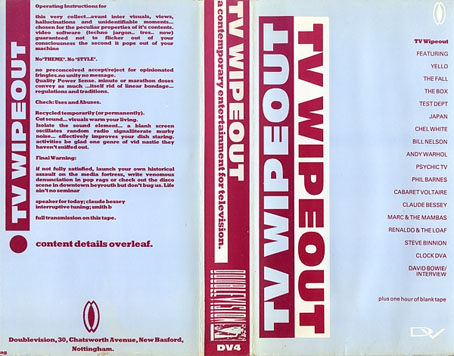
Another of the videocassette releases on Cabaret Voltaire’s Doublevision label, TV Wipeout was released in 1984 as a “video magazine”. This and Johnny YesNo were the two Doublevision releases I was most interested in, and I did get to see some of the former release when Cabaret Voltaire’s first appearance at the Haçienda in 1983 was preceded by an hour of “Doublevision Presents…”. The most memorable sights from that screening were the weird and scary Renaldo & The Loaf film and the video for Terminus by Psychic TV, a very Wild Boys-esque piece directed by Peter Christopherson. The Cabs’ Stephen Mallinder explained why the contents of the tape tended to be more commercial than other releases on the label:

Q: The next Doublevision was the TV Wipeout video which was a sort of disposable magazine compilation. It contained a fairly wide variety of contributors, from people like The Fall and Test Dept to some more mainstream groups like Bill Nelson and Japan.

Mal: The point was that Virgin Films were quite happy to work with us; they even gave us money in the form of advertising revenue for using some film clips from the Virgin catalogue. We were then able to camouflage them into the whole set-up and make them look as if they were part of the whole nature of the video compilation.

Q: One of those clips was a particularly inane interview with David Bowie. Was its inclusion merely a selling point?

Mal: Yes, it was purely that. There are a lot of people who will buy anything with David Bowie on it. So we said “Fuck it, why not use that as a selling point!” Actually the interview is appalling, it’s terrible. Our including it was almost like a piss-take. We were saying “you really will buy anything with David Bowie on it if you buy this”.

From Cabaret Voltaire: The Art of the Sixth Sense by M. Fish and D. Hallbery

Unlike some of the other Doublevision releases this one doesn’t seem to have been uploaded anywhere but since much of the content was music videos it’s possible to compile an incomplete playlist. The Paul Morrissey films (Heat and Flesh), Eating Raoul and Plan 9 from Outer Space were cult items that weren’t being screened on TV so this was an opportunity to see them outside a cinema. Some of the other selections—the Chel White, Steve Binnion and Space Movie—are still a mystery. Lost Possibilities Of Modern Dreams was footage of a painting exhibition by Phil Barnes soundtracked by the Cabs. The Claude Bessy piece is the only one from the original tape, a short film of the Haçienda’s VJ shot by Ikon Video’s Malcolm Whitehead in the basement of the club.

Bill Nelson: Flaming Desire
Bill Nelson interview
Plan 9 from Outer Space excerpt
Clock DVA: Resistance
Chel White: Industrial Park
Cabaret Voltaire: Just Fascination
Steve Binnion: Mediaevil
Renaldo & The Loaf: Songs For Swinging Larvae
David Bowie interview for Merry Christmas, Mr. Lawrence
Andy Warhol: excerpt from Heat
The Fall: Live at The Venue (1983) with documentary footage
Space Movie excerpt
The Box: Old Style Drop Down
IKON FCL advertisement featuring various groups on the Factory label
Japan: excerpt from Oil On Canvas
Andy Warhol: excerpt from Flesh
Test Dept: Shockwork
Dieter Meier interview
Yello: excerpt from Jetzt Und Alles
Eating Raoul excerpt
Psychic TV: Terminus
Phil Barnes featuring Cabaret Voltaire: Lost Possibilities Of Modern Dreams
Marc & The Mambas: Caroline Says
Claude Bessy: Operating Instructions

Previously on { feuilleton }
Seven Songs by 23 Skidoo
Elemental 7 by CTI
The Crackdown by Cabaret Voltaire
Network 21 TV

Astronomy in China: The Pekin Observatory, 1888

observatory6.jpg

Observatoire de Peking (c. 1790).

Work this week has necessitated going through more 19th-century journals. For a while now I’ve had some downloaded copies of Scientific News, a kind of London equivalent of Scientific American, but I hadn’t noticed this particular article until I had to look through it again. The uncredited piece describes the ancient astronomical instruments at the observatory in the heart of Beijing, China (or “Pekin” as they have it here). Armillary spheres always catch my attention, and the Beijing ones are splendid examples supported by ornamental dragons. The text is informative but also mildly condescending as most discussion of China or Japan at this time tended to be. The piece includes some nice engraved illustrations of the instruments (scroll down), all of which can still be seen today surrounded by a city which the Chinese of 1888 would no longer recognise.

*   *   *

ASTRONOMY IN CHINA: THE PEKIN OBSERVATORY

VICE-ADMIRAL MOUCHEZ has just received from Pekin, for the Astronomical Museum which he has founded in connection with the Observatory of Paris, a series of photographs representing the Pekin Observatory and the instruments there erected. By the courtesy of our contemporary La Nature we are enabled to place these curious views before our readers, and thus give them an exact idea of the present state of astronomy in the nation which has cultivated it with the greatest zeal, for the longest time, and among whom it has received the most remarkable developments.

Astronomical functions have not ceased to be held in honour in China, and the Observatory of the Celestial Empire is at present under the direction of an uncle of the Emperor, who ranks as the fifth prince of the blood, and bears the title of Chancellor.

The number of persons attached to this establishment is more considerable than that at Paris. It amounts, including students, to 196. The chief functionaries after the Chancellor are a Chinese director and a Tartar director, having the right to wear a button of a precious stone, and to bear on the chest the image of a sea-raven. Then follow two sub-directors, one Chinese and one Tartar, and two assistants entrusted with calculations. These latter, prior to the expulsion of the Jesuits, were always foreigners. Two other functionaries require to be noted. The first is the keeper of the buildings, and the second the custodian of the water-clocks, as chronometers have not been as yet introduced into the observatory, any more than have telescopes.

Continue reading “Astronomy in China: The Pekin Observatory, 1888”

Weekend links 130

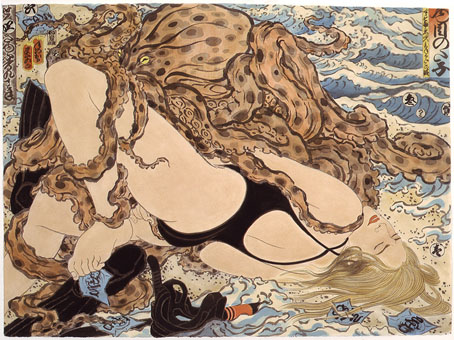
teraoka.jpg

Sarah and Writhing Octopus (New Wave Series, 1992) by Masami Teraoka.

Strange Flowers continues to push all my buttons. For a while now I’d been intent on writing something about the strange (unbuilt) temples designed by German artist/obsessive naturist Fidus (Hugo Höppener) but I reckon James has done a better job than I would have managed. Also last week he wrote about Schloss Schleißheim, a palatial estate outside Munich with connections to Last Year in Marienbad and another eccentric, pseudonymous German artist: Alastair (Hans Henning Voigt).

• The circus poster that inspired John Lennon’s Sgt. Pepper song Being For The Benefit Of Mr. Kite! has been reproduced as a limited edition letterpress print. Related: Wikipedia’s page about Pablo Fanque (1796–1871), “the first black circus proprietor in Britain”.

• The first two volumes of The Graphic Canon, both edited by Russ Kick, are reviewed at Literary Kicks. I’ve not seen either of these yet but volume 2 contains my interpretation of The Picture of Dorian Gray. Related: the second book previewed at Brain Pickings.

You only have to read [Alan Bennett’s] diaries to see that, underneath the wit and humour and sandwich-filled pottering around old churches, there is a deep resentment at what has happened to England in his lifetime and an instinctive distrust, sometimes amounting to deep loathing, of most politicians. Listening, for instance, to Alan Clark and Kenneth Clarke talking on the radio about the arrest of General Pinochet in 1998, he writes: “Both have that built-in shrug characteristic of 80s Conservatism, electrodes on the testicles a small price to pay when economic recovery’s at stake.”

Michael Billington on Alan Bennett: a quiet radical

Hauntologists mine the past for music’s future: Mark Pilkington draws a Venn diagram encompassing Coil, Broadcast, the Ghost Box label, Arthur Machen, MR James, Nigel Kneale, Iain Sinclair and others.

Hell Is a City: the making of a cult classic – in pictures. The mean streets of Manchester given the thriller treatment by Hammer Films in 1959. The film is released on DVD this month.

The Function Room: The Kollection, Matt Leyshon’s debut volume of horror stories, has just been published. The cover painting is one of my pieces from the 1990s.

New Worlds magazine (now apparently known as “Michael Moorcock’s New Worlds“) has been relaunched online.

konahin.jpg

A drawing from Anatomy (part 1), a series by Alex Konahin.

• The forthcoming Scott Walker album, Bish Bosch, will be released on December 3rd. 4AD has a trailer.

Cormac McCarthy Cuts to the Bone: Noah Gallagher Shannon on the early drafts of Blood Meridian.

• The Velvet Underground of English Letters: Simon Sellars Discusses JG Ballard.

• Michelle Dean on The Comfort of Bad Books.

The typewriter repairers of Los Angeles

Cats With Famous People

Marienbad (1987) by Sonoko | Komm Nach Marienbad (2011) by Marienbad | Marienbad (2012) by Julia Holter.

(Thanks to Ian and Pedro for this week’s picture links!)

Weekend links 129

proffer.jpg

Daughters of Maternal Impression by Arabella Proffer.

A genre’s landscape should be littered with used tropes half-visible through their own smoke & surrounded by salvage artists with welding sets, otherwise it isn’t a genre at all.

M. John Harrison, incisive as ever, on what he memorably labels “Pink Slime Fiction”. Elsewhere (and at much greater length) Cowardice, Laziness and Irony: How Science Fiction Lost the Future by Jonathan McCalmont, and a two-part Paul Kincaid interview here and here.

• “Once upon a time, in almost every city, many rivers flowed. Why did they disappear? How? And could we see them again? This documentary tries to find answers by meeting visionary urban thinkers, activists and artists from around the world.” A trailer for Lost Rivers, written and directed by Caroline Bâcle. Related (and mentioned here before), London’s Lost Rivers: A Walker’s Guide by Tom Bolton.

Ghosts in the Machine: “Curated by Massimiliano Gioni and Gary Carrion-Murayari, a recent exhibition was imagined as a Wunderkammer simultaneously tracing and questioning the relationship between people and technology.” And in Istanbul a Wunderkammer of a different kind: Rick Poynor looks at Orhan Pamuk’s Museum of Innocence.

• “There’s a vast territory still to be explored…” Bristol duo Emptyset (James Ginzburg & Paul Purgas), many of whose releases I’ve designed, talk about their music. Tracks from their new EP on the Raster-Noton label can be heard here. You’re going to need bigger speakers.

• “I liked doing it one time but I don’t want to become the gay porn soundtrack guy.” Ben Chasny of Six Organs of Admittance talking to Sir Richard Bishop about one of his more unusual commissions.

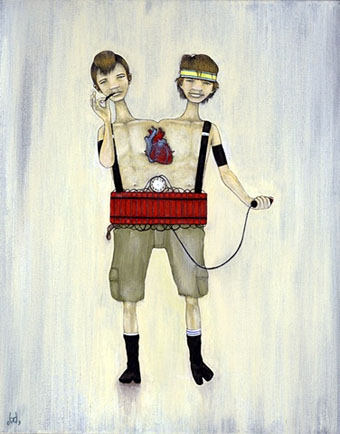
durham.jpg

Double Vision (2009) by Bonnie Durham.

FACT mix 349: Silent Servant puts together a great selection of music old and new with the emphasis on the grit of the early Industrial era.

• Read Joyce’s Ulysses line by line, for the next 22 years, with Frank Delaney’s podcast.

Borges and the Plain Sense of Things, an article from 2006 by Gabriel Josipovici.

Clive Hicks-Jenkins on Equus and seeing your inspirations come full circle.

• At Pinterest: A few nice paintings of men

Spunk [arts] magazine

Derelict London

• Ritualistic Bug Use (2009) by Pink Skull | Demiurge Variations (2012) by Emptyset | Utopian Disaster (End) (2012) by Silent Servant.

Golden apples and silver apples

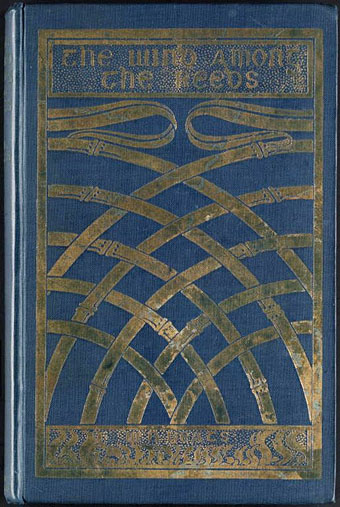
yeats.jpg

The Wind Among the Reeds (1899). Cover design by Althea Gyles.

1: The Song of Wandering Aengus by WB Yeats.

I went out to the hazel wood,
Because a fire was in my head,
And cut and peeled a hazel wand,
And hooked a berry to a thread;
And when white moths were on the wing,
And moth-like stars were flickering out,
I dropped the berry in a stream
And caught a little silver trout.

When I had laid it on the floor
I went to blow the fire a-flame,
But something rustled on the floor,
And someone called me by my name:
It had become a glimmering girl
With apple blossom in her hair
Who called me by my name and ran
And faded through the brightening air.

Though I am old with wandering
Through hollow lands and hilly lands,
I will find out where she has gone,
And kiss her lips and take her hands;
And walk among long dappled grass,
And pluck till time and times are done,
The silver apples of the moon,
The golden apples of the sun.


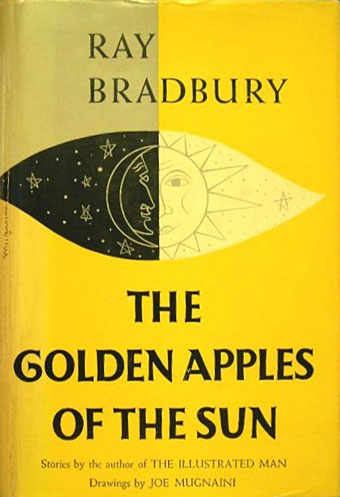
bradbury.jpg

Illustration by Joe Mugnaini.

2: The Golden Apples of the Sun (1953), a story collection by Ray Bradbury.


judycollins.jpg

Cover design by William S. Harvey.

3: Golden Apples of the Sun (1962), the debut album by Judy Collins. The first track is her setting of The Song of Wandering Aengus.


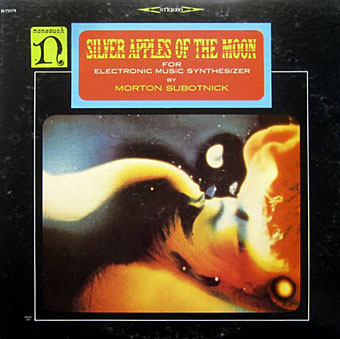
subotnick.jpg

Cover design by William S. Harvey. Artwork by Anthony Martin.

4: The Silver Apples of the Moon (1967), an album of electronic music by Morton Subotnick.


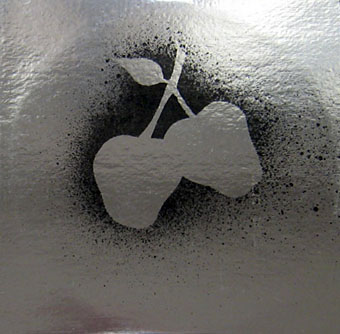
silverapples.jpg

Artwork by Anonymous Arts.

5: Silver Apples (1968), an album of electronic music by Silver Apples.


donovan.jpg

Art Direction by Sid Maurer. Artwork by Patrick.

6: HMS Donovan (1971), a double album of poems for children set to music by Donovan. The second song on side four is The Song of Wandering Aengus.


goldenapples.jpg

Cover by Devendra Banhart.

7: The Golden Apples of the Sun (2004), a freak folk compilation selected by Devendra Banhart for Arthur magazine‘s Bastet label.

Previously on { feuilleton }
The Golden Apples of the Sun