Weekend links 132

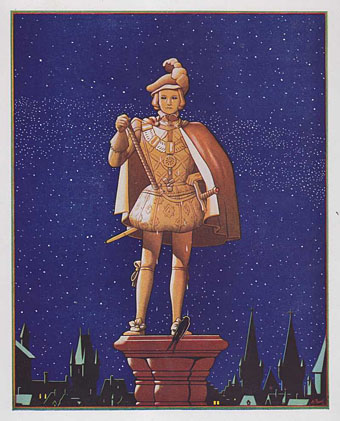
janini1.jpg

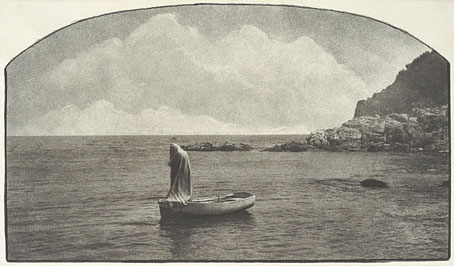
La Hora del Fantasma (no date) by Joaquim Pla Janini.

• Many of the art links featured here are tips from Thom Ayres, so it’s only right to point to his new album project which he’s funding through Kickstarter and embellishing with his own nature photography.

• Anne Billson is another writer beguiled by Philippe Jullian’s masterwork, Dreamers of Decadence. And thanks to Ms Billson for drawing attention to the insane opening of Crime Without Passion (1934).

• Does this fake ad for The Necronomicon use one of my Cthulhu pictures? Possibly. Get the picture for yourself in this year’s Cthulhu calendar. (My thanks to everyone who’s bought a copy so far.)

To break the ice, I talk about books: he is delighted to discover that I have read his beloved Denton Welch, also J. W. Dunne’s An Experiment With Time. I have found them in my old school library, and know both have been a tremendous influence on him in different ways. Knowing of his interest I also mention that I have just read Colin Wilson’s The Quest For Wilhelm Reich, published the year before. He likes Wilson, he says, jokes that “the Colonel” with his cottage in Wales in Wilson’s Return of the Lloigor and his own Colonel Sutton-Smith from The Discipline of DE are one and the same. On something of a roll, I mention Real Magic by Isaac Bonewits, and he acknowledges that it has “some good information” – but is much more enthusiastic about Magic: An Occult Primer by David Conway [years later I would discover that Burroughs & Conway had in fact exchanged letters on various subjects pertaining to magic, occultism, and psychic phenomena – but that is decidedly another story!]

Matthew Levi Stevens recalls The Final Academy and an encounter with William Burroughs thirty years ago.

Locomotif: A short survey of trains, music & experiments: Gautam Pemmaraju on Kraftwerk, Pierre Schaeffer, Luigi Russolo and others.

A flip-through of The Graphic Canon, volume 2. Wait to the end and you’ll see a couple of my Dorian Gray pages. Imprint has a review of the book.

• Julian Bell reviews two new books about Romantic painter Caspar David Friedrich.

Alan Moore talks to The Occupied Times about art, education and anarchism.

• Colin Dickey reviews Vilém Flusser’s Vampyroteuthis Infernalis: A Treatise.
janini2.jpg

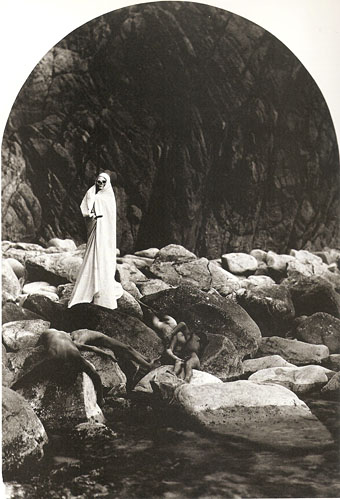
Las Parcas II (1930) by Joaquim Pla Janini.

• Michael Newton reviews A Natural History of Ghosts by Roger Clarke.

• Golden Age Comic Book Stories revisits the work of Sidney Sime.

Front Free Endpaper asks “What’s in an inscription…?”

Mormon Missionary Positions

Amateur Aesthete

Ghosts (1981) by Japan | Ghosts (2008) by Ladytron | Ghosts (2012) by Monolake.
Weekend links 131

thingposter.jpg

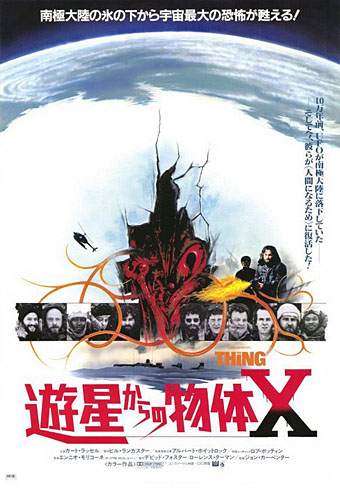
Japanese poster (1982).

At The Quietus Steve Earles looks back at John Carpenter’s visceral and uncompromising The Thing which exploded messily onto cinema screens thirty years ago. It’s always worth being reminded that this film (and Blade Runner in the same year) was considered a flop at the time following bad reviews and a poor showing at the summer box office. One reason was The Thing‘s being overshadowed by the year’s other film of human/alien encounters, something called E.T. the Extra-Terrestrial. To The Thing‘s status as the anti-E.T. you can add its reversal of the can-do heroics of Howard Hawks’ The Thing from Another World (1951), an attitude out-of-step with Reaganite America. Carpenter’s film is not only truer to the original story but from the perspective of 2012 looks like one of the last films of the long 1970s, with Hawks’ anti-Communist subtext replaced by bickering, mistrust, paranoia and an unresolved and completely pessimistic ending that most directors would have a problem getting past a studio today.

I was fortunate to see The Thing in October of 1982 knowing little about it beyond its being a John Carpenter film (whose work I’d greatly enjoyed up to that point) and a remake of the Hawks film (which I also enjoyed a great deal). One benefit of the film’s poor box office was a lack of the kind of preview overkill which made E.T. impossible to avoid, and which a couple of years earlier did much to dilute the surprise of Ridley Scott’s Alien. I went into The Thing mildly interested and came out overwhelmed and aghast. For years afterwards I was insisting that this was the closest you’d get on-screen to Lovecraft’s At the Mountains of Madness. The correspondence is more than merely Antarctica + monsters when you consider this:

Lovecraft’s story was rejected by his regular publisher Weird Tales but was accepted by Astounding Stories in 1936 >> The editor of Astounding, John W. Campbell, published his own Antarctica + monsters story (under the pen-name Don A. Stuart), “Who Goes There?”, in the same magazine two years later >> Charles Lederer wrote a loose screen adaptation of Campbell’s story which Howard Hawks and Christian Nyby filmed as The Thing from Another World.

This isn’t to say that Campbell copied Lovecraft—both stories are very different—but I’d be surprised if Lovecraft’s using Antarctica as the setting for a piece of horror-themed science fiction didn’t give Campbell the idea.

More things elsewhere: Anne Billson, author of the BFI Modern Classics study of The Thing, on the framing of Carpenter’s shots, and her piece from 2009 about the film | Mike Ploog’s storyboards | Ennio Morricone’s soundtrack music, of which only a small percentage was used in the film.

• The week in music: 22 minutes of unreleased soundtrack by Coil for Sara Dale’s Sensual Massage | Analog Ultra-Violence: Wendy Carlos and the soundtrack for A Clockwork Orange | A Halloween mixtape by The Outer Church | Herbie Hancock & The Headhunters, live in Bremen, 1974: a 66-minute set, great sound, video and performances | Giorgio Moroder’s new SoundCloud page which features rare mixes and alternate versions | A video for Collapse by Emptyset.

One of the main themes of the book, and what I found in The Arabian Nights, was this emphasis on the power of commodities. Many of the enchanted things in the book are lamps, carpets, sofas, gems, brass rings. It is a rather different landscape than the fairy tale landscape of the West. Though we have interiors and palaces, we don’t have bustling cities, and there isn’t the emphasis on the artisan making things. The ambiance from which they were written was an entirely different one. The Arabian Nights comes out of a huge world of markets and trade. Cairo, Basra, Damascus: trades and skills.

Nina Moog talks to Marina Warner

John Palatinus, “one of the last living male physique photographers of the 1950s”, is interviewed. Related: the website of Ronald Wright, British illustrator for the physique magazines.

• “A classic is a work which persists as a background noise even when a present that is totally incompatible with it holds sway.” Italo Calvino’s 14 Definitions of What Makes a Classic.

Huge Franz Kafka archive to be made public. Related: Judith Butler asks “Who owns Kafka?”

• Geoff Manaugh’s Allen Ginsberg Photos & Ephemera, 1994–Dec 1996.

Magic mushrooms and cancer: My magical mystery cure?

Clark Ashton Smith Portfolio (1976) by Curt Pardee.

Jan Toorop’s 1924 calendar.

artQueer: a Tumblr.

• All The Things You Are (1957) by Duke Ellington | Things That Go Boom In The Night (1981) by Bush Tetras | Things Happen (1991) by Coil | Dead People’s Things (2004) by Deathprod.

Wildeana #8

happy.jpg

Illustration by H. Paul.

Continuing an occasional series.

Front Free Endpaper has illustrations by one H. Paul from a “talking book” adaptation of Wilde’s The Happy Prince. This was a hardcover volume published in 1948 which came with a 78rpm vinyl disc containing a recording of the story by BBC newsreader Frank Phillips. Callum found the reading on YouTube. By coincidence I discovered this week that Klaus Kinski recorded some of Wilde’s stories in 1959, German versions of The Happy Prince (again) and The Selfish Giant, and also a reading of The Young King.

Wilde is strikingly prophetic in his denunciations of what he describes here as “authoritarian socialism”.  He says again that in the present state of affairs, at least some men with the advantages of privilege manage to find themselves, to realise their potential “If the Socialism is authoritarian; if there are governments to be armed with economic power as they are now with political power; if, in a word, we are to have industrial tyrannies, then the last state of man will be worse than the first.”  At least some can have freedom now, in this state, no-one would at all. Wilde sees no virtue at all in the equitable distribution of misery.  The collectivism of compunction which existed in Soviet Russia or Mao’s China was precisely the nightmare scenario he was warning against. It seems clear though that Wilde actually thought the sheer unattractiveness of this made it unlikely. “I hardly think any Socialist, nowadays, would seriously propose that an inspector should call every morning to see that each citizen rose up and did manual labour for eight hours”.  He may have ‘hardly thought’ it, but at the same time Wilde wrote this there were plenty of socialists who had just such a vision in mind – and sadly their type were to proliferate, and in some areas to predominate. No wonder that The Soul of Man was an inspiration to many revolutionaries rebelling against the Tsars of Russia, but was later suppressed and banned by Stalin himself.

Ben Granger takes a lengthy and perceptive look at The Soul of Man Under Socialism (1891), an essay of Wilde’s that seldom receives the same degree of attention as his other works.

• “As the weeks have gone by, it’s become clear to my actors that Dorian is the work of a much darker – more radical, and more modern – writer than the flippant genius we’re all so familiar with.” So says Neil Bartlett whose new stage production of The Picture of Dorian Gray is currently running at the Abbey Theatre, Dublin.

• A recipe for Oscar Wilde Strawberry Champagne cocktails? Yes, please.

Elsewhere on { feuilleton }
The Oscar Wilde archive

In the Key of Blue by John Addington Symonds

symonds1.jpg

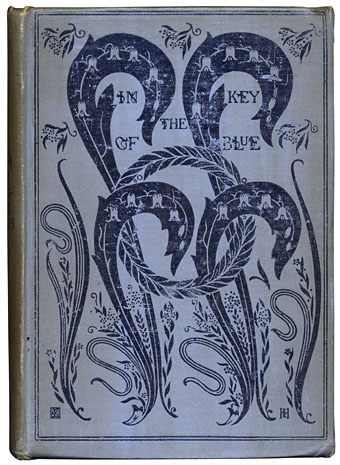
I probably overspent a little on this charity-shop purchase, the third edition (published 1918) of In the Key of Blue by John Addington Symonds (1840–1893), a personal selection of writings first published in 1893. First edition copies sell for over a thousand pounds so this was an opportunity to acquire something close to the original without breaking the bank. The book is significant for two reasons: on a decorative level the cover design is one of my favourites by book designer (he preferred the term “book builder”) Charles Ricketts. The first editions have the design blocked in gold on cream cloth (below); a few copies were made with blue cloth but Ricketts apparently changed the colour after worrying that reviewers would joke about “Reckitt’s Blue” a popular laundry product. The contraposed curves of the leaf shapes pre-empt the Art Nouveau style which only started to emerge a year or two later.

symonds2.jpg

The other notable feature of Symonds’ book is its being one of the more outspoken manifestations of the author’s advocacy for what he called “a man’s love for a man”. Symonds was a pioneer of what are now called gay studies: in addition to accurately translating the love sonnets of Michelangelo which previous translators had heterosexualised, his 1873 study A Problem in Greek Ethics sought to show 19th-century readers that the Ancient Greek culture they so admired had an indisputable history of same-sex relationships running through its core. This was only one side of Symonds’ work but it was an admirably continual thread. I often think of Symonds and Oscar Wilde as twinned in this respect: Wilde made frequent use of Greek attitudes as a justification for his views on love; both men had to perform a careful balancing act, trying to advocate the unacceptable without drawing too much attention to their own proclivities. If Wilde was the public advocate for Uranian desire then Symonds was a kind of think-tank man, labouring behind the scenes to bring to light the historical precedent. Finally, both men were connected by Charles Ricketts, a friend of Wilde’s who designed and illustrated a number of Wilde’s early editions.

In the Key of Blue was published in the last year of Symonds’ life by which time much of his previous equivocations had been abandoned. In homoerotic terms it’s far more out of the closet than pre-trial Wilde ever dared to be. The title piece is a poem which presents eight studies of an unnamed “you”, a figure seen by the poet in various Venetian settings, painted in a range of colours with blue as the dominant tone. I have the poem in another book; taken alone as it is there it seems mildly homoerotic—the ecstatically observed subject is obviously male—but remains ambiguous enough for any subtext to be a matter of interpretation. In the collected edition Symonds adds additional text that picks apart the poem, explaining the origin of each setting. Thus we learn that the mysterious “you” is a 19-year-old Venetian porter named Augusto whom the author had befriended. The explanatory paragraphs discuss the artistic intent of the poem, its depiction of contrasted tones and colours, while the circumstantial details quietly remove all the ambiguity from its paean to male youth.

Elsewhere in the book, there’s a discussion of male love among the Greeks, culled from Symonds’ earlier researches, then in Clifton and a Lad’s Love, written thirty years earlier, we have another piece of alternating poetic verse and prose description. Part seven of the poem could hardly be less equivocal:

I saw a vision of deep eyes
In morning sleep when dreams are true:
Wide humid eyes of hazy blue,
Like seas that kiss the horizon skies.

Then as I gazed, I felt the rain
Of soft warm curls around my cheek,
And heard a whisper low and meek:
“I love, and canst thou love again?”

A gentle youth beside me bent;
His cool moist lips to mine were pressed,
That throbbed and burned with love’s unrest:
When, lo, the powers of sleep were spent;

And noiseless on the airy wings
That follow after night’s dim way,
The beauteous boy was gone for aye,
A theme of vague imaginings.

Yet I can never rest again:
The flocks of morning dreams are true;
And till I find those eyes of blue
And golden curls, I walk in pain.

Anyone wishing to read In the Key of Blue can find most of Symonds’ work online. Project Gutenberg has all his major texts available while the Internet Archive has a scan of the 1918 edition, albeit in slightly better condition than my copy.

Elsewhere on { feuilleton }
The book covers archive

Previously on { feuilleton }
Greek games
Charles Ricketts’ Salomé
Achilles by Barry JC Purves
Der Eigene: Kultur und Homosexualität
Charles Ricketts’ Hero and Leander

Weekend links 129

proffer.jpg

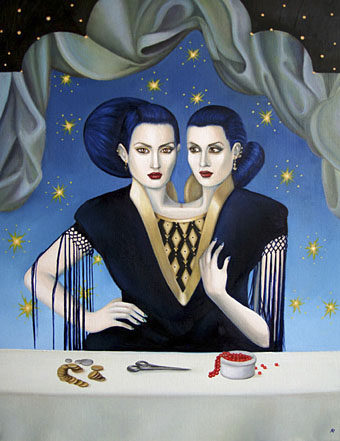
Daughters of Maternal Impression by Arabella Proffer.

A genre’s landscape should be littered with used tropes half-visible through their own smoke & surrounded by salvage artists with welding sets, otherwise it isn’t a genre at all.

M. John Harrison, incisive as ever, on what he memorably labels “Pink Slime Fiction”. Elsewhere (and at much greater length) Cowardice, Laziness and Irony: How Science Fiction Lost the Future by Jonathan McCalmont, and a two-part Paul Kincaid interview here and here.

• “Once upon a time, in almost every city, many rivers flowed. Why did they disappear? How? And could we see them again? This documentary tries to find answers by meeting visionary urban thinkers, activists and artists from around the world.” A trailer for Lost Rivers, written and directed by Caroline Bâcle. Related (and mentioned here before), London’s Lost Rivers: A Walker’s Guide by Tom Bolton.

Ghosts in the Machine: “Curated by Massimiliano Gioni and Gary Carrion-Murayari, a recent exhibition was imagined as a Wunderkammer simultaneously tracing and questioning the relationship between people and technology.” And in Istanbul a Wunderkammer of a different kind: Rick Poynor looks at Orhan Pamuk’s Museum of Innocence.

• “There’s a vast territory still to be explored…” Bristol duo Emptyset (James Ginzburg & Paul Purgas), many of whose releases I’ve designed, talk about their music. Tracks from their new EP on the Raster-Noton label can be heard here. You’re going to need bigger speakers.

• “I liked doing it one time but I don’t want to become the gay porn soundtrack guy.” Ben Chasny of Six Organs of Admittance talking to Sir Richard Bishop about one of his more unusual commissions.

durham.jpg

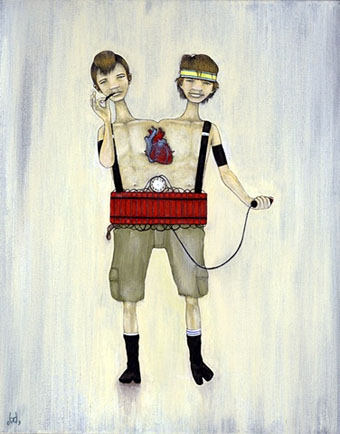
Double Vision (2009) by Bonnie Durham.

FACT mix 349: Silent Servant puts together a great selection of music old and new with the emphasis on the grit of the early Industrial era.

• Read Joyce’s Ulysses line by line, for the next 22 years, with Frank Delaney’s podcast.

Borges and the Plain Sense of Things, an article from 2006 by Gabriel Josipovici.

Clive Hicks-Jenkins on Equus and seeing your inspirations come full circle.

• At Pinterest: A few nice paintings of men

Spunk [arts] magazine

Derelict London

• Ritualistic Bug Use (2009) by Pink Skull | Demiurge Variations (2012) by Emptyset | Utopian Disaster (End) (2012) by Silent Servant.